
Idea Vilariño
Idea Vilariño Romani (Montevideo, 18 August 1920 – 28 April 2009) was a Uruguayan poet, essayist and literary critic. She belonged to the group of intellectuals known as "Generación del 45". In this generation, there are several writers such as Juan Carlos Onetti, Mario Benedetti, Sarandy Cabrera, Carlos Martínez Moreno, Ángel Rama, Carlos Real de Azúa, Carlos Maggi, Alfredo Gravina, Mario Arregui, Amanda Berenguer, Humberto Megget, Emir Rodríguez Monegal, Gladys Castelvecchi and José Pedro Díaz among others.
Idea Vilariño

Ana Ines Larre Borges · CC BY-SA 3.0
- Full name
- Idea Vilariño Romani.
- Born
- 1920. · Montevideo.
- Died
- 2009. · Montevideo.
- Nationality
- Uruguay.
- Occupation
- translator, writer, professor, poet, composer, literary scholar and university teacher.
- Fields
- Uruguayan literature, Uruguayan poetry, literary theory and literary criticism.
- Movements
- Generación del 45.
- Honours
- Premio José Lezama Lima and Konex Award.
- Languages
- Spanish.
VALÉORINE Encyclopedia
VALÉORINE documentary reading
Documentary summary
Idea Vilariño Romani (Montevideo, 18 August 1920 – 28 April 2009) was a Uruguayan poet, essayist and literary critic. She belonged to the group of intellectuals known as "Generación del 45". In this generation, there are several writers such as Juan Carlos Onetti, Mario Benedetti, Sarandy Cabrera, Carlos Martínez Moreno, Ángel Rama, Carlos Real de Azúa, Carlos Maggi, Alfredo Gravina, Mario Arregui, Amanda Berenguer, Humberto Megget, Emir Rodríguez Monegal, Gladys Castelvecchi and José Pedro Díaz among others.
Admitted source layer · organised and presented by VALÉORINE
Note VALÉORINE
Idea Vilariño (1920–2009) was a composer, literary scholar and poet, among other activities and a national of Uruguay. Born Idea Vilariño Romani in Montevideo, the composer died in Montevideo. Idea Vilariño was also known as Elena Rojas.
Idea Vilariño worked for University of the Republic. The composer was active in literary criticism, literary theory and Uruguayan literature. Idea Vilariño was associated with Generación del 45.
Languages used include Spanish. The composer received Konex Award and Premio José Lezama Lima.
Composed from admitted, traceable facts · 27 September 2026
VALÉORINE
Reference Check
Propose documentary evidence for Idea Vilariño. A contribution is never written directly as fact: identity, source, rights and evidence gates still decide.
Sign in to contribute
World of VALÉORINE
Documentary connections
Only confirmed graph relationships appear here. Images are shown only when their identity and reuse rights both pass the documentary gate.

Documentary evidence
Evidence Panel
not yet certified
- Identity
- resolved
- Independent source families
- 0
- Admitted assertions
- 0
- Open conflicts
- 0
Authority files
wikidata · Q129533 · wikipedia · Idea Vilariño
In this article
Biography
Biography
She also worked as a translator, composer and lecturer.
She was born to an educated, middle-class family where music and literature were always present. Her father, Leandro Vilariño (1892–1944), was a poet whose works were not published in his lifetime. Just like her siblings, Numen, Poema, Azul, and Alma, she studied music. Her mother was very well educated in European literature. She was a professor of literature and secondary education from 1952 until The Coup of 1973. After the restoration of the democratic system, she returned to education, working as a professor in the department of Uruguayan and Latin-American literature in the College of Education of Humanities and Sciences of The University of the Republic. She started writing at a very young age, and her first mature poems were written between 17 and 21 years old. Her first poetic work, La suplicante, was published in 1945. In the subsequent years, she would become recognized internationally and awarded with various awards. Her poems were marked by an intimate experience, intense and distressing, but always very coherent. Idea was included in the group of writers known as the Generación del 45 who became prominent between 1945 and 1950. Among the Generación del 45 the following authors can be found: Juan Carlos Onetti, with whom she had a love affair, Mario Benedetti, Sarandy Cabrera, Carlos Martínez Moreno, Ángel Rama, Carlos Real de Azúa, Carlos Maggi, Alfredo Gravina, Mario Arregui, Amanda Berenguer, Humberto Megget, Emir Rodríguez Monegal, Gladys Castelvecchi, José Pedro Díaz, and others. She participated in numerous literary ventures. She was one of the founders of the journals Clinamen, and Número, between 1945 and 1955 (where she met Juan Ramón Jiménez); and she collaborated on other publications, such as Marcha, La Opinión, Brecha, Asir, and Texto crítico. Her translations also have been the object of recognition, with some of them, such as the more recognized works of Shakespeare, being performed in the theaters of Montevideo. In 1997, she was interviewed by Rosario Peyrou and Pablo Rocca, from which the documentary Idea arose. The documentary was directed by Mario Jacob and premiered in May 1998. Her work has been translated to various languages, including Italian, German, and Portuguese. As a composer, four emblematic songs can be mentioned that are pertinent to popular Uruguayan music: A una paloma (performed by Daniel Viglietti), La canción y el poema (performed by Alfredo Zitarrosa), Los orientales, and Ya me voy pa' la guerrilla (performed by Los Olimareños). In 2004, she received the Premio Konex (Konex prize) MERCOSUR a las Letras, granted by the Konex Foundation (Argentina), as the most influential writer of the region. Later, she had to undergo surgery that left her with an intestinal and arterial occlusion. She did not recover, and died in Montevideo on 28 April 2009.
Poetry
Poetry
La suplicante (1945). Cielo Cielo (1947). Paraíso perdido (Número. 1949). Por aire sucio (Número. 1950). Nocturnos (1955). Poemas de amor (1957). Pobre Mundo (1966). Poesía (1970). No (1980). Canciones (1993). Poesía 1945 - 1990 (1994). Poesía completa (Montevideo. Cal y Canto. 2000).
Essays
Essays
Grupos simétricos en la poesía de Antonio Machado (1951). La rima en Herrera y Reissig (1955). Grupos simétricos en poesía (1958). Las letras de tango (1965). El tango cantado (1981).
Translations
Translations
Raymond Queneau: El rapto de Ícaro, Buenos Aires, Losada, 19737 Jacques C. Alexis: Romancero de las estrellas, Montevideo, Arca, 19738 William Shakespeare: Hamlet, príncipe de Dinamarca, Montevideo, Ediciones de la Banda Oriental, 1974.9 Andrew Cecil Bradley: Macbeth, la atmósfera, las brujas, Montevideo, Editorial Técnica, 1976.9 William Shakespeare: Macbeth, Montevideo, Editorial Técnica, 1977.9 Guillermo Enrique Hudson: La tierra purpúrea, Caracas, Biblioteca Ayacucho, 1980 (traducida junto con Jaime Rest).10 Guillermo Enrique Hudson: Allá lejos y hace tiempo, Caracas, Biblioteca Ayacucho, 1980 (traducida junto con Jaime Rest).10 Christine Laurent: Transatlántico (Adaptación de André Tachiné y Philippe Arnaud. Traducción del francés de Idea Vilariño). Montevideo, Trilce, 1996.9

Idea Vilariño en su escritorio
Ana Ines Larre Borges
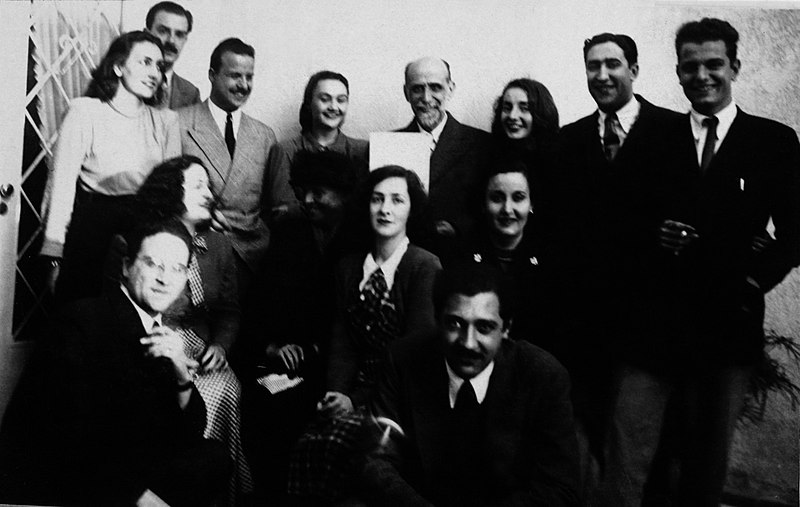
La Generación del 45 en ocasión de la visita de Juan Ramón Jiménez. De izquerda a derecha, parados: Maria Zulema Silva Vila, Manuel Claps, Carlos Maggi, María Inés Silva Vila, Juan Ramón Jiménez, Idea Vilariño, Emir Rodríguez Monegal, Ángel Rama.
Ana Ines Larre Borges
Life and career
Dated record
Life and career
The full dated record · 1 entries
2009
Idea Vilariño died at Montevideo.
Primary material
Documents and archives
scholarly publication
- Idea Vilariño: imagen social y política en la poesía uruguaya, Revista de Ciencias Sociales, 2006
Scholarly · Crossref registry · 2006
reference work
- “Idea Vilariño”, English Wikipedia, consulted as further reading
Reputable secondary · Wikipedia
authority record
- Wikidata, structured authority record Q129533: Idea Vilariño
Unverified · Wikidata
Notes from the source article
Cited by Wikipedia
Notes from the source article
These works are cited by the source article, in its own numbering. They are recorded as its citations, not as sources VALÉORINE has verified.
- 1.Uruguayan poet Idea Vilariño dies. El País. 28 April 2009.
- 2.Idea Vilariño, la poeta que quiso vivir. abc.
- 3.Poemas de IDEA VILARIÑO. www.poemaspoetas.com.
- 4.Fernando Casales: Idea Vilariño: Eros y Tanathos - nº 34 Espéculo (UCM). pendientedemigracion.ucm.es.
- 5.Factory, Troop Software. Fundación Konex.
Bibliography printed in the source article · 4
- Idea: La vida escrita (libro álbum. Contiene entrevistas, fragmentos de su diario íntimo y cartas. Montevideo, Cal y Canto y Academia Nacional de Letras, 2007, .
- Rosario Peyrou, prologue to Vuelo ciego, Visor, Madrid, 2004, ISBN 978-84-7522-565-4 (anthology by the author).
- Larre Borges, Ana Inés. Idea Vilariño y la traducción. Biblioteca Nacional de Uruguay. 2023.
- Ramos González, Tania. Tesis de maestría sobre la idea de muerte en la poesía de la uruguaya Idea Vilariño. University of Puerto Rico, Río Piedras Campus.
References
Citations
References
Each reference names the institution holding it, so a reader may go to the document itself.
scholarly publication
Idea Vilariño: imagen social y política en la poesía uruguaya, Revista de Ciencias Sociales, 2006Crossref registry
Verifiedreference work
Partially resolvedauthority record
Unverified
The Encyclopedia exists whether or not anything is for sale. Corrections are recorded rather than overwritten, and every version of this record is kept. Published 14 August 2026.
Elsewhere in Music memorabilia
42,307 published records in this field, each with its sources named.
- Ida TurayPerson
- Idan RaichelPerson
- Idde SchultzPerson
- Idea RecordsOrganisation
- Idina MenzelPerson
- Ido MosseriPerson
- Idol RecordsOrganisation
- iDOL StreetOrganisation
Best supported in this field
For owners
Own a work by Idea Vilariño?
A specialist will read what you send and tell you what the house can establish, what it cannot, and whether the object is suited to sale. There is no charge and no obligation. The object stays with you throughout; nothing is shipped to us unless it is arranged in writing beforehand.