
Hishikawa Moronobu
Hishikawa Moronobu (1618 – 25 July 1694) was a Japanese artist known for popularizing the ukiyo-e genre of woodblock prints and paintings in the late 17th century. He consolidated the works of scattered Japanese art styles and forged the early development of ukiyo-e.
Also recorded as Moronobu · Kichibē Hishikawa · Moronobu Hishikawa · Yūchiku
Hishikawa Moronobu
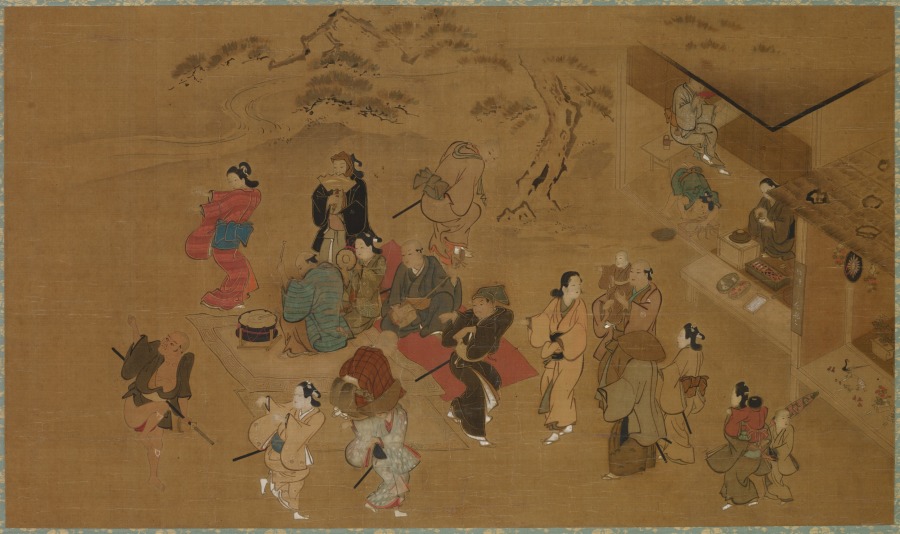
Hishikawa Moronobu · The Cleveland Museum of Art · The Kelvin Smith Collection, given by Mrs. Kelvin Smith · CC0
- Name
- Hishikawa Moronobu
- Born
- 1618
- Birthplace
- Hodomura, Kyonan, Awa Province, Japan
- Died
- 25 July 1694 (aged 76)
- Place of death
- Edo, now Tokyo, Japan
- Field
- ukiyo-e Hishikawa
- Nationality
- Japan
- Occupation
- illustrator · ukiyo-e artist
- Fields
- bijin-ga · shunga · meisho-e · genre painting · book illustration · nikuhitsu-ga
- Movements
- Hishikawa school
- Known for
- Beauty Looking Back
VALÉORINE Encyclopedia
VALÉORINE documentary reading
Documentary summary
Hishikawa Moronobu (1618 – 25 July 1694) was a Japanese artist known for popularizing the ukiyo-e genre of woodblock prints and paintings in the late 17th century. He consolidated the works of scattered Japanese art styles and forged the early development of ukiyo-e.
Admitted source layer · organised and presented by VALÉORINE
Note VALÉORINE
Hishikawa Moronobu (1618–1694) was a Japanese illustrator and ukiyo-e artist. Born in Hota, the illustrator died in Edo.
Hishikawa Moronobu was active in ukiyo-e. The illustrator was associated with Hishikawa school.
Works include Beauty Looking Back. Genres include bijin-ga, book illustration and genre painting, among others. Languages used include Japanese.
Composed from admitted, traceable facts · 27 September 2026
VALÉORINE
Reference Check
Propose documentary evidence for Hishikawa Moronobu. A contribution is never written directly as fact: identity, source, rights and evidence gates still decide.
Sign in to contribute
Documentary evidence
Documentary basis
Authority files
getty · 500118854 · wikidata · Q746217 · wikipedia · Hishikawa Moronobu
In this article
Key facts
Key facts
• Name — Hishikawa Moronobu • Born — 1618 • Birthplace — Hodomura, Kyonan, Awa Province, Japan • Died — 25 July 1694 (aged 76) • Place of death — Edo, now Tokyo, Japan • Field — ukiyo-e Hishikawa
Early life
Early life
Born in Hoda at the distant end of Edo Bay, Moronobu was the son of a well-respected embroiderer of rich tapestries who produced them for the use of temples and wealthy patrons. His initial works consisted designs for embroidery. After moving to Edo in the 1660s, Moronobu, who had likely learned skills from his father's craft, and studied both Tosa and Kanō-style painting. He thus had a solid grounding in both decorative crafts and academic painting, which served him well when he then turned to ukiyo-e, which he studied with his mentor, the Kanbun Master. Moronobu's surnames included both Hishikawa and Furuyama; his personal name in his early years was Kichibei, and he later adopted the art pseudonym Yūchiku.
Work
Work
• Illustration — Beauty looking back. This painting was completed around the 17th century, depicting a beautiful woman wearing a kimono turning around. It was adopted as a stamp design around 1948 and became popular. • Illustration — Courtesans parading with servants while holding umbrellas • Illustration — Panel from a series of 12, in abuna-e style Late 1670s–early 1680s; Hishikawa Moronobu (1618-1694); Woodcut, sumi ink on paper The earliest known illustration of Moronobu that can be dated comes from his work titled One Hundred Warrior Poets from 1672, although earlier works may yet surface. By the mid-1670s Moronobu had already become the most important ukiyo-e printmaker, a position he maintained until his death. He produced more than 100 sets of illustrations, perhaps as many as 150, with around 20 being of an erotic nature. Though it is difficult to attribute to him many unsigned examples (for example, the scholar Kiyoshi Shibui established, in 1926, a basis for crediting some of the designs previously given to Moronobu as the work of Sugumura Jihei). Very few of Moronobu's single-sheet prints have survived, and most, if not all, are unsigned. Moronobu assimilated inchoate ukiyo-e designs by previous artists, creating the first truly mature form of ukiyo-e, in a style of strength and presence that would set the standards for generations of artists who followed. In 1685, the ukiyo-e book "Images of Bushidō Through the Ages" by Moronobu was published. It features heroic popular tales of samurai warriors with simple descriptions for each artwork. The title includes the word bushido and was meant for children, which shows that it had spread among the general population. Despite his popularity with ukiyo-e prints, his illustrations found in collaborations with other artists and in printed books are what kicked off his career. In some cases Moronobu would take the images and subjects from other prints and illustrations made in Kyoto but would replace the images with his own illustrations to make them his own. A common subject Moronobu worked with was the depiction of women in their daily lives. He did this right up until the end of the 19th century, or in other words, the end of the Edo period. An example would be his contribution of illustrations for Hyankunin isshu zōsanshō (One Hundred Poets with Portraits and Commentaries). This publication produced an argument on whether it was designed for women or not. Moronobu's illustrations can also be found in The Pictorial Survey, drafted by Ochikochi Dōin. The images depicted include long military processions and travelers of all ages and stations. As he continued to do prints the subjects, scenes, colors, composition, and even his line work changed with adaptation of techniques and the audience that was interested in the current activities displayed. Moronobu's work is held in numerous museum collections around the world, and in the Library of Congress.
Gallery
Gallery
• Illustration — Lobby of a brothel from Yoshiwara no tei series, ca. 1680. • Illustration — Shunga, early 1680s, private collection. • Illustration — Ayame no Sikku, between 1650 and 1700, Brooklyn Museum. • Illustration — Women dressmaking and artisans at work, between 1675 and 1695, Brooklyn Museum. • Illustration — Gardens and Pavilions of Pleasure, late 17th century, Nelson-Atkins Museum of Art. • Illustration — Book cover of Kokon Bushido Ezukushi (Bushido Through The Ages) (1685) • Illustration — Two beauties (ink and color on silk)
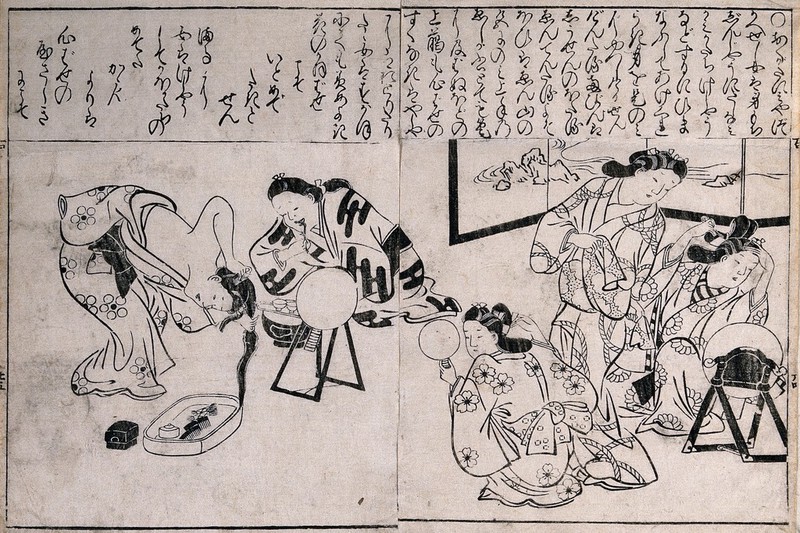
Women brushing their teeth and dressing their hair. Woodcut by Moronobu, 1695., 1695, by Hishikawa Moronobu
Hishikawa Moronobu · Wellcome Collection, London · Wellcome Collection
![A middle-aged couple making love. Coloured reproduction of a woodcut by Moronobu, ca. 1680s., [168?-], by Hishikawa Moronobu](https://iiif.wellcomecollection.org/image/V0047300/full/800,/0/default.jpg)
A middle-aged couple making love. Coloured reproduction of a woodcut by Moronobu, ca. 1680s., [168?-], by Hishikawa Moronobu
Hishikawa Moronobu · Wellcome Collection, London · Wellcome Collection
Life and career
Dated record
Life and career
The full dated record · 2 entries
1618
Hishikawa Moronobu was born on 1 January 1618.
1694
Hishikawa Moronobu died on 25 July 1694.
Primary material
Documents and archives
reference work
- Wikidata, structured authority record Q746217: Hishikawa Moronobu
Reputable secondary · Wikimedia Foundation
- “Hishikawa Moronobu”, English Wikipedia, consulted as further reading
Reputable secondary · Wikipedia
authority file
- Getty Union List of Artist Names 500118854, Hishikawa Moronobu.
General reference · The Getty Research Institute
Notes from the source article
Cited by Wikipedia
Notes from the source article
These works are cited by the source article, in its own numbering. They are recorded as its citations, not as sources VALÉORINE has verified.
- 1.Hishikawa's birth date is sometimes placed as late as c1625; see Lawrence Gowing, ed., Biographical Encyclopedia of Artists, v.3 (Facts on File, 2005): 473.
- 2.Lyons, Martyn. "Books: A Living History". Getty Publishing, 2011, p 161.
- 3.Lane, Richard. Masters of Japanese Print, Their World and Their Work. Thames & Hudson. 42, 46, 49. 1962. 9781015300231.
- 4.Hishikawa Moronobu Biography, Art, & Facts Britannica. www.britannica.com.
- 5.Milone, Marco. Ukiyo-e. L'Erudita. 41. 2022. 9788867707270.
- 6.菱川師宣の浮世絵「見返り美人図」を解説!見どころはどこ? | thisismedia. 6 April 2021.
- 7.A Parade of Courtesans. The Art Institute of Chicago.
- 8.Shogakukan. Moronobu. Encyclopedia of Japan. 2012.
- 9.Kasaya Kazuhiko. Bushidō: An Ethical and Spiritual Foundation in Japan. Nippon.com. June 12, 2019.
- 10.The female as subject : reading and writing in early modern Japan. 2 February 2016. 9781929280759.
- 11.Berry, Mary Elizabeth, 1947-. Japan in print : information and nation in the early modern period. University of California Press. 2006. 9780520941465.
- 12.Cordaro, Madalena Natsuko Hashimoto. Hishikawa Moronobu: from paintings to prints. Estudos Japoneses. 17. 129–140. 1997. 2447-7125.
- 13.World Digital Library. Pictorial Map of the Tōkaidō Highroad.
- 14.Resig, John. "Hishikawa Moronobu". Ukiyo-e Search, 2012. 23, February 2015.
References
Citations
References
Each reference names the institution holding it, so a reader may go to the document itself.
authority file
Getty Union List of Artist Names 500118854, Hishikawa Moronobu.The Getty Research Institute
Secondary witnessreference work
Wikidata, structured authority record Q746217: Hishikawa MoronobuWikimedia Foundation
Secondary witnessreference work
Secondary witness
Further particulars
Held on the record
Further particulars
Open the remaining particulars
Each of those relationships is stated by the authority record rather than inferred from style.
The authorities additionally record the headings Moronobu, Kichibē Hishikawa, Moronobu Hishikawa, Yūchiku and Moronobu Hishigawa. His recorded language was Japanese. One child is recorded: Hishikawa Morofusa. Work and production. One work is recorded as notable: Beauty Looking Back. His recorded genres are bijin-ga, shunga, meisho-e, genre and book illustration.
Identity and origins
Recognition and collections
Work by Hishikawa Moronobu is
Minneapolis Institute of Art, Art Institute of Chicago, The Nelson-Atkins Museum of Art and National Gallery of Victoria
The Encyclopedia exists whether or not anything is for sale. Corrections are recorded rather than overwritten, and every version of this record is kept. Published 14 August 2026.
Elsewhere in Illustration
5,224 published records in this field, each with its sources named.
- Hiroshi ŌsakaIllustrator
- HiroyukiIllustrator
- Hiroyuki AsadaIllustrator
- Hiroyuki KaidōIllustrator
- Holling C. HollingIllustrator
- Holly KellerIllustrator
- Homer DavenportIllustrator
- Homer Dodge MartinIllustrator
Best supported in this field
For owners
Own a work by Hishikawa Moronobu?
A specialist will read what you send and tell you what the house can establish, what it cannot, and whether the object is suited to sale. There is no charge and no obligation. The object stays with you throughout; nothing is shipped to us unless it is arranged in writing beforehand.