
hichiriki
The hichiriki is a double reed Japanese used as one of two main melodic instruments in gagaku music. It is one of the "sacred" instruments and is often heard at Shinto weddings in Japan. Its sound is often described as haunting.
hichiriki
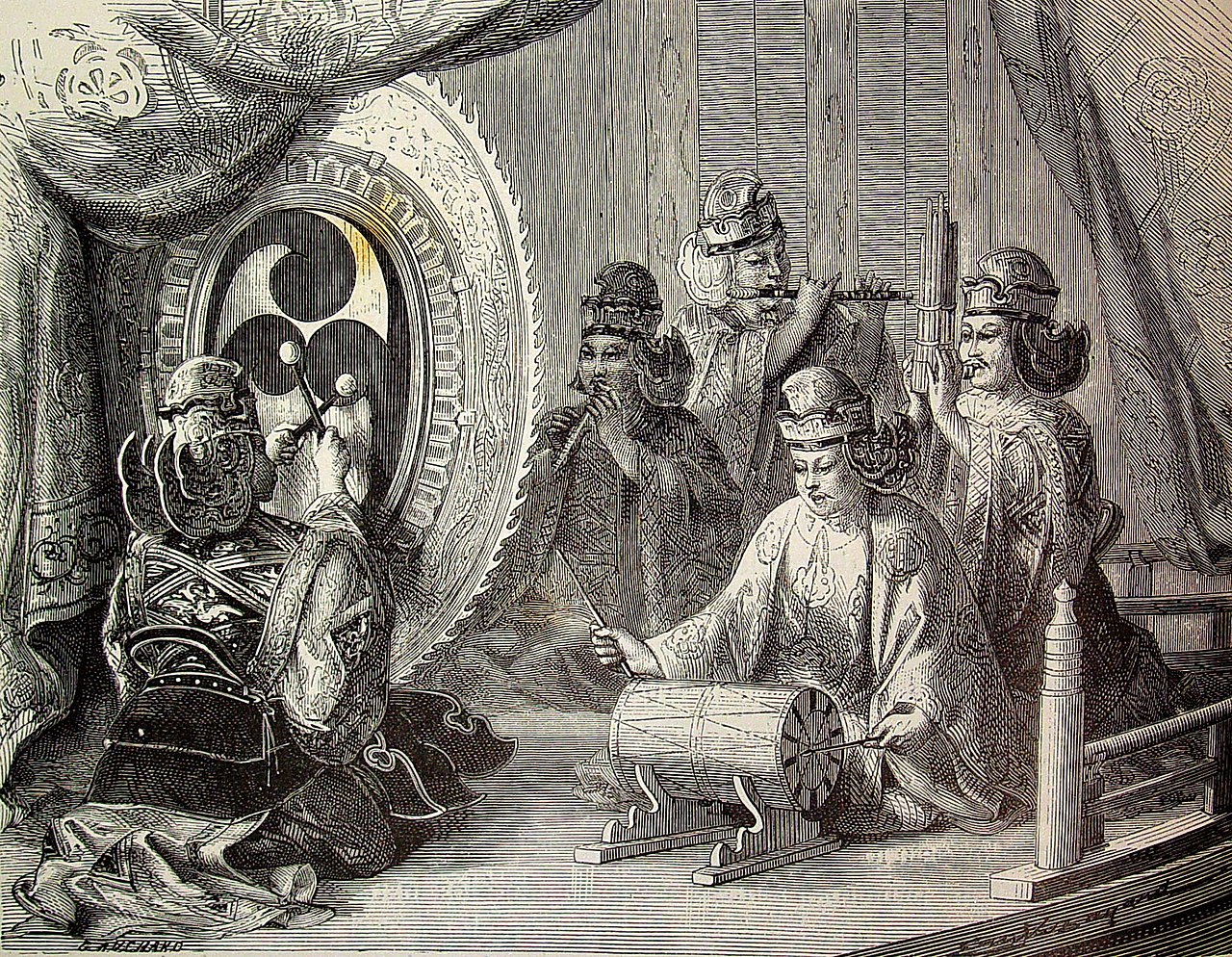
Biblioteca de la Facultad de Derecho y Ciencias del Trabajo Universidad de Sevilla · 1004177 Uploaded by clusternote · CC BY 2.0
- Name
- Hichiriki
- Field
- double reed instrument · single oboe with cylindrical bore and with fingerholes · traditional Japanese musical instrument
- Region
- Japan
VALÉORINE Encyclopedia
VALÉORINE documentary reading
Documentary summary
The hichiriki is a double reed Japanese used as one of two main melodic instruments in gagaku music. It is one of the "sacred" instruments and is often heard at Shinto weddings in Japan. Its sound is often described as haunting.
Admitted source layer · organised and presented by VALÉORINE
Reference Check
Propose documentary evidence for hichiriki. A contribution is never written directly as fact: identity, source, rights and evidence gates still decide.
Sign in to contribute
World of VALÉORINE
Documentary connections
Only confirmed graph relationships appear here. Images are shown only when their identity and reuse rights both pass the documentary gate.

Documentary evidence
Documentary basis
Authority files
wikidata · Q425748
In this article
Overview
Overview
The hichiriki is derived from the Chinese guan, which was imported into Japan during the Tang dynasty. According to scholars, the hichiriki emerged after the 12th century when the popularity of the Chinese melodies in Japan called tōgaku waned.

Thomas Piercy - Hichiriki 篳篥
Got212
Key facts
Key facts
• Name — Hichiriki • Classification — Double reed • Related — * Duduk • Guan • Piri
Places
Named by the record
Places
Only places the record itself states, plotted where the house gazetteer settles their coordinates. Nothing is inferred from a name or a nationality.
- Japan
Named but not plotted · 1
hichiriki is associated with Japan.
Country
Description
• Illustration — Gagaku musician playing hichiriki Although a double reed instrument like the oboe, the hichiriki has a cylindrical bore and thus its sound is similar to that of a clarinet. It is difficult to play due in part to the double reed configuration. It is made of a piece of bamboo that measures 18 cm with a flat double reed inserted which makes a loud sound. Pitch and ornamentation (most notably bending tones) are controlled largely with the embouchure. The instrument is particularly noted for the embai ("salted plum seasoning"), a kind of pitch-gliding technique. The hichiriki is the most widely used of all instruments in gagaku and it is used in all forms of music aside from poetry recitation. The hichiriki is derived from the Chinese guan or bili, and is also related to the Korean piri. This is evident in the notations of the finger positioning, a tablature of signs derived from Chinese characters. Notable Japanese musicians who play the hichiriki include Hideki Togi. Non-Japanese musicians who have learned to play the hichiriki include Alan Hovhaness, Richard Teitelbaum, Valerie Samson, Thomas Piercy and Joseph Celli.
Context
Primary material
Context
The circumstances in which hichiriki stands. Hichiriki is recorded as a kind of single oboe with cylindrical bore, with fingerholes. Hichiriki is recorded as a kind of traditional Japanese musical instrument. Hichiriki is recorded as a kind of double reed instrument. Hichiriki is recorded as type of musical instrument.
Documents and archives
Primary material
Documents and archives
scholarly publication
authority record
- Wikidata, structured authority record Q425748: hichiriki
General reference · Wikidata
References
Citations
References
Each reference names the institution holding it, so a reader may go to the document itself.
scholarly publication
Institutional witnessauthority record
General reference
Further particulars
Held on the record
Further particulars
Open the remaining particulars
Identity. Hichiriki is classified as a double reed instrument, single oboe with cylindrical bore, with fingerholes or traditional Japanese musical instrument. Hichiriki is associated with Japan. Within the Encyclopedia. Hichiriki is connected to 1 other published record in the VALÉORINE Encyclopedia.
The Encyclopedia exists whether or not anything is for sale. Corrections are recorded rather than overwritten, and every version of this record is kept. Published 16 August 2026.
Elsewhere in Collectables
20,755 published records in this field, each with its sources named.
- hi-hatTerminology
- Hi-OctaneWork
- Hi-Ten BombermanWork
- Hi-wayWork
- HICOM Automotive ManufacturersOrganisation
- Hidden & DangerousWork
- Hidden & Dangerous 2Work
- Hidden AgendaWork
Best supported in this field
For owners
Own an object connected with hichiriki?
A specialist will read what you send and tell you what the house can establish, what it cannot, and whether the object is suited to sale. There is no charge and no obligation. The object stays with you throughout; nothing is shipped to us unless it is arranged in writing beforehand.