
traditional Japanese musical instrument
Illustration — Women playing the Shamisen, Tsuzumi, and Taiko in Meiji-era Japan. Traditional Japanese musical instruments, known as wagakki in Japanese, are musical instruments used in the traditional folk music of Japan. They comprise a range of string, wind, and percussion instruments.
Also recorded as Japanese musical instrument
traditional Japanese musical instrument
![Playing on samisen, fuye, taiko, and tsuzumi. CREATED/PUBLISHED [between 1910 and 1920] NOTES "B 1010" on negative. No Detroit Publishing Co. no. Gift; State Historical Society of Colorado; 1949.](https://upload.wikimedia.org/wikipedia/commons/thumb/5/52/Japanesewomenmusicians.jpg/1280px-Japanesewomenmusicians.jpg)
Detroit Publishing Co., publisher. · This image is available from the United States Library of Congress 's Prints and Photographs division under the digital ID det.4a25731. This tag does not indicate the copyright status of the attached · Public domain
- Field
- musical instrument
- Region
- Japan
VALÉORINE Encyclopedia
VALÉORINE documentary reading
Documentary summary
Illustration — Women playing the Shamisen, Tsuzumi, and Taiko in Meiji-era Japan. Traditional Japanese musical instruments, known as wagakki in Japanese, are musical instruments used in the traditional folk music of Japan. They comprise a range of string, wind, and percussion instruments.
Admitted source layer · organised and presented by VALÉORINE
Note VALÉORINE
No house-authored Note is published until its assertions and sources pass the VALÉORINE evidence contract. The documentary article remains available in full while that enrichment is being consolidated.
Documentary enrichment in progress · no unsupported statement published
Reference Check
Propose documentary evidence for traditional Japanese musical instrument. A contribution is never written directly as fact: identity, source, rights and evidence gates still decide.
Sign in to contribute
World of VALÉORINE
Documentary connections
Only confirmed graph relationships appear here. Images are shown only when their identity and reuse rights both pass the documentary gate.

Broader Term · incoming
binzasara
Term
Own work

Broader Term · incoming
den-den daiko
Term
Own work

Broader Term · incoming
gottan
Term
Own work

Broader Term · incoming
hichiriki
Term
1004177 Uploaded by clusternote

Broader Term · incoming
horagai
Term
Own work

Broader Term · incoming
hyōshigi
Term
Own work

Broader Term · incoming
kokyū
Term
Own work

Broader Term · incoming
konghou
Term
Own work

Broader Term · incoming
minteki
Term
Own work

Broader Term · incoming
mukkuri
Term
Own work

Broader Term · incoming
ryūteki
Term
Japanese traditional flute "Ryuteki"
Broader Term · incoming
sanba
Term

Broader Term · incoming
sanshin
Term
Own work
Broader Term · incoming
shakubyoshi
Term

Broader Term · incoming
shamisen
Term
Transferred from en.wikipedia to Commons.

Broader Term · incoming
shime-daiko
Term
Own work
Documentary evidence
Evidence Panel
not yet certified
- Identity
- resolved
- Independent source families
- 0
- Admitted assertions
- 0
- Open conflicts
- 0
Authority files
wikidata · Q1071649
In this article
Percussion instruments
Percussion instruments
• Bin-sasara; also spelled bin-zasara – clapper made from wooden slats connected by a rope or cord • Chappa – Hand cymbals • Hyoshigi – wooden or bamboo clappers • Denden-daiko – a children's toy • Ikko – small, ornately decorated hourglass-shaped drum • Kagura suzu – hand-held bell tree with three tiers of pellet bells • Kakko – small drum used in gagaku • Kane – small flat gong • Kokiriko – a pair of sticks which are beaten together slowly and rhythmically • Shakubyoshi (also called shaku) – clapper made from a pair of flat wooden sticks • Mokugyo – woodblock carved in the shape of a fish, struck with a wooden stick; often used in Buddhist chanting • Ōtsuzumi – hand drum • Rin or daikin (大磬) – singing bowls used by Buddhist monks in religious practice or rituals • San-no-tsuzumi – hourglass-shaped double-headed drum; struck only on one side • Sasara – clapper made from wooden slats connected by a rope or cord • Sekkin – a lithophone either bowed or struck • Shime-daiko – small drum played with sticks • Shōko – small bronze gong used in gagaku; struck with two horn beaters * • Tsuri-daiko – drum on a stand with ornately painted head, played with a padded stick • Tsuzumi – small hand drum
Zithers
Zithers
• Ichigenkin – monochord • Junanagen – the 17-string koto • Koto – a long zither • Yamatogoto – ancient long zither; also called wagon
Harps
Harps
• Kugo – an angled harp used in ancient times and recently revived • Taishōgoto – a zither with metal strings and keys
Lutes
Lutes
• Biwa – a pear-shaped lute
Other
Other
• Gottan or hako-jamisen • – an Okinawan precursor of the mainland Japanese (and Amami Islands) shamisen • Shamisen – a banjo-like lute with three strings; brought to Japan from China in the 16th century. Popular in Edo's pleasure districts, the shamisen is often used in kabuki theater. Made from red sandalwood and ranging from 1.1 to 1.4 m long, the shamisen has ivory pegs, strings made from twisted silk, and a belly covered in cat or dog skin or a synthetic skin. The strings, which are of different thickness, are plucked or struck with a tortoise shell, ivory or synthetic ivory pick. • Tonkori (トンコリ) – a plucked instrument used by the Ainu people of Hokkaidō
Bowed
Bowed
• Kokyū – a bowed lute with three (or, more rarely, four) strings and a skin-covered body
Flutes
Flutes
Japanese flutes are called fue. There are eight traditional flutes, as well as more modern creations. • Hocchiku – vertical bamboo flute • Nohkan – transverse bamboo flute used for Noh theater • Ryūteki – transverse bamboo flute used for gagaku • Kagurabue – transverse bamboo flute used for mi-kagura, Shinto ritual music) • Komabue – transverse bamboo flute used for komagaku; similar to the ryūteki • Shakuhachi – vertical bamboo flute used for Zen meditation • Shinobue – transverse folk bamboo flute • – globular flute made from clay • Bow flute (弓笛) – a flute developed by Ishida Nehito with bow hair on it to accompany the kokyū
Reed instruments
Reed instruments
• Hichiriki – double-reeded flute used in different kinds of music
Free reed mouth organs
Free reed mouth organs
• Shō – 17-pipe mouth organ used for gagaku • U – large mouth organ
Horns
Horns
• Horagai – seashell horn; also called jinkai
Other instruments
Other instruments
• Mukkuri (ムックリ) – jaw harp used by the Ainu people • Koukin – general name for the jaw harp, also known as the biyabon in the Edo period
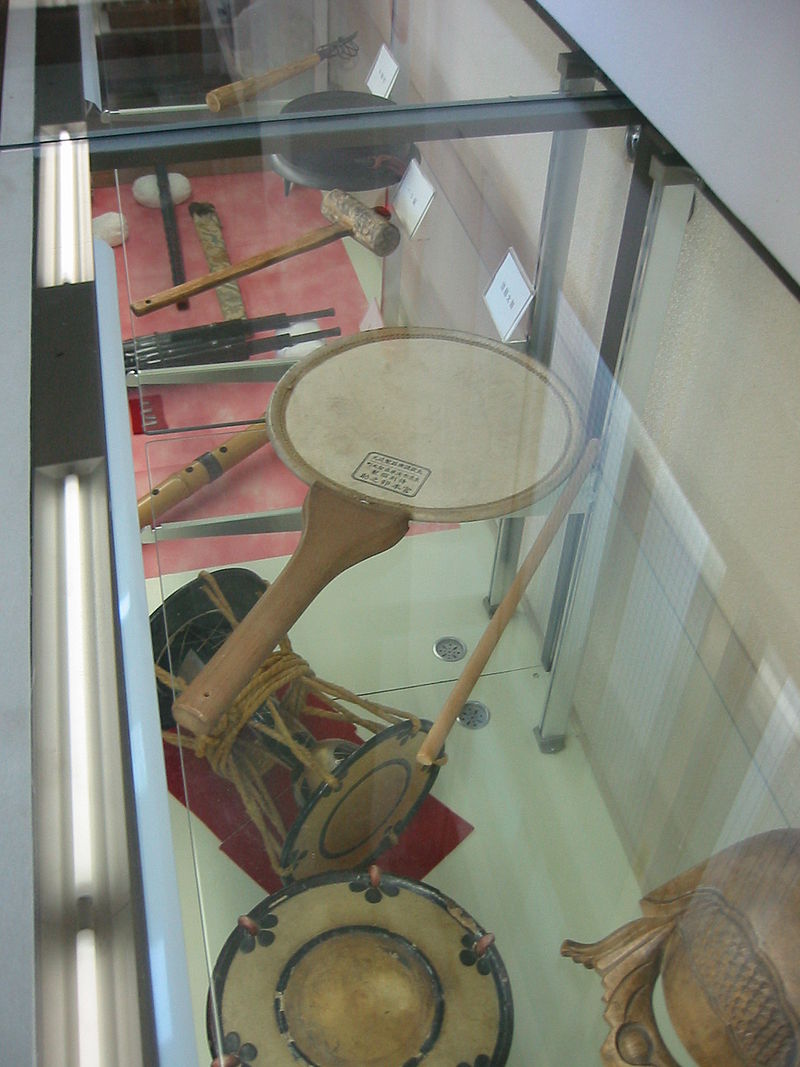
団扇太鼓 岐阜城資料館 にて
日: Jnn · Jnn · Photo or data with a Canon IXY DIGITAL 200 ® by © Jnn. 日: Jnn Own work

traditional Japanese musical instrument, Gaki zoshi - Tokyo - part 1
Tokyo National Museum, Emuseum
Places
Named by the record
Places
Only places the record itself states, plotted where the house gazetteer settles their coordinates. Nothing is inferred from a name or a nationality.
- Japan
References
Citations
References
Each reference names the institution holding it, so a reader may go to the document itself.
authority record
Unverified
Connections
The Encyclopedia exists whether or not anything is for sale. Corrections are recorded rather than overwritten, and every version of this record is kept. Published 14 August 2026.
Elsewhere in Collectables
20,755 published records in this field, each with its sources named.
- Trade EmpiresWork
- Trade NationsWork
- traditional Cambodian musical instrumentTerminology
- traditional French musical instrumentTerminology
- traditional Korean musical instrumentTerminology
- traditional Malaysian musical instrumentTerminology
- Traditional Thai musical instrumentsTerminology
- traditional Vietnamese musical instrumentTerminology
Best supported in this field
For owners
Own an object connected with traditional Japanese musical instrument?
A specialist will read what you send and tell you what the house can establish, what it cannot, and whether the object is suited to sale. There is no charge and no obligation. The object stays with you throughout; nothing is shipped to us unless it is arranged in writing beforehand.