
Hewlett-Packard 9100A
Illustration — "The new Hewlett-Packard 9100A personal computer" is "ready, willing, and able.. To relieve you of waiting to get on the big computer." The Hewlett-Packard 9100A (HP 9100A) is an early programmable calculator (or computer), first appearing in 1968. HP called it a desktop calculator because, as Bill Hewlett said, "If we had called it a computer, it would have been rejected by our customers' computer gurus because it didn't look like an IBM. We therefore decided to call it a calculator, and all such nonsense disappeared." An ad for the 9100A in 1968 Science magazine contains one of the earliest documented use (as of 2000) of the phrase personal computer.
Also recorded as HP-9100A · HP 9100A · HP 9100
Hewlett-Packard 9100A
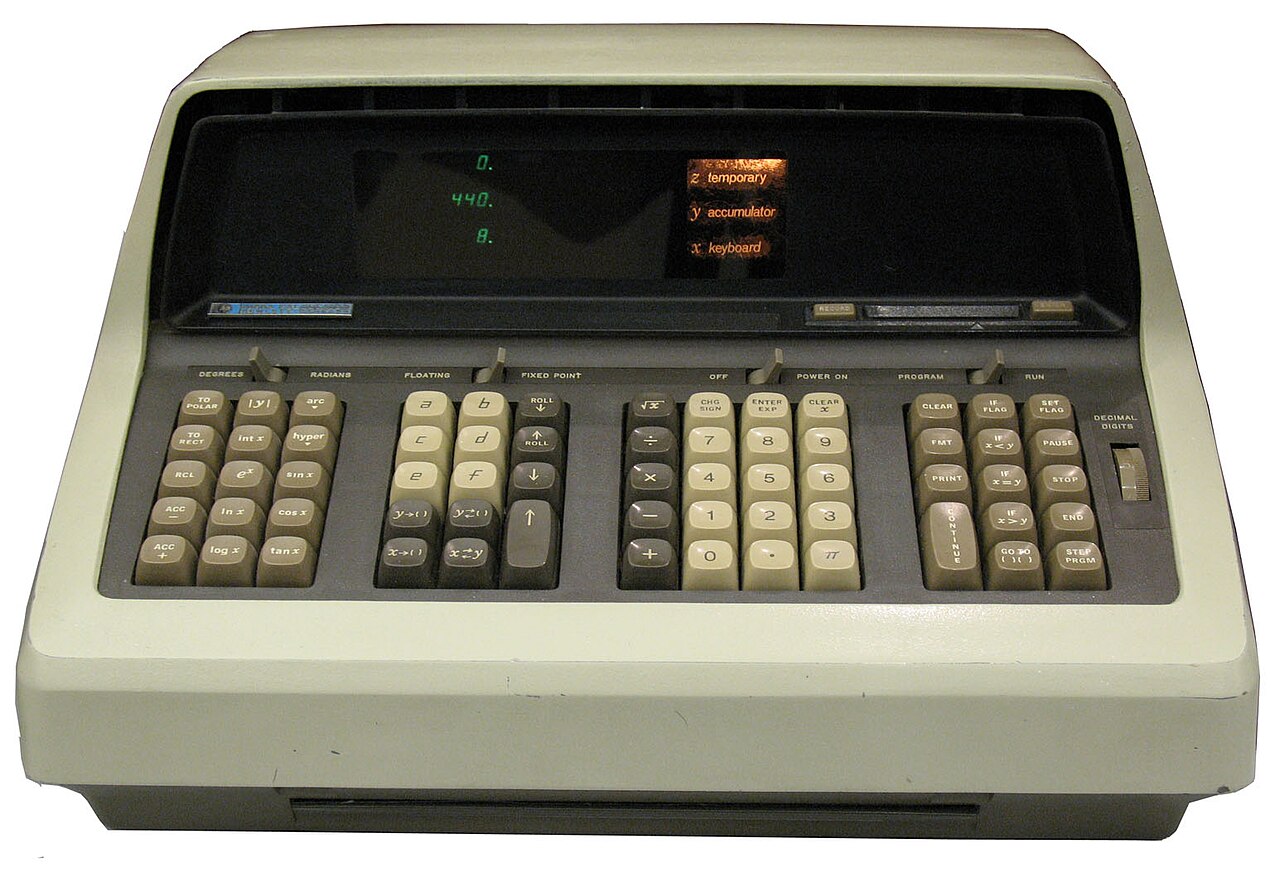
Swtpc6800 en:User:Swtpc6800 Michael Holley · Public domain
- Field
- programmable calculator
- Period
- 1968
VALÉORINE Encyclopedia
VALÉORINE documentary reading
Documentary summary
Illustration — "The new Hewlett-Packard 9100A personal computer" is "ready, willing, and able.. To relieve you of waiting to get on the big computer." The Hewlett-Packard 9100A (HP 9100A) is an early programmable calculator (or computer), first appearing in 1968. HP called it a desktop calculator because, as Bill Hewlett said, "If we had called it a computer, it would have been rejected by our customers' computer gurus because it didn't look like an IBM. We therefore decided to call it a calculator, and all such nonsense disappeared." An ad for the 9100A in 1968 Science magazine contains one of the earliest documented use (as of 2000) of the phrase personal computer.
Admitted source layer · organised and presented by VALÉORINE
Note VALÉORINE
No house-authored Note is published until its assertions and sources pass the VALÉORINE evidence contract. The documentary article remains available in full while that enrichment is being consolidated.
Documentary enrichment in progress · no unsupported statement published
Reference Check
Propose documentary evidence for Hewlett-Packard 9100A. A contribution is never written directly as fact: identity, source, rights and evidence gates still decide.
Sign in to contribute
World of VALÉORINE
Documentary connections
Only confirmed graph relationships appear here. Images are shown only when their identity and reuse rights both pass the documentary gate.

Documentary evidence
Evidence Panel
wikipedia incomplete · checked 25 September 2026
- Identity
- resolved
- Independent source families
- 0
- Admitted assertions
- 0
- Open conflicts
- 0
Authority files
wikidata · Q1250052 · wikipedia · Hewlett-Packard 9100A
In this article
History
• Illustration — Electronic calculator prototype, made by Thomas E. Osborne for Hewlett-Packard, 1964, in the National Museum of American History The device descended from a prototype designed by engineer Thomas "Tom" E. Osborne, who joined the company when HP adopted his idea. An engineering triumph, the logic circuit was produced without any integrated circuits. The CPU was entirely executed using discrete components. With CRT readout, magnetic card storage, and printer, the price was around. Thanks to its high speed operation an order of magnitude faster than competitors – addition or subtraction took just 2 ms, multiplication 22 ms and division 27 ms – the device could quickly execute not just regular trigonometric functions (330 ms) or logarithms (130 ms) but many iterative computations when following a program. This made the 9100A the first scientific calculator by the modern definition, and also marked the beginning of Hewlett-Packard's long history of using Reverse Polish notation (RPN) entry on their calculators. Due to the similarities of their machines, Hewlett-Packard was ordered to pay about in royalties to Olivetti after copying some of the features adopted from the Programma 101, like the magnetic card and the architecture.
Notes from the source article
Cited by Wikipedia
Notes from the source article
These works are cited by the source article, in its own numbering. They are recorded as its citations, not as sources VALÉORINE has verified.
- 1.Aaron, Clark. Wired 8.12: Must Read: The First PC. Dec 2000.
- 2.Note in: WANTED - Data Acquisition Corp. DAC-512. www.oldcalculatormuseum.com. Note with asterisk at the end.
- 3.Hewlett-Packard. History of the 9100A desktop calculator, 1968.
- 4.HP9825.com. Osborne's Story.
- 5."How the Model 9100A Was Developed", Bernard M. Oliver, September 1968, Hewlett-Packard Journal]
- 6.1994 letter from Tom Osborne to Barney Oliver, hp9825.com
- 7.Monoskop/Whole Earth. 9100A Calculator. Whole Earth Catalog (fall 1968), no. #1010. 34. 1968.
- 8.The 9100 Part 2. www.hp9825.com.
- 9.HP9100. hpmemoryproject.org.
- 10.Old Computers. Olivetti Programma P101/P102.
References
Citations
References
Each reference names the institution holding it, so a reader may go to the document itself.
reference work
Partially resolvedreference work
Partially resolved
The Encyclopedia exists whether or not anything is for sale. Corrections are recorded rather than overwritten, and every version of this record is kept. Published 14 August 2026.
Elsewhere in Scientific instruments
736 published records in this field, each with its sources named.
- Heath RobinsonTerminology
- Heinrich Hertz Submillimeter TelescopeTerminology
- heliometerTerminology
- hemi engineTerminology
- Hexapod-TelescopeTerminology
- High Definition Earth Viewing camerasTerminology
- High Elevation Antarctic Terahertz TelescopeTerminology
- High Energy Stereoscopic SystemTerminology
Best supported in this field
For owners
Own an object connected with Hewlett-Packard 9100A?
A specialist will read what you send and tell you what the house can establish, what it cannot, and whether the object is suited to sale. There is no charge and no obligation. The object stays with you throughout; nothing is shipped to us unless it is arranged in writing beforehand.