
Herbie Mann
Herbert Jay Solomon (April 16, 1930 – July 1, 2003), known by his stage name Herbie Mann, was an American jazz flute player and important early practitioner of world music. Early in his career, he also played tenor saxophone and clarinet (including bass clarinet), but Mann was among the first jazz musicians to specialize on the flute. His most popular single was "Hi-Jack", which was a Billboard No.
Also recorded as Herbert J. Solomon · Herbert Solomon
Herbie Mann
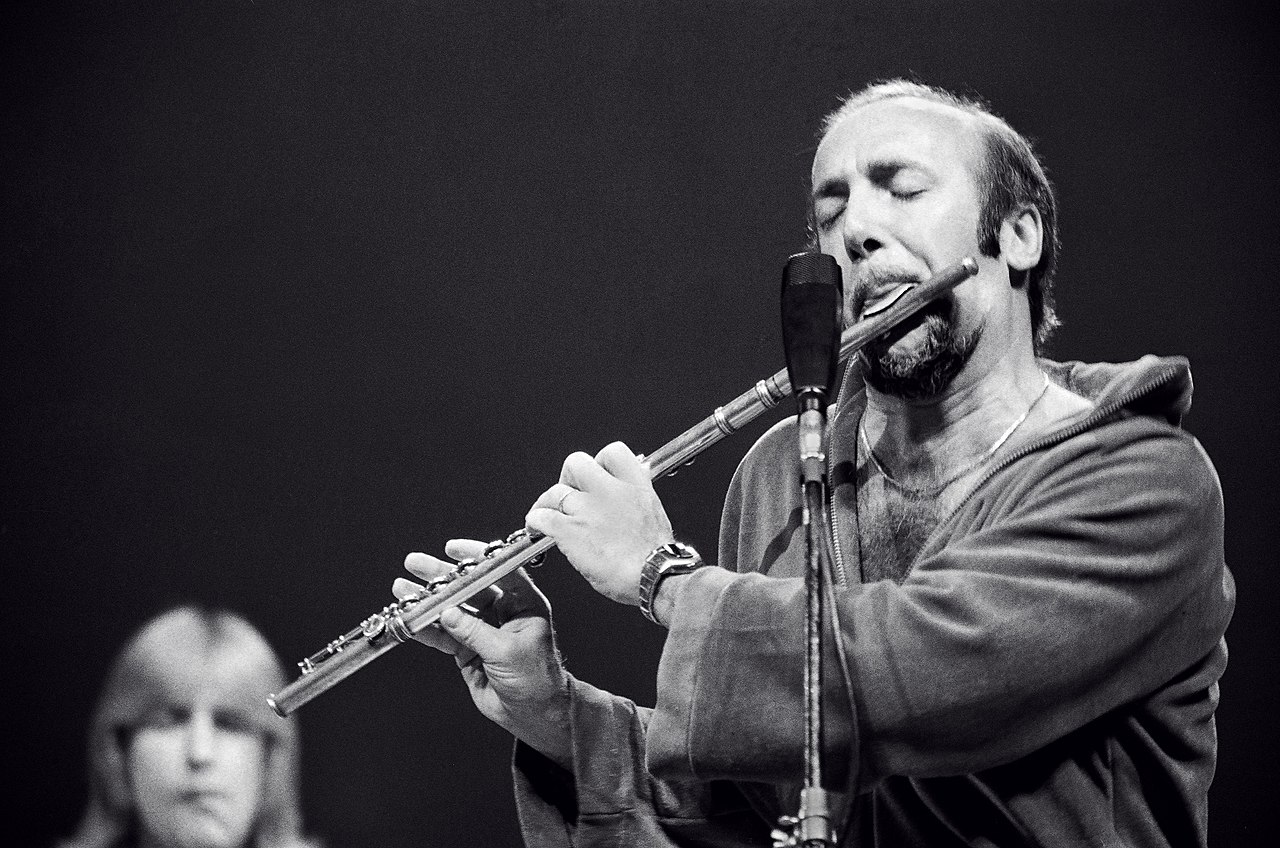
Tom Marcello Webster, New York, USA · Herbie Mann (w/ Will Lee) · CC BY-SA 2.0
- Name
- Herbie Mann
- Birth Name
- Herbert Jay Solomon
- Born
- 16 April 1930
- Birthplace
- Brooklyn, New York City, U.S.
- Died
- 1 July 2003
- Place of death
- Pecos, New Mexico, U.S.
- Occupation
- * Musician
- Full name
- Herbert Jay Solomon.
- Nationality
- United States.
- Fields
- jazz, bossa nova, jazz fusion, disco, world music and acid jazz.
- Education
- Abraham Lincoln High School and Manhattan School of Music.
VALÉORINE Encyclopedia
VALÉORINE documentary reading
Documentary summary
Herbert Jay Solomon (April 16, 1930 – July 1, 2003), known by his stage name Herbie Mann, was an American jazz flute player and important early practitioner of world music. Early in his career, he also played tenor saxophone and clarinet (including bass clarinet), but Mann was among the first jazz musicians to specialize on the flute. His most popular single was "Hi-Jack", which was a Billboard No.
Admitted source layer · organised and presented by VALÉORINE
Note VALÉORINE
Herbie Mann (1930–2003) was a composer, flautist and musician, among other activities, of American nationality. The composer was born Herbert Jay Solomon in Brooklyn and died in Pecos. Herbie Mann was educated at Abraham Lincoln High School and Manhattan School of Music. The work spans acid jazz, bossa nova and disco, among others.
Composed from admitted, traceable facts · 26 September 2026
VALÉORINE
Reference Check
Propose documentary evidence for Herbie Mann. A contribution is never written directly as fact: identity, source, rights and evidence gates still decide.
Sign in to contribute
World of VALÉORINE
Documentary connections
Only confirmed graph relationships appear here. Images are shown only when their identity and reuse rights both pass the documentary gate.
Documentary evidence
Documentary basis
Authority files
gnd · 10299619-2 · museum · 04271c28-b9a7-4724-b7fd-022409fbce60 · wikidata · Q551912 · wikipedia · Herbie Mann
In this article
Biography
Biography
1 dance hit for three weeks in 1975. Mann emphasized the groove approach in his music. Mann felt that from his repertoire, the "epitome of a groove record" was Memphis Underground or Push Push, because the "rhythm section locked all in one perception."

Herbie Mann, 1975 in NYC
Tom Marcello
Key facts
Key facts
• Name — Herbie Mann • Birth Name — Herbert Jay Solomon • Born — 16 April 1930 • Birthplace — Brooklyn, New York City, U.S. • Died — 1 July 2003 • Place of death — Pecos, New Mexico, U.S. • Instrument — * Flute • saxophone • bass clarinet • Genre — * Jazz • bossa nova • disco • world music • Occupation — * Musician • record label executive • Discography — Herbie Mann discography • Years Active — 1953–2003 • Label — * Atlantic • Cotillion • Embryo • Kokopelli • Associated Acts — Antônio Carlos Jobim, João Gilberto, Whitney Houston, Cissy Houston • Website — www.herbiemannmusic.com (inactive)
Early life, family and education
Early life, family and education
Herbie Mann was born in Brooklyn, New York, New York, to Jewish parents Harry C. Solomon (May 30, 1902 – May 31, 1980), who was of Russian descent, and Ruth Rose Solomon (née Brecher) (July 4, 1905 – November 11, 2004), of Romanian descent who was born in Bukovina, Austria-Hungary but immigrated to the United States with her family at the age of 6. Both of his parents were dancers and singers, as well as dance instructors later in life. Mann started studying the clarinet when he was in grade school. He attended Lincoln High School in Brighton Beach, Brooklyn. By the time he graduated, he had begun to take saxophone and flute lessons.
Career
Career
His first professional performance was playing the Catskills resorts at age 15. Following high school graduation, he served four years in the U.S. Army and for most of his tour was stationed in Italy with the 98th Army Band. After discharge, Mann worked with accordianist Mat Mathews and then joined Pete Rugolo's band. After Rugolo disbanded, Mann formed a quartet with guitarist Benny Weeks, bassist Keith Hodgson and drummer Lee Rockey and recorded his first album for Bethlehem Records in December of 1954. In the 1950s Mann was primarily a bop flutist, playing in combos with artists such as Phil Woods, Sam Most, Bobby Jaspar and Buddy Collette, occasionally playing bass clarinet, tenor saxophone and solo flute. In 1957, he won the Down Beat jazz magazine poll for best flutist, winning again in 1958, 1959 and 1960. Mann was an early pioneer of the fusion of jazz and world music. In 1959, following a US State Department-sponsored tour of Africa, he recorded Flautista!, an album of Afro-Cuban jazz. In 1961, Mann toured Brazil, returning to the US to record with Brazilian musicians, including Antonio Carlos Jobim and guitarist Baden Powell. These albums helped popularize bossa nova in the US and Europe. He often worked with Brazilian themes. In the mid-1960s Mann hired a young Chick Corea to play in some of his bands. In the late 1970s and early 1980s Mann played duets at New York City's The Bottom Line and Village Gate clubs, with Sarod virtuoso Vasant Rai. • Illustration — Herbie Mann at Bach Dancing & Dynamite Society, Half Moon Bay CA 9/5/82 Following the 1969 hit album Memphis Underground, a number of smooth jazz records influenced by Southern soul, blues rock, reggae, funk and disco elicited criticism from jazz purists but allowed Mann to remain active during a period of declining interest in jazz. The musicians on these recordings are some of the best-known session players in soul and jazz, including singer Cissy Houston, guitarists Duane Allman, Larry Coryell, and Sonny Sharrock, bassists Donald "Duck" Dunn, Chuck Rainey, and Miroslav Vitous, and drummers Al Jackson, Jr. and Bernard Purdie. In this period Mann had a number of pop hits — rare for a jazz musician. According to a 1998 interview Mann had made at least 25 albums that were on the Billboard 200 pop charts, success denied most of his jazz peers." Mann provided the music for the 1978 National Film Board of Canada animated short Afterlife, by Ishu Patel. • Illustration — Herbie Mann and Will Lee (1975) In the early 1970s, he founded his own label, Embryo Records, distributed by Cotillion Records, a division of Atlantic Records. Embryo produced jazz albums, such as Ron Carter's Uptown Conversation (1970); Miroslav Vitous' first solo album, Infinite Search (1969); Phil Woods and his European Rhythm Machine at the Frankfurt Jazz Festival (1971); and Dick Morrissey and Jim Mullen's Up (1976), which featured the Average White Band as a rhythm section; and the 730 Series, with a more rock-oriented style, including Zero Time (1971) by TONTO's Expanding Head Band. He later set up Kokopelli Records after difficulty with established labels. In 1996, Mann collaborated with Stereolab on the song "One Note Samba/Surfboard" for the AIDS-Benefit album Red Hot + Rio produced by the Red Hot Organization. Mann also played flutes on the Bee Gees' album Spirits Having Flown. His last appearance was on May 3, 2003, at the New Orleans Jazz and Heritage Festival. In a review of Mann's Beyond Brooklyn (2004), his final recording (co-led with Phil Woods), critic George Kanzler proposed that Mann's status as an innovator had been overlooked: •...Mann's career, in both its questing nature and embrace of various musical styles, parallels that of Miles Davis. Mann championed Brazilian music even before Stan Getz. When Miles was fusing jazz with rock, Mann was fusing it with Memphis soul and Southern rock. He also was an early exponent of world music. But while Miles was usually hailed as a visionary, Mann was dismissed as just a popularizer selling out. It was a bum rap.
Personal life and death
Personal life and death
Mann was married to Susan Janeal Arison. His four children are: Paul Mann, Claudia Mann, Laura Mann-Lepik and Geoffrey Mann. Geoff is a multi-instrumentalist who plays drums for Los Angeles-based metal/afrobeat group Here Lies Man. Mann died from prostate cancer on July 1, 2003, at his home in Pecos, New Mexico.
Identity
Identity
Herbie Mann is recorded as composer, saxophonist, flautist and musician. Recorded at birth as Herbert Jay Solomon.
Life and career
Dated record
Life and career
Explore 1965–2003
The full dated record · 3 entries
1965
The Best Of Herbie Mann (1965) is digitised and catalogued by Internet Archive.
1974
Herbie Mann - Reggae 1974 (1974) is digitised and catalogued by Internet Archive.
2003
Herbie Mann died at Pecos.
Places
Named by the record
Places
Only places the record itself states, plotted where the house gazetteer settles their coordinates. Nothing is inferred from a name or a nationality.
Brooklyn.
Birth place
Pecos.
Death place
Primary material
Digitised editions and texts
The Best Of Herbie Mann (1965) — Internet Archive
Herbie Mann - Reggae 1974 (1974) — Internet Archive
Holdings and surviving copies
Where the work is held
Holdings and surviving copies
Where material relating to Herbie Mann is held.
Documents and archives
Primary material
Documents and archives
reference work
- Wikidata, structured authority record Q551912: Herbie Mann
Reputable secondary · Wikidata
- “Herbie Mann”, English Wikipedia, consulted as further reading
Reputable secondary · Wikipedia
Institutional database
- MusicBrainz artist record for Herbie Mann
Scholarly · MetaBrainz Foundation
Literature
Literature
Literature
Mann, Herbie, Oxford Music Online, 2013
Mann, Herbie, Oxford Music Online, 2003
The Evolution of Mann: Herbie Mann and the Flute in Jazz by Cary Ginell (review), Notes, 2015
Scholarly footprint
Literature
Scholarly footprint
A count of publications is evidence of attention, not of standing, and is given here only as a measure.
Notes from the source article
Cited by Wikipedia
Notes from the source article
These works are cited by the source article, in its own numbering. They are recorded as its citations, not as sources VALÉORINE has verified.
- 1.Scott Yanow. Herbie Mann | Biography. AllMusic.
- 2.Jimnewsom.com. Herbie Mann's New Groove. 2002-07-09.
- 3.Peter Hawkins. 'Family Legacy Endures; Mother Of Herbie Mann Dancing At 98'. Sun Sentinel. September 10, 2003.
- 4.Alberto Manguel, Ara Guler - Creating the 20th Century: 100 Artists, Writers and Thinkers. Retrieved March 24, 2011.
- 5.Robert Palmer. 'Why Herbie 'Sold Out,' Or The Evolution of Mann; The Evolution of Herbie Mann'. The New York Times. November 11, 1973.
- 6.Mann, Herbie. East Coast Jazz Series No. 4 Herbie Mann. Bethlehem Records. 1955.
- 7.Jim Newsom. Herbie Mann Articles. jimnewsom.com.
- 8.Embryo Album Discography. bsnpubs.com. 2005-09-21.
- 9.Herbie Mann & Phil Woods: Beyond Brooklyn. All About Jazz. 15 October 2004.
- 10.Here Lies Man Archives. Ridingeasyrecs.com.
- 11.Keepnews, Peter. Herbie Mann, Jazz Musician, Dies at 73. New York Times. July 2, 2003.
- 12.Levy, Claudia. Herbie Mann Dies. Washington Post. July 2, 2003.
- 13.Thurber, Jon. Herbie Mann, 73; Jazz Flutist Explored Genres. Los Angeles Times. July 3, 2003.
Bibliography printed in the source article · 1
- Ginell, Cary, "The Evolution of Mann: Herbie Mann and the Flute in Jazz" - Hal Leonard Books, 2013,
References
Citations
References
Each reference names the institution holding it, so a reader may go to the document itself.
Institutional database
MusicBrainz artist record for Herbie MannMetaBrainz Foundation
Institutional witnessreference work
Secondary witnessreference work
Secondary witness
The Encyclopedia exists whether or not anything is for sale. Corrections are recorded rather than overwritten, and every version of this record is kept. Published 16 August 2026.
Elsewhere in Music memorabilia
42,307 published records in this field, each with its sources named.
- Herbert WindtPerson
- Herbert ZipperPerson
- Herbie HancockPerson
- Herbie LovellePerson
- Herbie NicholsPerson
- Herbrand LarsenPerson
- Heresy RecordsOrganisation
- Heri JoensenPerson
Best supported in this field
For owners
Own a work by Herbie Mann?
A specialist will read what you send and tell you what the house can establish, what it cannot, and whether the object is suited to sale. There is no charge and no obligation. The object stays with you throughout; nothing is shipped to us unless it is arranged in writing beforehand.