
Henry Golden Dearth
Henry Golden Dearth (22 April 1864 – 27 March 1918) was a distinguished American painter who studied in Paris and continued to spend his summers in France painting in the Normandy region. He would return to New York in winter, and became known for his moody paintings of the Long Island area. Around 1912, Dearth changed his artistic style, and began to include portrait and still life pieces as well as his paintings of rock pools created mainly in Brittany.
Also recorded as Henry G. Dearth · h.g. dearth · dearth h.g. · dearth
Henry Golden Dearth
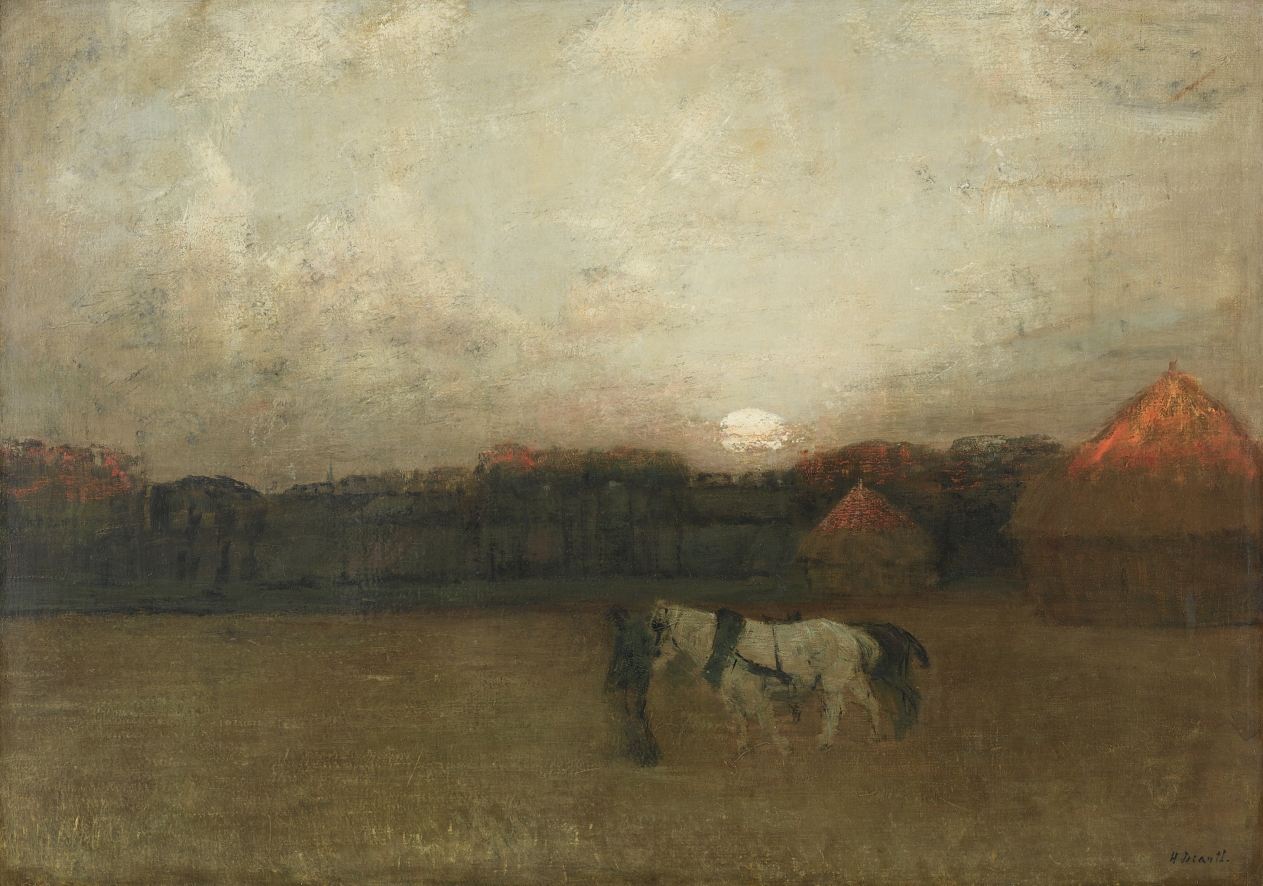
Henry Golden Dearth · The Cleveland Museum of Art · Gift of George E. Gage and Frederic S. Porter · CC0
- Name
- Henry Golden Dearth
- Born
- 22 April 1864
- Birthplace
- Bristol, Rhode Island, United States
- Died
- 27 March 1918
- Place of death
- New York City, United States
- Field
- Painting
- Training
- École des Beaux-Arts, Paris, France
- Movement
- American Barbizon school
- Nationality
- United States
- Occupation
- painter
VALÉORINE Encyclopedia
VALÉORINE documentary reading
Documentary summary
Henry Golden Dearth (22 April 1864 – 27 March 1918) was a distinguished American painter who studied in Paris and continued to spend his summers in France painting in the Normandy region. He would return to New York in winter, and became known for his moody paintings of the Long Island area. Around 1912, Dearth changed his artistic style, and began to include portrait and still life pieces as well as his paintings of rock pools created mainly in Brittany.
Admitted source layer · organised and presented by VALÉORINE
Reference Check
Propose documentary evidence for Henry Golden Dearth. A contribution is never written directly as fact: identity, source, rights and evidence gates still decide.
Sign in to contribute
World of VALÉORINE
Documentary connections
Only confirmed graph relationships appear here. Images are shown only when their identity and reuse rights both pass the documentary gate.
Documentary evidence
Documentary basis
Authority files
wikidata · Q5722045 · wikipedia · Henry Golden Dearth
In this article
Biography
Biography
A winner of several career medals and the Webb prize in 1893, Dearth died suddenly in 1918 aged 53 and was survived by a wife and daughter.
The field of work recorded is painting. Subjects and genres recorded for the work are portrait. Work by Henry Golden Dearth is recorded in the collections of Art Institute of Chicago, Reading Public Museum, Smithsonian American Art Museum, Cleveland Museum of Art and Detroit Institute of Arts.
Key facts
Key facts
• Name — Henry Golden Dearth • Born — 22 April 1864 • Birthplace — Bristol, Rhode Island, United States • Died — 27 March 1918 • Place of death — New York City, United States • Field — Painting • Training — École des Beaux-Arts, Paris, France • Movement — American Barbizon school • Illustration — Henry Golden Dearth by James W. Porter, 1912, silver print
Early life
Early life
Born on April 22, 1864 in Bristol, Rhode Island, Henry Golden Dearth was the youngest of five children of John Willis and Ruth Marshall Dearth. His father was connected with the whaling business and was an artillery officer during the civil war. He was also a talented musician and provided favorable influences to the development of Henry's talent. His grandfather was a commander in the United States Navy during the War of 1812. At the age of 15, his family moved to Waterbury, Connecticut, where he entered the employ of Brown & Brothers, and was afterward for a time connected with the Waterbury Clock company. Dearth's passionate love for art led him to eventually devote himself solely to the study of painting. He entered the studio of portrait painter Horace Johnson for three months before he went to Paris and studied in the atelier of Ernest Hébert and Aimé Morot at L’Ecole des Beaux Arts. Returning to the United States in 1888, Dearth established himself with a debut exhibition of landscape at the National Academy of Design. In 1889 he exhibited for the first time with the more progressive Society of American Artists. In 1893 he was awarded the Webb prize for works by an artist under the age of 40. In 1902 he opened his studio at 18 E. 40th Street in New York and started to return to spend his summers in Normandy, the region that first attracted him to landscape painting. He had a house and studio at Montreuil-sur-Mer, in the Pas-de-Calais, on the English Channel coast, where he worked several months each season. He married Cornelia Van Rensselaer Vail, the younger sister of Anna Murray Vail, on 26 February 1896 and they had one daughter Nina Van Rensselaer Dearth. • Illustration — Evening Glow (1889), private collection. An example of Dearth's early tonalist style. • Illustration — Flecks of Foam (1911/12), National Gallery of Art. One of Dearth's numerous 'rock pool' subjects.
Careers
Careers
Dearth's career can be divided into two periods. Before 1912, he was a tonalism painter and is considered part of the American Barbizon school. Spending most of his time in France, he was naturally fond of the picturesque country, and many of his subjects were found near Boulogne and Montreuil-sur-Mer. These early works show a marked indifference to detail, a somewhat limited palette and a preference for a low key. In art critic Charles Buchanan's words, Dearth was more or less repainting Barbizon, but was "inexpressively exquisite" and "a supreme gentleman of aethetics". After 1912, he altered his technique and painted with broken colors, changing his subjects from the moody landscapes of Long Island and Montreuil to still life and figurative subjects in a style reminiscent of Adolphe Monticelli. Such a style change was marked by his request to the Metropolitan Museum of Art in 1915 to replace his earlier work with his recent figure painting. Although his late works include portraits and genre subject, his most numerous works of this period were paintings of rock pools in Brittany. The canvases were highly colored; the pigment thickly applied with impressive decorative effect of the compositions. In his final days, Dearth frequently used objects from his substantial collection of Gothic, Renaissance, and Eastern artifacts as his subjects or as backgrounds. His final pictures incorporated important Japanese screens, early Chinese paintings, and stone carvings of the Wei period in still life arrangements or as backgrounds for some finely modeled figures.
Existing works in museums
Existing works in museums
•, 1889, Detroit Institute of Arts •, 1911–1912, National Gallery of Art, Washington. • The Stubble Field, 1890s, Cleveland Museum of Art • Landscape with Brook, c 1900, Mattatuck Museum Arts and History Center • Still Life, not dated, Mattatuck Museum Arts and History Center • An Old Church at Montreuil, 1906–1907, Smithsonian American Art Museum • Dreamland, not dated, Brooklyn Museum • Harvest Time in Norman, Berlin Museum, bought by the German government in 1903 International Exhibition in Berlin • Boulogne Harbor, Metropolitan Museum of Art, later exchanged by his later portrait work titled Cornelia • The Blue Coat, c. 1912, Chrysler Museum of Art, Norfolk, VA
Exhibitions in chronological order
Exhibitions in chronological order
• 1888: Exhibition of the American Academy in New York • 1901: Exhibition of the Fine Arts, Buffalo, NY • 1902: Union League Club • 1903: the International Exhibition in Berlin, Germany • 1904: Lotos Club (with other members), New York • 1907: Oehme Gallery (Representative American Artists) • 1907: Lotos Club, New York • 1909: Yearly Exhibition of the Pennsylvania Academy of the Fine Arts, Philadelphia • 1910: Detroit Museum of Art (with Paul Dessar) • 1911: Buffalo Fine Arts Academy • 1912: Albright Art Gallery, Buffalo • 1912: Pennsylvania Academy of the Fine Arts, Philadelphia • 1912: Knoedler Galleries, New York • 1913: Pennsylvania Academy of the Fine Arts, Philadelphia • 1913: New York Montross Gallery, New York • 1916: Milwaukee Art Institute, Milwaukee • 1916: Arts Club of Chicago, Chicago • 1918: The Milch Galleries, New York
Origins
Origins
Henry Golden Dearth was born on 22 April 1864 in Bristol. Dearth held the nationality of United States.
Life and career
Dated record
Life and career
Explore 1864–1918
The full dated record · 3 entries
1864
Henry Golden Dearth was born in 1864 at Bristol.
1918
Dies at New York City.
1918
Henry Golden Dearth died in 1918 at New York City.
Places
Named by the record
Places
Only places the record itself states, plotted where the house gazetteer settles their coordinates. Nothing is inferred from a name or a nationality.
Bristol.
Birth place
New York City.
Death place
Paintings, drawings and prints, 1889–1918
Catalogued output
Paintings, drawings and prints, 1889–1918
These are objects catalogued as visual works, each held or recorded by the institution named against it. 11 works carry dates between 1889 and 1918. The 1910s are the densest part of the run, with 4 titles, and that concentration is a fact about what the registers have catalogued rather than a judgement on the work itself. They belong to a run of 13 titles in all, from 1889 to 1918.
The run opens with In the Gloaming and closes with Still life
In the Gloaming
1889
Untitled (Moonlight Stroll)
1889
Begonias
1891
Bronze Buddha
1891
An Old Church at Montreuil
1906
The Stubble Field
1909
Flecks of Foam
1911
Virgin and Child
1913
The Black Hat (Miss Dorothy Hart)
1916
Still life
1918
Paintings, drawings and prints without a settled date
Catalogued output
Paintings, drawings and prints without a settled date
2 further works are catalogued under Dearth's name without a date the collections agree on, which is why they are set apart from the dated run rather than placed in it.
Sand Dunes, Wastelands
Madonna (Still Life)
Death, reception and posthumous fame
• Illustration — The Imperial Dragon (before 1918), private collection. One of the paintings on display in the memorial exhibition, and an example of the artist's incorporation of Japanese motifs into his later compositions. Henry Golden Dearth died of a heart attack on March 27, 1918, at his home at 116 E. 63 Street, New York City. Dearth's works from the 1890s to the early 1900s show him to be the landscape painter of considerable delicacy, refinement, and imaginative feeling. Paintings such as Springtme Montigny (1899) and Montigny (1898) exemplify his conscientious regard for the facts of nature, combined with a notable faculty for their poetic interpretation in artistic terms. His pictures are full of light and atmosphere, and no matter how brilliant his color schemes, the result is a subtle depth of tone instead of hardness. When Boulogne Harbor was exchanged for Cornelia in Metropolitan Museum of Art, the New York Times critic commented that "the two pictures seen together would have formed an extraordinary commentary on the completeness and rapidity of a style change possible to an impressionable painter". In the works dating from 1912 and beyond, he freely used pure color spots and splashes in order to render what he saw so that the paintings display great harmony and are pervaded with a rich, unctuous feeling. After his death, a memorial exhibition was organized by Mrs. Henry Golden Dearth and Cornelia B. Sage Quinton, Director of the Buffalo Fine Arts Academy and Albright Art Gallery in the principal museums or art galleries in the cities of Buffalo, New York, Detroit, Pittsburgh, St. Louis, Muskegon, Youngstown, Chicago, Cleveland, Milwaukee, Des Moines, Cincinnati, Minneapolis, Worcester, Providence and Boston in 1919.
Primary material
Documents and archives
scholarly publication
- MEMORIAL EXHIBITION OF PAINTINGS BY HENRY GOLDEN DEARTH, Bulletin of the Detroit Museum of Art, 1919
Scholarly · Crossref registry · 1919
reference work
- “Henry Golden Dearth”, English Wikipedia, consulted as further reading
Reputable secondary · Wikipedia
institutional register
- VIAF cluster 95748198 for Henry Golden Dearth, aggregating national library name authorities.
General reference · VIAF
Affiliations and awards
Dearth became a member of the Society of American Artists in 1888 and was elected to full Academician in 1906 when the National Academy and the Society merged. He was also a member of the Fencers Club, Lotos Club, and the Century Association. He won the Society of American Artists' Webb prize in 1893. He also won a bronze medal at the Exposition Universal in Paris (1900) and silver medals at the Pan-American Exposition in Buffalo (1901) and at an exhibition in Buenos Aires (1907). • Illustration — Still Life (before 1918), Mattatuck Museum. An example of Dearth's later still life works.
Authority records
References
Citations
References
Each reference names the institution holding it, so a reader may go to the document itself.
scholarly publication
MEMORIAL EXHIBITION OF PAINTINGS BY HENRY GOLDEN DEARTH, Bulletin of the Detroit Museum of Art, 1919Crossref registry
Institutional witnessreference work
Secondary witnessinstitutional register
General referenceauthority record
General reference
Further particulars
Held on the record
Further particulars
Open the remaining particulars
Those registers additionally record the forms Henry Golden Dearth American artist, Henry Golden Dearth, 1864-1918, Henry Golden Dearth, Amerikaans kunstschilder (1864-1918), Henry Golden Dearth, ealaíontóir Meiriceánach, Henry Golden Dearth, pintor estauxunidense (1864–1918), Henry Golden Dearth, artista estadounidense, Henry Golden Dearth, artiste américain, Henry Golden Dearth, artist amerikan and Henry Golden Dearth, artista estatunidenc.
The Encyclopedia exists whether or not anything is for sale. Corrections are recorded rather than overwritten, and every version of this record is kept. Published 18 August 2026.
Elsewhere in Paintings
19,261 published records in this field, each with its sources named.
- Henry Fitch TaylorArtist
- Henry GalesArtist
- Henry George GlydeArtist
- Henry George HoylandArtist
- Henry GrittenArtist
- Henry Guillaume SchlesingerArtist
- Henry GylesArtist
- Henry H. ParkerArtist
Best supported in this field
For owners
Own a work by Henry Golden Dearth?
A specialist will read what you send and tell you what the house can establish, what it cannot, and whether the object is suited to sale. There is no charge and no obligation. The object stays with you throughout; nothing is shipped to us unless it is arranged in writing beforehand.