
Henry Fuseli
Henry Fuseli (Johann Heinrich Füssli; 7 February 1741 – 17 April 1825) was a Swiss painter, draughtsman, and writer on art who spent much of his career in Britain. Many of his successful works depict supernatural experiences, such as The Nightmare. He produced painted works for John Boydell's Shakespeare Gallery and for his own "Milton Gallery".
Also recorded as Johann Heinrich Füssli · R. A. Henry Fuseli · Jean-Henri Fuseli · Johann Heinrich Fuzelli
Henry Fuseli
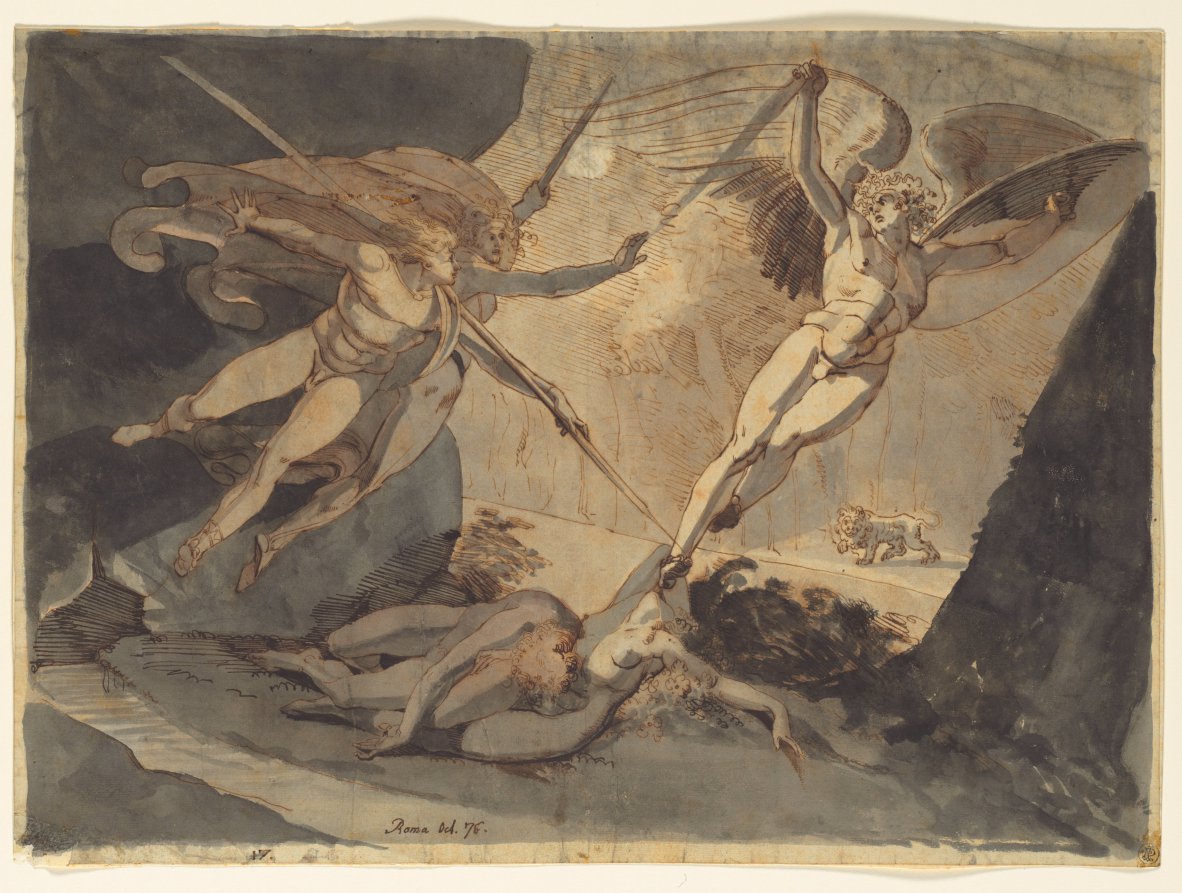
Henry Fuseli · The Cleveland Museum of Art · Dudley P. Allen Fund · CC0
- Birth Name
- Johann Heinrich Füssli
- Born
- 7 February 1741
- Birthplace
- Zürich, Switzerland
- Died
- 17 April 1825
- Place of death
- Putney Hill, London, England
- Movement
- Romanticism
- Nationality
- Switzerland · United Kingdom
- Occupation
- painter · poet · draftsperson · illustrator · graphic artist · architectural drafter · visual artist · artist
- Fields
- portrait painting · religious painting · history painting · portrait
- Movements
- Romanticism · fairy painting · Neoclassicism
- Known for
- Titania and Bottom · Percival Delivering Belisane from the Enchantment of Urma · The Nightmare
VALÉORINE Encyclopedia
VALÉORINE documentary reading
Documentary summary
Henry Fuseli (Johann Heinrich Füssli; 7 February 1741 – 17 April 1825) was a Swiss painter, draughtsman, and writer on art who spent much of his career in Britain. Many of his successful works depict supernatural experiences, such as The Nightmare. He produced painted works for John Boydell's Shakespeare Gallery and for his own "Milton Gallery".
Admitted source layer · organised and presented by VALÉORINE
Reference Check
Propose documentary evidence for Henry Fuseli. A contribution is never written directly as fact: identity, source, rights and evidence gates still decide.
Sign in to contribute
Documentary evidence
Documentary basis
Authority files
wikidata · Q122382 · wikipedia · Henry Fuseli
In this article
Biography
Biography
He held the posts of Professor of Painting and Keeper at the Royal Academy. His style had a considerable influence on many younger British artists, including William Blake (1757–1827).
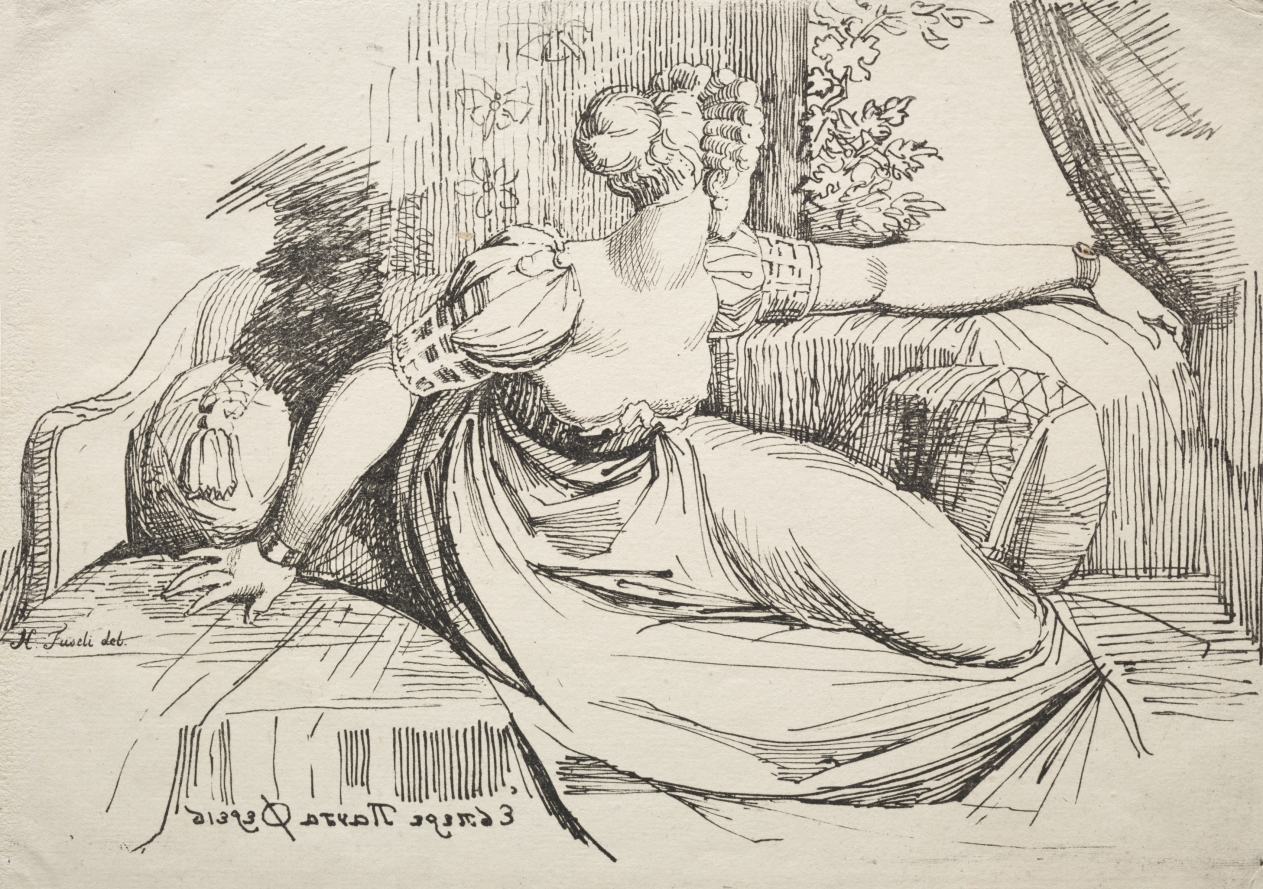
Evening Thou Bringest All, 1803, by Henry Fuseli
Henry Fuseli · The Cleveland Museum of Art · Mr. and Mrs. Lewis B. Williams Collection
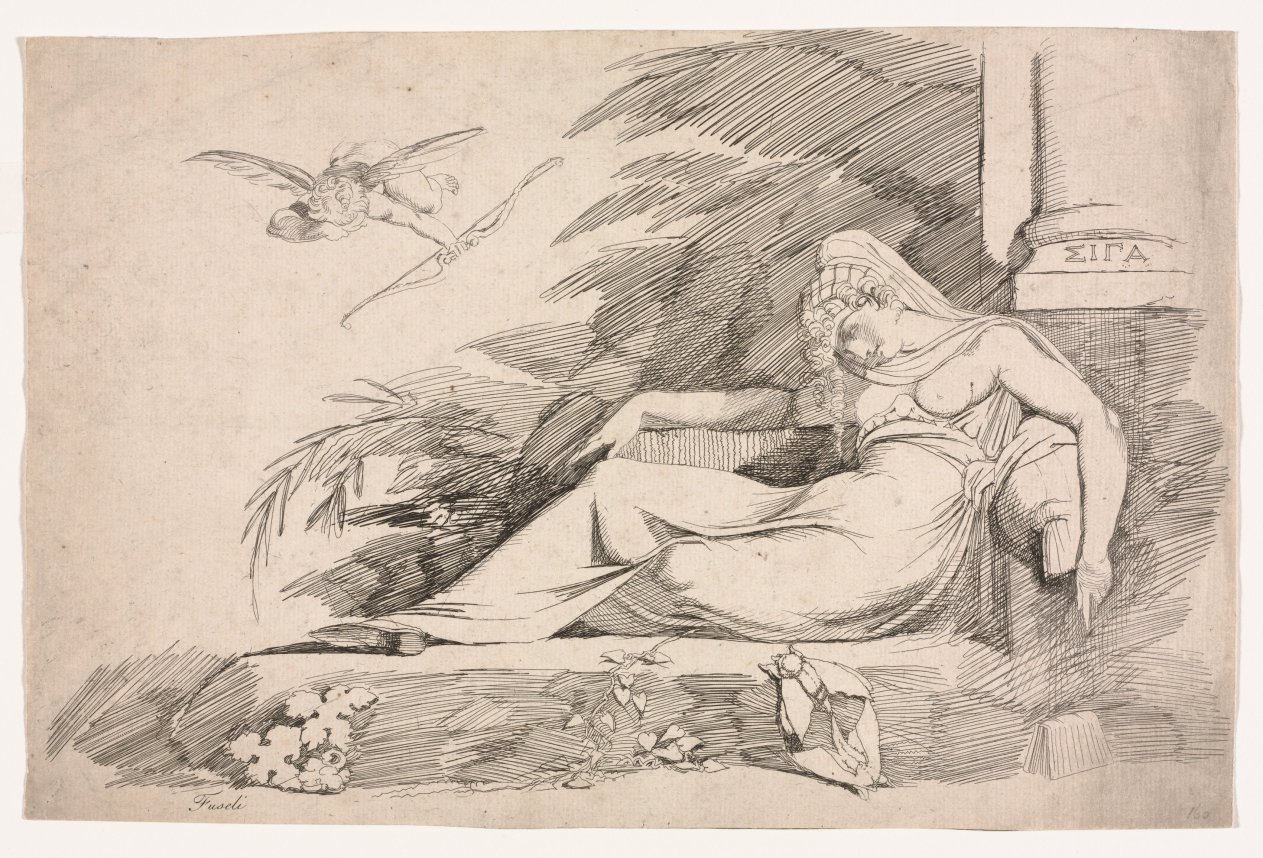
Sleeping Woman with a Cupid, 1780–1790, by Henry Fuseli
Henry Fuseli · The Cleveland Museum of Art · Severance and Greta Millikin Trust
Key facts
Key facts
• Honorific Suffix — RA • Birth Name — Johann Heinrich Füssli • Born — 7 February 1741 • Birthplace — Zürich, Switzerland • Died — 17 April 1825 • Place of death — Putney Hill, London, England • Movement — Romanticism • Notable Works — The Nightmare
Biography
Biography
• Illustration — Thor Battering the Midgard Serpent was Fuseli's diploma work for the Royal Academy, accepted 1790. Fuseli was born on 7 February 1741 in Zürich, the second of 18 children. Among his brothers and sisters were Johann Kaspar and Anna. His father was Johann Caspar Füssli, a painter of portraits and landscapes, and author of Lives of the Helvetic Painters. He intended Henry for the church, and sent him to the Caroline college of Zürich, where he received a classical education. One of his schoolmates there was Johann Kaspar Lavater, with whom he became close friends. After taking orders in 1761, Fuseli was forced to leave the country as a result of having helped Lavater to expose an unjust magistrate, whose powerful family sought revenge. He travelled through Germany, and then, in 1765, visited England, where he supported himself for some time by miscellaneous writing. Eventually, he became acquainted with Sir Joshua Reynolds, to whom he showed his drawings. Following Reynolds' advice, he decided to devote himself entirely to art. In 1770, he made an art pilgrimage to Italy, where he remained until 1778, changing his name from Füssli to the more Italian-sounding Fuseli. In Rome, he moved in the same circles as the Scottish artist Alexander Runciman and the Swedish sculptor Tobias Sergel. In early 1779, he returned to Britain, visiting Zürich on the way. In London, he found a commission awaiting him from Alderman John Boydell, who was then setting up his Shakespeare Gallery. Fuseli painted a number of pieces for Boydell, and supervised the first English edition of Lavater's work on physiognomy. He also gave William Cowper some valuable assistance in preparing a translation of Homer. In 1788, Fuseli married Sophia Rawlins (originally one of his models), and he soon after became an associate of the Royal Academy. The early feminist Mary Wollstonecraft, whose portrait he had painted, planned a trip with him to Paris, and pursued him determinedly, but communication between the two was stopped by Rawlins. Fuseli later said, "I hate clever women. They are only troublesome". In 1790, he became a full academician, presenting Thor Battering the Midgard Serpent as his diploma work. In 1799, Fuseli was appointed professor of painting to the Academy. Four years later, he was chosen as Keeper and resigned his professorship, but resumed it in 1810, continuing to hold both offices until his death. He was succeeded as keeper by Henry Thomson. In 1799, Fuseli exhibited a series of paintings from subjects furnished by the works of John Milton, with a view to forming a Milton gallery comparable to Boydell's Shakespeare gallery. There were 47 Milton paintings, many of them very large, completed at intervals over nine years. The exhibition proved a commercial failure and closed in 1800. In 1805, he brought out an edition of Matthew Pilkington's Lives of the Painters, which did little for his reputation. Antonio Canova, when on his visit to England, was much taken with Fuseli's works, and on returning to Rome in 1817, caused him to be elected a member of the first class in the Accademia di San Luca.
Works
Works
• Illustration — Head of Christ — etching and engraving by John Corner after a drawing by Henry Fuseli (1791), based on a work by Andrea del Verrocchio As a painter, Fuseli favoured the supernatural. He pitched everything on an ideal scale, believing a certain amount of exaggeration was necessary in the higher branches of historical painting. In this theory, he was confirmed by the study of Michelangelo's works and the marble statues of the Monte Cavallo, which, when at Rome, he liked to contemplate in the evening, relieved against a murky sky or illuminated by lightning. Describing his style, William Michael Rossetti in the 1911 Encyclopædia Britannica Eleventh Edition said that: His figures are full of life and earnestness, and seem to have an object in view which they follow with intensity. Like Rubens, he excelled in the art of setting his figures in motion. Though the lofty and terrible was his proper sphere, Fuseli had a fine perception of the ludicrous. The grotesque humour of his fairy scenes, especially those taken from A Midsummer-Night's Dream, is in its way not less remarkable than the poetic power of his more ambitious works. Though not noted as a colourist, Fuseli was described as a master of light and shadow. Rather than setting out his palette methodically in the manner of most painters, he merely distributed the colours across it randomly. He often used his pigments in the form of a dry powder, which he hastily combined on the end of his brush with oil, or turpentine, or gold size, regardless of the quantity, and depending on accident for the general effect. This recklessness may perhaps be explained by the fact that he did not paint in oil until the age of 25. • Illustration — The Nightmare (1781), Detroit Institute of Arts Fuseli painted more than 200 pictures, but he exhibited only a small number of them. His earliest painting represented Joseph Interpreting the Dreams of the Baker and Butler, but the first to excite particular attention was The Nightmare, exhibited in 1782, a painting of which he painted several versions. Themes seen in The Nightmare, such as horror, dark magic and sexuality, were echoed in his 1796 painting, Night-Hag visiting the Lapland Witches. His sketches or designs numbered about 800; they have admirable qualities of invention and design and are frequently superior to his paintings. In his drawings, as in his paintings, his methods included deliberately exaggerating the proportions of the human body and throwing his figures into contorted attitudes. One technique involved setting down arbitrary points on a sheet, which then became the extreme points of the various limbs. Notable examples of these drawings were made in concert with George Richmond when the two artists were together in Rome. He rarely drew figures from life, basing his art on study of the antique and Michelangelo. He produced no landscapes—"Damn Nature! she always puts me out" was his characteristic exclamation—and painted only two portraits. However, similar to contemporary landscape painters such as J. M. W. Turner, he evoked qualities of terror and the sublime. Many interesting anecdotes of Fuseli, and his relations to contemporary artists, are given in his Life by John Knowles (1831). He influenced the art of Fortunato Duranti.
Death
Death
After a life of uninterrupted good health, he died on 17 April 1825, at the house of the Countess of Guildford on Putney Hill, aged 84, and was buried in the crypt of St Paul's Cathedral. He was comparatively wealthy at the time of his death.
Gallery
Gallery
• Illustration — The Artist's Despair Before the Grandeur of Ancient Ruins, 1778–79 • Illustration — Anna Magdalena Schweizer, 1779 • Illustration — The artist in conversation with Johann Jakob Bodmer, 1778–1781 • Illustration — The death of Achilles, 1780 • Illustration — The two murderers of the Duke of Clarence, 1780–1782 • Illustration — Percival Delivering Belisane from the Enchantment of Urma, 1783 • Illustration — Titania and Bottom, c. 1790 • Illustration — Falstaff in the Laundry Basket, 1792 • Illustration — The Creation of Eve from Milton's Paradise Lost, 1793 • Illustration — Macbeth consulting the Vision of the Armed Head, 1793 • Illustration — The daughters of Pandareus, c. 1795 • Illustration — Odysseus in front of Scylla and Charybdis, 1794–1796 • Illustration — The Night-Hag visiting the Lapland Witches, 1796 • Illustration — Horseman attacked by a giant snake, c. 1800 • Illustration — Ariel, c. 1800–1810 • Illustration — Kriemhild and Gunther, 1807 • Illustration — Romeo stabs Paris at the bier of Juliet, c. 1809 • Illustration — Lady Macbeth Seizing the Daggers, 1810–1812 • Illustration — Puck, or Robin Goodfellow, c. 1810–1820 • Illustration — Fairy Mab, 1815–1820 • Illustration — Britomart Delivering Amoretta from the Enchantment of Busirane, 1824
Identity and origins
Identity and origins
The authorities additionally record the headings Johann Heinrich Füssli, R. Henry Fuseli, Jean-Henri Fuseli, Johann Heinrich Fuzelli and Esq. His recorded language was English. His recorded confession was Protestantism. He was the child of Johann Caspar Füssli. He married Sophia Fuseli.
Life and career
Dated record
Life and career
Explore 1741–1831
The full dated record · 3 entries
1741
Henry Fuseli was born in 1741.
1825
Henry Fuseli died at Putney.
1831
The Life and Writings of Henry Fuseli... (1831) is digitised and catalogued by Internet Archive.
Writings
Writings
• Illustration — Henry Fuseli (aged 83) by Edward Hodges Baily, 1824, National Gallery, London He was a thorough master of French, Italian, English and German, and could write in all these languages with equal facility and vigour, although he preferred German as the vehicle of his thoughts. His principal written work was his series of twelve lectures delivered to the Royal Academy, begun in 1801.
Books
Books
• Creator of Nightmares: Henry Fuseli's Art and Life by Christopher Baker, Reaktion Books, 2024
Films
• Passion and Obsession: Henry Fuseli, 1741–1825: painter and writer by Gaudenz Meili and David H. Weinglass, Zurich 1997
Influence
His pupils included David Wilkie, Benjamin Haydon, William Etty, and Edwin Landseer. William Blake was also inspired by him.
Primary material
Documents and archives
scholarly publication
- Fuseli, Henry [formerly Johann Heinrich Füssli] (1741–1825), painter and writer, Oxford Dictionary of National Biography, 2004
Scholarly · Crossref registry · 2004
- Fuseli, Henry, Benezit Dictionary of Artists, 2011
Scholarly · Crossref registry · 2011
Institutional database
- Wikidata, structured authority record Q122382: Henry Fuseli
Scholarly · Wikimedia Foundation
reference work
- “Henry Fuseli”, English Wikipedia, consulted as further reading
Reputable secondary · Wikipedia
Notes from the source article
Cited by Wikipedia
Notes from the source article
These works are cited by the source article, in its own numbering. They are recorded as its citations, not as sources VALÉORINE has verified.
- 1.Cite American Heritage Dictionary Fuseli access-date=14 August 2019
- 2.HarperCollins. Fuseli. Collins English Dictionary.
- 3.Oxford University Press. Fuseli, Henry.
- 4.Fuseli, Henry. 11. Rossetti. William Michael. William Michael Rossetti. 368.
- 5.Henry Fuseli at The National Gallery of Art
- 6.Macmillan, Duncan (2023), Scotland and the Origins of Modern Art, Lund Humphries, London, pp. 65–71,
- 7.Henry Fuseli at The National Gallery of Art
- 8.LAVATER, John Caspar. Essays on Physiognomy, designed to promote the Knowledge and Love of Mankind. Translated by Henry Hunter, D. D. Lond. 1789-98, royal 4to. In 41 nos. forming 5 vols. "A sumptuous Edition, executed by, and under the inspection of, Thomas Holloway. The translation and engravings were under the superintendence of the celebrated H. Fuseli, R.A., at whose solicitation Lavater furnished an entire fresh set of Drawings in quarto, to suite the prevailing taste of the public, it having been originally intended for folio size. The Engravings were executed by Thos. Holloway, Bartolozzi, Wm. Blake, and other eminent artists. […]" In: The bibliographer's manual of English literature by William Thomas Lowndes volume 5
- 9.Advertisement [by Henry Fuseli]. In: Essays on physiognomy; designed to promote the knowledge and the love of mankind. London: 1789-1798 (first edition). pp. [III-VIII]. Weblink: Wellcome Collection.
- 10.Myrone, Martin (2001) Henry Fuseli. London: Tate Gallery Publishing, p. 53.
- 11.battering the Midgard Serpent, 1790. Royal Academy of Arts Collections, 5 February 2014. Retrieved 5 February 2014. Archived here.
- 12.Papal Palace on Monte Cavallo, Rome. Retrieved 28 December 2011.
- 13.Leslie, C. R. Autobiographical Recollections. Ticknor & Fields. 1855.
- 14.The Night-Hag Visiting Lapland Witches. The Met.
- 15.Oxford University Press. Benezit Dictionary of Artists. 31 October 2011. 10.1093/benz/9780199773787.article.b00069309.
- 16.Keay, Carolyn (1974). Henry Fuseli. London: Academy Editions. p. 7.
- 17.Tomory, Peter A. (1972). The Life and Art of Henry Fuseli. New York: Praeger. p 211.
- 18.Schiff, Gert (1975). Henry Fuseli 1741–1825: [Essay Catalogue Entries and Biographical Outline]. London: Tate Gallery Publications. p. 14. .
- 19.British-history.ac.uk. Putney | Old and New London: Volume 6 (pp. 489–503). 22 June 2003.
- 20."Memorials of St Paul's Cathedral" Sinclair, W. p. 465: London; Chapman & Hall, Ltd; 1909.
Bibliography printed in the source article · 9
- Fuseli, Henry. 11. Rossetti. William Michael. William Michael Rossetti. 368.
- Calè, Luisa. Fuseli's Milton Gallery: 'Turning readers into spectators. Oxford: Clarendon Press, 2006.
- Hammelmann, Hans (1957). "Eighteenth-Century English Illustrators: Henry Fuseli, R.A.," The Book Collector 6 No.4 (winter): 350–363.
- Lentzsch, Franziska, et al. Fuseli: The Wild Swiss. Zürich: Scheidegger & Spiess, 2005.
- Myrone, Martin. Gothic Nightmares: Fuseli, Blake and the Romantic Imagination. London: Tate Publishing, 2006.
- Andrei Pop. Antiquity, Theatre, and the Painting of Henry Fuseli. Oxford: Oxford University Press, 2015.
- Powell, Nicolas. Fuseli: The Nightmare. London: Allen Lane, 1973.
- Pressly, Nancy L. The Fuseli Circle in Rome: Early Romantic Art of the 1770s. New Haven: Yale Center for British Art, 1979.
- Weinglass, David H. Henry Fuseli and the Engraver's Art. Boston: Worldwide Books, 1982.
References
Citations
References
Each reference names the institution holding it, so a reader may go to the document itself.
scholarly publication
Fuseli, Henry [formerly Johann Heinrich Füssli] (1741–1825), painter and writer, Oxford Dictionary of National Biography, 2004Crossref registry
Institutional witnessscholarly publication
Fuseli, Henry, Benezit Dictionary of Artists, 2011Crossref registry
Institutional witnessInstitutional database
Wikidata, structured authority record Q122382: Henry FuseliWikimedia Foundation
Institutional witnessreference work
Secondary witness
Further particulars
Held on the record
Further particulars
Open the remaining particulars
His work is associated with Romanticism, fairy painting and Neoclassicism. He belonged to Royal Academy of Arts. He worked at Germany, Great Britain, Italy, Rome and 37 Foley Street. Work and production. Works recorded as notable number 3: Titania and Bottom, Percival Delivering Belisane from the Enchantment of Urma and The Nightmare. His recorded genres are portrait, religious and history.
Career and activity
Recognition and collections
Work by Henry Fuseli is
Art Institute of Chicago, Auckland Art Gallery, J. Paul Getty Museum and Tate
The Encyclopedia exists whether or not anything is for sale. Corrections are recorded rather than overwritten, and every version of this record is kept. Published 14 August 2026.
Elsewhere in Illustration
5,224 published records in this field, each with its sources named.
- Henry C. PearsonIllustrator
- Henry CliveIllustrator
- Henry De la BecheIllustrator
- Henry DetmoldIllustrator
- Henry George HineIllustrator
- Henry H. NeffIllustrator
- Henry HintermeisterIllustrator
- Henry Hobart NicholsIllustrator
Best supported in this field
For owners
Own a work by Henry Fuseli?
A specialist will read what you send and tell you what the house can establish, what it cannot, and whether the object is suited to sale. There is no charge and no obligation. The object stays with you throughout; nothing is shipped to us unless it is arranged in writing beforehand.