
Henri Rivière
Illustration — Henri Rivière in late life. Henri Rivière (March 11, 1864 – August 24, 1951) was a French artist and designer best known for his creation of a form of shadow play at the Chat Noir cabaret, and for his post-Impressionist illustrations of Breton landscapes and the Eiffel Tower.
Also recorded as Benjamin Jean Pierre Henri Rivière · Henri Riviere · Henry Benjamin Jean Pierre Rivière · Henri Benjamin Jean Pierre Rivière
Henri Rivière
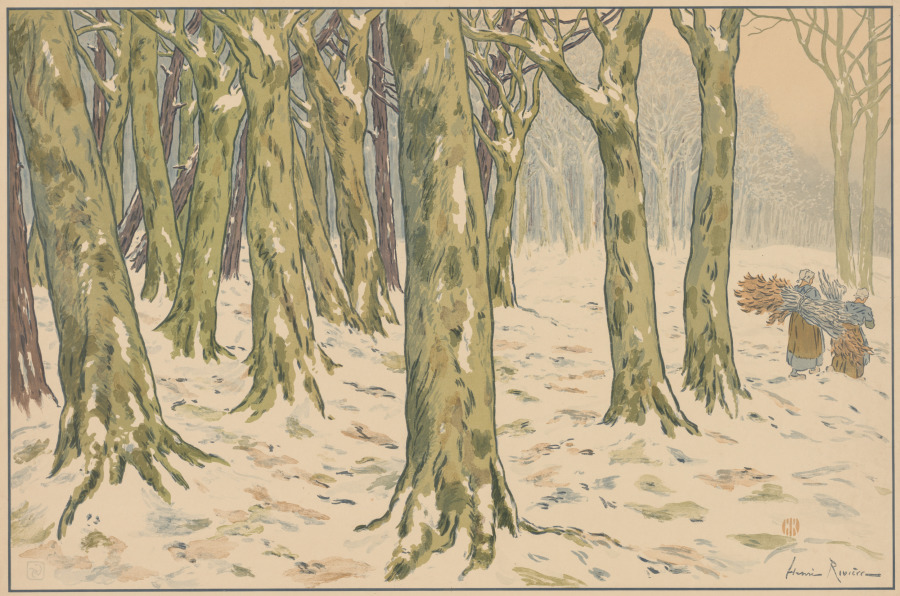
Henri Rivière · The Cleveland Museum of Art · Gift of John Bonebrake · CC0
- Born
- Henri Rivière was born, sources differ on the date (on 11 March 1864 and on 11 May 1864).
- Nationality
- France.
- Movements
- Pont-Aven School.
VALÉORINE Encyclopedia
VALÉORINE documentary reading
Documentary summary
Illustration — Henri Rivière in late life. Henri Rivière (March 11, 1864 – August 24, 1951) was a French artist and designer best known for his creation of a form of shadow play at the Chat Noir cabaret, and for his post-Impressionist illustrations of Breton landscapes and the Eiffel Tower.
Admitted source layer · organised and presented by VALÉORINE
Note VALÉORINE
Henri Rivière was a national of France. Henri Rivière died in 1951. The movement is Pont-Aven School.
Composed from admitted, traceable facts · 27 September 2026
VALÉORINE
Reference Check
Propose documentary evidence for Henri Rivière. A contribution is never written directly as fact: identity, source, rights and evidence gates still decide.
Sign in to contribute
Documentary evidence
Evidence Panel
not yet certified
- Identity
- resolved
- Independent source families
- 0
- Admitted assertions
- 0
- Open conflicts
- 0
Authority files
wikidata · Q2731112
In this article
Early life and education
Early life and education
Rivière was born in Paris. His father, Prosper Rivière, was an embroidery merchant from the Pyrénées. His mother, Henriette Thérese Leroux Rivière, was a Parisienne "from a petit bourgeois family". Rivière had one brother, Jules, born 1866. In 1870, fleeing from the advancing Prussians during the Franco-Prussian War, his father moved the family back to Ax-les-Thermes, his childhood home in the Pyrenees. Rivière's time spent in the rural environment helped develop his love of nature, later a strong theme in his art. After the war finished in 1871, Rivière returned to Paris with his parents, while his brother remained in Ax to finish his studies. Rivière was enrolled in a boarding-school outside Paris. Rivière's father died in 1873, and his mother was forced to move to a cheaper apartment and send Rivière to a local day school. There, he became friends with Paul Signac, with whom he would later study art. • Illustration — Long Fresnay, 1925 Rivière's mother remarried, and as circumstances improved, Rivière went to a new school and excelled in reading and painting, reading Victor Hugo, Jules Verne and showing an early interest in art, especially Impressionism. • Illustration — Le Vent, chromolithograph from The Magic Hours (1901-1902) After working for one week at an ostrich-feather importation business, a job his mother had arranged for him, he left work and went to paint at the Butte Montmartre, a habit he had developed. His mother, frustrated with Rivière, complained to his step-father, who spoke to his friend and art teacher, Emile Bin. Bin, after seeing Rivière's work, offered to teach him and Rivière began his formal training at Bin's studio.
Chat Noir and development of work
Chat Noir and development of work
From 1880, he was contributing illustrations to magazines and journals. Rivière was introduced to the cabarets in Montmartre by Paul Signac, especially the popular Chat Noir (Black Cat) café. From 1882, Rivière worked as part of the editorial team on the weekly Chat Noir journal, which published light verse, short stories and illustrations. Rivière edited and contributed art and reviews to the journal until 1885. In 1888, Riviére met Eugenie Estelle Ley, who he would spend the rest of his life with. That year Sigfried Bing began publishing the journal Le Japon Artistique, which inspired Riviére to begin collecting Japanese art and teaching himself to make woodblock prints in the Japanese method. Riviére made his own cutting tools, mixed his own inks and did the printing himself.
Shadow plays
Shadow plays
• Illustration — L'album du Chat Noir, 1882 In 1886 Rivière created a form of shadow theatre at the Chat Noir under the name "ombres chinoises". This was a notable success, lasting for a decade until the cafe closed in 1897. He used back-lit zinc cut-out figures which appeared as silhouettes. Rivière was soon joined by Caran d'Ache and other artists, initially performing d'Ache's drama L’Epopee. From 1886 to 1896, Rivière created 43 shadow plays on a great variety of subjects from myth, history and the Bible. He collaborated with many different artists and writers, but made the illustrations for only 9 of the productions himself. He concentrated on improving the technical aspects of the production using enamelling and lighting to create extremely delicate effects of light and colour. The Ombres evolved into numerous theatrical productions and had a major influence on phantasmagoria. According to historians Phillip Cate and Mary Shaw, Rivière's work involved both aesthetic and technical innovations, Essentially, Rivière created a system in which he placed silhouettes of figures, animals, elements of landscapes, and so forth, within a wooden framework at three distances from the screen: the closest created an absolutely black silhouette, and the next two created gradations of black to gray, thus suggesting recession into space. Silhouettes could be moved across the screen on runners within the frame. Along with d'Ache's L’Epopee, Rivière's own works Le Temptation de Saint Antoine (1887) and La Marche a L'etoile (1890), were the most successful and popular. Rivière's shadow theatre was the cabaret's greatest attraction and "played a crucial role in establishing the credibility of the cabaret with that other tier of the avant-garde, the Impressionists/Post Impressionists: Edgar Degas, Camille Pissarro, Claude Monet, Mary Cassatt, and others."
Life and career
Dated record
Life and career
The full dated record · 2 entries
1864
Henri Rivière born at 2nd arrondissement of Paris.
1951
Henri Rivière died at Sucy-en-Brie.
Prints
• Illustration — Plate One of the 36 Views of the Eiffel Tower Between 1882 and 1886 Rivière created a large number of etchings. He also showed an interest in photography, making a series of picturesque scenes of everyday life. He later experimented with colour woodcuts and chromolithography in the late 1880s. Rivière first visited Brittany in 1884, spending most of his summers there until 1916. Together with bustling Parisian life, rural Brittany constituted the majority of the subjects of his landscape works. Rivière’s prints were generally intended to be published as collections. These include forty images used in Breton Landscapes, created between 1890 and 1894. He also made colour woodcuts for The Sea: Studies of Waves, and prepared other sequences that remained unfinished, including 36 Views of the Eiffel Tower, which were eventually published as lithographs. These were influenced by the vogue for Japonisme at the time, modernising the famous prints by Hiroshige and Hokusai of 36 Views of Mount Fuji. His colour lithographic series' include: • The Aspects of Nature (1897 to 1899), 16 images • The Beautiful Land of Brittany (1897 to 1917), 20 images • Parisian Landscapes (1900), 8 images • The Magic Hours (1901 to 1902), 16 images • Thirty-Six Views of the Eiffel Tower (1902), 36 images • The Noirot Wind (1906), 4 images Rivière ceased making prints in 1917, effectively retiring as a professional artist, but continued to work on watercolours in his later years. He died on August 24, 1951.
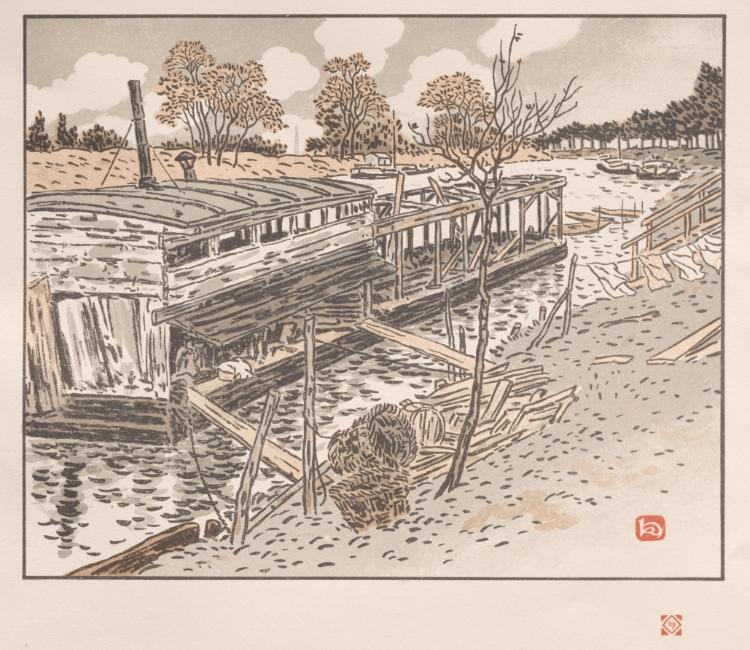
From Bas-Meudon, Old Lavoir, 1902, by Henri Rivière
Henri Rivière · The Cleveland Museum of Art · Gift of John Bonebrake
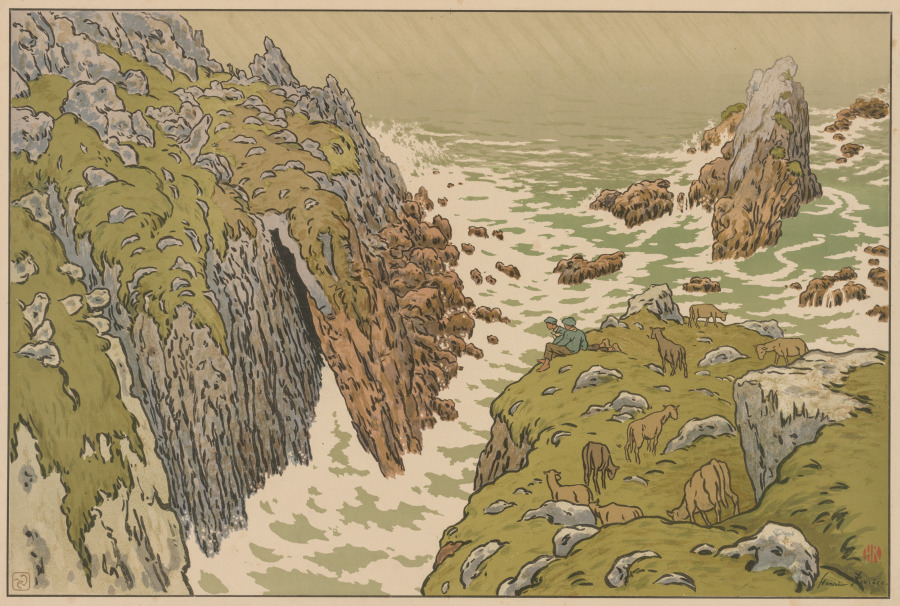
Aspects of Nature: The Cliff, 1897, by Henri Rivière
Henri Rivière · The Cleveland Museum of Art · Gift of John Bonebrake
Notes from the source article
Cited by Wikipedia
Notes from the source article
These works are cited by the source article, in its own numbering. They are recorded as its citations, not as sources VALÉORINE has verified.
- 1.Catalogue, Henri Rivière: The Thirty-Six Views of the Eiffel Tower (1888-1902), Watermarks Gallery, Pittsboro, NC, 1995.
- 2.Fields, Armond. Henri Rivière. G.M. Smith/Peregrine Smith Books. 3. 1983. 978-0-87905-133-4.
- 3.Fields, Armond. Henri Rivière. G.M. Smith/Peregrine Smith Books. 6. 1983. 978-0-87905-133-4.
- 4.Phillip Dennis Cate and Mary Shaw (eds), The Spirit of Montmartre: Cabarets, Humor and the Avant-Garde, 1875-1905, Rutgers University Press, 1996, pp.55-58 excerpted on line as Henri Riviere: Le Chat noir and 'Shadow Theatre' .
- 5.Catalogue, Henri Rivière: Graveur et photographe, Musee d'Orsay, 1988
References
Citations
References
Each reference names the institution holding it, so a reader may go to the document itself.
Institutional database
Wikidata, structured authority record Q2731112: Henri RivièreWikimedia Foundation
Verified
The Encyclopedia exists whether or not anything is for sale. Corrections are recorded rather than overwritten, and every version of this record is kept. Published 14 August 2026.
Elsewhere in Prints
4,138 published records in this field, each with its sources named.
- Henri Le SecqEngraver
- Henri LebasqueEngraver
- Henri MatisseEngraver
- Henri MeunierEngraver
- Henri RousseauEngraver
- Henri ThiriatEngraver
- Henri van der HaertEngraver
- Henri van RaalteEngraver
Best supported in this field
For owners
Own a work by Henri Rivière?
A specialist will read what you send and tell you what the house can establish, what it cannot, and whether the object is suited to sale. There is no charge and no obligation. The object stays with you throughout; nothing is shipped to us unless it is arranged in writing beforehand.