
Heinrich Vogeler
Johann Heinrich Vogeler (German pronunciation: [ˈjoːhan ˈhaɪnʁɪç ˈfoːɡəlɐ]; December 12, 1872 – June 14, 1942) was a German painter, designer, and architect, associated with the Düsseldorf school of painting.
Also recorded as Heinrich Vogeler-Worpswede · Johann Heinrich Vogeler · Genrikh Fogeler · Heinrich Vogeler- Worpswede
Heinrich Vogeler
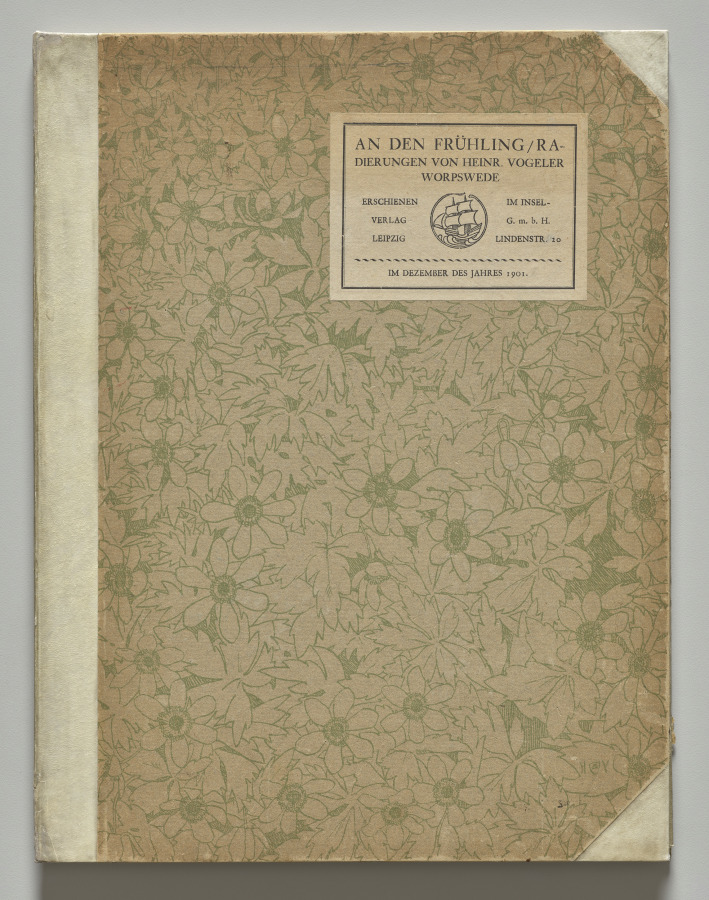
Heinrich Vogeler · The Cleveland Museum of Art · Prints & Drawings Sundry Art Purchase · CC0
- Born
- 1872.
- Died
- 1942.
- Nationality
- Soviet Union and German Reich.
- Occupation
- painter, architect, writer, illustrator, printmaker, graphic artist, designer and teacher.
- Fields
- graphics and watercolor.
- Movements
- Symbolism.
VALÉORINE Encyclopedia
VALÉORINE documentary reading
Documentary summary
Johann Heinrich Vogeler (German pronunciation: [ˈjoːhan ˈhaɪnʁɪç ˈfoːɡəlɐ]; December 12, 1872 – June 14, 1942) was a German painter, designer, and architect, associated with the Düsseldorf school of painting.
Admitted source layer · organised and presented by VALÉORINE
Note VALÉORINE
Heinrich Vogeler (1872–1942) was an architect, designer and graphic artist, among other activities and a national of German Reich and the Soviet Union.
The architect worked in Barkenhoff and Worpswede. Heinrich Vogeler was associated with Symbolism. Genres include graphics and watercolor.
Composed from admitted, traceable facts · 27 September 2026
VALÉORINE
Reference Check
Propose documentary evidence for Heinrich Vogeler. A contribution is never written directly as fact: identity, source, rights and evidence gates still decide.
Sign in to contribute
Documentary evidence
Evidence Panel
not yet certified
- Identity
- resolved
- Independent source families
- 0
- Admitted assertions
- 0
- Open conflicts
- 0
Authority files
gnd · 1361178442 · wikidata · Q213734 · wikipedia · Heinrich Vogeler
In this article
Early life
Early life
He was born in Bremen, and studied at the Kunstakademie Düsseldorf from 1890–1895. His artistic studies during this period included visits to Belgium and Italy. Vogeler was a central member of the original artist colony in Worpswede, which he joined in 1894. In 1895 Vogeler bought a cottage there and planted many birch trees around it, which gave the house its new name: Barkenhoff (Low German for Birkenhof, or "birch tree cottage"). In 1901, he married Martha Schröder. He made book illustrations in an Art Nouveau style, and executed decorative paintings for the town hall of Bremen shortly before traveling to Ceylon in 1906. During a trip to Łódź, he studied Maxim Gorky's works, which resulted in the development of a deep sympathy for the working class. This feeling reached further heights when he saw life in the slums of Glasgow and Manchester during a trip. In 1908 he and his brother Franz founded the 'Worpsweder Werkstätte', which produced household objects. His paintings increasingly reflected his sympathy for the working class.
During the First World War
During the First World War
He volunteered for military service in World War I in 1914, and he was sent to the eastern front in 1915. Vogeler learned of the Bolsheviks ideology during his time at the front as well as through his trips to Poland, Romania, Dobrudscha and Russia. After he made a written appeal for peace to the German Emperor, he was briefly sent to a mental hospital in Bremen before being discharged from military service.
Political activism
Political activism
After the war he became a pacifist. During the German Revolution of 1918–19, he joined the workers' and soldiers' council of the Bremen Soviet Republic, together with his friend Curt Stoermer. He joined the Communist Party of Germany (KPD), but when it split, he joined the Communist Workers' Party of Germany (KAPD). He was close to Franz Pfemfert, who published Die Aktion. After the end of the Revolution, he was arrested for some time. It was at that time that he and his wife Martha were divorced. From that point on, he wanted to work ideologically, and the romanticism of his earlier work gave way to proletarian content. In 1931 Vogeler and his second wife Zofia "Sonja" Marchlewska, daughter of Julian Marchlewski, emigrated to Russia. After the German invasion of the Soviet Union he along with other German citizens was deported in 1941 to Kazakhstan by the Soviet authorities, and died there in 1942. KPD leader Wilhelm Pieck apparently had wanted to prevent his deportation, but Vogeler himself refused privileged treatment. As his wife Zofia and son Jan were Polish citizens they were drafted instead of being deported with him. Jan soon became a founding member of the National Committee for a Free Germany and after a long post-war academic career in Moscow died in his father's Worpswede in 2005. Zofia emigrated to Poland and died in Warsaw in 1983. Meanwhile, the Barkenhoff became a children's home. It was recently restored and has re-opened as a Heinrich Vogeler Museum in 2004. Late works from Heinrich Vogeler's oeuvre appear to have some Egyptian influences, particularly in images such as Der Aufbau der zentralasiatischen Sowjetrepubliken (1927). The influence remains in Worpswede amongst particular sculptures, and market performances.
Life and career
Dated record
Life and career
The full dated record · 2 entries
1872
Heinrich Vogeler was born in 1872.
1942
Heinrich Vogeler died at Bukhar-Zhyrau District.
Primary material
Documents and archives
Institutional database
- Wikidata, structured authority record Q213734: Heinrich Vogeler
Scholarly · Wikimedia Foundation
authority file
- Gemeinsame Normdatei 1361178442, Heinrich Vogeler.
Unverified · Deutsche Nationalbibliothek
reference work
- “Heinrich Vogeler”, English Wikipedia, consulted as further reading
Reputable secondary · Wikipedia
Notes from the source article
Cited by Wikipedia
Notes from the source article
These works are cited by the source article, in its own numbering. They are recorded as its citations, not as sources VALÉORINE has verified.
References
Citations
References
Each reference names the institution holding it, so a reader may go to the document itself.
Institutional database
Wikidata, structured authority record Q213734: Heinrich VogelerWikimedia Foundation
Verifiedauthority file
Gemeinsame Normdatei 1361178442, Heinrich Vogeler.Deutsche Nationalbibliothek
Partially resolvedreference work
Partially resolved
A further 1 witness is held back from this article because the person or object named in it is not yet resolved to this record. They are kept, not discarded, and return once the identity is established.
The Encyclopedia exists whether or not anything is for sale. Corrections are recorded rather than overwritten, and every version of this record is kept. Published 14 August 2026.
Elsewhere in Prints
4,138 published records in this field, each with its sources named.
- Hector GiacomelliEngraver
- Hedwig JarkeEngraver
- Heinrich Jacob AldenrathEngraver
- Heinrich NauenEngraver
- Heinrich VogtherrEngraver
- Helen DahmEngraver
- Helen Flora Victoria ScalesEngraver
- Helen ForbesEngraver
Best supported in this field
For owners
Own a work by Heinrich Vogeler?
A specialist will read what you send and tell you what the house can establish, what it cannot, and whether the object is suited to sale. There is no charge and no obligation. The object stays with you throughout; nothing is shipped to us unless it is arranged in writing beforehand.