
Harvey Postlethwaite
Harvey Ernest Postlethwaite (4 March 1944 – 15 April 1999) was a British engineer and Technical Director of several Formula One teams during the 1970s, 1980s and 1990s. He died of a heart attack in Spain while supervising the testing of the aborted Honda F1 project.
Also recorded as Harvey Ernest Postlethwaite
Harvey Postlethwaite

Ericd · I (en:User:Ericd) took this picture myself in Monaco (1979 Grand Prix) with a Minolta XD-7 and a 100-300 Tamron zoom on Ektachrome 200. The picture has been scanned from film. · CC BY-SA 3.0
- Born
- 1944.
- Died
- 1999.
- Nationality
- United Kingdom.
- Occupation
- engineer and designer.
VALÉORINE Encyclopedia
VALÉORINE documentary reading
Documentary summary
Harvey Ernest Postlethwaite (4 March 1944 – 15 April 1999) was a British engineer and Technical Director of several Formula One teams during the 1970s, 1980s and 1990s. He died of a heart attack in Spain while supervising the testing of the aborted Honda F1 project.
Admitted source layer · organised and presented by VALÉORINE
Reference Check
Propose documentary evidence for Harvey Postlethwaite. A contribution is never written directly as fact: identity, source, rights and evidence gates still decide.
Sign in to contribute
Documentary evidence
Documentary basis
Authority files
wikidata · Q173558 · wikipedia · Harvey Postlethwaite
In this article
Early career
Early career
After leaving the Royal Masonic School for Boys, Harvey Postlethwaite attended the University of Birmingham, England to study mechanical engineering and graduated, with a BSc and then a doctorate, during the 1960s. He was a keen follower of motor sport, competing in a Mallock at club level for a while. After graduation Postlethwaite joined ICI as a research scientist, but bored by this he soon began to pursue a career as a race car engineer, joining March in 1970, then aged just 26. Postlethwaite worked on the fledgling company's Formula 2 and Formula 3 cars but was lured away to join the Hesketh Formula One team who were a March customer. The Hesketh team was well known for an unconventional approach to Formula One—Postlethwaite was himself considered 'eccentric': "The Doc's explanation of his move to Hesketh was that 'They got me drunk'."
Formula One
Formula One
Working to modify and improve the novice team's March 731 chassis, Postlethwaite elevated the team into serious contention and the following year designed the team's car from scratch. 'Doc' Postlethwaite's 1974 Hesketh 308 secured a number of podium positions. The following year he further developed the car's unusual rubber spring suspension and saw his creation take victory at the Dutch Grand Prix in the hands of James Hunt. By 1976 Lord Hesketh could no longer afford to run the team and sold out. Postlethwaite went with his cars to the newly founded Wolf–Williams Racing, headed by Walter Wolf and Frank Williams, but the results were poor and the owners soon went their separate ways. Postlethwaite remained with Wolf, designing the team's 1977 challenger, the WR1. Success was immediate with Jody Scheckter taking victory at the season's opening race. Two more wins and a number of podium results followed and Scheckter eventually finished second in the Drivers' Championship. Although Postlethwaite remained with the team until 1979 they were never to repeat their 1977 success. When Walter Wolf closed the team down at the end of 1979 he transferred, along with the Wolf cars and driver Keke Rosberg to the Fittipaldi Automotive team. He produced a new design, the F8, for the latter half of 1980 but left to join Ferrari in early 1981. At the time the Italian team were considered amongst the best engine and gearbox builders in the sport, but amongst the worst chassis designers. Postlethwaite was selected personally by Enzo Ferrari to rectify this problem and by the following year everything was in place for success. The 1982 126C2 Ferrari took the Constructors' title despite several serious setbacks, including the practice crash at Zolder which claimed the life of Gilles Villeneuve. Despite the loss of their inspirational Canadian driver, Postlethwaite's updated design, the 126C2B, took the Constructors' title again in 1983. Postlethwaite remained with Ferrari until 1987. After 1983 his cars took several more wins, but were unable to compete with McLaren and Williams for title victory. He was eventually replaced by John Barnard and moved to Tyrrell, where he worked for four years. During his tenure as technical director Tyrrell's results improved noticeably, culminating in the 1990 season opener in Phoenix, where Jean Alesi was able to challenge Ayrton Senna's McLaren for victory and finished second in a Tyrrell 018. Alesi repeated the feat in Postlethwaite's novel 019 – the first of the 'high nose' Formula One cars – at Monaco. At the car's launch Postlethwaite proved the structural integrity of its unusual front 'gull wing' by standing on it. While at Tyrrell Postlethwaite employed Mike Gascoyne, who became his assistant and protégé. In 1991, Postlethwaite was signed as technical director of the Sauber team who planned to enter Formula One in 1993. Taking Gascoyne with him, Postlethwaite relocated to Switzerland and designed the team's first car. Despite leaving Sauber before the start of 1993, the designer's car went on to considerable success in the hands of JJ Lehto and Karl Wendlinger regularly scoring points. Postlethwaite moved back to Tyrrell in 1994 where he remained until 1998 when the team was sold to become British American Racing. Although by the late 1980s and 1990s Tyrrell was a small, and largely uncompetitive team, the designer remained well respected within the sport and was hired as technical director of the abortive in-house Honda F1 project in 1999. Although Honda had not committed to race in Formula One the project produced an evaluation car, designed by Postlethwaite and built by Dallara, and it was during testing of this car at Barcelona in Spain that he suffered a fatal heart attack. The project was subsequently discontinued, although Honda began supplying engines again from the 2000 season onwards, eventually taking over the BAR team for 2006.
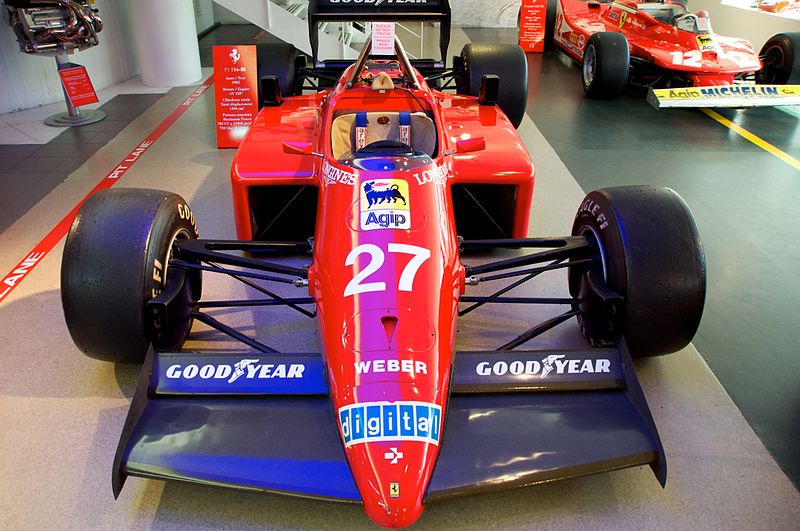
Ferrari 156-85 in the Galleria Ferrari (later: "Museo Ferrari") on September 28, 2010. It was built as a gift for Enzo Ferrari’s 87th birthday as he had said that what he really wanted was a completely new single-seater. The car’s name hinted at a plethora of new features as the 1 and 5 referred to its 1500 cc capacity and the 6 to its number of cylinders. Alboreto was first across the line in it
Jitesh Jagadish from Dubai, United Arab Emirates · Ferrari F1 156-85 Uploaded by Sporti

Didier Pironi drove for Ferrari in the 1981 and 1982 seasons. In 1981 the car was the 126CK and in 1982 it was substantially revised by Dr. Harvey Postlethwaite resulting in the 126C2. It was a skirted, ground effect chassis, and the first full monococque Ferrari built for F1. The original CK was mechanically adequate but suffered from poor aerodynamics and an underdeveloped engine. But the combin
Bill Abbott · 1/43 Ferrari 126C #28 Dieter Peroni 1.5l turbo V6 DSC_0884
Notes from the source article
Cited by Wikipedia
Notes from the source article
These works are cited by the source article, in its own numbering. They are recorded as its citations, not as sources VALÉORINE has verified.
References
Citations
References
Each reference names the institution holding it, so a reader may go to the document itself.
reference work
Secondary witnessreference work
Secondary witness
The Encyclopedia exists whether or not anything is for sale. Corrections are recorded rather than overwritten, and every version of this record is kept. Published 14 August 2026.
Elsewhere in Modern design
3,254 published records in this field, each with its sources named.
- Harry Melville PopeDesigner
- Hartmut EsslingerDesigner
- Harumi Klossowska de RolaDesigner
- Harvey LittletonDesigner
- Harvey PrattDesigner
- Hassan BastaniDesigner
- Hattie BartholomayDesigner
- Hazel SalmiDesigner
Best supported in this field
For owners
Own a work by Harvey Postlethwaite?
A specialist will read what you send and tell you what the house can establish, what it cannot, and whether the object is suited to sale. There is no charge and no obligation. The object stays with you throughout; nothing is shipped to us unless it is arranged in writing beforehand.