
Harold Gilman
Harold John Wilde Gilman (11 February 187612 February 1919) was a British painter of interiors, portraits and landscapes, and a founder-member of the Camden Town Group.
Also recorded as Harold John Wilde Gilman · Harold J. W. Gilman · Gilman
Harold Gilman
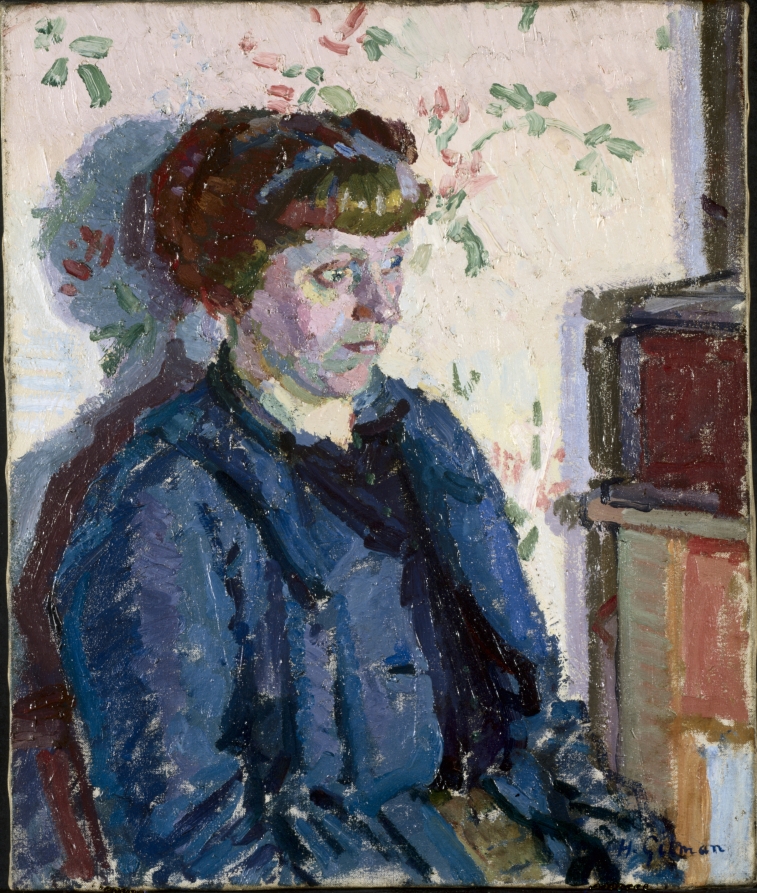
Harold Gilman · The Cleveland Museum of Art · Mr. and Mrs. William H. Marlatt Fund · CC0
- Name
- Harold John Wilde Gilman
- Born
- 11 February 1876
- Birthplace
- Rode, Somerset, England
- Died
- 12 February 1919
- Place of death
- London, England
- Occupation
- Painter
- Nationality
- United Kingdom of Great Britain and Ireland
- Education
- Brasenose College · Slade School of Fine Art · Abingdon School
- Languages
- English
VALÉORINE Encyclopedia
VALÉORINE documentary reading
Documentary summary
Harold John Wilde Gilman (11 February 187612 February 1919) was a British painter of interiors, portraits and landscapes, and a founder-member of the Camden Town Group.
Admitted source layer · organised and presented by VALÉORINE
Note VALÉORINE
No house-authored Note is published until its assertions and sources pass the VALÉORINE evidence contract. The documentary article remains available in full while that enrichment is being consolidated.
Documentary enrichment in progress · no unsupported statement published
Reference Check
Propose documentary evidence for Harold Gilman. A contribution is never written directly as fact: identity, source, rights and evidence gates still decide.
Sign in to contribute
World of VALÉORINE
Documentary connections
Only confirmed graph relationships appear here. Images are shown only when their identity and reuse rights both pass the documentary gate.

Documentary evidence
Evidence Panel
not yet certified
- Identity
- resolved
- Independent source families
- 0
- Admitted assertions
- 0
- Open conflicts
- 0
Authority files
wikidata · Q176368 · wikipedia · Harold Gilman
In this article
Biography
Biography
Harold Gilman studied at Brasenose College, Slade School of Fine Art and Abingdon School. The recorded working language is English. Work by Harold Gilman is recorded in the collections of Auckland Art Gallery, Tate, National Gallery of Victoria, National Gallery of Canada and Victoria and Albert Museum.
Key facts
Key facts
• Name — Harold John Wilde Gilman • Born — 11 February 1876 • Birthplace — Rode, Somerset, England • Died — 12 February 1919 • Place of death — London, England • Occupation — Painter
Early life and studies
Early life and studies
Harold John Wilde Gilman was the second son and one of the seven children of Emily Purcell Gulliver and John Gilman, curate of Rode, Somerset. Though born in Rode, Gilman spent his early years at Snargate Rectory, in the Romney Marshes in Kent, where his father was the Rector. He was educated in Kent, Abingdon School in Berkshire, from 1885 to 1890, in Rochester and at Tonbridge School, and for one year at Brasenose College in Oxford University. Although he developed an interest in art during a childhood convalescence period, Gilman did not begin his artistic training until after his year at Oxford University (cut short by ill health) and after working in Ukraine as a tutor to a British family in Odessa (1895). In 1896 he entered the Hastings School of Art to study painting, but in 1897 transferred to the Slade School of Fine Art in London, where he remained from 1897 to 1901, and where he met Spencer Gore. In 1902 he went to Spain and spent over a year studying Spanish masters. Velázquez and Goya as well as Whistler were major early influences. • Illustration — Gilman's portrait of his first wife, Grace Canedy • Illustration — Mrs Mounter at the Breakfast Table, 1917 • Illustration — Detail of Mrs Mounter at the Breakfast Table, 1917 – showing closeness of actual tones
Marriages
Marriages
At this time Gilman met the American painter Grace Cornelia Canedy; they had both been copying Velázquez in the Museo del Prado in Madrid. They married on 7 February 1903 in the garden of the United States consulate in Toledo, Spain. The couple settled in London (apart from a visit to her family in Chicago, when Gilman ducked pressure to join the Canedy family business). They had five children, of whom three survived, Elizabeth (born 19 January 1904, in London), Hannah (born 4 February 1905, in Chicago), and David Canedy (born 20 September 1908, at Letchworth Garden City in Hertfordshire). The family address at this time was 15 Westholm Green, Letchworth. Grace Gilman left him in 1909, taking her three children to Chicago. The couple were later divorced. Harold Gilman was married, for the second time, to (Dorothy) Sylvia Hardy (formerly Meyer), an artist he had met at Westminster and who had studied with him since 1914. She had their child in December 1917 and they married on 20 April 1918, on learning that Gilman's divorce had been finalised. After Gilman's death, in 1921 Sylvia married Leofric Gilman, his brother.
Painting career
Painting career
Meeting Walter Sickert in 1907, Gilman became a founder member of both the Fitzroy Street Group (in 1907) and the Camden Town Group (in 1911). In the meantime he joined the Allied Artists' Association, moved to Letchworth, and began to show influence from work of Vuillard as well as Sickert. • Illustration — Harold Gilman painted by Walter Sickert, 1912. In 1910 he was stimulated by the first post-Impressionist exhibition at the Grafton Galleries, and visited Paris with Ginner. He soon outpaced Sickert's understanding of post-Impressionism and moved out from under his shadow, using ever stronger colour, under the influence of Van Gogh, Gauguin and Signac. In 1913 he exhibited jointly with Gore, and became the first president of the London Group, and identified with Charles Ginner as a 'Neo-Realist', exhibiting with Ginner under that label in 1914. Gilman visited Scandinavia in 1912 and 1913, and may have travelled with the artist William Ratcliffe, whose relations lived there. Gilman made studies of the environment, and painted Canal Bridge, Flekkefjord, an accurate depiction, whose subject is likely to have been inspired by Van Gogh's depiction of a similar bridge in Provence. Gilman had rejected Van Gogh's work when he first encountered it, but later became a strong admirer. According to Wyndham Lewis, he kept postcards of Van Gogh's work on his wall and sometimes hung one of his own works next to them, if he was especially satisfied with it. In 1914 he joined Robert Bevan's short-lived Cumberland Market Group, with Charles Ginner and (later) John Nash. In 1915 the group held their only exhibition. From 1914 to 1917, he had lodgings at 47 Maple Street, where he painted many works, including his landlady, Mrs Mounter at the Breakfast Table. He taught at the Westminster School of Art, where he influenced students such as Mary Godwin, Ruth Doggett, and Marjorie Sherlock. He then started his own school with Ginner. • Illustration — Canal Bridge, Flekkefjord, c. 1913 In 1918 he was commissioned to travel to Nova Scotia by the Canadian War Records; and painted a picture of Halifax Harbour for the War Memorial at Ottawa. He died in London on 12 February 1919, of the Spanish flu.
Gallery
Gallery
• Illustration — The Thames at Chelsea, 1899–1901 • Illustration — Clarissa, c. 1911 • Illustration — Sylvia Gosse, c. 1913 • Illustration — An Eating House, 1913/14 • Illustration — A Portrait in Profile: Mary L. Harold Gilman, 1914 • Illustration — Girl with a Tea Cup, c. 1914 • Illustration — Miss Ruth Doggett, c. 1915 • Illustration — Mother and Child, 1918
Life and career
Dated record
Life and career
The full dated record · 2 entries
1876
Harold Gilman born at Somerset.
1919
Harold Gilman died at London.
Places
Named by the record
Places
Only places the record itself states, plotted where the house gazetteer settles their coordinates. Nothing is inferred from a name or a nationality.
Somerset.
Birth place
London.
Death place
Legacy
Exhibitions were devoted to him at the Tate in 1954 and 1981, and he also featured in its 2007–2008 Camden Town Group retrospective at Tate Britain. David Bowie purchased Gilman's A London Interior for his private art collection; the piece was sold at auction after Bowie died in 2016.
Primary material
Documents and archives
scholarly publication
- Gilman, Harold John Wilde (1876–1919), painter, Oxford Dictionary of National Biography, 2004
Scholarly · Crossref registry · 2004
- Gilman, Harold, Benezit Dictionary of Artists, 2011
Scholarly · Crossref registry · 2011
reference work
- Wikidata, structured authority record Q176368: Harold Gilman
Reputable secondary · Wikimedia Foundation
- “Harold Gilman”, English Wikipedia, consulted as further reading
Reputable secondary · Wikipedia
References
Citations
References
Each reference names the institution holding it, so a reader may go to the document itself.
scholarly publication
Gilman, Harold John Wilde (1876–1919), painter, Oxford Dictionary of National Biography, 2004Crossref registry
Verifiedscholarly publication
Gilman, Harold, Benezit Dictionary of Artists, 2011Crossref registry
Verifiedreference work
Wikidata, structured authority record Q176368: Harold GilmanWikimedia Foundation
Partially resolvedreference work
Partially resolved
Further particulars
Held on the record
Further particulars
Open the remaining particulars
He also worked under the name Gilman, Harold John Wilde. The authorities additionally record the headings Harold John Wilde Gilman, Harold J. Gilman and Gilman. His recorded language was English. Recorded as painter and artist.
Identity and origins
The Encyclopedia exists whether or not anything is for sale. Corrections are recorded rather than overwritten, and every version of this record is kept. Published 14 August 2026.
Elsewhere in Paintings
18,717 published records in this field, each with its sources named.
- Harold CohenArtist
- Harold Dow BugbeeArtist
- Harold F. WestonArtist
- Harold FreedmanArtist
- Harold GresleyArtist
- Harold HarveyArtist
- Harold Heartt FoleyArtist
- Harold KnightArtist
Best supported in this field
For owners
Own a work by Harold Gilman?
A specialist will read what you send and tell you what the house can establish, what it cannot, and whether the object is suited to sale. There is no charge and no obligation. The object stays with you throughout; nothing is shipped to us unless it is arranged in writing beforehand.