
Hans Wechtlin
Illustration — Wechtlin's woodcut Knight and Halberdier, reproduced in black-and-white. 26.8 x 18 cm. Johann, Johannes or Hans Wechtlin was a German Renaissance artist, active between at least 1502 and 1526, whose woodcuts are his only certainly surviving work.
Also recorded as Master of the crossed pilgrim's staves, · Hans Wächtlin · Hans Waechtlin · Hans Vuechtlin
Hans Wechtlin
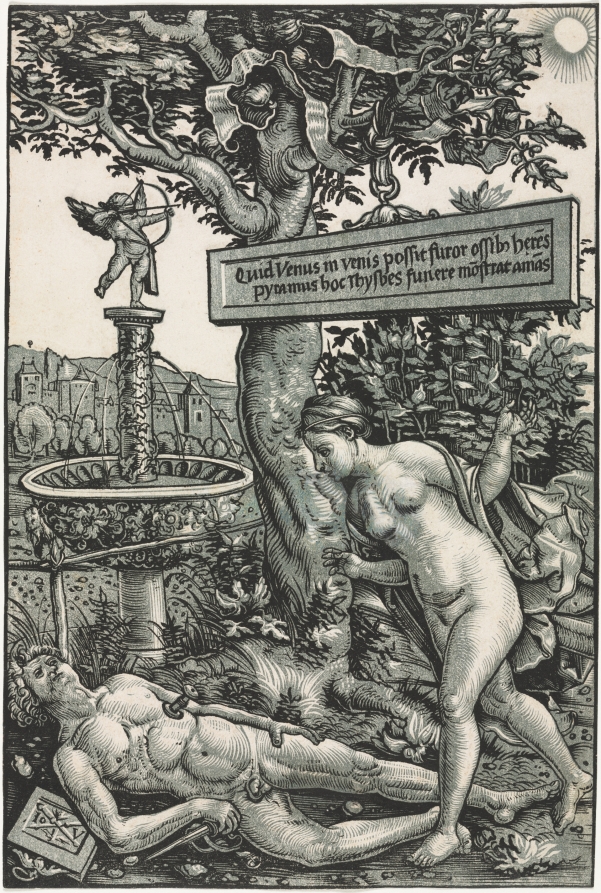
Hans Wechtlin · The Cleveland Museum of Art · John L. Severance Fund · CC0
- Born
- 1480 · Strasbourg.
- Died
- 1526 · Strasbourg.
- Nationality
- Germany
- Occupation
- painter · printmaker · scientific illustrator · draftsperson · xylographer
- Languages
- German
VALÉORINE Encyclopedia
VALÉORINE documentary reading
Documentary summary
Illustration — Wechtlin's woodcut Knight and Halberdier, reproduced in black-and-white. 26.8 x 18 cm. Johann, Johannes or Hans Wechtlin was a German Renaissance artist, active between at least 1502 and 1526, whose woodcuts are his only certainly surviving work.
Admitted source layer · organised and presented by VALÉORINE
Reference Check
Propose documentary evidence for Hans Wechtlin. A contribution is never written directly as fact: identity, source, rights and evidence gates still decide.
Sign in to contribute
World of VALÉORINE
Documentary connections
Only confirmed graph relationships appear here. Images are shown only when their identity and reuse rights both pass the documentary gate.
Documentary evidence
Documentary basis
Authority files
wikidata · Q1698584 · wikipedia · Hans Wechtlin
In this article
Life
Life
He was the most prolific producer of German chiaroscuro woodcuts, printed in two or more colours, during their period in fashion, though most of his output was of book illustrations.
The recorded working language is German. Places of work recorded in the authority are Strasbourg. Work by Hans Wechtlin is recorded in the collections of Art Institute of Chicago, Cleveland Museum of Art, Print Collection and Bibliothèque nationale de France.
He was born in about 1480-85, presumably in Strasbourg, then in Germany and now in France, where his father, also called Hans Wechtlin, was a cloth merchant. Most of his identified works are woodcut book illustrations, the first, scenes from the Life of Christ, are from a Strasbourg book of 1502, and the last is a Strasbourg title-page of 1526. In 1505 he began a year of employment as a painter to René II, Duke of Lorraine in Nancy. After he left Nancy he was in Wittenberg in 1506-7, where he must have met the court painter, Lucas Cranach the Elder. He became a citizen of Strasbourg in 1514, and by 1519 was a master of the painter's guild there.
Single woodcuts
Single woodcuts
He left nineteen single-leaf wood-cuts (i.e. prints rather than book illustrations), apparently made in the period 1505-15, and is mainly remembered for his twelve chiaroscuro woodcuts, which are all extremely rare. The dating of these has been much discussed by art-historians, as part of the very tangled issue of the development of the German chiaroscuro woodcut. Bartrum assigns them "towards the end" of the 16th century. No surviving paintings are attributed to him, although a few drawings have been, tentatively. As with most artists in woodcut, art historians now consider that Wechtlin probably just designed the woodcuts, leaving the block-cutting to a specialist "formschneider" who pasted the design to the wood and chiselled the white areas away. The quality of the final woodcuts, which varies considerably, depended on the skill of the cutter as well as the artist. • Illustration — An illustration for Feldtbuch der Wundartzney (1517, 1st edn.), a manual for the military surgeon His best known print is the chiaroscuro Skull Within an Ornamental Frame, "by far his most impressive" and "one of the most powerful [images] of the German Renaissance", which is the only one for which there is evidence of dating, as it is copied in a book of 1512. Four of his chiaroscuro prints are somewhat ostentatiously classical, two on the very obscure subjects of Alcon Slaying the Serpent and Pyrgoteles (a famous Ancient Greek gem-carver), as well the better known ones of Pyramus and Thisbe and Orpheus. They show Italianate influence, especially from the engravings of Marcantonio Raimondi, from whom the figures of Pyramus and Thisbe are directly borrowed. His woodcut technique is based on that of Albrecht Dürer, though his wooded backgrounds owe more to Cranach. His Knight and Halberdier (illustrated above) is in the chivalrous spirit influenced by Emperor Maximilian and his calls for a crusade; indeed the style of armour the knight wears is often called "Maximilian armour". Other early chiaroscuro woodcuts were equestrian portraits of similar knightly figures, a portrait of Maximilian by Hans Burgkmair, and versions of Saint George and the Dragon looking very similar to the Emperor, by both Cranach and Burgkmair. Wechtlin's twelve prints were the largest individual contribution to the corpus of about sixty German chiaroscuro woodcuts from the early 16th century - the technique was probably invented by Burgkmair in 1508. Unlike Burgkmair's often frankly garish colours, Wechtlin's colour woodcuts use only two blocks and muted colours. In both the Cleveland and Cincinnati impressions of the Knight and Halberdier there are black line blocks and a "greyish-blue" tone block; other tone blocks are described as "blue-grey" (Orpheus and the Skull) and "grey-green" (Pyramus and Thisbe). • Illustration — Another illustration to the Feldtbuch der Wundartzney His monogram, used only on eleven of his chiaroscuro prints, consists in its fullest form of his initials "Io V" between two diagonally crossed pilgrim's staves, with a flower in the centre, on a cartellino or plaque, a style copied from Albrecht Dürer. His prints, recognised as a group, remained unattributed to any documented artist until 1851, when his name on the title page of a book he illustrated was connected with the monogram and the few documentary records. A similar monogram was used by the glass-painter Jacob Wechtlin, perhaps a brother.
Identity
Identity
Hans Wechtlin is recorded with the occupation draftsperson. Recorded as painter, printmaker, scientific illustrator, draftsperson and xylographer.
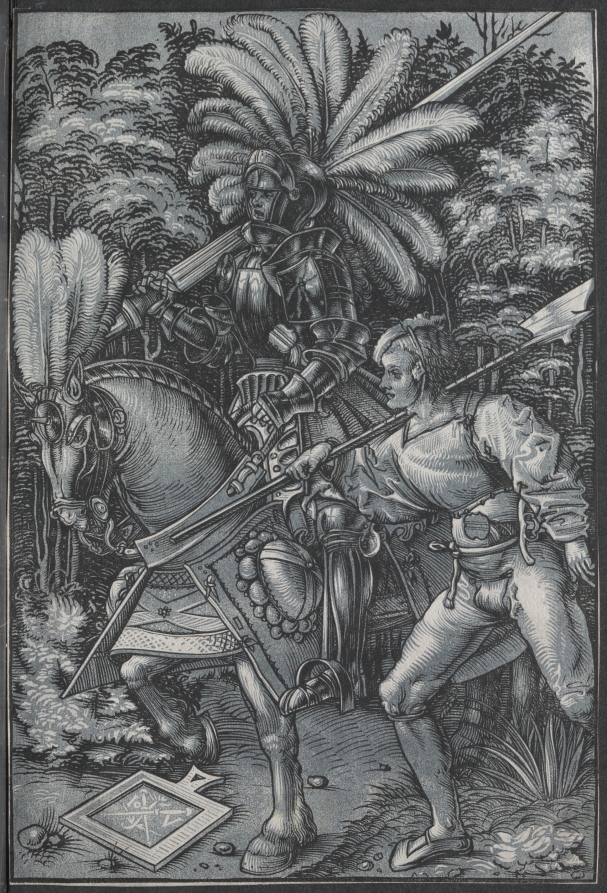
The Knight and Lansquenet, c. 1512, by Hans Wechtlin
Hans Wechtlin · The Cleveland Museum of Art · John L. Severance Fund
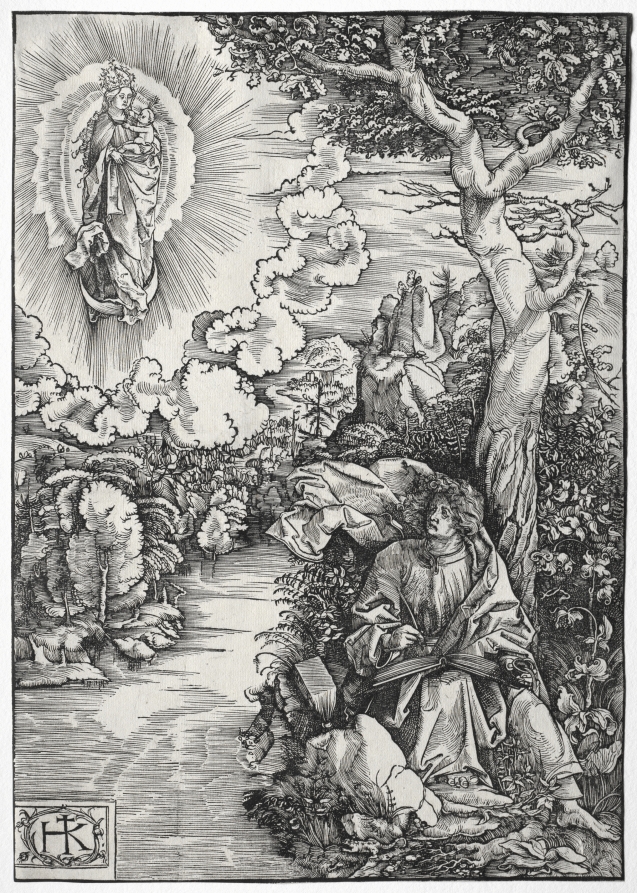
St. John on the Island of Patmos, by Hans Wechtlin
Hans Wechtlin · The Cleveland Museum of Art · John L. Severance Fund
Life and career
Dated record
Life and career
The full dated record · 2 entries
1480
Hans Wechtlin was born on 1 January 1480.
1526
Hans Wechtlin died on 1 January 1526.
Book illustrations
His best known book illustrations in his own time were 135 woodcuts from Sebastian Brant's 1502 edition of Virgil's Aeneid, "perhaps the most influential book illustrations ever produced in Europe", though the attribution to him is not universally agreed. This was the first printed Virgil with illustrations. These crowded compositions retain many Gothic features, compared for example with Botticelli's rather earlier painted illustrations to Dante. They were copied in many other book editions and about thirty years later in a famous series of Limoges enamel plaques by the "Master of the Aeneid Series", one of many such derivative works. Better-known today are the often rather gruesome woodcuts for Hans von Gersdorff's (1455–1529) Feldtbuch der Wundartzney (literally "Field-book of the Wound-medicine", 1517, 1st edn.), a manual for the military surgeon (see Commons). These have sometimes been coloured by hand, but are printed in black and white. His frontispiece for the 1526 edition, produced when he was probably in his forties, is the last known trace of him. He is not to be confused with Hans Weiditz, another Strasbourg woodcut artist of the period.
Primary material
Documents and archives
authority record
- Wikidata, structured authority record Q1698584: Hans Wechtlin
General reference · Wikidata
reference work
- “Hans Wechtlin”, English Wikipedia, consulted as further reading
Reputable secondary · Wikipedia
Notes from the source article
Cited by Wikipedia
Notes from the source article
These works are cited by the source article, in its own numbering. They are recorded as its citations, not as sources VALÉORINE has verified.
- 1.Coloured version from Cleveland Museum of Art.
- 2.Variant contemporary spellings are Veuchtelin, Wächtlin, or Wechtle
- 3.Bartrum, 67
- 4.Bartrum, 67. Skull Within an Ornamental Frame British Museum, with image.
- 5.Cleveland impression
- 6.Bartrum, 66-67
- 7.Peters, 69
- 8.Peters, 69. Illustrated in Landau & Parshall, 186-189, also Bartrum & Peters.
- 9.Peters, 69. See: David Landau & Peter Parshall, The Renaissance Print, Yale, 1996, , for a full discussion of the origin of the technique.
- 10.Peters, 69, and see link at illustration note for a colour image of Cleveland
- 11.One, St John on the Island of Patmos (see External links), was added by Campbell Dodgson in 1903 JSTOR, Burlington Magazine
- 12.Bartrum, 65. He was known by the invented name "Johann Ulrich Pilgrim" until this point.
- 13.Bartrum, 65
- 14.Erika Langmuir Imagining Childhood: Themes in the Imagery of Childhood, pp. 72-3, Yale University Press, 2006, , including one page illustrated. Another woodcut of "Fame" is shown here , and further pages here, here and here
- 15.See section 16 with example
- 16.Examples, with commentary, from the Fitzwilliam Museum and the Metropolitan Museum
- 17.copy at Columbia University Library
References
Citations
References
Each reference names the institution holding it, so a reader may go to the document itself.
authority record
Secondary witnessreference work
Secondary witness
Further particulars
Held on the record
Further particulars
Open the remaining particulars
The authorities additionally record the headings Master of the crossed pilgrim's staves, Hans Wächtlin, Hans Waechtlin and Hans Vuechtlin. His recorded language was German.
Identity and origins
Recognition and collections
Work by Hans Wechtlin is
Art Institute of Chicago, Cleveland Museum of Art, Print Collection and Bibliothèque nationale de France
The Encyclopedia exists whether or not anything is for sale. Corrections are recorded rather than overwritten, and every version of this record is kept. Published 17 August 2026.
Elsewhere in Prints
4,138 published records in this field, each with its sources named.
- Hans Sebald LautensackEngraver
- Hans SpringinkleeEngraver
- Hans ThomaEngraver
- Hans Vredeman de VriesEngraver
- Hanuš SchwaigerEngraver
- HAP GrieshaberEngraver
- Harald ConradsenEngraver
- Harden Sidney MelvilleEngraver
Best supported in this field
For owners
Own a work by Hans Wechtlin?
A specialist will read what you send and tell you what the house can establish, what it cannot, and whether the object is suited to sale. There is no charge and no obligation. The object stays with you throughout; nothing is shipped to us unless it is arranged in writing beforehand.