
Hans Sebald Lautensack
Illustration — View of Steyr, etching by Hanns Lautensack (1554) Hanns Lautensack (sometimes erroneously referred to as Hans Sebald Lautensack) (1524 – c. 1560) was a German etcher and draughtsman. He was one of two sons of Paul Lautensack, a painter of Bamberg, where he was born in 1524.
Also recorded as Hanns Sebald Lautensack · Hanns Lautensack
Hans Sebald Lautensack

Hans Sebald Lautensack · Bildarchiv Austria · Public domain
- Born
- 1524 · Bamberg.
- Nationality
- Germany
- Occupation
- painter · printmaker
- Languages
- German
VALÉORINE Encyclopedia
VALÉORINE documentary reading
Documentary summary
Illustration — View of Steyr, etching by Hanns Lautensack (1554) Hanns Lautensack (sometimes erroneously referred to as Hans Sebald Lautensack) (1524 – c. 1560) was a German etcher and draughtsman. He was one of two sons of Paul Lautensack, a painter of Bamberg, where he was born in 1524.
Admitted source layer · organised and presented by VALÉORINE
Note VALÉORINE
Hans Sebald Lautensack (1524–1565) was a painter and printmaker, of German nationality. The painter was born in Bamberg and died in Vienna.
Languages used include German. Works are held at Finnish National Gallery, Museum Boijmans Van Beuningen and National Gallery of Victoria, among others.
Composed from admitted, traceable facts · 26 September 2026
VALÉORINE
Reference Check
Propose documentary evidence for Hans Sebald Lautensack. A contribution is never written directly as fact: identity, source, rights and evidence gates still decide.
Sign in to contribute
World of VALÉORINE
Documentary connections
Only confirmed graph relationships appear here. Images are shown only when their identity and reuse rights both pass the documentary gate.
Documentary evidence
Documentary basis
Authority files
wikidata · Q1392217 · wikipedia · Hanns Lautensack
In this article
Biography
Biography
When still a child his parents settled in Nuremberg, and there he lived during the greater portion of his life. In 1556 he was working in Vienna. He may have been summoned to Vienna by the Emperor, Ferdinand I, to make pictures of his collection of coins from antiquity. He died in Vienna sometime between 1564 and 1566. His etchings are generally marked with a monogram composed of the letters H. His brother Heinrich was a goldsmith. Lautensack is known primarily for his etchings. Stylistically, these can be divided into two periods, one from the time when he was working in Nuremberg and the other comprising his Vienna years. The Nuremberg etchings include several portraits of burghers of the city portrayed by a window opening on to a distant landscape. In his treatment of the subject matter, Lautensack here displays influences from the Little Masters and the Danube school; as for individual artistic links, Barthel Beham, Sebald Beham, Georg Pencz, Albrecht Altdorfer and Wolfgang Huber can be mentioned. In Vienna, Lautensack received more prestigious commissions, making portraits for the aristocracy and similar commissions. He contributed to several illustrated books. His style of portraits became more mannered, similar to that of the School of Fontainebleau, while his landscapes drew more inspiration from Netherlandish printmaking, notably Hieronymus Cock. In his characterisation of Lautensack, Michael Bryan notes that his landscapes are etched in a dark, forbidding style; and also opines that some portraits, etched and finished with the graver, possess considerable merit. Arthur Mayger Hind points to similarities with the etchings made by Augustin Hirschvogel and Albrecht Altdorfer, but notes that "the usual charm of this school of landscape is in Lautensack somewhat marred by the overcrowding of detail, and in the attempt at working more in a painter's manner the value of line is lost."
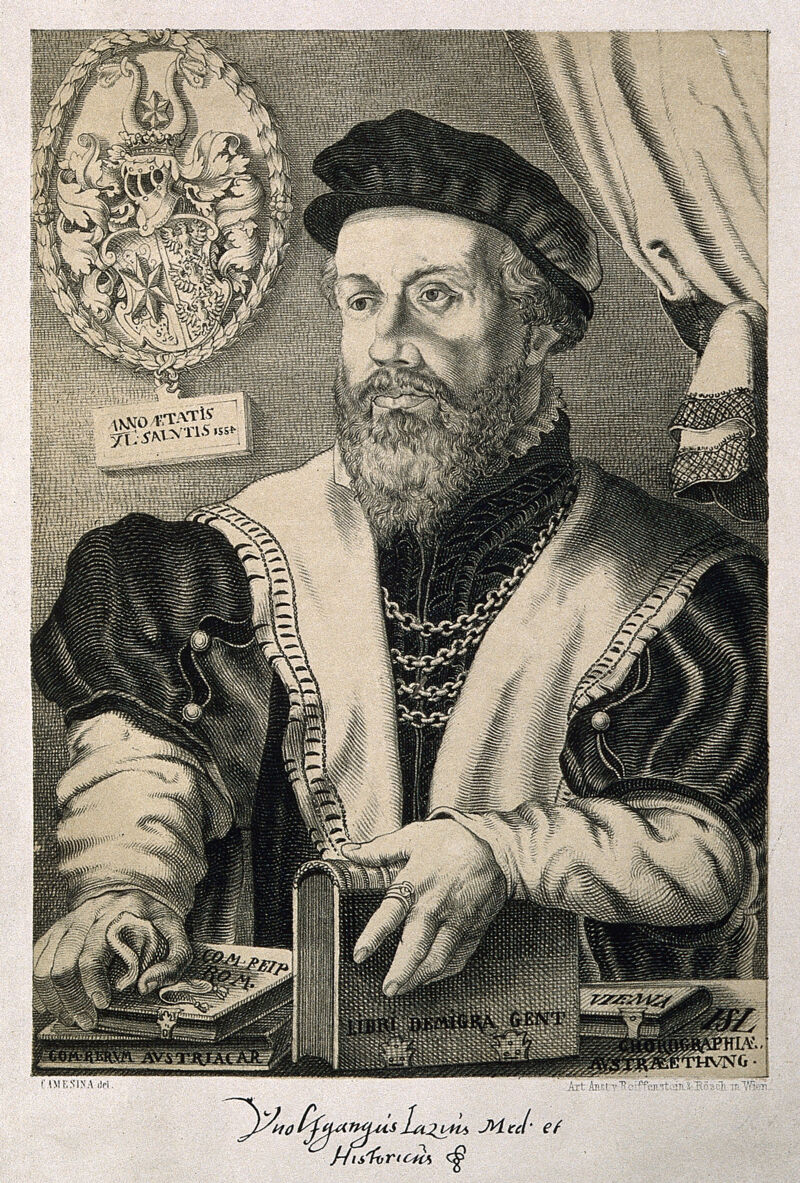
Wolfgang Lazius. Lithograph by A. Camesina after H. S. Lautensack, 1558., 1800-1899, by Hans Sebald Lautensack
Hans Sebald Lautensack · Wellcome Collection, London · Wellcome Collection
Life and career
Dated record
Life and career
The full dated record · 2 entries
1524
Hans Sebald Lautensack born at Bamberg.
1565
Hans Sebald Lautensack died at Vienna.
Places
Named by the record
Places
Only places the record itself states, plotted where the house gazetteer settles their coordinates. Nothing is inferred from a name or a nationality.
Bamberg.
Birth place
Vienna.
Death place
Literature
Scholarly footprint
A count of publications is evidence of attention, not of standing, and is given here only as a measure.
Notes from the source article
Cited by Wikipedia
Notes from the source article
These works are cited by the source article, in its own numbering. They are recorded as its citations, not as sources VALÉORINE has verified.
- 1.Oxford University Press. The Grove Encyclopedia of Northern Renaissance Art. 2. 442–443. 2009. 9780195334661.
- 2.Hind, Arthur M. A History of Engraving & Etching From the 15th Century to the Year 1914. Dover Publications. 108. 1963. 9780486209548.
References
Citations
References
Each reference names the institution holding it, so a reader may go to the document itself.
reference work
Wikidata, structured authority record Q1392217: Hans Sebald LautensackWikimedia Foundation
Secondary witness
People, houses and institutions
Knowledge graph
People, houses and institutions
Teachers, collaborators, publishers and institutions recorded against this person, each on a stated basis.
Born at
1- BambergPlace
Established from a fact already recorded on a verified source.
The Encyclopedia exists whether or not anything is for sale. Corrections are recorded rather than overwritten, and every version of this record is kept. Published 16 August 2026.
Elsewhere in Prints
4,138 published records in this field, each with its sources named.
- Hans GlaserEngraver
- Hans Holbein the YoungerEngraver
- Hans Leonhard SchäufeleinEngraver
- Hans QvistEngraver
- Hans SpringinkleeEngraver
- Hans ThomaEngraver
- Hans Vredeman de VriesEngraver
- Hans WechtlinEngraver
Best supported in this field
For owners
Own a work by Hans Sebald Lautensack?
A specialist will read what you send and tell you what the house can establish, what it cannot, and whether the object is suited to sale. There is no charge and no obligation. The object stays with you throughout; nothing is shipped to us unless it is arranged in writing beforehand.