
Hanabusa Itchō
Illustration — "The Falling Thunder God" by Hanabusa Itchō • Illustration — "Blind monks examining an elephant", an ukiyo-e print by Hanabusa Itchō Hanabusa 1652 – February 7, 1724 was a Japanese painter born in Osaka, calligrapher, and haiku poet. He originally trained in the Kanō style, under Kanō Yasunobu, but ultimately rejected that style and became a literati (bunjin). He was also known as Hishikawa Waō and by a number of other art-names.
Also recorded as Chokō · Ushimaro · Taga Shinkō · Hokusōō
Hanabusa Itchō
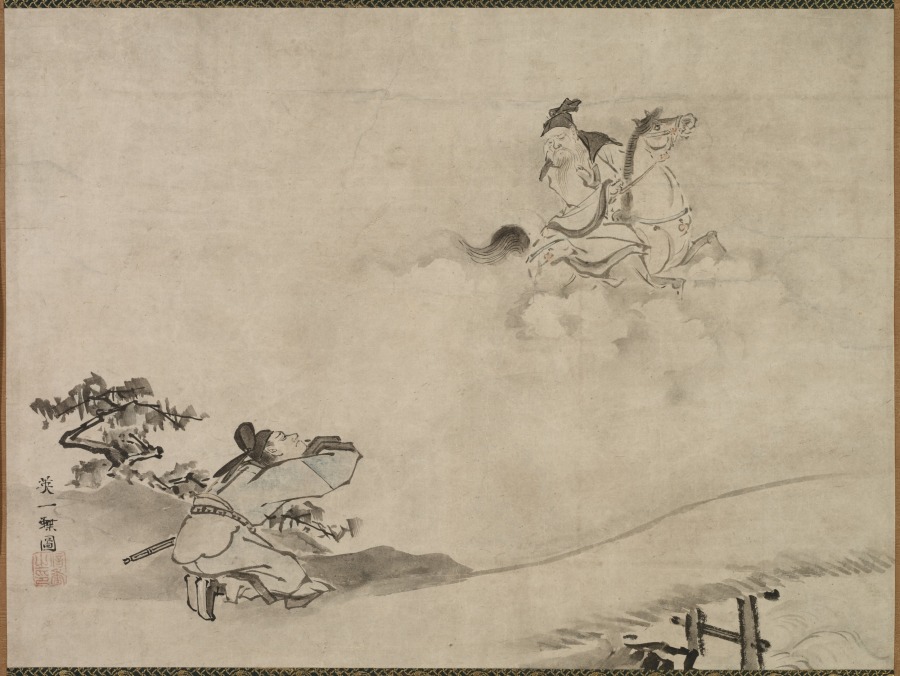
Hanabusa Itchō · The Cleveland Museum of Art · Gift of Leighton R. and Rosemarie Longhi · CC0
- Born
- 1652 · Osaka.
- Died
- 1724
- Nationality
- Japan
- Occupation
- painter · taikomochi · artist · poet
- Fields
- visual arts · calligraphy · haiku
- Teachers
- Kanō Yasunobu
- Languages
- Japanese
Reference Check
Propose documentary evidence for Hanabusa Itchō. A contribution is never written directly as fact: identity, source, rights and evidence gates still decide.
Sign in to contribute
Documentary evidence
Documentary basis
Authority files
getty · 500121207 · gnd · 143129864 · wikidata · Q3109209 · wikipedia · Hanabusa Itchō
In this article
Biography
Biography
Training under Kanō Yasunobu is recorded. Sawaki Sūshi, Hanabusa Ippō and Hanabusa Isshū are recorded as having studied under Hanabusa Itchō. The recorded working language is Japanese. The field of work recorded is visual arts, calligraphy and haiku. Work by Hanabusa Itchō is recorded in the collections of Minneapolis Institute of Art, Metropolitan Museum of Art, Yale University Art Gallery, Cleveland Museum of Art and Detroit Institute of Arts.
The son of a physician, he was originally named Taga Shinkō. He studied Kanō painting, but soon abandoned the school and his master to form his own style, which would come to be known as the Hanabusa school. He was exiled in 1698, for parodying one of the shōgun's concubines in painting, to the island of Miyake-jima; he would not return until 1710. That year, in Edo, the artist would formally take the name Hanabusa Itchō. Most of his paintings depicted typical urban life in Edo, and were approached from the perspective of a literati painter. His style, in-between the Kanō and ukiyo-e, is said to have been "more poetic and less formalistic than the Kanō school, and typical of the "bourgeois" spirit of the Genroku period". Hanabusa was the master of the later painter Sawaki Suushi. His humorous caricature paintings, depicting parodic scenes drawn from noh, kabuki and Japanese mythology, later influenced the comic print albums produced by the ukiyo-e artist Okumura Masanobu. His school was continued by his successor Hanabusa Ikkei; the gō "Gototei", later used by Utagawa Kunisada, was itself formed by combining the art names of Hanabusa Itchō and Ikkei, with whom Kunisada had studied a new painting style around 1824–1825. Hanabusa studied poetry under the master Matsuo Bashō, and is said to have been an excellent calligrapher as well. His friends included the poets Matsuo Bashō and Enomoto Kikaku. His work is held in several institutions worldwide, including the Museum of Fine Arts Boston, the Philadelphia Museum of Art, the Los Angeles County Museum of Art, the Smithsonian Libraries, the Israel Museum, the Suntory Museum of Art, the Seattle Art Museum, the Museum of Cultural History Oslo, the University of Michigan Museum of Art, the Brooklyn Museum, the Minneapolis Institute of Art, the National Museum of Korea, and the British Museum.
Life and career
Dated record
Life and career
The full dated record · 2 entries
1652
Hanabusa Itchō born at Osaka.
1724
Hanabusa Itchō died.
Primary material
Documents and archives
scholarly publication
- Hanabusa Itchō: Head of the Studio, The Life and Afterlives of Hanabusa Itchō, Artist-Rebel of Edo, 2013
Scholarly · Crossref registry · 2013
- Island Itchō, The Life and Afterlives of Hanabusa Itchō, Artist-Rebel of Edo, 2013
Scholarly · Crossref registry · 2013
- The Life and Afterlives of Hanabusa Itchō, Artist-Rebel of Edo, 2013
Scholarly · Crossref registry · 2013
authority file
- Gemeinsame Normdatei 143129864, Hanabusa, Itchō.
General reference · Deutsche Nationalbibliothek
- Getty Union List of Artist Names 500121207, Hanabusa Itchō.
General reference · The Getty Research Institute
reference work
- Wikidata, structured authority record Q3109209: Hanabusa Itchō
Reputable secondary · Wikimedia Foundation
- “Hanabusa Itchō”, English Wikipedia, consulted as further reading
Reputable secondary · Wikipedia
Text attribution
Licensing
Text attribution
Part of the biographical narrative on this page reuses licensed material. Its origin, revision and licence are recorded here.
The biographical narrative on this page is based on the Wikipedia article Hanabusa Itchō, revision 1371831513 (EN edition), by its contributors. VALÉORINE has edited that text and built its own documentary record around it. The reused material is available under CC BY-SA 4.0, and this page's reuse of it is offered under the same licence. Everything else on this page — the chronology, the holdings, the evidence, the plates and the connections — is VALÉORINE's own record. Sources and licences.
Notes from the source article
Cited by Wikipedia
Notes from the source article
These works are cited by the source article, in its own numbering. They are recorded as its citations, not as sources VALÉORINE has verified.
- 1.Hanabusa Itchō Ukiyo-e, Edo Period, Woodblock Prints Britannica. www.britannica.com.
- 2.Frederic, Louis (2002). "Japan Encyclopedia." Cambridge, Massachusetts: Harvard University Press.
- 3.Edo-period monster paintings by Sawaki Suushi ~ Pink Tentacle.
- 4.Milone, Marco. Ukiyo-e. L'Erudita. 61. 2022. 9788867707270.
- 5.Milone, Marco. Ukiyo-e. L'Erudita. 218. 2022. 9788867707270.
- 6.The Death of the Historical Buddha. collections.mfa.org.
- 7.Voon, Claire. MFA Boston Publicly Conserves 18th-Century Buddhist Painting Masterpiece. Hyperallergic. 2016-08-19.
- 8.An Ancient Japanese Scroll Gets Pieced Back Together. Vice.com.
- 9.Philadelphia Museum of Art - Collections Object : Children at Play. www.philamuseum.org.
- 10.Otafuku LACMA Collections. collections.lacma.org.
- 11.Hanabusa, Itchō. Gunchō gaei. library.si.edu.
- 12.Hanabusa Itcho, Japan, 1652-1724 The Israel Museum, Jerusalem. www.imj.org.il.
- 13.Rural genre scenes: Collection Database. SUNTORY MUSEUM of ART.
- 14.Works – Hanabusa Itcho – Artists – eMuseum. art.seattleartmuseum.org.
- 15.Hanabusa Itcho - Museum of Cultural History. www.khm.uio.no.
- 16.Exchange: Mt. Fuji in Autumn. exchange.umma.umich.edu.
- 17.Brooklyn Museum. www.brooklynmuseum.org.
- 18.Parinirvana of Sakyamuni, the Historical Buddha, Hanabusa Itchō ^ Minneapolis Institute of Art. collections.artsmia.org.
- 19.Genre Painting Collection Database. NATIONAL MUSEUM OF KOREA.
- 20.Collections Online British Museum. www.britishmuseum.org.
References
Citations
References
Each reference names the institution holding it, so a reader may go to the document itself.
scholarly publication
Hanabusa Itchō: Head of the Studio, The Life and Afterlives of Hanabusa Itchō, Artist-Rebel of Edo, 2013Crossref registry
Institutional witnessscholarly publication
Institutional witnessscholarly publication
The Life and Afterlives of Hanabusa Itchō, Artist-Rebel of Edo, 2013Crossref registry
Institutional witnessauthority file
Gemeinsame Normdatei 143129864, Hanabusa, Itchō.Deutsche Nationalbibliothek
Secondary witnessauthority file
Getty Union List of Artist Names 500121207, Hanabusa Itchō.The Getty Research Institute
Secondary witnessreference work
Wikidata, structured authority record Q3109209: Hanabusa ItchōWikimedia Foundation
Secondary witnessreference work
Secondary witness
The Encyclopedia exists whether or not anything is for sale. Corrections are recorded rather than overwritten, and every version of this record is kept. Published 14 August 2026.
Elsewhere in Paintings
19,456 published records in this field, each with its sources named.
- Han SnelArtist
- Han van MeegerenArtist
- Han XimengArtist
- Hanaa MalallahArtist
- Hani ZurobArtist
- Hanna BakułaArtist
- Hanna Bekker vom RathArtist
- Hanna Bieber-BöhmArtist
Best supported in this field
For owners
Own a work by Hanabusa Itchō?
A specialist will read what you send and tell you what the house can establish, what it cannot, and whether the object is suited to sale. There is no charge and no obligation. The object stays with you throughout; nothing is shipped to us unless it is arranged in writing beforehand.