
Halmstadgruppen
Illustration — Mjellby Art Museum outside Halmstad, Sweden Halmstadgruppen was a group of six artists that collectively followed and developed avant-garde modern art movements such as cubism, post-cubism, purist, futurist and surrealism at Halmstad in Halland County, Sweden. A permanent showroom in Mjellby, now Mjellby Art Museum in Halmstad was created to exhibit their art. Here an extensive collection of the Halmstadgruppen works are exhibited.
Halmstadgruppen
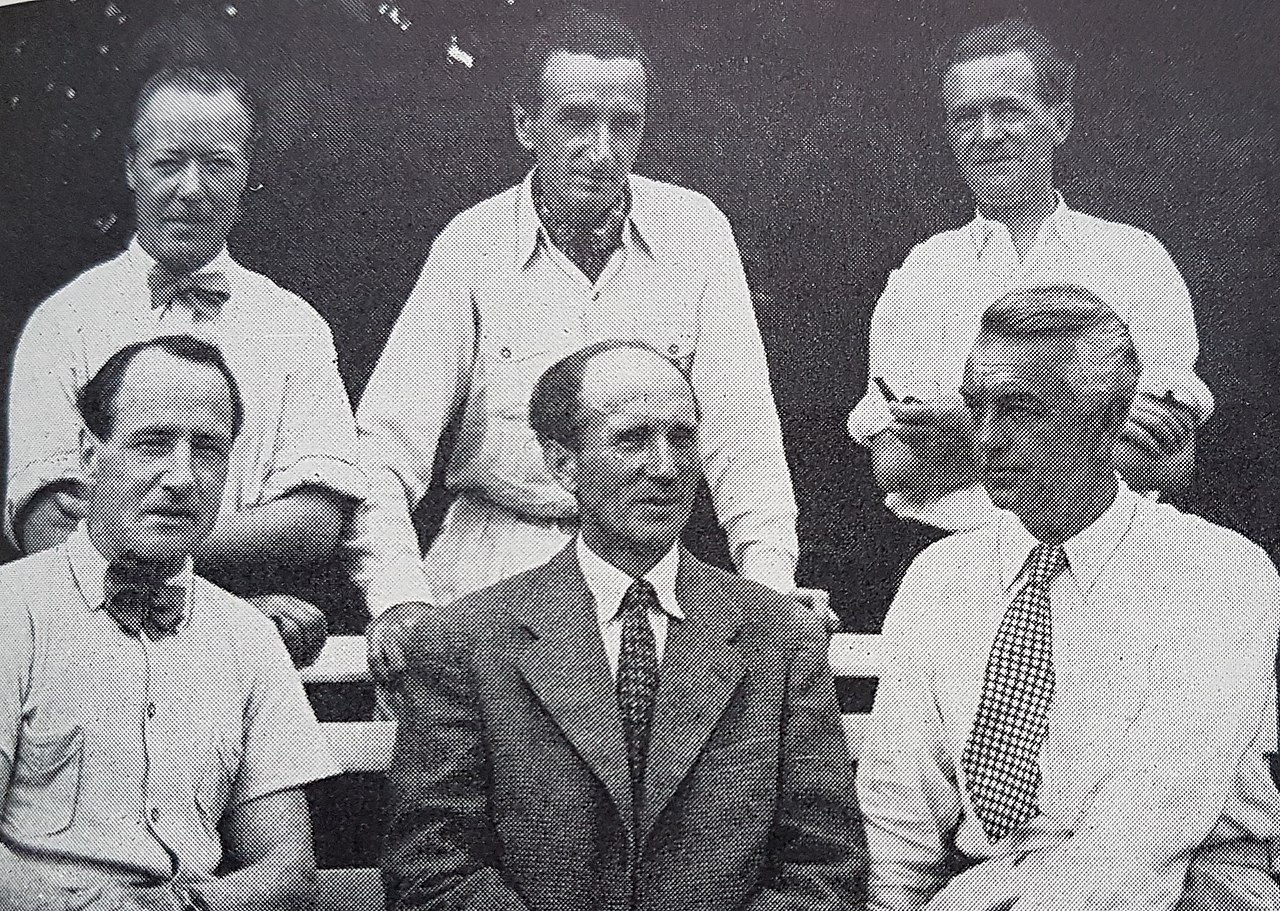
Svenskt konstnärslexikon · Public domain
- Period
- 1929
- Region
- Sweden
VALÉORINE Encyclopedia
VALÉORINE documentary reading
Documentary summary
Illustration — Mjellby Art Museum outside Halmstad, Sweden Halmstadgruppen was a group of six artists that collectively followed and developed avant-garde modern art movements such as cubism, post-cubism, purist, futurist and surrealism at Halmstad in Halland County, Sweden. A permanent showroom in Mjellby, now Mjellby Art Museum in Halmstad was created to exhibit their art. Here an extensive collection of the Halmstadgruppen works are exhibited.
Admitted source layer · organised and presented by VALÉORINE
Reference Check
Propose documentary evidence for Halmstadgruppen. A contribution is never written directly as fact: identity, source, rights and evidence gates still decide.
Sign in to contribute
World of VALÉORINE
Documentary connections
Only confirmed graph relationships appear here. Images are shown only when their identity and reuse rights both pass the documentary gate.
Documentary evidence
Documentary basis
Authority files
gnd · 4235463-8 · wikidata · Q10516501 · wikipedia · Halmstadgruppen
In this article
History
History
The museum was founded in 1980 by Swedish art critic and museum director Viveka Bosson. She is the daughter of the late Erik Olson, one of the members in Halmstadgruppen. Bosson bought the former site of the Mjellby folkskola (elementary school) outside Halmstad in 1980, setting up Mjellby Art Museum and later donated it to the Halmstad Municipality in 1997.
Impressed by the avant-garde movements Axel Olson, his younger brother Erik and their cousin Waldemar Lorentzon in Halmstad formed into a group aptly calling themselves "Gnistan" which translated means “The Spark”. In May 1919, “Gnistan” made their debut at an amateur exhibition in Halmstad. Through this they met Egon Östlund an engineer philanthropist, who was also exhibiting with some Gösta Adrian-Nilsson (GAN) influenced canvases of his own GAN was a close friend of Östlund. By July 1919, Östlund had introduced them to Gösta Adrian-Nilsson who was spending part of the summer with friends in Halmstad. Stellan Mörner's father had become governor of Halland County. This had prompted Stellen to return from Paris to exhibit his art in the Halmstad city library and work on a local commission. Mörner was an artist with a skill for portraiture but again was interested in the avant-garde. Egon Östlund, introduced Mörner to the young painters Sven Jonson and Esaias Thorén. They organized an exhibition in Halmstad in 1929. Stellen Mörner exhibited his modern art paintings together with Erik and Axel Olson, Sven Jonson, Waldemar Lorentzon and Esaias Thorén. The local Halmstad press denounced the exhibition of new modernist art with derision. However, unfazed the young Halmstad artists were invited to exhibit in Lund that year. The Halmstad group was born as they got together in 1929, a group with the single aim of introducing cubism, surrealism and concrete art (modern art) to Swedish audiences. They engaged an imaginative and dreamlike imagery with figurative content and expressions of their costal origin in a plain geometric image, giving an adequate expression using pure colour and form synthesis. In the 1930s the young artists had slipped from early cubism into a surrealist imagery of a Nordic character. The Halmstadgruppen lasted 50 years together. This period was the end of Dadasim and the beginning of the “Age of Anxiety” as described in the poem by W.H. Auden, published in 1947. During the years 1922–23, Axel Olson (1899-1986) studied in Berlin with the Russian painter and sculptor Alexander Archipenko. Axel's brother Erik Olson (1901-1986) and their cousin Waldemar Lorentzon (1899-1984) studied in 1924 at the Fernand Léger painting academy in Paris. Sven Jonson (1902-1981), Stellan Mörner (1896-1979), and Esaias Thorén (1901- 1981), also studied in Paris during that time. During their periods abroad they came in contact with modern developments in painting. Returning to Sweden, Halmstadgruppen was founded in 1929 and was unchanged until 1979, with the death of Stellan Mörner. The members of Halmstadgruppen were pioneers in the Swedish modernist art movement. During the 1920s, they were cubists and during the 1930s introduced surrealism in Sweden together with Gösta Adrian-Nilsson (1884–1965).
Members
Members
• Stellan Mörner (1896–1979) • Waldemar Lorentzon (1899–1984) • Axel Olson (1899–1986) • Esaias Thorén (1901–1981) • Erik Olson (1901–1986) • Sven Jonson (1902–1981)
Course of the movement
Dated record
Course of the movement
Explore 1929
The full dated record · 3 entries
1929
Halmstadgruppen first recorded.
1929
Halmstadgruppen is recorded from 1929.
1929
Halmstadgruppen was established or created in 1929.
Places
Named by the record
Places
Only places the record itself states, plotted where the house gazetteer settles their coordinates. Nothing is inferred from a name or a nationality.
- Sweden
Figures, places and works
Knowledge graph
Figures, places and works
Those recorded within this movement, and the places and works associated with it.
Place
1- SwedenPlace
Established from a fact already recorded on a verified source.
Context
Primary material
Context
The circumstances in which Halmstadgruppen stands. Established or created in 1929. Recorded as artist collective. Situated in Sweden. Halmstadgruppen lies within Sweden.
Documents and archives
Primary material
Documents and archives
authority file
- Gemeinsame Normdatei 4235463-8, Halmstadgruppen.
General reference · Deutsche Nationalbibliothek
reference work
- “Halmstadgruppen”, English Wikipedia, consulted as further reading
Reputable secondary · Wikipedia
authority record
- Wikidata, structured authority record Q10516501: Halmstadgruppen
General reference · Wikidata
Other sources
Other sources
• Folke Holmér (1947) Halmstadgruppen. Waldemar Lorentzon, Axel Olson, Erik Olson, Esaias Thorén, Sven Jonson, Stellan Mörner (Stockholm, Rabén & Sjögren)
Notes from the source article
Cited by Wikipedia
Notes from the source article
These works are cited by the source article, in its own numbering. They are recorded as its citations, not as sources VALÉORINE has verified.
- 1.The Halmstad Group history. Halmstads kommun.
- 2."Halmstad Group." The Concise Grove Dictionary of Art. Oxford University Press, Inc., 2002.
- 3.Biography of Axel Olson (1899-1986). thebiography.us.
- 4.The art of Gösta Adrian-Nilsson, 1884–1965. johncoulthart.com. Nov 15, 2012.
- 5.Stellan Mörner. Mjellbykonstmuseum.se. 2011-10-14.
- 6.Axel Olson. Mjellbykonstmuseum.se. 2011-10-14.
- 7.Esaias Thorén. Mjellbykonstmuseum.se. 2011-10-14.
- 8.Erik Olson. Mjellbykonstmuseum.se. 2011-10-14.
- 9.Sven Jonson. Mjellbykonstmuseum.se. 2011-10-14.
References
Citations
References
Each reference names the institution holding it, so a reader may go to the document itself.
authority file
Gemeinsame Normdatei 4235463-8, Halmstadgruppen.Deutsche Nationalbibliothek
Secondary witnessreference work
Secondary witnessauthority record
General reference
The Encyclopedia exists whether or not anything is for sale. Corrections are recorded rather than overwritten, and every version of this record is kept. Published 16 August 2026.
Elsewhere in Terminology
620 published records in this field, each with its sources named.
- Grupo MontparnasseMovement
- Gustavian styleMovement
- Hague SchoolMovement
- hallucinatory realismMovement
- Hamburger SchuleMovement
- Hara school of paintersMovement
- hard-edge paintingMovement
- Harlem RenaissanceMovement
Best supported in this field
For owners
Own an object connected with Halmstadgruppen?
A specialist will read what you send and tell you what the house can establish, what it cannot, and whether the object is suited to sale. There is no charge and no obligation. The object stays with you throughout; nothing is shipped to us unless it is arranged in writing beforehand.