
Gunnar Asplund
Erik Gunnar Asplund (22 September 1885 – 20 October 1940) was a Swedish architect, mostly known as a key representative of Nordic Classicism of the 1920s during the last decade of his life. At this time, he was a major proponent of the modernist style which made its breakthrough in Sweden at the Stockholm International Exhibition (1930). Asplund was professor of architecture at the Royal Institute of Technology from 1931.
Also recorded as Erik Gunnar Asplund · E. G. Asplund · Erik Gunnar · Eric Gunnar Asplund
Gunnar Asplund

Den moderna staden tar form · Public domain
- Born
- 1885. · Stockholm.
- Died
- 1940. · Stockholm.
- Nationality
- Sweden.
- Occupation
- architect.
- Education
- Royal Institute of Technology and Royal Swedish Academy of Fine Arts.
- Known for
- Skogskapellet.
- Languages
- Swedish.
VALÉORINE Encyclopedia
VALÉORINE documentary reading
Documentary summary
Erik Gunnar Asplund (22 September 1885 – 20 October 1940) was a Swedish architect, mostly known as a key representative of Nordic Classicism of the 1920s during the last decade of his life. At this time, he was a major proponent of the modernist style which made its breakthrough in Sweden at the Stockholm International Exhibition (1930). Asplund was professor of architecture at the Royal Institute of Technology from 1931.
Admitted source layer · organised and presented by VALÉORINE
Note VALÉORINE
Gunnar Asplund (1885–1940) was a Swedish architect. The architect was born and died in Stockholm.
Gunnar Asplund studied at Royal Institute of Technology and Royal Swedish Academy of Fine Arts. The architect worked for Royal Institute of Technology and worked in Stockholm.
Works include Skogskapellet. Languages used include Swedish. Works by Gunnar Asplund are held at Museum of Modern Art, Nationalmuseum and Swedish Centre for Architecture and Design.
Composed from admitted, traceable facts · 27 September 2026
VALÉORINE
Reference Check
Propose documentary evidence for Gunnar Asplund. A contribution is never written directly as fact: identity, source, rights and evidence gates still decide.
Sign in to contribute
World of VALÉORINE
Documentary connections
Only confirmed graph relationships appear here. Images are shown only when their identity and reuse rights both pass the documentary gate.

Documentary evidence
Evidence Panel
not yet certified
- Identity
- resolved
- Independent source families
- 0
- Admitted assertions
- 0
- Open conflicts
- 0
Authority files
gnd · 1091166757 · wikidata · Q312070 · wikipedia · Gunnar Asplund
In this article
Major works
Major works
His appointment was marked by a lecture, later published under the title "Our architectonic concept of space." The Woodland Crematorium at Stockholm South Cemetery (1935–1940) is considered his finest work and one of the masterpieces of modern architecture.
Gunnar Asplund studied at Royal Institute of Technology and Royal Swedish Academy of Fine Arts. The recorded working language is Swedish. Places of work recorded in the authority are Stockholm. Employment is recorded with Royal Institute of Technology. Works named in the authority record are Skogskapellet. Work by Gunnar Asplund is recorded in the collections of Nationalmuseum, Museum of Modern Art and Swedish Centre for Architecture and Design.
Among Asplund's most important works is the Stockholm Public Library, constructed between 1924 and 1928, which stands as the prototypical example of the Nordic Classicism and so-called Swedish Grace movement. It was particularly influential on the proposal submitted for the competition for the design of the Viipuri Library in 1927 by Finnish architect Alvar Aalto, who regarded Asplund as his mentor. Another important work is the extension of the Gothenburg City Hall Extension building which Asplund started on 1913 and finished 1937 – it shows his transformation from neo-classical to functionalist architect, a transformation in parallel with other European modernists like Erich Mendelsohn. Asplund collaborated with architect Sigurd Lewerentz in the design of Skogskyrkogården, a cemetery which is a UNESCO world heritage site, created between 1914 and 1940. They were also the main architects for the temporary Stockholm International Exhibition (1930). Although temporary, the modernist, exposed-glass-and-steel-frame Entry Pavilion at the fair was internationally influential. In fact, it was influential already before its completion, having an influence on the much smaller Turku Fair in Finland, designed by Alvar Aalto and Erik Bryggman, who had travelled to Stockholm to see its construction. Gunnar Asplund is considered perhaps the most important modernist Swedish architect and has had a major influence on later generations of Swedish and Nordic architects.
Our architectonic concept of space
Our architectonic concept of space
The lecture "Our architectonic concept of space" was delivered in 1931 on the occasion of Asplund being appointed professor of architecture at the Royal Institute of Technology in Stockholm. Asplund published few theoretical texts. The lecture was later regarded as an important contribution to the attitudes of Asplund, as well as others of his generation, towards the architectural problems of the time. The lecture has its background in the then well known 2-volume book by German philosopher Oswald Spengler "The decline of the West" (1918 and 1922).
Exhibitions
Exhibitions
The Architecture of Gunnar Asplund, MoMA, New York (1978) En chantier: The Collections of the CCA, 1989–1999, Canadian Centre for Architecture, Montreal (1999–2000) Architecture and Design Drawings: Inaugural Installation, MoMA, New York (2004–2005) 75 Years of Architecture at MoMA, MoMA, New York (2007–2008) In Situ: Architecture and Landscape, MoMA, New York (2009–2010) Asplund Pavilion, Biennale of Architecture, Venice (2018–)
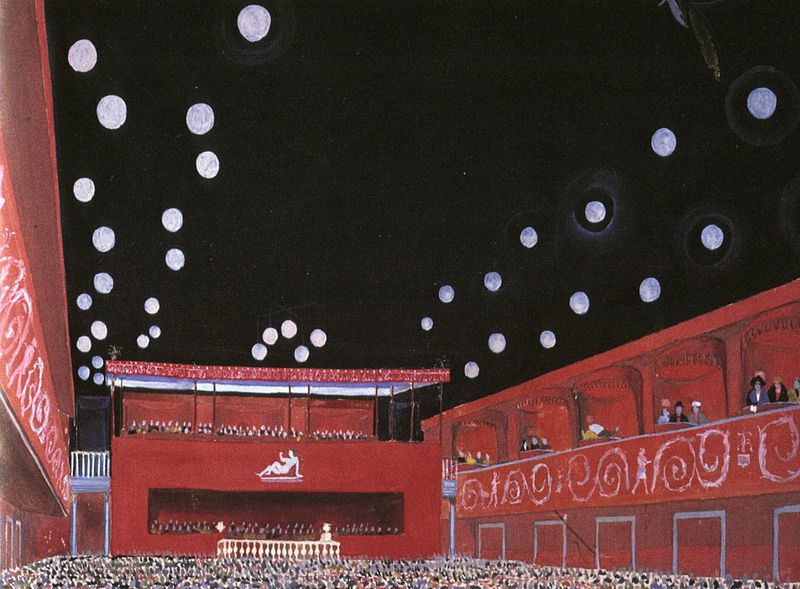
Asplunds interiörskiss för Skandia-Teatern i Stockholm
Gunnar Asplund · Swedish Centre for Architecture and Design

Planritning till sommarhuset Stennäs, arkitekt Gunnar Asplund
Gunnar Asplund · http: place=Sorunda search_context=1 pos=56 count=68
Life and career
Dated record
Life and career
The full dated record · 2 entries
1885
Gunnar Asplund born at Stockholm.
1940
Gunnar Asplund died at Stockholm.
Notes from the source article
Cited by Wikipedia
Notes from the source article
These works are cited by the source article, in its own numbering. They are recorded as its citations, not as sources VALÉORINE has verified.
- 1.Gunnar Asplund, "Our architectonic concept of space", reproduced in "Swedish Grace: Modern classicism in Stockholm", International Architect, No. 8, vol. 1, Iss.8, 1982.
- 2.Oxford University Press. Oxford illustrated encyclopedia. 24. 1985–1993. 0-19-869129-7.
- 3.Alvar Aalto Arkkitehti / Architect 1898–1976. Helsinki, Rakennustieto / Alvar Aalto Säätiö, 1998.
- 4.Schildt, G. (1984) Alvar Aalto: The Early Years, Otava: Helsinki. .
- 5.Gunnar Asplund. Nationalencyklopedin.
- 6.Gunnar Asplund, "Our architectonic concept of space", reproduced in "Swedish Grace: Modern classicism in Stockholm", International Architect, No. 8, vol. 1, Iss.8, 1982, pp. 40–41.
Bibliography printed in the source article · 3
- López Peláez, José Manuel (2002). La arquitectura de Gunnar Asplund. Barcelona, Fundación Caja de Arquitectos. .
- Wrede, Stuart (1983). The Architecture of Erik Gunnar Asplund. Cambridge, Mass., MIT Press.
- Fiell, Charlotte. Design of the 20th Century. Taschen. 72. 2005. 9783822840788.
References
Citations
References
Each reference names the institution holding it, so a reader may go to the document itself.
reference work
Wikidata, structured authority record Q312070: Gunnar AsplundWikimedia Foundation
Partially resolvedreference work
Partially resolved
A further 1 witness is held back from this article because the person or object named in it is not yet resolved to this record. They are kept, not discarded, and return once the identity is established.
The Encyclopedia exists whether or not anything is for sale. Corrections are recorded rather than overwritten, and every version of this record is kept. Published 14 August 2026.
Elsewhere in Design
11,558 published records in this field, each with its sources named.
- Gulnara MehmandarovaDesigner
- Gülsün SağlamerDesigner
- GunadharmaDesigner
- Gundan AnivaritachariDesigner
- Gunnar BirkertsDesigner
- Gunnar FougnerDesigner
- Gunnar HeckscherDesigner
- Gunnar TaucherDesigner
Best supported in this field
For owners
Own a work by Gunnar Asplund?
A specialist will read what you send and tell you what the house can establish, what it cannot, and whether the object is suited to sale. There is no charge and no obligation. The object stays with you throughout; nothing is shipped to us unless it is arranged in writing beforehand.