
Guillaume Coustou the Elder
Guillaume Coustou the Elder (ɡijom kustu; 29 November 1677, Lyon – 22 February 1746, Paris) was a French sculptor of the Baroque and Louis XIV style. He was a royal sculptor for Louis XIV and Louis XV and became Director of the Royal Academy of Painting and Sculpture in 1735. He is best known for his monumental statues of horses made for the Château de Marly, whose replicas now stand in the Place de la Concorde in Paris.
Also recorded as Guillaume Coustou I · Guillaume Coustou · Guillaume, I Coustou · Guillaume I Coustou
Guillaume Coustou the Elder
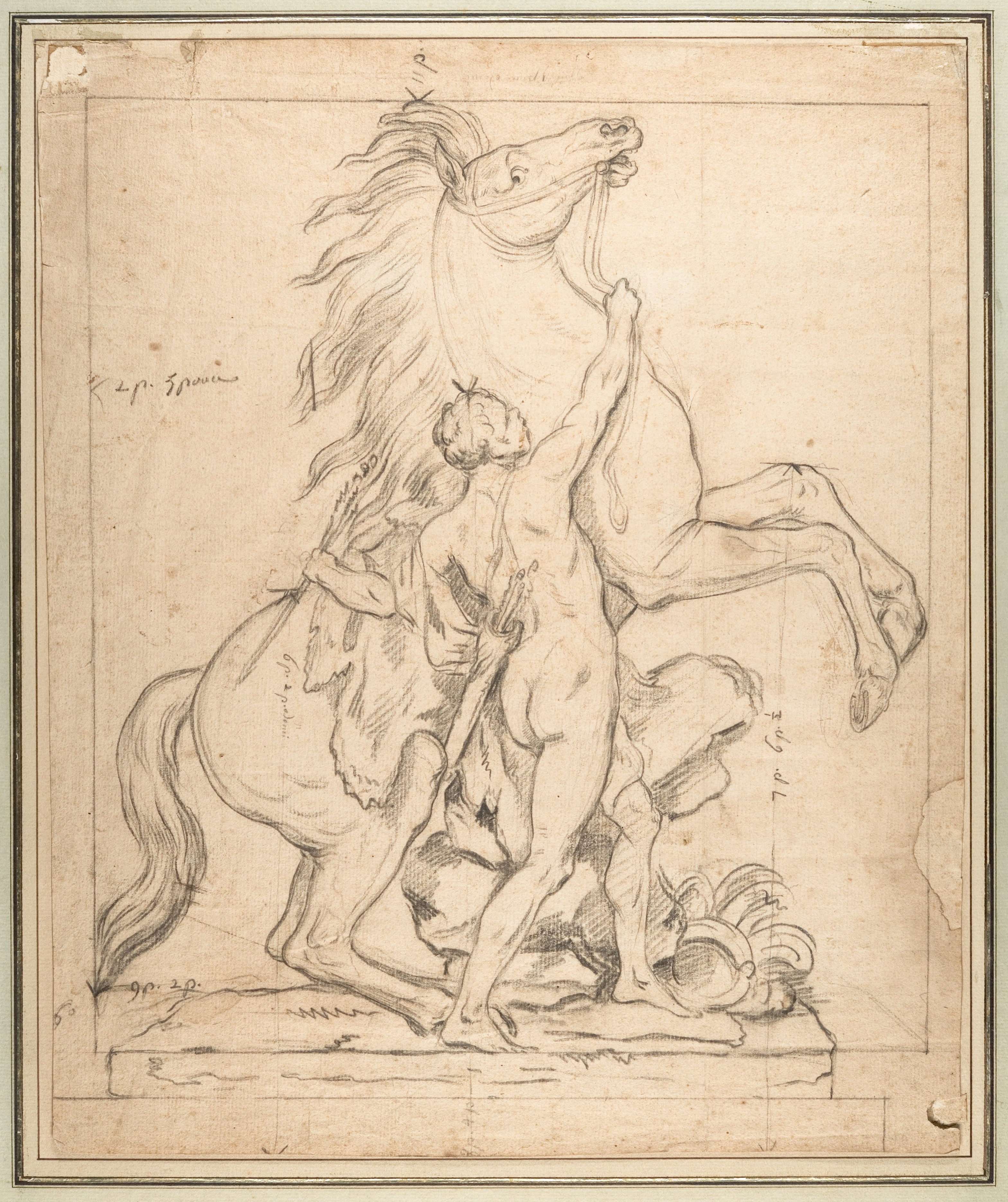
Guillaume Coustou the Elder · The Metropolitan Museum of Art, New York · Harry G. Sperling Fund, 2006 · Public domain (CC0, Met Open Access)
- Name
- Guillaume Coustou the Elder
- Born
- 29 November 1677
- Birthplace
- Lyon, the Lyonnais, Kingdom of France
- Place of death
- Paris, Kingdom of France
- Field
- Sculpture
- Movement
- Baroque and Louis XIV style
- Died
- 1746. · Paris.
- Nationality
- France.
- Occupation
- sculptor and painter.
- Movements
- Baroque.
- Known for
- Hippomenes, Summer and Marly horses.
- Honours
- Prix de Rome for sculpture.
VALÉORINE Encyclopedia
VALÉORINE documentary reading
Documentary summary
Guillaume Coustou the Elder (ɡijom kustu; 29 November 1677, Lyon – 22 February 1746, Paris) was a French sculptor of the Baroque and Louis XIV style. He was a royal sculptor for Louis XIV and Louis XV and became Director of the Royal Academy of Painting and Sculpture in 1735. He is best known for his monumental statues of horses made for the Château de Marly, whose replicas now stand in the Place de la Concorde in Paris.
Admitted source layer · organised and presented by VALÉORINE
Note VALÉORINE
Guillaume Coustou the Elder (1677–1746) was a painter and sculptor, of French nationality. The painter was born in Lyonnais and died in Paris.
Guillaume Coustou the Elder was a member of Académie royale de peinture et de sculpture and worked in Paris. The painter was associated with Baroque.
Among the works are Hippomenes, Marly horses and Summer. Languages used include French. Works are held at Art Institute of Chicago, Metropolitan Museum of Art and Museum of Fine Arts of Lyon, among others. Honours include Prix de Rome for sculpture.
Composed from admitted, traceable facts · 01 October 2026
VALÉORINE
Reference Check
Propose documentary evidence for Guillaume Coustou the Elder. A contribution is never written directly as fact: identity, source, rights and evidence gates still decide.
Sign in to contribute
World of VALÉORINE
Documentary connections
Only confirmed graph relationships appear here. Images are shown only when their identity and reuse rights both pass the documentary gate.
Documentary evidence
Documentary basis
Authority files
wikidata · Q1358924 · wikipedia · Guillaume Coustou the Elder
In this article
Biography
Biography
Edme Bouchardon is recorded as having studied under Guillaume Coustou the Elder. The recorded working language is French. Places of work recorded in the authority are Paris. Works named in the authority record are Hippomenes, Summer and Marly horses. Work by Guillaume Coustou the Elder is recorded in the collections of Art Institute of Chicago, The Nelson-Atkins Museum of Art, Nationalmuseum, National Museum in Warsaw and National Museum of Fine Arts, Argentina. Distinctions recorded are Prix de Rome for sculpture.
Key facts
Key facts
• Name — Guillaume Coustou the Elder • Born — 29 November 1677 • Birthplace — Lyon, the Lyonnais, Kingdom of France • Place of death — Paris, Kingdom of France • Field — Sculpture • Movement — Baroque and Louis XIV style • Father — François Coustou • Mother — Claudine Coysevox • Relatives — Nicolas Coustou (brother), Antoine Coysevox (uncle) • Children — Guillaume Coustou • Illustration — August the Strong of Saxony by Guillaume Coustou the Elder, c.1725, Museum of Old Masters, Dresden
Life
Life
Coustou was a member of a family of famous sculptors; his uncle, Antoine Coysevox, was a royal sculptor; his elder brother, Nicolas Coustou was a sculptor, and his son Guillaume Coustou the Younger also become a noted royal sculptor. Like his older brother, he won the (Prix de Rome) of the Royal Academy which entitled him to study for four years at the French Academy in Rome. However, he refused to accept the discipline of the academy, gave up his studies, set out to make his own career as an artist. He worked for a time in the atelier of the painter Pierre Legros, and eventually returned to Paris. Upon his return to Paris, he assisted his uncle Coysevox in making two monumental equestrian sculptures, Fame and Mercury, for the Château de Marly, the new residence of Louis XIV near the Palace of Versailles, where he went to escape the crowds and ceremony of the palace. He later (1740–1745), made his own horses, the Marly Horses, his most famous works, to replace them. The horses reinvent the theme of the colossal Roman marbles of the Horse Tamers in the Piazza Quirinale, Rome. They were commissioned by Louis XV in 1739 and installed in 1745 at the Abreuvoir ("Horse Trough") at Marly. The horses were considered masterpieces of the grace and expressiveness of the French Late Baroque or Rococo style. After the Revolution they were moved from Marly to the beginning of the Champs-Élysées on the Place de la Concorde. The originals were brought indoors for protection at the Louvre Museum in 1984. Coustou was received into the Académie royale de peinture et de sculpture in 1704. The work he made to mark his entrance was Hercules on the Pyre, now in the Louvre. It displays the special hallmark of the Baroque, a twisting and rising transverse pose, as well as highly skillful carving. Following the death of directeur Louis de Boullogne on 28 November 1733, the painter Hyacinthe Rigaud proposed that the four rectors of the Académie, Coustou, Claude-Guy Hallé, Nicolas de Largillière, and himself, rotate the post. This oligarchy would persist until the election of Coustou as sole director on 5 February 1735. Coustou also created two colossal monuments, The Ocean and the Mediterranean among other sculptures for the park at Marly; the bronze Rhone, which formed part of the statue of Louis XIV at Lyons, and the sculptures at the entrance of the Hôtel des Invalides. Of these latter, the bas-relief representing Louis XIV mounted and accompanied by Justice and Prudence was destroyed during the Revolution, but was restored in 1815 by Pierre Cartellier from Coustou's model; the bronze figures of Mars and Minerva (1733–34), on either side of the doorway, were not interfered with. In 1714 for Marly he collaborated in two marble sculptures representing Apollo Chasing Daphne (both at the Louvre), in which Nicolas Coustou sculpted the Apollo and Guillaume the Daphne. About the same time he was commissioned to produce another running figure in marble, a Hippomenes designed to complement an Atalanta copied from the Antique by Pierre Lepautre: each was placed at the center of one of the carp pools at Marly. In 1725, the Louis Antoine de Pardaillan de Gondrin, Duke of Antin, general director of the Bâtiments du Roi, commissioned a pair of life-size marbles of Louis XV as Jupiter and Marie Leszczyńska as Juno for the park of his Château de Petit-Bourg, which adjoined the park of Versailles, to which it was added after the Duke's death. A number of his sculptures were for the Tuileries Gardens, most notably a bronze Diane à la biche ("Diana and a Deer"), and Hippoméne (1714), which was originally in the goldfish pond at Marly, then moved to the Tuileries until 1940, when it was brought into the Louvre. Coustou's marble Bust of Samuel Bernard is at the Metropolitan Museum of Art, Guillaume often worked with his brother Nicolas Coustou, particularly in the decoration of royal domestic architecture at Versailles.
Identity and origins
Identity and origins
The authorities additionally record the headings Guillaume Coustou I, Guillaume Coustou, Guillaume, I Coustou, Guillaume I Coustou and Coustou. His recorded language was French. He was the child of François Coustou and Claudine Coysevox. 2 children are recorded: Guillaume Coustou the Younger and Charles-Pierre Coustou.
Life and career
Dated record
Life and career
Explore 1677–1746
The full dated record · 4 entries
1677
Guillaume Coustou the Elder born at Lyonnais.
1713
equestrian statue of Louis XIV is dated 1713.
1715
Cardiotaph of Louis XIV is dated 1715.
1746
Guillaume Coustou the Elder died at Paris.
Places
Named by the record
Places
Only places the record itself states, plotted where the house gazetteer settles their coordinates. Nothing is inferred from a name or a nationality.
Lyonnais.
Birth place
Paris.
Death place
Sculpture
• Illustration — Hercules on the pyre, (1704), Louvre • Illustration — Study for one of the horses of Marly, Metropolitan Museum of Art • Illustration — One of the Marly Horses • Illustration — Daphne chased by Apollo, Louvre • Illustration — Allegory of the Rhone River, Lyon • Illustration — Marie Leszczyńska, Louvre • Illustration — Hippomène, Tuileries Garden • Illustration — Summer from The Four Seasons, originally at Marly, now in Tuileries Garden • Illustration — Bust of Samuel Bernard
Notes from the source article
Cited by Wikipedia
Notes from the source article
These works are cited by the source article, in its own numbering. They are recorded as its citations, not as sources VALÉORINE has verified.
- 1.Le Petit Robert des Noms Propres (2010)
- 2.J. Baur. Procès-Verbaux de l’Académie Royale de peinture et de sculpture, 1648-1793. V. 127-128. 1883.
- 3.Michel, Christian. The Académie Royale de Peinture Et de Sculpture: The Birth of the French School, 1648-1793. Getty Research Institute. 352. 2018.
- 4.Williams, Hannah. Académie Royale: A History in Portraits. Routledge. 294. 2016. 978-1-4094-5742-8.
Bibliography printed in the source article · 4
- Geese, Uwe. Baroque: Architecture - Sculpture - Painting. H.F. Ulmann. 2007. 978-3-8331-4675-6.
- Le Petit Robert des Noms Propres, Paris (2010), ( )
- Coustou. Coustou s.v. 336.
- Louvre website: Guillaume I Coustou, Hippomène
References
Citations
References
Each reference names the institution holding it, so a reader may go to the document itself.
reference work
Wikidata, structured authority record Q1358924: Guillaume Coustou the ElderWikimedia Foundation
Secondary witnessreference work
Secondary witness
Further particulars
Held on the record
Further particulars
Open the remaining particulars
Formation and teaching. Each of those relationships is stated by the authority record rather than inferred from style. Elder received Prix de Rome for sculpture.
Recognition and collections
Work by Guillaume Coustou the Elder is
Art Institute of Chicago, The Nelson-Atkins Museum of Art, Nationalmuseum and National Museum in Warsaw
The Encyclopedia exists whether or not anything is for sale. Corrections are recorded rather than overwritten, and every version of this record is kept. Published 16 August 2026.
Elsewhere in Paintings
19,183 published records in this field, each with its sources named.
- Guillam DuboisArtist
- Guillaume BodinierArtist
- Guillaume CammasArtist
- Guillaume CourtoisArtist
- Guillaume CureauArtist
- Guillaume de MarcillatArtist
- Guillaume EberhardArtist
- Guillaume Guillon-LethièreArtist
Best supported in this field
For owners
Own a work by Guillaume Coustou the Elder?
A specialist will read what you send and tell you what the house can establish, what it cannot, and whether the object is suited to sale. There is no charge and no obligation. The object stays with you throughout; nothing is shipped to us unless it is arranged in writing beforehand.