
Guildhall Art Gallery
The Guildhall Art Gallery houses the art collection of the City of London, England. The museum is located in the Moorgate area of the City of London. It is a stone building in a semi-Gothic style intended to be sympathetic to the historic Guildhall, which is adjacent and to which it is connected internally.
Also recorded as Guildhall Art Gallery and London's Roman Amphitheatre
Guildhall Art Gallery

The wub · CC BY-SA 4.0
- Name
- Guildhall Art Gallery
- Founded
- 1885
- Headquarters
- United Kingdom
- Part of
- City of London Corporation
VALÉORINE Encyclopedia
VALÉORINE documentary reading
Documentary summary
The Guildhall Art Gallery houses the art collection of the City of London, England. The museum is located in the Moorgate area of the City of London. It is a stone building in a semi-Gothic style intended to be sympathetic to the historic Guildhall, which is adjacent and to which it is connected internally.
Admitted source layer · organised and presented by VALÉORINE
Reference Check
Propose documentary evidence for Guildhall Art Gallery. A contribution is never written directly as fact: identity, source, rights and evidence gates still decide.
Sign in to contribute
World of VALÉORINE
Documentary connections
Only confirmed graph relationships appear here. Images are shown only when their identity and reuse rights both pass the documentary gate.
Documentary evidence
Documentary basis
Authority files
wikidata · Q4968030 · wikipedia · Guildhall Art Gallery
In this article
Key facts
Key facts
• Name — Guildhall Art Gallery • Established — 1885 (original), 1999 (current) • Location — Moorgate area, City of London, England • Type — Art museum • Collection Size — About 4,000 items • Director — Elizabeth Scott • Architect — Richard Gilbert Scott (current building) • Website — https: www.thecityofldn.com/directory/guildhall-art-gallery/
History
History
The City of London Corporation had commissioned and collected portraits since 1670, originally to hang in the Guildhall. In the 19th and 20th centuries, the Corporation's art collections grew through gifts and bequests to include history paintings and other genres of art. A notable donation came with the bequest of the businessman and art collector Charles Gassiot in 1902 who left over a hundred paintings to the gallery. This massively bolstered the Guildhall's collection of Victorian era art and included works by Clarkson Stanfield, David Roberts, John Everett Millais, William Dyce and James Tissot. The first purpose-built gallery for displaying the collection was completed in. This building was destroyed in The Blitz in 1941, resulting in the loss of 164 paintings, drawings, watercolours, and prints, and 20 sculptures. It was not until 1985 that the City of London Corporation decided to redevelop the site and build a new gallery. The building was designed in a postmodern style by the British architect Richard Gilbert Scott. The new facility, which was intended to house a collection of about 4,000 items, was completed in. The centrepiece of the collection, John Singleton Copley's huge painting depicting The Defeat of the Floating Batteries at Gibraltar, was placed in a prominent position in the entrance hall of the gallery. Vivien Knight was head of the Gallery, from 1983 until her death in 2009.
Amphitheatre
Amphitheatre
• Illustration — The Roman amphitheatre below the Guildhall Art Gallery The Guildhall complex was built on the site of London's Roman amphitheatre, and some of the remains of this are displayed in situ in a room in the basement of the art gallery.
Gallery
Gallery
• Illustration — Winter Landscape with a Frozen River and Figures by Hendrick Avercamp, c.1620 • Illustration — Boy with a Glass and a Lute by Frans Hals, 1626 • Illustration — Cityscape with a Church and a Square by Jan van der Heyden, c.1669 • Illustration — Panoramic View of Haarlem by Jacob van Ruisdael, 1670 • Illustration — Blackfriars Bridge and St Paul's Cathedral by William Marlow, c.1762 • Illustration — The Murder of Rizzio by John Opie, 1787 • Illustration — Portrait of Thomas Tomkins by Joshua Reynolds, 1789 • Illustration — The Defeat of the Floating Batteries at Gibraltar, September 1782 by John Singleton Copley, 1791 • Illustration — John Philip Kemble as Coriolanus by Thomas Lawrence, 1798 • Illustration — Portrait of John Boydell by William Beechey, 1801 • Illustration — Old Drury Lane Theatre on Fire by Abraham Pether, 1809 • Illustration — Shrimp Boys at Cromer by William Collins, 1815 • Illustration — Barmouth Sands by William Collins, 1835 • Illustration — St Paul's Cathedral with the Lord Mayor's Procession by David Roberts, 1836 • Illustration — Queen Victoria Enthroned in the House of Lords by George Hayter, 1838 • Illustration — Keats Listening to a Nightingale on Hampstead Heath by Joseph Severn, 1845 • Illustration — In the Gulf of Venice by Clarkson Stanfield, 1848 • Illustration — The Wounded Cavalier by William Shakespeare Burton • Illustration — The Forum, Rome, 1859 • Illustration — Henry VI at Towton by William Dyce, 1860 • Illustration — On the Road from Waterloo to Paris by Marcus Stone, 1863 • Illustration — My First Sermon by John Everett Millais, 1863 • Illustration — Sanctuary by Richard Burchett, 1867 • Illustration — Caught by the Tide by James Clarke Hook, 1869 • Illustration — The Last Evening by James Tissot, 1873 • Illustration — Too Early by James Tissot, 1873 • Illustration — La Ghirlandata by Dante Gabriel Rossetti, 1873 • Illustration — Margaret of Anjou Being Taken Prisoner After the Battle of Tewkesbury by John Gilbert, 1875 • Illustration — The Music Lesson by Frederic Leighton, 1877 • Illustration — Clytemnestra by John Collier, 1882 • Illustration — The Thames by Moonlight with Southwark Bridge by John Atkinson Grimshaw, 1884 • Illustration — The Violinist by George Adolphus Storey, 1886 • Illustration — The Ninth of November, 1888 by William Logsdail, 1890 • Illustration — The Betrothed by John William Godward, 1892 • Illustration — On a Fine Day by Elizabeth Forbes, 1903
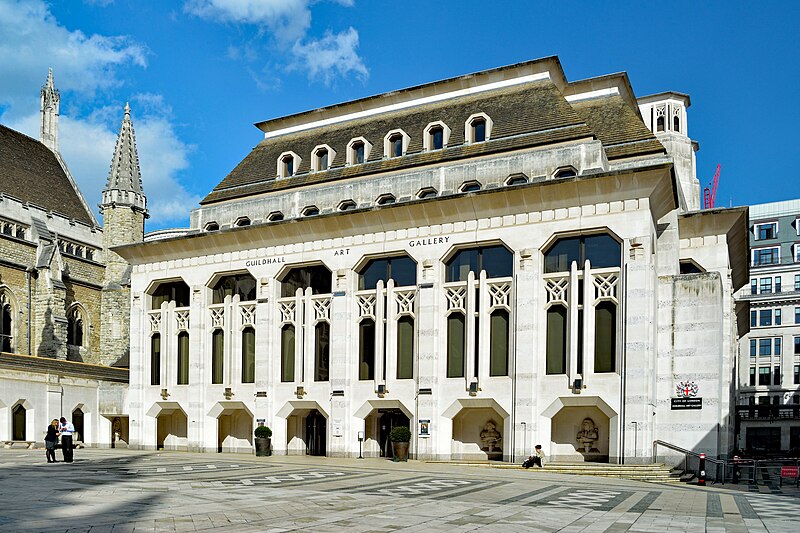
Guildhall Art Gallery 2.0
Elias Gayles from USA · Guildhall Art Gallery 2.0
Places
Named by the record
Places
Only places the record itself states, plotted where the house gazetteer settles their coordinates. Nothing is inferred from a name or a nationality.
- United Kingdom
Primary material
Documents and archives
reference work
- “Guildhall Art Gallery”, English Wikipedia, consulted as further reading
Reputable secondary · Wikipedia
authority record
- Wikidata, structured authority record Q4968030: Guildhall Art Gallery
General reference · Wikidata
Citations
References
Each reference names the institution holding it, so a reader may go to the document itself.
reference work
Secondary witnessauthority record
General reference
The Encyclopedia exists whether or not anything is for sale. Corrections are recorded rather than overwritten, and every version of this record is kept. Published 17 August 2026.
Elsewhere in Institutions
3,152 published records in this field, each with its sources named.
- Guanfu MuseumOrganisation
- Guarnacci MuseumOrganisation
- Guggenheim Hermitage MuseumOrganisation
- Guido Sutermeister MuseumOrganisation
- Guimet MuseumOrganisation
- Gujari Mahal Archaeological MuseumOrganisation
- Gulf Coast Museum of ArtOrganisation
- Gummeson GalleryOrganisation
Best supported in this field
For owners
Own an object connected with Guildhall Art Gallery?
A specialist will read what you send and tell you what the house can establish, what it cannot, and whether the object is suited to sale. There is no charge and no obligation. The object stays with you throughout; nothing is shipped to us unless it is arranged in writing beforehand.