
Guercino
Giovanni Francesco Barbieri (8 February 1591 – 22 December 1666), better known as (il) Guercino (Italian pronunciation: [ɡwerˈtʃiːno]), was an Italian Baroque painter and draftsman from Cento in the Emilia region, who was active in Rome and Bologna. The vigorous naturalism of his early manner contrasts with the classical equilibrium of his later works. His many drawings are noted for their luminosity and lively style.
Also recorded as Giovanni Francesco Barbieri · B. Guercino da Centro · Barbieri · Barbieri da Cento
Guercino
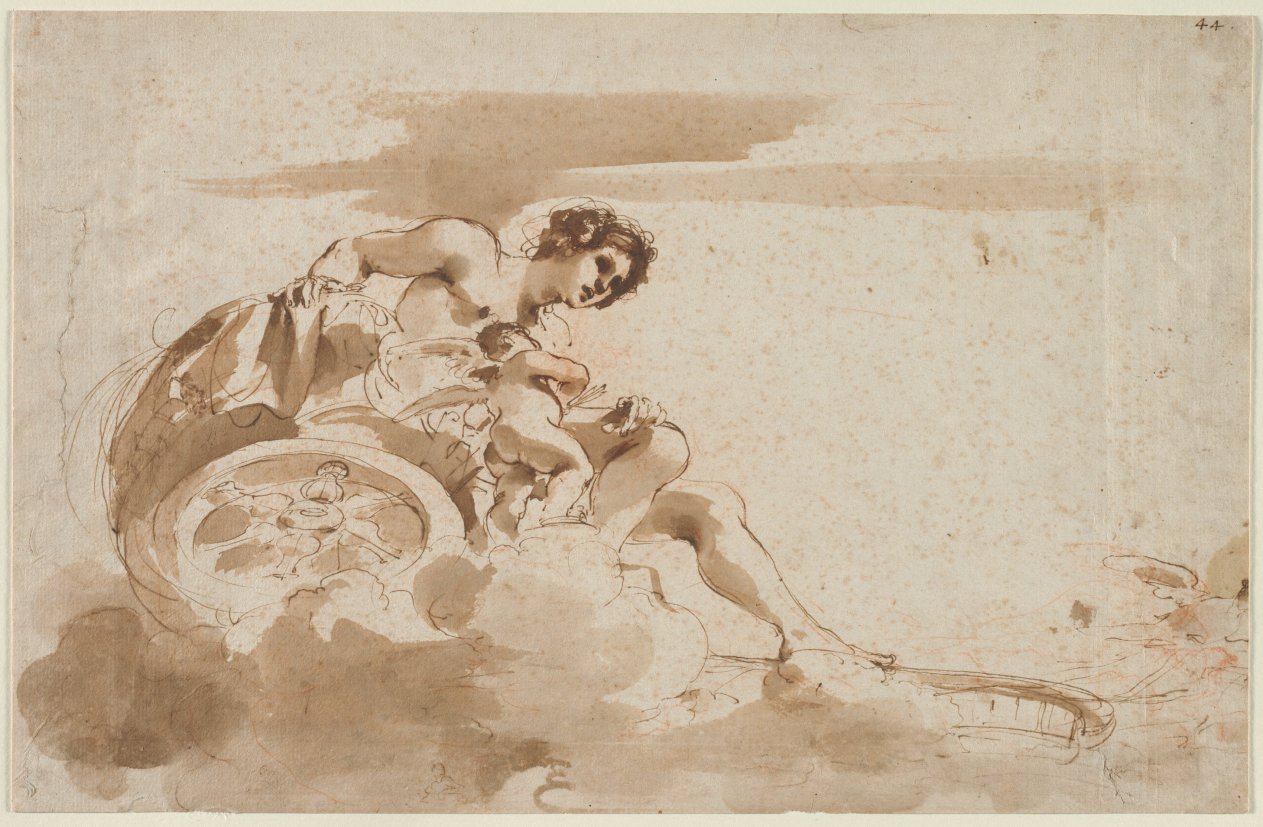
Guercino · The Cleveland Museum of Art · Dudley P. Allen Fund · CC0
- Born
- 1591.
- Died
- 1666.
- Nationality
- Papal States.
- Occupation
- painter, draftsperson, designer and visual artist.
- Fields
- portrait and religious painting.
- Movements
- Baroque.
- Known for
- Landscape with bathing women, Et in Arcadia ego, Ecce Homo, The Burial of Saint Petronilla, Saint Gregory the Great with Jesuit Saints and Samson Captured by the Philistines.
VALÉORINE Encyclopedia
VALÉORINE documentary reading
Documentary summary
Giovanni Francesco Barbieri (8 February 1591 – 22 December 1666), better known as (il) Guercino (Italian pronunciation: [ɡwerˈtʃiːno]), was an Italian Baroque painter and draftsman from Cento in the Emilia region, who was active in Rome and Bologna. The vigorous naturalism of his early manner contrasts with the classical equilibrium of his later works. His many drawings are noted for their luminosity and lively style.
Admitted source layer · organised and presented by VALÉORINE
Note VALÉORINE
Guercino (1591–1666) was a designer, draftsperson and painter, among other activities and a national of the Papal States. Born in Cento, the designer died in Bologna.
Guercino worked in Geographical region of Italy. The designer was active in painting. Guercino was associated with Baroque.
Works include Assumption of the Virgin Mary, Aurora, Cleansing of the Temple and Cleopatra killing herself, among others. Genres include portrait and religious painting. Languages used include Italian.
Composed from admitted, traceable facts · 26 September 2026
VALÉORINE
Reference Check
Propose documentary evidence for Guercino. A contribution is never written directly as fact: identity, source, rights and evidence gates still decide.
Sign in to contribute
Documentary evidence
Documentary basis
Authority files
wikidata · Q334262 · wikipedia · Guercino
In this article
Biography
Biography
Giovanni Francesco Barbieri was born into a family of peasant farmers in Cento, a town in the Po Valley mid-way between Bologna and Ferrara. Being cross-eyed, at an early age he acquired the nickname by which he is universally known, Guercino (a diminutive of the Italian noun guercio, meaning 'squinter'). Mainly self-taught, at the age of 16, he worked as apprentice in the shop of Benedetto Gennari, a painter of the Bolognese School. An early commission was for the decoration with frescoes (1615–1616) of Casa Pannini in Cento, where the naturalism of his landscapes already reveals considerable artistic independence, as do his landscapes on canvas Moonlit Landscape and Country Concert from the same era. In Bologna, he won the praise of Ludovico Carracci. He always acknowledged that his early style had been influenced by study of a Madonna painted by Ludovico Carracci for the Capuchin church in Cento, affectionately known as "La Carraccina". St William Receiving the Monastic Habit (1620, Pinacoteca Nazionale di Bologna, Italy), painted for Santi Gregorio e Siro in Bologna, was Guercino's largest ecclesiastical commission at the time and is considered a high point of his early career. His painting Et in Arcadia ego from around 1618–1622 contains the first known usage anywhere of the Latin motto, later taken up by Poussin and others, signifying that death lurks even in the most idyllic setting. The dramatic composition of this canvas (related to his Flaying of Marsyas by Apollo (1617–1618) created for Cosimo II de' Medici, Grand Duke of Tuscany, which shares the same pair of shepherds) is typical of Guercino's early works, which are often tumultuous in conception. He painted two large canvases, Samson Seized by Philistines (1619) and Elijah Fed by Ravens (1620), for Cardinal Giacomo Serra, a Papal Legate to Ferrara. Painted at a time when it is unlikely that Guercino could have seen Caravaggio's work in Rome, these works nevertheless display a starkly naturalistic Caravaggesque style.
Rome
Rome
Guercino was recommended by Marchese Enzo Bentivoglio to the newly elected Bolognese Ludovisi Pope, Pope Gregory XV in 1621. The years he spent in Rome, 1621–23, were very productive. From this period are his frescoes Aurora at the casino of the Villa Ludovisi, the ceiling in San Crisogono (1622) of San Chrysogonus in Glory, the portrait of Pope Gregory XV (now in the Getty Museum), and the St. Petronilla Altarpiece for St. Peter's Basilica in the Vatican (now in the Capitoline Museums).
Return to Bologna
Return to Bologna
Following the death of Gregory XV in 1623, Guercino returned to his hometown of Cento. In 1626, he began his frescoes in Piacenza Cathedral. The details of his career after 1629 are well documented in the account book, the Libro dei Conti di Casa Barbieri, that Guercino and his brother Paolo Antonio Barbieri, a notable painter of still lifes, kept updated, and which has been preserved. Between 1618 and 1631, Giovanni Battista Pasqualini produced 67 engravings that document the early production of Guercino, which is not included in the Libro dei Conti. In 1642, following the death of his commercial rival Guido Reni, Guercino moved his busy workshop to Bologna, where he was now able to take over Reni's role as the city's leading painter of sacred subjects. In 1655, the Franciscan Order of Reggio paid him 300 ducats for the altarpiece of Saint Luke Displaying a Painting of the Madonna and Child (now in Nelson-Atkins Museum of Art, Kansas City). The Corsini family also paid him 300 ducats for the Flagellation of Christ painted in 1657.
Style
Style
Guercino was remarkable for the extreme rapidity of his executions: he completed no fewer than 106 large altarpieces for churches, and his other paintings amount to about 144. He was also a prolific draftsman. His production includes many drawings, usually in ink, washed ink, or red chalk. Most of them were made as preparatory studies for his paintings, but he also drew landscapes, genre subjects, and caricatures for his own enjoyment. Guercino's drawings are known for their fluent style in which "rapid, calligraphic pen strokes combined with dots, dashes, and parallel hatching lines describe the forms". Despite presumably having monocular vision due to a 'lazy' right eye, Guercino showed remarkable facility to imply depth in his works, perhaps assisted by an enhanced perception of light and shade thanks to compensation by the healthy eye. Other artists with different types of strabismus include Rembrandt, Dürer, Degas, Picasso and (possibly) Leonardo da Vinci. His lively treatment of the Aurora myth (1621, Villa Aurora, Rome, Italy), painted for the pope's nephew, Cardinal Ludovico Ludovisi. challenges the more measured representation of the same subject painted by Guido Reni at Palazzo Rospigliosi on behalf of a Ludovisi family rival Scipione Borghese and makes a statement of political triumph. Some of his later works are closer to the style of Reni, and are painted with much greater luminosity and clarity than his early works with their prominent use of chiaroscuro.
Exhibitions
Exhibitions
A groundbreaking exhibition held at the Archiginnasio of Bologna in 1968 provided the most complete panorama of Guercino's work to date, including paintings from the later parts of his career after the death of Pope Gregory XV, which had previously attracted relatively little attention. For the fourth centenary of the artist's birth in 1991, an expanded exhibition was organized by the Pinacoteca Nazionale di Bologna in conjunction with the Schirn Kunsthalle Frankfurt and the National Gallery of Art, Washington. Both these exhibitions were curated by Guercino's biggest modern champion, Denis Mahon, who was responsible for their catalogues. In 2011–2012, a large exhibition was displayed at Palazzo Barberini in Rome, dedicated to the memory of Mahon, who had recently died. An exhibition displayed at the National Museum, Warsaw in 2013–2014 offered another extensive presentation of the artist's work. In 2019–2010 the Morgan Library & Museum held of an exhibit of his drawings titled, Guercino: Virtuoso Draftsman. A catalogue was published in conjunction with the exhibit.
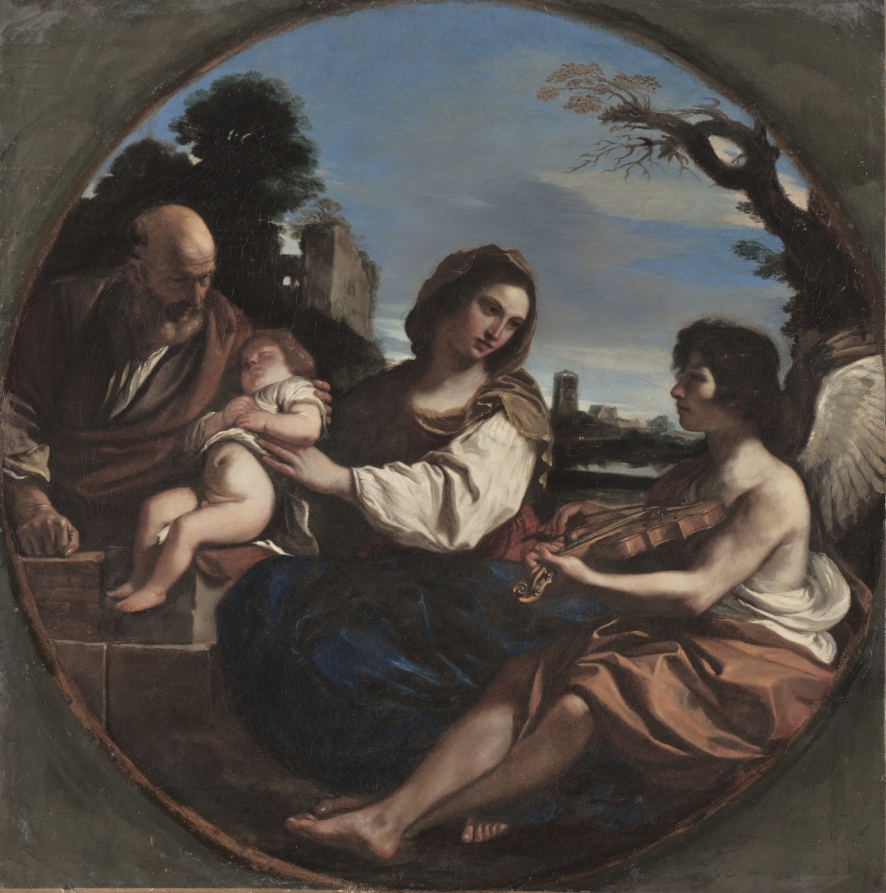
Rest on the Flight into Egypt, 1624, by Guercino
Guercino · The Cleveland Museum of Art · Mr. and Mrs. William H. Marlatt Fund
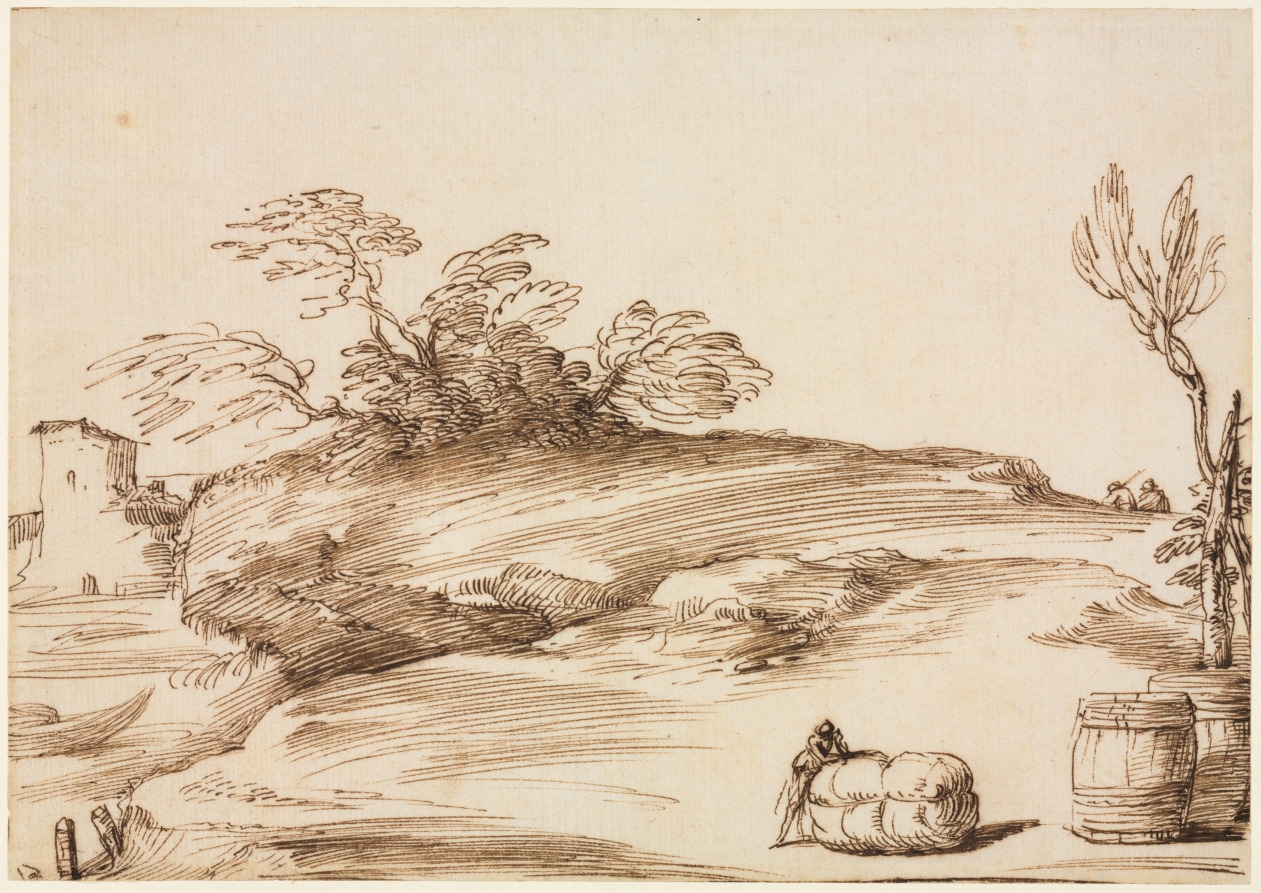
Landscape with a Man Leaning on a Bale, c. 1640, by Guercino
Guercino · The Cleveland Museum of Art · John L. Severance Fund
Pupils
Guercino continued to paint and teach until the end of his life, amassing a notable fortune. He died on 22 December 1666 in Bologna. As he never married, his estate passed to his nephews and pupils, Benedetto Gennari II and Cesare Gennari. Other pupils include Giulio Coralli, Giuseppe Bonati of Ferrara, Cristoforo Serra of Cesena, Father Cesare Pronti of Ferrara, Sebastiano Ghezzi, Sebastiano Bombelli, Lorenzo Bergonzoni of Bologna, Francesco Paglia of Brescia, Benedetto Zallone of Cento, Bartolomeo Caravoglia, Giuseppe Maria Galeppini of Forli, and Matteo Loves.
Primary material
Documents and archives
reference work
- “Guercino”, English Wikipedia, consulted as further reading
Reputable secondary · Wikipedia
authority record
- Wikidata, structured authority record Q334262: Guercino
General reference · Wikidata
Notes from the source article
Cited by Wikipedia
Notes from the source article
These works are cited by the source article, in its own numbering. They are recorded as its citations, not as sources VALÉORINE has verified.
- 1.Miller, 1964
- 2.besidetheeasel.blogspot.se. Beside the easel.
- 3.National Gallery of Victoria. Giovanni Francesco Barbieri, called Guercino – Ottavio Leoni. www.ngv.vic.gov.au.
- 4.Mahon, 1937a
- 5.Turner, 2003
- 6.Griswold 1991, p. 6
- 7.Casa Pannini di Cento. www.geoplan.it.
- 8.Stone, pp. 3, 37.
- 9.Regione Emilia Romagna. La Carraccina. bbcc.ibc.regione.emilia-romagna.it.
- 10.San Guglielmo d'Aquitania riceve l'abito religioso da San Felice Vescovo. (Vestizione di San Guglielmo). www.pinacotecabologna.beniculturali.it.
- 11.Lubbock, Tom. Guercino: Et in Arcadia Ego (1618–22). The Independent. 23 February 2007.
- 12.Palazzo Pitti: Galleria Palatina – Apollo e Marsia. www.abcfirenze.com.
- 13.Web Gallery of Art. Et in Arcadia Ego by Guercino. www.wga.hu.
- 14.Griswold 1991, p. 13
- 15.Metropolitan Museum of Art. Samson Captured by the Philistines. www.metmuseum.org.
- 16.Vivian, 1971
- 17.Lawrence Gowing, ed., Biographical Encyclopedia of Artists, v.2 (Facts on File, 2005): 291.
- 18.Griswold 1991, p. 35
- 19.Gozzi, Fausto. Sacro e Profano nelle Incisioni da Guercino. Culturalia. 2006.
- 20.Smarthistory at Khan Academy. Guercino's Saint Luke Displaying a Painting of the Virgin.
- 21.Griswold 1991, p. 36
- 22.Scholtz et al, 2019
- 23.Tyler, CW. Evidence That Leonardo da Vinci Had Strabismus. JAMA Ophthalmology. 137. 1. 82–86. 18 October 2018. 10.1001/jamaophthalmol.2018.3833.
- 24.Vodret and Gozzi, 2011, pp. 159–161
- 25.Web Gallery of Art. Aurora by Guercino. www.wga.hu.
- 26.Guercino (Giovanni Francesco Barbieri) The Vocation of Saint Aloysius (Luigi) Gonzaga. The Metropolitan Museum of Art.
- 27.Orlandi, 1719, p. 207
- 28.Orlandi, p. 207
- 29.Orlandi, p. 120.
- 30.Orlandi, p. 350.
- 31.Orlandi, p. 399
- 32.Orlandi, p. 397.
- 33.Orlandi, p. 294.
- 34.Orlandi, p. 171
- 35.Lanzi, 1847, pp. 309–310
- 36.Nationalmuseum. Giovanni Francesco Barbieri Il Guercino. emp-web-84.zetcom.ch.
- 37.Fondazione Zeri, University of Bologna. Barbieri Giovan Francesco, Mietitura. catalogo.fondazionezeri.unibo.it.
- 38.Susannah and the Elders - The Collection. Museo Nacional del Prado.
- 39.Posner, 1968
- 40.Mahon, 1992, p. 7
- 41.van Serooskerken, 1991
- 42.Vodret and Gozzi, 2011
- 43.Organizacja Monarchistów Polskich. Guercino. Triumf baroku. www.legitymizm.org.
- 44.Guercino: Virtuoso Draftsman The Morgan Library & Museum. www.themorgan.org.
Bibliography printed in the source article · 16
- Griswold, William M. Guercino. Metropolitan Museum of Art Bulletin. 48. 4. 5–56. 1991. 10.2307/3258858.
- Lanzi, Luigi. History of Painting in Italy; From the Period of the Revival of the Fine Arts to the End of the Eighteenth Century. Henry G. Bohn. III. 1847.
- Mahon, Denis. Notes on the Young Guercino I. – Cento and Bologna. The Burlington Magazine for Connoisseurs. 70. 408. 112–122. 1937a. 866850.
- Mahon, Denis. Notes on the Young Guercino II. – Cento and Ferrara. The Burlington Magazine for Connoisseurs. 70. 409. 177–189. 1937b. 866750.
- Mahon, Denis. Guercino: Master Painter of Baroque. National Gallery of Art. 1992. 978-0-89468-167-7.
- Marciari, John (2019). Guercino: Virtuoso Draftsman. New York, NY : The Morgan Library & Museum.
- Miller, Dwight C. Barbieri, Giovanni Francesco detto il Guercino. Dizionario Biografico degli Italiani. 6. 1964.
- Orlandi, Pellegrino Antonio. Abecedario pittorico. 1719.
- Posner, Donald. The Guercino Exhibition at Bologna. The Burlington Magazine. 110. 788. 596–607. 1968. 875813.
- Scholtz, Sibylle. Lights and darks of a picture. The life of Giovanni Francesco Barbieri, "il Guercino" – the squinter. Strabismus. 27. 1. 39–42. 2019. 10.1080/09273972.2019.1559532.
- van Serooskerken, Carel van Tuyll. Guercino. Bologna, Cento and Frankfurt. The Burlington Magazine. 133. 1065. 864–868. 1991. 885077.
- Stone, David M. Guercino: Catalogo Completo Dei Dipinti. Cantini. 1991. 978-88-7737-137-9.
- Unger, Daniel M. Guercino's Paintings and His Patrons' Politics in Early Modern Italy. Routledge. 2016. 978-1-351-56482-3.
- Vivian, Frances. Guercino Seen from the Archivio Barberini. The Burlington Magazine. 113. 814. 22–29. 1971. 876502.
- Vodret, Rossella. Guercino (1591–1666): capolavori da Cento e da Roma. Giunti. 2011. 9788809775350.
- Amorini, Antonio Bolognini. Vite de Pittori ed Artifici Bolognesi. Tipografia Governativa alla Volpe, Bologna. 223–272. 1843.
References
Citations
References
Each reference names the institution holding it, so a reader may go to the document itself.
reference work
Secondary witnessauthority record
General reference
The Encyclopedia exists whether or not anything is for sale. Corrections are recorded rather than overwritten, and every version of this record is kept. Published 14 August 2026.
Elsewhere in Modern design
3,254 published records in this field, each with its sources named.
- Gretl AicherDesigner
- Grey OrganisationDesigner
- Grivel Mont BlancDesigner
- Guðmundur Oddur MagnússonDesigner
- Gui BonsiepeDesigner
- Guido CanellaDesigner
- Guido SeeberDesigner
- Gunārs LūsisDesigner
Best supported in this field
For owners
Own a work by Guercino?
A specialist will read what you send and tell you what the house can establish, what it cannot, and whether the object is suited to sale. There is no charge and no obligation. The object stays with you throughout; nothing is shipped to us unless it is arranged in writing beforehand.