
Gryazev-Shipunov GSh-6-30
The Gryazev-Shipunov GSh-6-30 (Russian: Грязев-Шипунов ГШ-6-30) is a Russian 30 mm rotary cannon aircraft-mounted and naval autocannon used by Soviet and later CIS military aircraft. The GSh-6-30 fires a 30×165mm, 390 g (13+3⁄4 oz) projectile.
Also recorded as GSh-6-30
Gryazev-Shipunov GSh-6-30
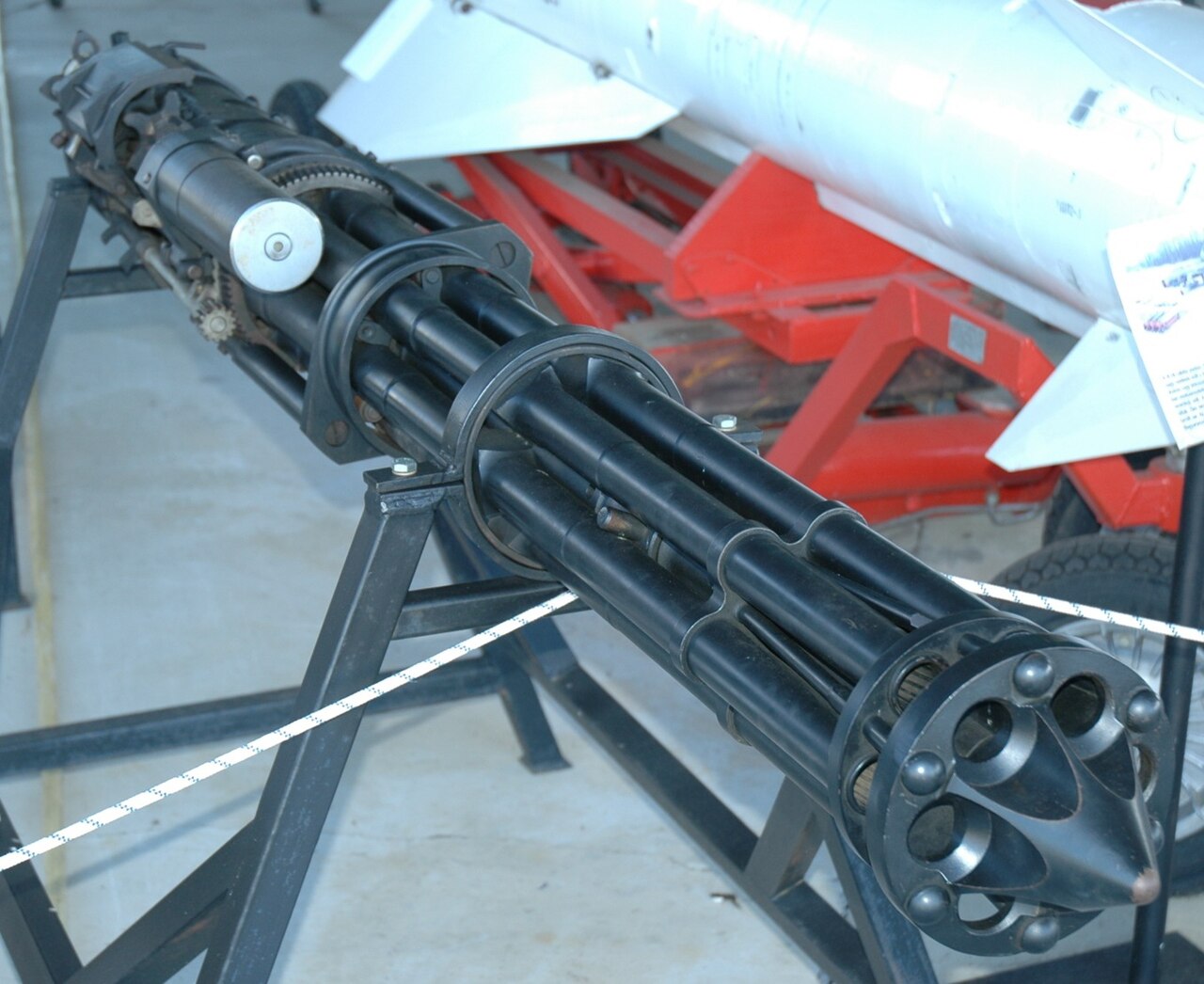
User:VargaA · CC BY-SA 4.0
- Field
- Gatling gun and autocannon.
- Region
- Soviet Union.
VALÉORINE Encyclopedia
VALÉORINE documentary reading
Documentary summary
The Gryazev-Shipunov GSh-6-30 (Russian: Грязев-Шипунов ГШ-6-30) is a Russian 30 mm rotary cannon aircraft-mounted and naval autocannon used by Soviet and later CIS military aircraft. The GSh-6-30 fires a 30×165mm, 390 g (13+3⁄4 oz) projectile.
Admitted source layer · organised and presented by VALÉORINE
Note VALÉORINE
No house-authored Note is published until its assertions and sources pass the VALÉORINE evidence contract. The documentary article remains available in full while that enrichment is being consolidated.
Documentary enrichment in progress · no unsupported statement published
Reference Check
Propose documentary evidence for Gryazev-Shipunov GSh-6-30. A contribution is never written directly as fact: identity, source, rights and evidence gates still decide.
Sign in to contribute
World of VALÉORINE
Documentary connections
Only confirmed graph relationships appear here. Images are shown only when their identity and reuse rights both pass the documentary gate.


Documentary evidence
Evidence Panel
wikipedia incomplete · checked 25 September 2026
- Identity
- resolved
- Independent source families
- 0
- Admitted assertions
- 0
- Open conflicts
- 0
Authority files
wikidata · Q1547163 · wikipedia · Gryazev-Shipunov GSh-6-30
In this article
History
History
While the GSh-6-30K was designed for use on aircraft, the gun was repurposed for use on armoured cars during the Yemeni Civil War.
Variants
Variants
GSh-6-30M; AO-18L; version used by ABM-BCM30 remote weapon station. GSh-6-30K; Naval variant of GSh-6-30, also known as AO-18 used in AK-630 CIWS system. AO-18K; Modernized AO-18 used by Kashtan CIWS. AO-18KD; Further improved AO-18K with a higher rate of fire and extended range used in AK-630M2, Palma/Palash and Pantsir-M CIWS systems.
Users
Users
China India Russian Federation Ukraine Vietnam Yemen
Former user
Former user
Soviet Union
Description
The GSh-6-30, designed in the early 1970s and entering service in 1975, has a six barrel design that is similar to the Gryazev-Shipunov GSh-6-23. It was based on the naval AO-18 used in the AK-630 system. Unlike most modern rotary cannons, it is gas-operated rather than hydraulically driven, allowing it to "spin up" to maximum rate of fire more quickly, allowing more rounds to be placed on target in a short-duration burst. This makes the weapon advantageous in dogfights, where pilots often have a very small window for engaging the enemy. Ignition is electrical, as with the smaller GSh-6-23. On the MiG-27 "Flogger" the GSh-6-30 had to be mounted obliquely to absorb recoil. The gun was noted for its high (often uncomfortable) vibration and extreme noise. The airframe vibration led to fatigue cracks in fuel tanks, numerous radio and avionics failures, the necessity of using runways with floodlights for night flights (as the landing lights on the plane would often be destroyed), tearing or jamming of the forward landing gear doors (leading to at least three crash landings), cracking of the reflector gunsight, an accidental jettisoning of the cockpit canopy and at least one case of the instrument panel falling off in flight. The weapons also dealt extensive collateral damage, as the sheer numbers of fragments from detonating shells was sufficient to damage aircraft flying within a 200-meter radius from the impact center, including the aircraft firing. The principal application for the GSh-6-30 is the MiG-27, which carries the weapon in a gondola under the fuselage, primarily for strafing and ground attack. It was fitted to some Su-25TM aircraft, but subsequently replaced with the GSh-30-2 twin-barreled autocannon of the original Su-25. It is also used as the gun component of the CADS-N-1 Kashtan close-in weapon system.
General references
General references
Koll, Christian (2009). Soviet Cannon: A Comprehensive Study of Soviet Arms and Ammunition in Calibres 12.7mm to 57mm. Austria: Koll. p. 305. ISBN 978-3-200-01445-9.
Notes from the source article
Cited by Wikipedia
Notes from the source article
These works are cited by the source article, in its own numbering. They are recorded as its citations, not as sources VALÉORINE has verified.
- 1.KBP Instrument Design Bureau - GSh-6-30.
- 2.Born in the USSR: Russia's most vicious Soviet mini-artillery guns - Russia Beyond. 13 March 2018.
- 3.The Gryazev-Shipunov GSh-6-30: A Destructive Force.
- 4.Kruszelnicki, Dr Karl. Game of Knowns: Science is Coming - Dr Karl Kruszelnicki - Google Books. Macmillan Publishers Aus. November 2013. 9781743514375.
- 5.New Russian Weapon Hybrid: AK-630 Naval Gun on a KamAZ Truck. Defense Express. 25 June 2025.
- 6.Navy Recognition - Kashtan, Kashtan-M, CADS-N-1, Palma, Palash close in weapon system (CIWS). 2022-07-13.
References
Citations
References
Each reference names the institution holding it, so a reader may go to the document itself.
reference work
Partially resolvedreference work
Partially resolved
The Encyclopedia exists whether or not anything is for sale. Corrections are recorded rather than overwritten, and every version of this record is kept. Published 14 August 2026.
Elsewhere in Militaria
6,095 published records in this field, each with its sources named.
- Gryazev-Shipunov GSh-23Terminology
- Gryazev-Shipunov GSh-30-2Terminology
- Gryazev-Shipunov GSh-301Terminology
- Gryazev-Shipunov GSh-6-23Terminology
- GSh-18Terminology
- GTR-18 Smokey SAMTerminology
- guandaoTerminology
- guided bombTerminology
Best supported in this field
For owners
Own an object connected with Gryazev-Shipunov GSh-6-30?
A specialist will read what you send and tell you what the house can establish, what it cannot, and whether the object is suited to sale. There is no charge and no obligation. The object stays with you throughout; nothing is shipped to us unless it is arranged in writing beforehand.