
Gregor Brandmüller
Illustration — Gregoire Brandmuller in Volume IV of Jean-Baptiste Descamps' "La Vie des Peintres.." Gregor Brandmüller (or Georg) was a late 17th-century Swiss painter, a pupil of Charles Le Brun.
Also recorded as Gregor Brandmuller · Gregor Brandmueller · Brandmüller · Brandmüller, Gregor
Gregor Brandmüller
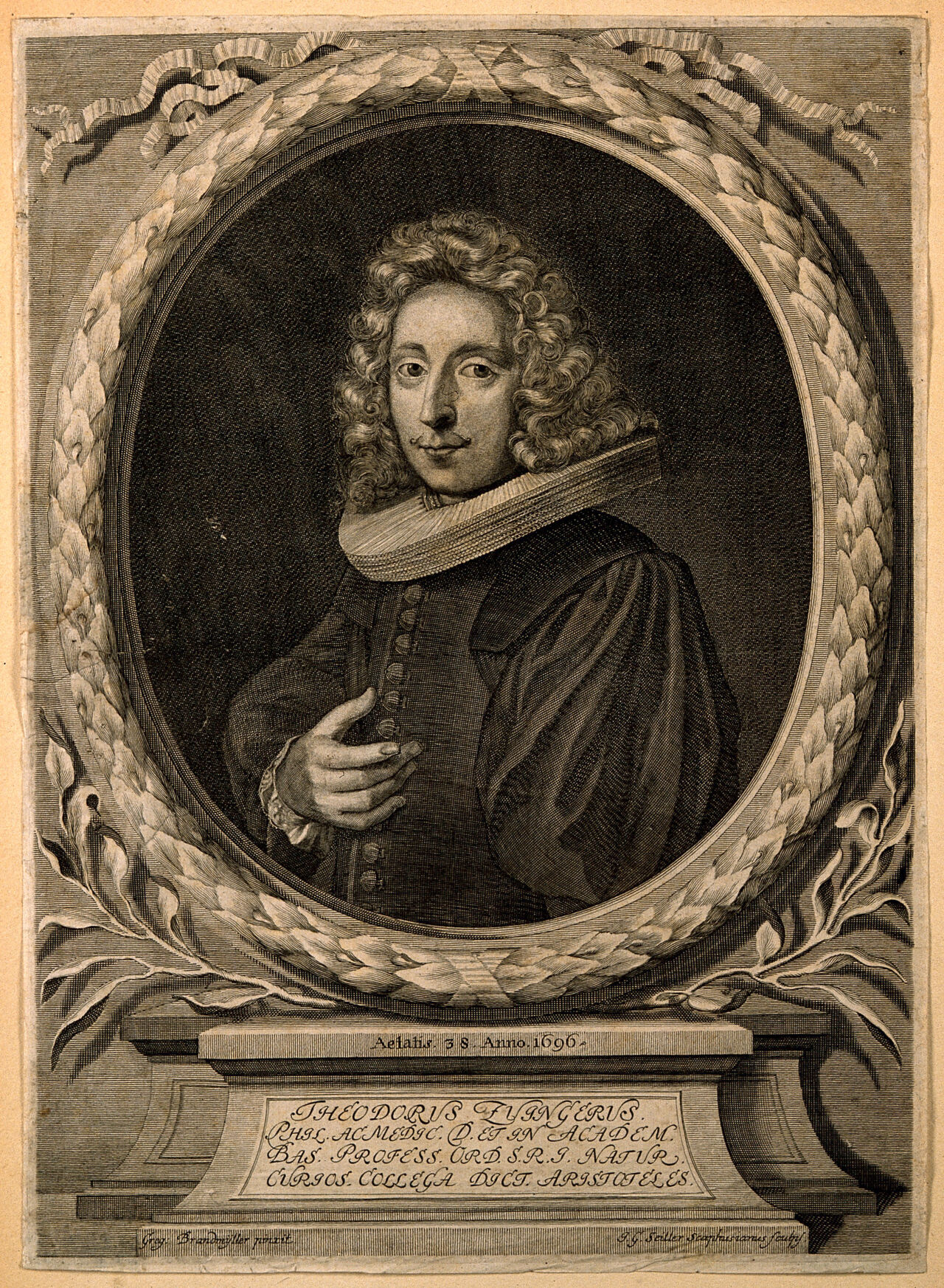
Gregor Brandmüller · Wellcome Collection, London · Wellcome Collection · Public Domain Mark
- Born
- 1661 · Basel.
- Nationality
- Switzerland
- Occupation
- painter
- Fields
- portrait
- Honours
- first Prix de Rome for painting
VALÉORINE Encyclopedia
VALÉORINE documentary reading
Documentary summary
Illustration — Gregoire Brandmuller in Volume IV of Jean-Baptiste Descamps' "La Vie des Peintres.." Gregor Brandmüller (or Georg) was a late 17th-century Swiss painter, a pupil of Charles Le Brun.
Admitted source layer · organised and presented by VALÉORINE
Reference Check
Propose documentary evidence for Gregor Brandmüller. A contribution is never written directly as fact: identity, source, rights and evidence gates still decide.
Sign in to contribute
World of VALÉORINE
Documentary connections
Only confirmed graph relationships appear here. Images are shown only when their identity and reuse rights both pass the documentary gate.
Documentary evidence
Documentary basis
Authority files
wikidata · Q3116302 · wikipedia · Gregor Brandmüller
In this article
Life
Brandmüller was born at Basle in 1661, the son of a member of the council. His father owned a collection of drawings and prints, and Brandmüller showed an early interest in art by copying some of them. He was placed under the tuition of an obscure painter called Gaspar Meyer. When he was seventeen he was sent to Paris, where he studied under Charles Le Brun, who thought highly enough of his abilities to employ him to paint from his designs, in the works he was then engaged in at Versailles. On his return to Switzerland he was invited to the Court of Würtemberg, where he met with great encouragement. He was equal to the composition of grand historical subjects, which he treated with nobleness, and painted with great spirit and fire. One of his most notable works is a Descent from the Cross, in the church of the Capuchins at Dornach. • Illustration — Gregor Brandmüller (1661-1691), Les Trésors de l'Amérique, Musée du Nouveau Monde, La Rochelle He also painted portraits, which he elaborated with the introduction of symbolic and historical attributes. His painting Les Trésors de l'Amérique (1682; Musée du Nouveau Monde, La Rochelle) is an allegorical portrait of four children, one of whom is held in the arms of a black nurse wearing a slave-collar; the other three are dressed to represent Asia, Europe and America, with the various "treasures" lying at their feet. He died young in 1690.
Notes from the source article
Cited by Wikipedia
Notes from the source article
These works are cited by the source article, in its own numbering. They are recorded as its citations, not as sources VALÉORINE has verified.
- 1.Yvonne Boerlin-Brodbeck.
- 2.Archives de l’art français (1851)
- 3.La Lousiane francaise.
- 4.Brandmüller, Georg. In: Michael Bryan (Autor), Robert Edmund Graves, Sir Walter Armstrong (Hrsg.): Bryan's Dictionary of Painters and Engravers. 1886–1889.
References
Citations
References
Each reference names the institution holding it, so a reader may go to the document itself.
reference work
Secondary witnessreference work
Secondary witness
The Encyclopedia exists whether or not anything is for sale. Corrections are recorded rather than overwritten, and every version of this record is kept. Published 18 August 2026.
Elsewhere in Paintings
18,623 published records in this field, each with its sources named.
- Gregoire BoonzaierArtist
- Grégoire GuérardArtist
- Grégoire MichonzeArtist
- Grégoire MüllerArtist
- Gregor von BochmannArtist
- Gregori AminoffArtist
- Gregorio de la FuenteArtist
- Gregorio di CeccoArtist
Best supported in this field
For owners
Own a work by Gregor Brandmüller?
A specialist will read what you send and tell you what the house can establish, what it cannot, and whether the object is suited to sale. There is no charge and no obligation. The object stays with you throughout; nothing is shipped to us unless it is arranged in writing beforehand.