
Great Melbourne Telescope
The Great Melbourne Telescope was built by the Grubb Telescope Company in Dublin, Ireland in 1868, and installed at the Melbourne Observatory in Melbourne, Australia in 1869. In 1945 that Observatory closed and the telescope was sold and moved to the Mount Stromlo Observatory near Canberra. It was rebuilt in the late 1950s.
Great Melbourne Telescope
CC BY-SA 3.0
- Region
- Australia
VALÉORINE Encyclopedia
VALÉORINE documentary reading
Documentary summary
The Great Melbourne Telescope was built by the Grubb Telescope Company in Dublin, Ireland in 1868, and installed at the Melbourne Observatory in Melbourne, Australia in 1869. In 1945 that Observatory closed and the telescope was sold and moved to the Mount Stromlo Observatory near Canberra. It was rebuilt in the late 1950s.
Admitted source layer · organised and presented by VALÉORINE
Reference Check
Propose documentary evidence for Great Melbourne Telescope. A contribution is never written directly as fact: identity, source, rights and evidence gates still decide.
Sign in to contribute
World of VALÉORINE
Documentary connections
Only confirmed graph relationships appear here. Images are shown only when their identity and reuse rights both pass the documentary gate.
Documentary evidence
Documentary basis
Authority files
gnd · 1172359008 · wikidata · Q5599558 · wikipedia · Great Melbourne Telescope
In this article
Specifications
Specifications
In 2003 the telescope, still in use as an observatory, was severely damaged in a bushfire. About 70% of the components were salvageable; a project to restore the telescope to working condition started in 2013. This is a significant size even into the 21st century, although the lower reflecting ability of speculum metal mirrors (about 2/3 reflected) makes them inferior to later metal-on-glass designs or large refractors. This was significantly larger than the largest refractors of the period such as the Lick telescope and Yerkes, although those were both in the northern hemisphere (they would view the northern skies as opposed to the southern)
The telescope had a 48 in speculum primary mirror, and was mounted on an equatorial mounting, enabling it to track the stars accurately as they appeared to move across the sky. The design had been approved by a committee of leading British astronomers and scientists. At the time of commissioning it was the second largest telescope operating in the world, after Lord Rosse's 6 foot reflector at Birr, Ireland, and it was the largest fully steerable telescope in the world. The telescope was designed to explore the nebulae visible from the southern hemisphere, and in particular to document whether any changes had occurred in the nebulae since they were charted by John Herschel in the 1830s at the Cape of Good Hope.
History
History
• Illustration — Great Melbourne Telescope 1880 The Great Melbourne Telescope was built by Thomas Grubb in Dublin, Ireland in 1868, and installed at the Melbourne Observatory in Melbourne, Australia in 1869. After some initial teething problems, the telescope was used for about 20 years at Melbourne Observatory, and one volume of observations produced, along with spectroscopic observations and some pioneering attempts at photographing nebulae. The telescope was upgraded with the addition of photographic equipment in 1872, but the difficulties of repolishing the mirror and the telescope's relative unsuitability for astrophotography deterred further use. When Melbourne Observatory closed in 1945, the Great Melbourne Telescope was sold to the Australian Government's Mount Stromlo Observatory near Canberra. It was rebuilt in the late 1950s with modern drive and a new 50 in pyrex mirror. In the early 1990s the telescope, still utilising Grubb's original equatorial mounting, was rebuilt with two charge-coupled device (CCD) arrays to detect MACHOs (massive astrophysical compact halo objects). This made it Australia's first professional robotic and computerized digital imaging telescope.
Destruction
Destruction
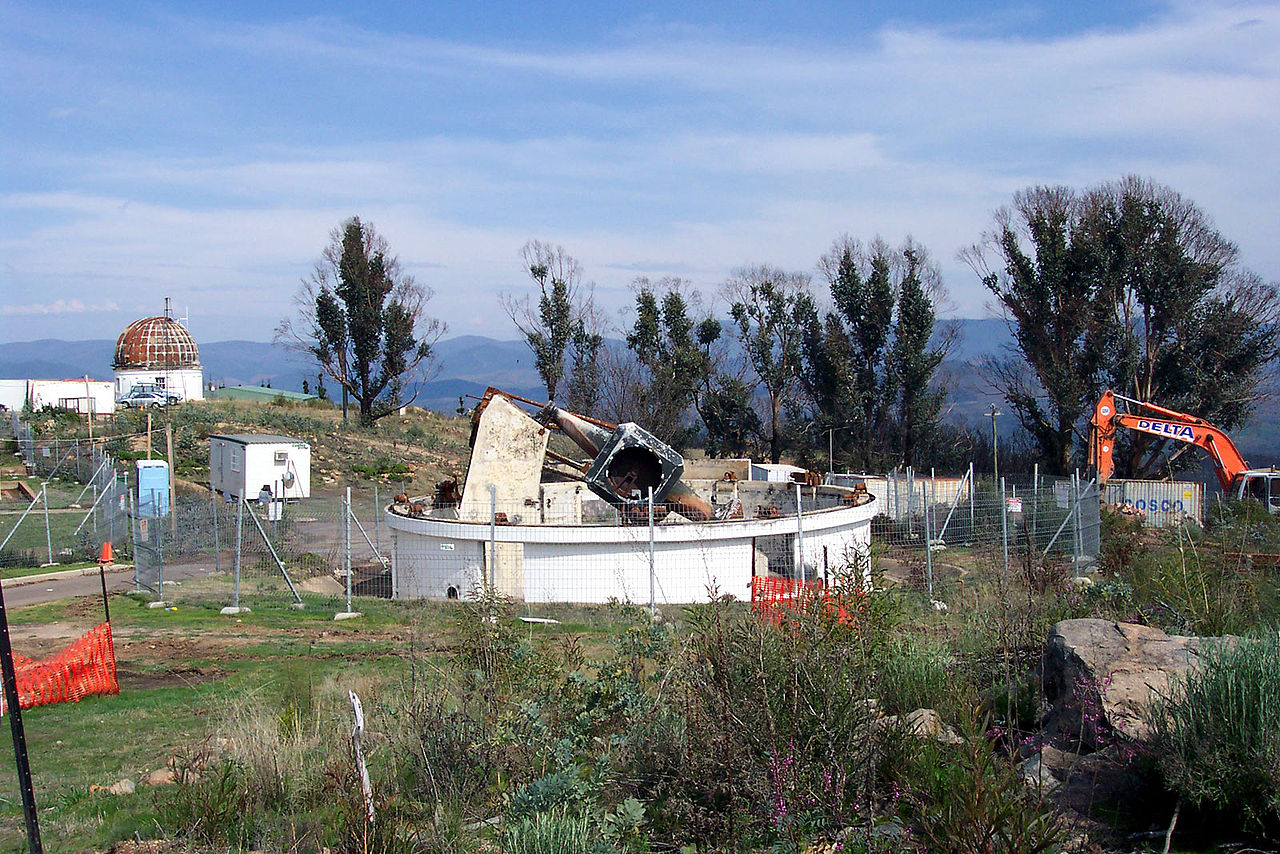
• Illustration — The remains of the telescope after the 2003 fire. In January 2003 an extreme bushfire destroyed the telescopes and buildings at Mount Stromlo - the temperatures were so high that the aluminium dome itself caught fire and melted onto the telescope, shattering the mirror. The fire-ravaged remnants of the telescope were transferred to Museum Victoria, which had previously acquired discarded parts of the original telescope in 1984.
Restoration project
Restoration project
After the fire about 70% of the Great Melbourne Telescope's components remained in reusable condition. A project was set up to restore it to working order and bring its optical, mechanical and electrical systems into line with current best practice, so that it may be used for educational and public viewing in its original home at the Melbourne Observatory. This is a joint undertaking of Museum Victoria, the Astronomical Society of Victoria and the Melbourne Royal Botanic Gardens. After more than five years weighing up different proposals, engineering work commenced in late 2013 thanks to a grant of from the Copland Foundation. As of 2021 restoration work was continuing. The Victorian government committed $600,000 for the first stage of the restoration, and private benefactors also provided financial support. In November 2019, the main structure of the telescope was reassembled for the first time in 74 years.
Timeline
Timeline
• 1849 — The British Association for the Advancement of Science calls for a large reflecting telescope to be erected in the Southern Hemisphere. • 1853 — First astronomical observatory at Williamstown. • 1863 — Melbourne Observatory opens. • 1865 — The Victorian Government orders the telescope from Thomas Grubb, Dublin. • 1868 — Great Melbourne Telescope (GMT) arrives in Melbourne. • 1869 — Observations of nebulae, comet and Neptune are made. • 1872 — The telescope was upgraded with the addition of photographic equipment • 1883 — First photos taken of Orion Nebula from Southern Hemisphere. • 1894 — GMT used for sketches of Mars at its close approach to Earth. • 1944 — Melbourne Observatory closes. • 1945 — GMT moves to Mount Stromlo Observatory near Canberra. • 1961 — Telescope rebuilt with a 1.25m pyrex mirror and new controls. Used for photoelectric photometry and infrared observations. • 1973 — Decommissioned when a bearing fails. • 1992 — GMT rebuilt for the MACHO project to detect evidence of dark matter. • 2003 — Bushfires destroy major telescopes and buildings at Mount Stromlo. • 2008 — Remaining parts of GMT returned to Melbourne. • 2009 — SkyMapper a telescope built to replace GMT opened at Siding Spring Observatory. • 2012 — Museum Victoria, the Astronomical Society of Victoria and the Royal Botanic Gardens start a collaboration to restore the telescope at Melbourne Observatory. • 2019 — Main structure re-assembled for the first time in 74 years.

The Great Melbourne Telescope, at one time the second largest telescope in the world, completed and installed in 1880, in the Royal Botanic Gardens, Melbourne, Australia. Summary Great Melbourne Telescope at the Melbourne Observatory, circa 1875. The 48 inch equatorial reflecting telescope was constructed by Thomas Grubb, Dublin and installed at the observatory in 1868-1869. The telescope was used
Museum Victoria, Australia · https: collections.museumsvictoria.com.au/items/774300

The great equatorial telescope for Melbourne. Wellcome Images
https: Gallery: https: Wellcome Collection gallery (2018-04-03)
Places
Named by the record
Places
Only places the record itself states, plotted where the house gazetteer settles their coordinates. Nothing is inferred from a name or a nationality.
- Australia
Primary material
Documents and archives
scholarly publication
- The Great Melbourne Telescope, Australian Historical Studies, 2013
Scholarly · Crossref registry · 2013
authority file
- Gemeinsame Normdatei 1172359008, Great Melbourne Telescope.
General reference · Deutsche Nationalbibliothek
authority record
- Wikidata, structured authority record Q5599558: Great Melbourne Telescope
General reference · Wikidata
Notes from the source article
Cited by Wikipedia
Notes from the source article
These works are cited by the source article, in its own numbering. They are recorded as its citations, not as sources VALÉORINE has verified.
- 1.Robinson, T. R. & Grubb, Thomas. (1869). 'Description of the Great Melbourne Telescope,' Philosophical Transactions of the Royal Society of London, 159: 127-161.
- 2.Melbourne Observatory. (1885). Observations of the Southern Nebulae made with the Great Melbourne Telescope from 1869 to 1885, Part 1, Melbourne: Government Printer.
- 3.Gillespie, Richard. The Great Melbourne Telescope. Museum Victoria Publishing. 2011. 978-1-921833-05-2.
- 4.Gascoigne, S. C. B. The Great Melbourne Telescope and Other 19th Century Reflectors. Historical Records of Australian Science. 10. 3. 223–245. 1995-03-01. 0727-3061.
- 5.Glass, I. S. Victorian Telescope Makers: The Lives and Letters of Thomas and Howard Grubb. Institute of Physics. 1997. 0-7503-0454-5.
- 6.Great Melbourne Telescope. Herald Sun. 53. 21 February 2012.
- 7.Gillespie, Richard. (2009). The Great Melbourne Telescope: A Contextual History. In 400 Years of Astronomical Telescopes, Bernhard R. Brandl, Remko Stuik & J.K. Katgert-Merkelijn, eds, Springer.
- 8.Frame, Tom & Faulkner, Don. (2003). Stromlo: An Australian Observatory. Crows Nest: Allen & Unwin,114-116, 222-230.
- 9.Great Melbourne Telescope Restoration Project. Recovering the Telescope.
- 10.Museum Victoria. Great Melbourne Telescope.
- 11.Mulcaster, Glenn. Great Melbourne Telescope to see night again. The Age. Fairfax Media. 21 February 2012.
- 12.Money, Lawrence. Rebuilding the Great Melbourne Telescope has universal appeal. Sydney Morning Herald. Fairfax Media. 15 January 2014.
- 13.Gillespie, Richard. Engineering Work Begins. The Great Melbourne Telescope. 28 January 2014.
- 14.Home page. Great Melbourne Telescope. n.d.
- 15.Fienberg, Richard. You Can Help Restore the Great Melbourne Telescope. American Astronomical Society. 27 March 2019.
- 16.Nally, Jonathan. GMT restoration reaches a major milestone. Australian Sky & Telescope. 16. 123. 7. February–March 2020. 1832-0457.
References
Citations
References
Each reference names the institution holding it, so a reader may go to the document itself.
scholarly publication
The Great Melbourne Telescope, Australian Historical Studies, 2013Crossref registry
Institutional witnessauthority file
Gemeinsame Normdatei 1172359008, Great Melbourne Telescope.Deutsche Nationalbibliothek
Secondary witnessauthority record
Secondary witnessreference work
Secondary witness
The Encyclopedia exists whether or not anything is for sale. Corrections are recorded rather than overwritten, and every version of this record is kept. Published 16 August 2026.
Elsewhere in Scientific instruments
736 published records in this field, each with its sources named.
- Gran Telescopio CanariasTerminology
- GranatTerminology
- graphing calculatorTerminology
- Gravity and Extreme Magnetism Small ExplorerTerminology
- Great Paris Exhibition Telescope of 2162Terminology
- Green Bank InterferometerTerminology
- Green Bank TelescopeTerminology
- Greenland TelescopeTerminology
Best supported in this field
For owners
Own an object connected with Great Melbourne Telescope?
A specialist will read what you send and tell you what the house can establish, what it cannot, and whether the object is suited to sale. There is no charge and no obligation. The object stays with you throughout; nothing is shipped to us unless it is arranged in writing beforehand.