
Giuliano da Maiano
Illustration — Portrait of Giuliano da Maiano from Vasari's Lives. • Illustration — Palazzo Antinori. Giuliano da Maiano (1432–1490) was an Italian architect, intarsia-worker, and sculptor, the elder brother of Benedetto da Maiano, with whom he often collaborated.
Also recorded as Giuliano Da Maiano · Giuliano Di Leonardo Di Antonio · da Maiano Giuliano · Giuliano di Leonardo
Giuliano da Maiano
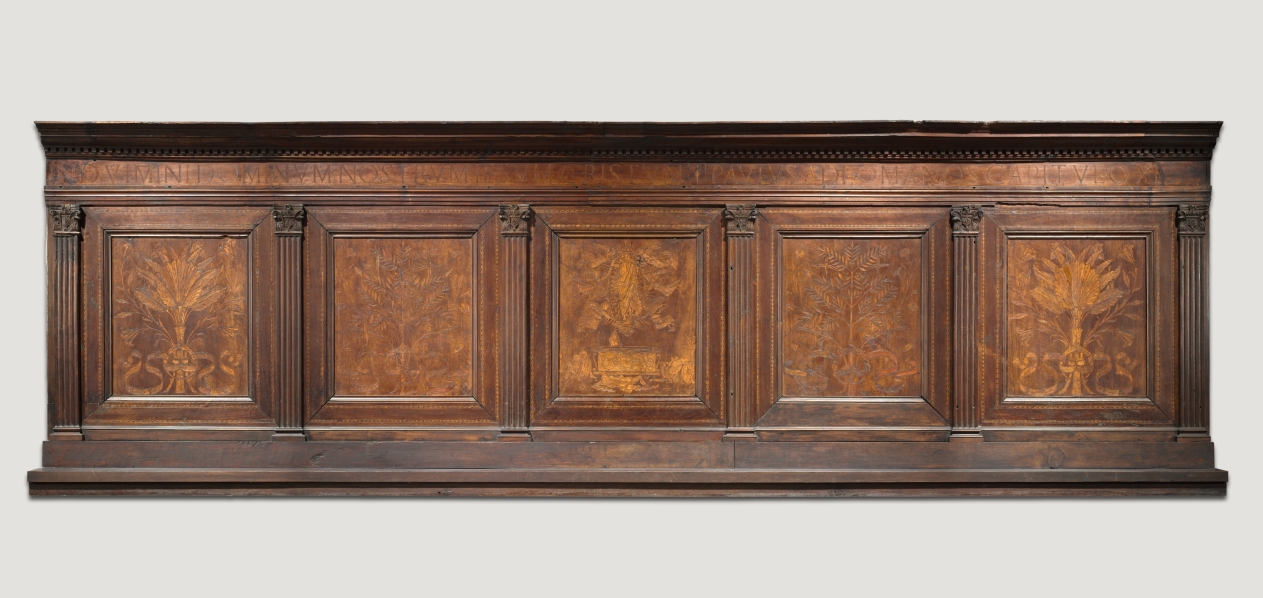
Giuliano da Maiano · The Cleveland Museum of Art · Gift of the John Huntington Art and Polytechnic Trust · CC0
- Born
- 1432 · Fiesole.
- Died
- 1490 · Naples.
- Nationality
- Italy
- Occupation
- sculptor · architect
VALÉORINE Encyclopedia
VALÉORINE documentary reading
Documentary summary
Illustration — Portrait of Giuliano da Maiano from Vasari's Lives. • Illustration — Palazzo Antinori. Giuliano da Maiano (1432–1490) was an Italian architect, intarsia-worker, and sculptor, the elder brother of Benedetto da Maiano, with whom he often collaborated.
Admitted source layer · organised and presented by VALÉORINE
Reference Check
Propose documentary evidence for Giuliano da Maiano. A contribution is never written directly as fact: identity, source, rights and evidence gates still decide.
Sign in to contribute
World of VALÉORINE
Documentary connections
Only confirmed graph relationships appear here. Images are shown only when their identity and reuse rights both pass the documentary gate.
Documentary evidence
Documentary basis
Authority files
wikidata · Q716519 · wikipedia · Giuliano da Maiano
In this article
Biography
Biography
He was born in the village of Maiano, near Fiesole, where his father was a stone-cutter who moved his family and business to Florence, where, according to Vasari, he operated a stonemason's yard, providing mouldings and carved stone detail for construction. Giuliano showed early promise, and his father hoped at first to make of him a notary, but his talent for sculpture and design won out. His first designs were for the intarsia inlay in the fittings for the New Sacristy of the Duomo, Florence, carried out in collaboration with Benedetto in 1463-1465, where Giuliano carved the wooden bas-reliefs of putti and garlands in the frieze, and for works in Palazzo Vecchio in collaboration with Benedetto, notably the ceiling in octagonal compartments and the white marble doorcase in Benedetto's Sala d'Audienza intarsia in the Sala dei Dugento (1472–1477) and in the Sala del Giglio. In 1480 he finished a tabernacle of the Madonna dell'Olivo for the Cathedral of Prato, executed in collaboration with his brothers Benedetto and Giovanni. As an architect he was virtually the house architect for the Pazzi, rebuilding Palazzo Pazzi (1462–1472), the main seat of the family, for Jacopo de' Pazzi. For the Strozzi, at the Palazzo dello Strozzino he added a piano nobile (c. 1456) in the manner of Palazzo Medici-Riccardi to a ground floor that had been begun by Michelozzo; he is also often credited with Palazzo Antinori (1465–1469). In Siena, he built Palazzo Spannocchieschi (c. 1475), in the Florentine manner of delicately rusticated facade and twinned arch-headed windows within a blind arch that had been established in Florence by Alberti's Palazzo Rucellai and Michelozzo's Palazzo Medici-Riccardi. Between the two cities, at San Gimignano, Giuliano is credited with enlarging the Romanesque church of Santa Maria and building the chapel of Santa Fina, in collaboration with Benedetto; at Arezzo, where Benedetto built the Portico of Santa Maria delle Grazie, Giuliano built the cloister of the Badia. The Badia of Fiesole influenced the design of the Brunellesque church of Santa Maria del Sasso, outside Bibbiena, built in 1486-87, where documents show craftsmen were presenting their bills to Giuliano for countersigning. The monks of San Marco were in charge, but the patron was a Medici, for stemme for the church were being painted even as construction progressed; doubtless it was Lorenzo de' Medici himself who paid the expenses. The rock for which the church is named, site of an apparition of the Virgin Mary, rises through the floor at the domed crossing, where Giuliano's delicate domed baldachin identifies and protects the sanctified spot. • Illustration — Plan of the Villa Poggio Reale His established reputation elicited commissions in Rome, Loreto (Basilica della Casa Santa), Faenza (at the cathedral, 1474–1486), in Recanati, where Lorenzo sent him to build Palazzo Venier for Cardinal Anton Giacomo Venier, and in other locations in the Marche. Above all, from 1487 he worked in Naples, where Alfonso, then duca di Calabria, employed him at the Villa di Poggio Reale (1487–1488, demolished). Giuliano also erected the marble Porta Capuana closely flanked by the cylindrical towers of the Castello; it takes the form of a triumphal arch with Corinthian columns and an elaborate sculptural program; in the Sala Grande of the Castello he carved bas-reliefs above the doors, within and without (Vasari). He died in Naples in 1490, and Alfonso himself supplied mourners for the funeral. He was also famous for the wooden room entirely of intarsia, the "Studiolo" in the Ducal Palace in Gubbio.
Places
Named by the record
Places
Only places the record itself states, plotted where the house gazetteer settles their coordinates. Nothing is inferred from a name or a nationality.
Fiesole.
Birth place
Naples.
Death place
Primary material
Documents and archives
authority record
- Wikidata, structured authority record Q716519: Giuliano da Maiano
General reference · Wikidata
reference work
- “Giuliano da Maiano”, English Wikipedia, consulted as further reading
Reputable secondary · Wikipedia
Notes from the source article
Cited by Wikipedia
Notes from the source article
These works are cited by the source article, in its own numbering. They are recorded as its citations, not as sources VALÉORINE has verified.
- 1.Now Palazzo Pazzi-Quaratesi.
- 2.The former church had burned in 1486.
- 3.Ludovico Borgo, "Giuliano da Maiano's Santa Maria del Sasso" The Burlington Magazine 114 No. 832 (July 1972), pp. 448-452.
- 4.George L. Hersey, Afonso II and the Artistic Renewal of Naples (Yale University Press) 1969, pp 60ff.
- 5.Studiolo from the Ducal Palace in Gubbio, The Metropolitan Museum of Art, 1478–82. Accessed 2015-07-05.
Bibliography printed in the source article · 2
- Cendali, Lorenzo. Giuliano e Benedetto da Maiano. 1926.
- von Fabriczy, Cornelius. Giuliano da Maiano. Jahrbuch der Preußischen Kunstsammlungen. 24. 1903.
References
Citations
References
Each reference names the institution holding it, so a reader may go to the document itself.
authority record
Secondary witnessreference work
Secondary witness
The Encyclopedia exists whether or not anything is for sale. Corrections are recorded rather than overwritten, and every version of this record is kept. Published 16 August 2026.
Elsewhere in Design
11,558 published records in this field, each with its sources named.
- Girolamo SartorioDesigner
- Girolamo TicciatiDesigner
- Giuli GegeliaDesigner
- Giulia GuarinoDesigner
- Giulio CaporaliDesigner
- Giulio Cesare FontanaDesigner
- Giulio LassoDesigner
- Giulio MongeriDesigner
Best supported in this field
For owners
Own a work by Giuliano da Maiano?
A specialist will read what you send and tell you what the house can establish, what it cannot, and whether the object is suited to sale. There is no charge and no obligation. The object stays with you throughout; nothing is shipped to us unless it is arranged in writing beforehand.