
Githa Hariharan
Githa Hariharan (born 1954) is an Indian writer and editor based in New Delhi. Her first novel, The Thousand Faces of Night, won the Commonwealth Writers' Prize for the best first novel in 1993. Her other works include the short story collection The Art of Dying (1993), the novels The Ghosts of Vasu Master (1994), When Dreams Travel (1999), In Times of Siege (2003), Fugitive Histories (2009) and I Have Become the Tide (2019), and a collection of essays entitled Almost Home: Cities and Other Places (2014).
Githa Hariharan

Amarjith Mohan · CC BY-SA 4.0
- Name
- Githa Hariharan
- Born
- 1954
- Birthplace
- Coimbatore, Madras State (now Tamil Nadu), India
- Known for
- The Thousand Faces of Night I Have Become the Tide
- Occupation
- Writer, editor
- Nationality
- India
- Education
- University of Mumbai · Fairfield University
- Languages
- English
Reference Check
Propose documentary evidence for Githa Hariharan. A contribution is never written directly as fact: identity, source, rights and evidence gates still decide.
Sign in to contribute
World of VALÉORINE
Documentary connections
Only confirmed graph relationships appear here. Images are shown only when their identity and reuse rights both pass the documentary gate.
Documentary evidence
Documentary basis
Authority files
wikidata · Q5565082 · wikipedia · Githa Hariharan
In this article
Biography
Biography
Hariharan has also written children's stories and co-edited a collection for children called Sorry, Best Friend! She has also edited a collection of translated short fiction, A Southern Harvest (1993), the essay collection From India to Palestine: Essays in Solidarity (2014) and co-edited Battling for India: A Citizen’s Reader (2019).
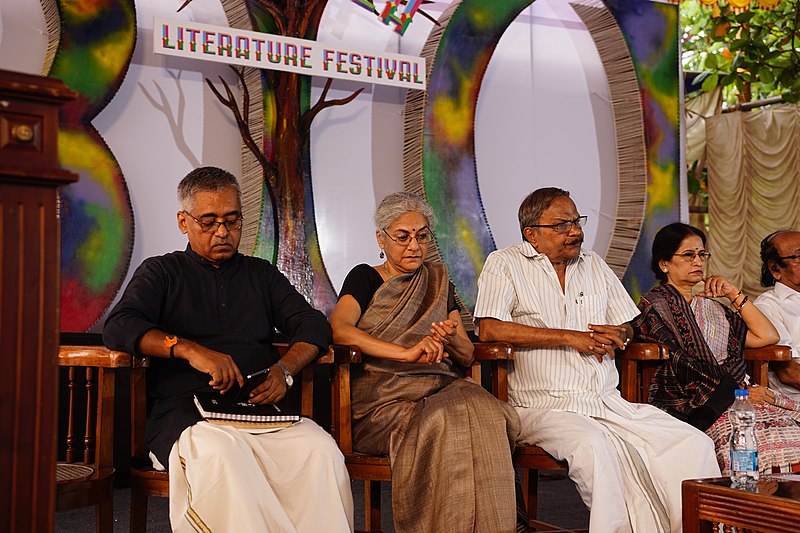
kerala literature festival
Amarjith Mohan
Key facts
Key facts
• Name — Githa Hariharan • Born — 1954 • Birthplace — Coimbatore, Madras State (now Tamil Nadu), India • Known for — The Thousand Faces of Night I Have Become the Tide • Occupation — Writer, editor • Website — https: githahariharan.com/
Biography
Biography
Githa Hariharan was born in 1954 in Coimbatore, Madras State (now Tamil Nadu), India. She was raised in a Tamil Brahmin home in Bombay and Manila with two siblings. Her father was a journalist for the Times of India and a founder and publisher of The Economic Times. During her childhood, she was encouraged to read, and she studied Carnatic music. She completed a B.A. in English Literature from Bombay University in 1974 and an M.A. in Communications from Fairfield University, Connecticut in 1977. From 1979 to 1984, Hariharan worked as an editor in the Mumbai, Chennai and New Delhi offices of Orient Longman. From 1985 to 2005, she worked as a freelance editor. She has been a Visiting Professor or Writer-in-Residence at Dartmouth College, George Washington University, the University of Kent, Nanyang Technological University, Jamia Millia Islamia and Goa University. Githa Hariharan is also a founder member of the Indian Writers' Forum.
Writing career
Writing career
According to The Atlantic Companion to Literature, "Githa Hariharan's works belong to the renaissance of Indo-English literature which began in the early 1980s when Salman Rushdie's novel Midnight's Children appeared." Hariharan published her first novel, The Thousand Faces of Night, in 1992, which she wrote while on maternity leave from work. According to Meenakshi Bharat, this book "questions the confining code of patriarchy and brings to light the survival strategies of three generations of women" and Hariharan "makes concerted use of myth and folktale to enlarge the space of the lives of "real" people, especially women." She then published a collection of short stories, The Art of Dying, in 1993. In The Ghost of Vasu Master (1994), a retired schoolteacher, Vasu Master, uses storytelling to support a student who "either cannot or will not speak." After forming the Movement for Secularism with other women writers, she wrote children's stories, and co-edited the collection Sorry, Best Friend (1997) with Shama Futehally. In her novel When Dreams Travel (1999), Hariharan retells Arabian Nights with Scheherazade and her sister Dunyazad as protagonists. According to Hariharan, her interest as a writer was "not in the story of how the 1001 nights began or happened, but where that tale ends. What happens in stories after the moment when people live happily ever after." Githa Hariharan has described In Times of Siege (2003) as her "first overtly political novel." According to The Atlantic Companion to Literature, it "is in fact a radical book which discusses the ruling political parties' attempt to rewrite history [...] to give the educational system a Hindu slant." In a 2019 interview with The Indian Express, she stated, "My other books, too, looked at the power structure but I finally decided that I had the confidence and the rage to write about where I was living." In The Hindu, Gowri Ramnarayan writes that In Times of Siege, her "angst is over the betrayal of the secularist vision which shaped the nation, the shrinkage of space in contemporary India for debate, dissent, for the co-existence of pluralities, minorities, cultures." In 2014, her edited volume of nonfiction essays From India to Palestine: Essays in Solidarity was published and includes essays by herself, Meena Alexander, Aijaz Ahmad, Ritu Menon and Nayantara Sehgal. Her 2016 collection Almost Home is described by Kirkus Reviews as "essays on identity, place, and the pervasiveness of the past in the present, by a global literary citizen" and "an uneven collection—never just travel writing or political analysis—that nonetheless seems to map new territory of its own." In a review for The Hindu, Latha Anantharaman writes "the essay on Algeria stands out [...] Hariharan discusses the psychology of colonialism, what happens to the identity of a people when you occupy their land and force them to speak French, think in French, and dress like the French, what happens when you indoctrinate them in French principles and philosophy and yet deny that they are French" and further states "It is in her essay on Palestine that Hariharan best evokes the living voices of people under occupation." Her sixth novel I Have Become the Tide was published in 2019 and is the third with a focus on contemporary India. In 2020, a Malayalam translation of the novel was published by Mātr̥bhūmi Buks. Githa Hariharan co-edited the 2019 essay collection Battling for India: A Citizen’s Reader with Salim Yusufji. In a review for The Wire, Priyanka Tripathi writes, "Drawing its vision from Ambedkar's democracy, the book reiterates that an Indian citizen’s political democracy (full rights to the nation) becomes null and void in the absence of social (discrimination on the basis of caste and age) and economic (freeing all Indians from poverty) democracy." Her work has been translated into Dutch, French, German, Greek, Italian, Spanish, Malayalam, Urdu and Vietnamese. Her writing has also been included in many anthologies of fiction and essays. She has regularly written a monthly column on culture in The Telegraph.
Activism
Activism
In 1995, with assistance from Indira Jaising and the Lawyers Collective, Hariharan challenged the Hindu Minority and Guardianship Act, which placed the mother of a child as the natural guardian "after" the father, as a violation of the right to equality guaranteed under Articles 14 and 15 of the Indian Constitution. The case, Hariharan v. Reserve Bank of India was filed with her husband also as a petitioner and led to a Supreme Court of India judgment protecting the rights of children and finding both the mother and father can be natural guardians of the child. The Supreme Court stated, "[the father] cannot be ascribed to have a preferential right over the mother in the matter of guardianship".
Author
Editor
Editor
• A Southern Harvest, Kath, 1993, • Sorry, Best Friend!, Illustrated Ranjan De, Tulika Publishers, 1997, • Battling for India: A Citizen's Reader, Speaking co-editor Salim Yusufji, 2019, Speaking Tiger,
Text attribution
Licensing
Text attribution
Part of the biographical narrative on this page reuses licensed material. Its origin, revision and licence are recorded here.
The biographical narrative on this page is based on the Wikipedia article Githa Hariharan, revision 1373480087 (EN edition), by its contributors. VALÉORINE has edited that text and built its own documentary record around it. The reused material is available under CC BY-SA 4.0, and this page's reuse of it is offered under the same licence. Everything else on this page — the chronology, the holdings, the evidence, the plates and the connections — is VALÉORINE's own record. Sources and licences.
Notes from the source article
Cited by Wikipedia
Notes from the source article
These works are cited by the source article, in its own numbering. They are recorded as its citations, not as sources VALÉORINE has verified.
- 1.Mukherjee, Sumana. Non-fiction: a fiction writer's gift. Mint. February 21, 2015.
- 2.Oxford University Press. The Oxford Companion to Twentieth-Century Literature in English. 1996. 9780192122711.
- 3.Meenakshi, Bharat. Hariharan, Githa (1954-). Encyclopedia of Post-Colonial Literatures in English. Routledge. 2005. 978-0-415-27885-0.
- 4.Sanga. South Asian Novelists in English: An A-to-Z Guide. Greenwood Publishing Group. 111–114. 2003. 9780313318856.
- 5.Riggan, William. The 1994 Neustadt International Prize for Literature: jurors and candidates. World Literature Today. Winter 1994. 40149846.
- 6.Dartmouth College. Githa Hariharan. The Montgomery Fellows Program. 6 June 2016.
- 7.Goa University. EGO 127 Reading and Writing Conflict ( 1 credit course- 15 hours) By Githa Hariharan, Visiting Chair Professor, Kavivarya Bakibaab Borkar Chair in Literature, Goa University. Visiting Research Professors Programme.
- 8.Githa Hariharan. The Indian Express.
- 9.Mehrotra, Arvind. A Concise History Indian Literature in English. Permanent Black. 2008. 978-8178243023.
- 10.Ray. The Atlantic Companion to Literature in English. Atlantic Publishers & Distributors (P) Limited. 230–232. 2007. 9788126908325.
- 11.When Dreams Travel (By Githa Hariharan). The Sentinel. October 6, 2018.
- 12.Kang, Bhavdeep. 'The Cerebral Erotica Was Fun'. Outlook. February 1, 1999.
- 13.Chakrabarti, Paromita. 'There is no such thing as an objective fiction writer'. The Indian Express. March 10, 2019.
- 14.Ramnarayan, Gowri. Plea for pluralism. The Hindu. April 22, 2003.
- 15.Dundoo, Sangeetha Devi. 'My voice is a medley'. The Hindu. January 27, 2014.
- 16.Almost Home. Kirkus Reviews. January 15, 2016.
- 17.Anantharaman, Latha. Home is where the heart is. The Hindu. April 4, 2015.
- 18.Sharma, Manik. Githa Hariharan on her latest novel I Have Become The Tide, Rohith Vemula, politics of her writing. Firstpost. March 6, 2019.
- 19.Tripathi, Priyanka. Review: Battling Hatred and Sectarianism for Indian Democracy. The Wire. April 10, 2019.
- 20.Cornell University. Hariharan v. Reserve Bank of India. Legal Information Institute. January 1999.
- 21.Fernandes, Joeanna Rebello. It's sad we needed the law to tell us that the mother's a natural guardian: Githa Hiraharan. Times of India. July 12, 2015.
- 22.SC redefined Hindu Guardianship Law. Indian National Bar Association.
- 23.Rajagopal, Bulbul. 'There is no one single authority in my stories': Githa Hariharan. The Hindu. April 6, 2019.
- 24.Masoodi, Ashwaq. Five cases where courts have given secular laws precedence over personal codes. Mint. March 1, 2016.
References
Citations
References
Each reference names the institution holding it, so a reader may go to the document itself.
reference work
Secondary witnessreference work
Secondary witness
People, houses and institutions
Knowledge graph
People, houses and institutions
Teachers, collaborators, publishers and institutions recorded against this person, each on a stated basis.
Citizenship
1- IndiaPlace
Established from a fact already recorded on a verified source.
The Encyclopedia exists whether or not anything is for sale. Corrections are recorded rather than overwritten, and every version of this record is kept. Published 21 August 2026.
Elsewhere in Books
39,529 published records in this field, each with its sources named.
- Gisèle PrassinosAuthor
- Gishūmon-in no TangoAuthor
- Gísli Örn GarðarssonAuthor
- Gita MehtaAuthor
- Gitl Schaechter-ViswanathAuthor
- Gitta SerenyAuthor
- Giulia EndersAuthor
- Giulia Molino ColombiniAuthor
Best supported in this field
For owners
Own a work by Githa Hariharan?
A specialist will read what you send and tell you what the house can establish, what it cannot, and whether the object is suited to sale. There is no charge and no obligation. The object stays with you throughout; nothing is shipped to us unless it is arranged in writing beforehand.