
Giovanni Salucci
Giovanni Battista Salucci (born 1 July 1769 in Florence; died 18 July 1845 in Florence) was an Italian architect.
Also recorded as Giovanni Battista Salucci
Giovanni Salucci
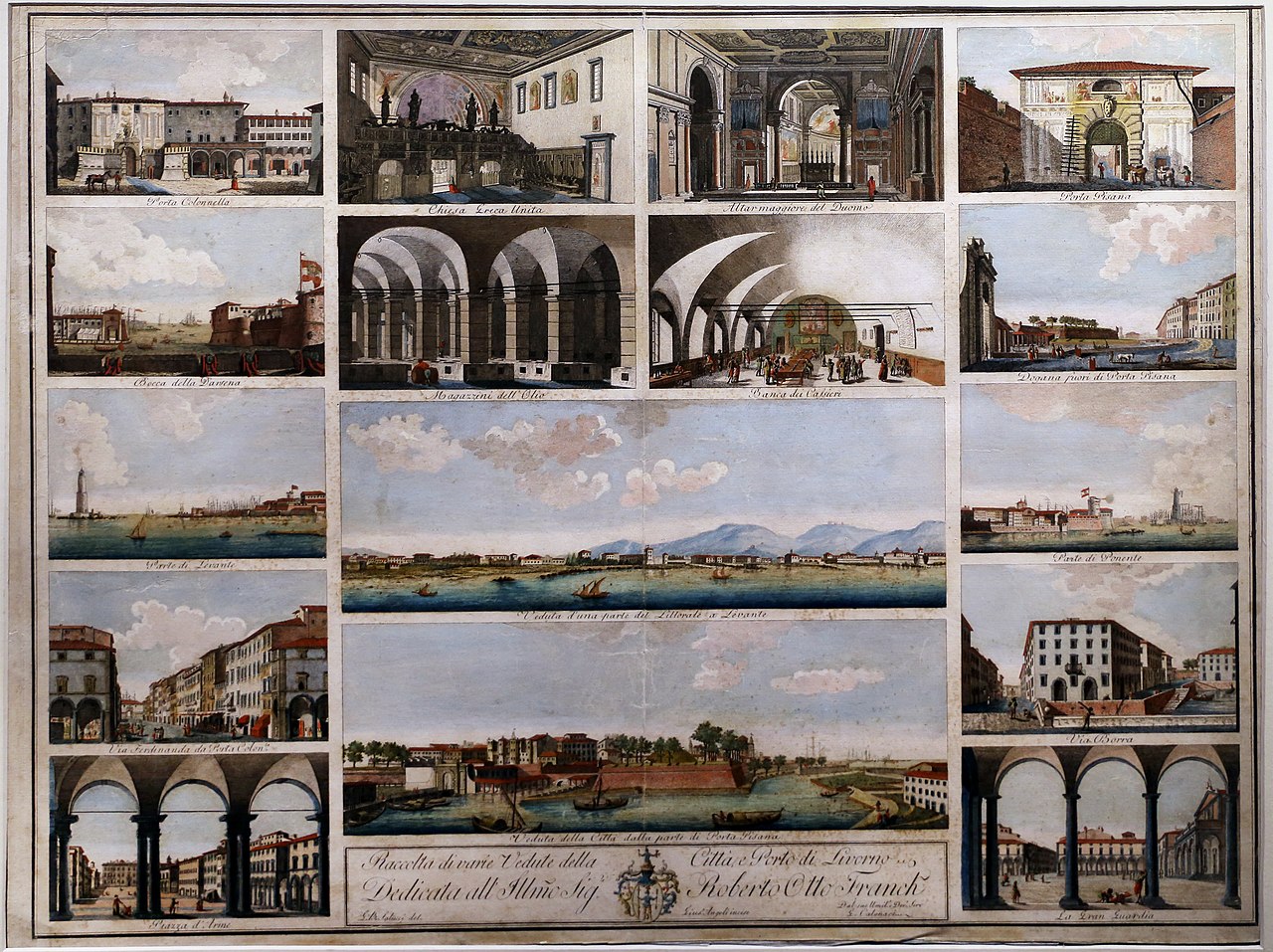
Sailko · CC BY 3.0
- Name
- Giovanni Salucci
- Birth Name
- Giovanni Battista Salucci
- Born
- 1 July 1769
- Birthplace
- Florence, Grand Duchy of Tuscany
- Died
- 18 July 1845
- Place of death
- Florence, Tuscany, Italy
- Education
- Accademia delle Arti del Disegno
- Occupation
- Architect
- Nationality
- Germany
- Fields
- architecture · visual arts
- Languages
- German · Italian
VALÉORINE Encyclopedia
VALÉORINE documentary reading
Documentary summary
Giovanni Battista Salucci (born 1 July 1769 in Florence; died 18 July 1845 in Florence) was an Italian architect.
Admitted source layer · organised and presented by VALÉORINE
Reference Check
Propose documentary evidence for Giovanni Salucci. A contribution is never written directly as fact: identity, source, rights and evidence gates still decide.
Sign in to contribute
World of VALÉORINE
Documentary connections
Only confirmed graph relationships appear here. Images are shown only when their identity and reuse rights both pass the documentary gate.
Documentary evidence
Documentary basis
Authority files
wikidata · Q1252994 · wikipedia · Giovanni Salucci
In this article
Key facts
Key facts
• Name — Giovanni Salucci • Birth Name — Giovanni Battista Salucci • Born — 1 July 1769 • Birthplace — Florence, Grand Duchy of Tuscany • Died — 18 July 1845 • Place of death — Florence, Tuscany, Italy • Education — Accademia delle Arti del Disegno • Occupation — Architect
Life and work
Life and work
In 1783 Giovanni Salucci began studying architecture at the Accademia di Belle Arti in Florence. He received his first commissions during study trips to Rome and the Veneto. In 1797, during a stay in Bologna, he moved in political circles close to the ideas of the French Revolution. Salucci thereby aroused the mistrust of the government of the Habsburg Grand Duchy of Tuscany and was sentenced to death in absentia in 1798. Thereupon he joined the French Italian Army. In 1801 he was employed as topographer for the Cisalpine Republic, a daughter republic under Napoleon in northern Italy, and in 1802 he worked on the fortifications of Alessandria, Mantua, and Verona. Afterwards he took part in the French invasion of Russia. He survived and managed to escape to Danzig. After the Battle of Waterloo he fell into English captivity, from which he was released in 1816. After his release, he initially worked for the Geneva banker Jean Gabriel Eynard, from whom he received a recommendation for King Wilhelm I of Württemberg. The latter appointed him court architect in 1818. In Württemberg, the Royal Pavilion in Weil near Esslingen was initially built in collaboration with the Queen Catherine of Württemberg, who was a passionate lover of architecture. In 1819, after her death, he built her Württemberg Mausoleum. From 1823 to 1829 the Schloss Rosenstein was built according to the plans of Salucci. Other buildings designed by him are the Wilhelmspalais and the Alte Reithalle (royal riding hall), both in Stuttgart. Since the planned costs for the Royal Pavilion in Weil were exceeded, he soon had to have everything approved by the Building and Garden Directorate. In 1828, after a dispute with a superior, he applied for his dismissal. Four days later, however, he asked to be reinstated. In 1839 dry rot was discovered in Rosenstein Castle, for which Salucci was made responsible; this led to his final dismissal. In 1840 Salucci returned to Florence almost penniless. He died there in 1845 and was buried in the cloister of the St Mark’s, Florence.
Gallery
Gallery
• Illustration — Royal pavilion in Esslingen-Weil • Illustration — Wilhelmspalais at Charlottenplatz in Stuttgart • Illustration — Castle Rosenstein in Stuttgart • Illustration — Württemberg Mausoleum in Stuttgart
Identity and overview
Identity and overview
The following is established of the heading itself.
Works and production
Works and production
Catalogued output is recorded as follows. The record continues: giovanni Salucci is recorded with the occupation architect.

Collections of the Museo della città (Livorno)
Sailko

Schloss Weil, Esslingen-Weil, Architekt Giovanni Salucci
Pjt56
Works in Public Collections
Works in Public Collections
• Salucci's estate, consisting of 142 drafts of buildings, is located in the Stuttgart University Library (Inv. No. Salu001-Salu142) and in the Digital Collections of the Stuttgart University Library. • Photographic collection "Giovanni Salucci's classicist buildings in Württemberg" by Rotraud Harling in the Map and Plan Collection of the Stuttgart University Library: Map and Plan Collection.
Documents and archives
Primary material
Documents and archives
Institutional database
- Wikidata, structured authority record Q1252994: Giovanni Salucci
Scholarly · Wikimedia Foundation
reference work
- “Giovanni Salucci”, English Wikipedia, consulted as further reading
Reputable secondary · Wikipedia
Literature
• Georg Leisten: Das zeitlos Schöne überlebt. Ausstellung: Die Stuttgarter Fotografin Rotraud Harling huldigt dem Werk des Architekten Giovanni Salucci. In: Stuttgarter Zeitung Nr. 289, 13. December 2013, page 29. • Giuseppe Ponsi: Memorie della vita e delle opere di Giovanni Salucci Fiorentino / Erinnerungen, Leben und Werk des Giovanni Salucci Fiorentino. Florence 1850. • Giuseppe Ponsi; Bruno Zoratto (editor): Giovanni Salucci in den Beschreibungen eines Freundes / Giovanni Salucci nelle descrizioni di un amico. Stuttgart 1998. Reprint of Ponsi 1850.
Citations
References
Each reference names the institution holding it, so a reader may go to the document itself.
Institutional database
Wikidata, structured authority record Q1252994: Giovanni SalucciWikimedia Foundation
Institutional witnessreference work
Secondary witness
The Encyclopedia exists whether or not anything is for sale. Corrections are recorded rather than overwritten, and every version of this record is kept. Published 16 August 2026.
Elsewhere in Design
11,558 published records in this field, each with its sources named.
- Giovanni Pietro de PomisDesigner
- Giovanni Pietro LigarioDesigner
- Giovanni Pietro MagniDesigner
- Giovanni PonzelloDesigner
- Giovanni SardiDesigner
- Giovanni SimonettiDesigner
- Giovanni Stefano MarucelliDesigner
- Giovanni VasanzioDesigner
Best supported in this field
For owners
Own a work by Giovanni Salucci?
A specialist will read what you send and tell you what the house can establish, what it cannot, and whether the object is suited to sale. There is no charge and no obligation. The object stays with you throughout; nothing is shipped to us unless it is arranged in writing beforehand.