
Gilbert Stuart
Gilbert Stuart (Stewart; December 3, 1755 – July 9, 1828) was an American painter born in the Rhode Island Colony who is widely considered one of America's foremost portraitists. His best-known work is an unfinished portrait of George Washington, begun in 1796, which is usually referred to as the Athenaeum Portrait. Stuart retained the original and used it to paint scores of copies that were commissioned by patrons in America and abroad.
Also recorded as Gilbert Charles Stuart · Gilbert Stewart · G. Stuart · American Stuart
Gilbert Stuart
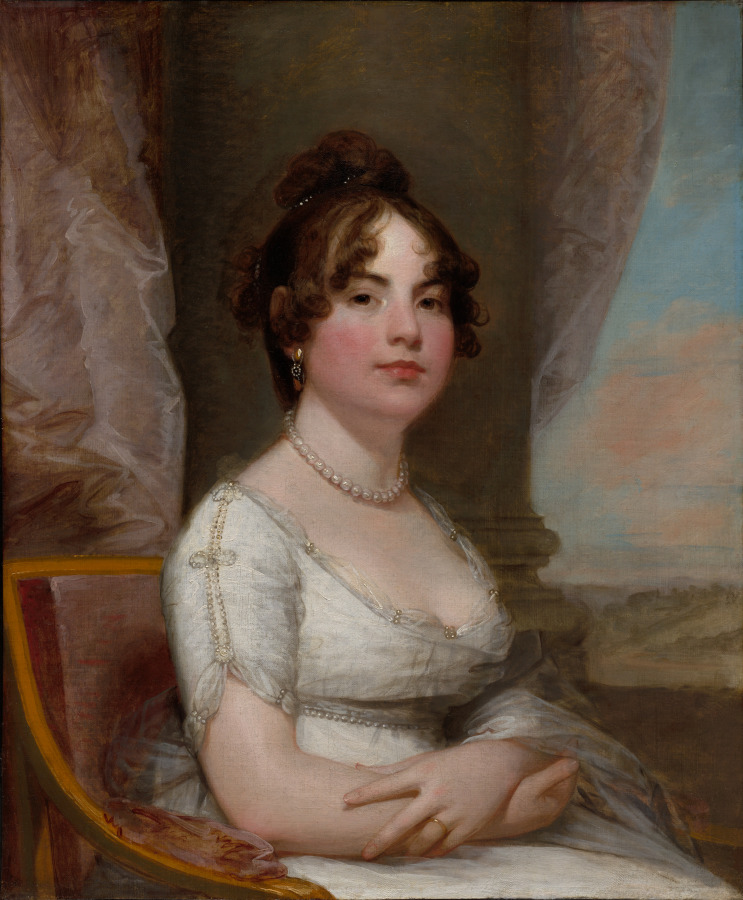
Gilbert Stuart · The Cleveland Museum of Art · Gift from J. H. Wade · CC0
- Name
- Gilbert Stuart
- Birth Name
- Gilbert Stewart
- Born
- 3 December 1755
- Birthplace
- Saunderstown, Colony of Rhode Island and Providence Plantations, British America
- Died
- 9 July 1828
- Place of death
- Boston, Massachusetts, U.S.
- Field
- Painting
- Nationality
- United States
- Occupation
- painter · portraitist · artist · portrait painter · organist
- Fields
- portrait · portrait painting
- Movements
- Neoclassicism
- Known for
- John Jones of Frankley · Mrs. Stephen Peabody · Lansdowne Portrait
VALÉORINE Encyclopedia
VALÉORINE documentary reading
Documentary summary
Gilbert Stuart (Stewart; December 3, 1755 – July 9, 1828) was an American painter born in the Rhode Island Colony who is widely considered one of America's foremost portraitists. His best-known work is an unfinished portrait of George Washington, begun in 1796, which is usually referred to as the Athenaeum Portrait. Stuart retained the original and used it to paint scores of copies that were commissioned by patrons in America and abroad.
Admitted source layer · organised and presented by VALÉORINE
Reference Check
Propose documentary evidence for Gilbert Stuart. A contribution is never written directly as fact: identity, source, rights and evidence gates still decide.
Sign in to contribute
Documentary evidence
Documentary basis
Authority files
gnd · 119151324 · wikidata · Q41402 · wikipedia · Gilbert Stuart
In this article
Biography
Biography
The image of George Washington featured in the painting has appeared on the United States one-dollar bill for more than a century and on various postage stamps of the 19th century and early 20th century. Stuart produced portraits of about 1,000 people, including the first six Presidents. His work can be found today at art museums throughout the United States and the United Kingdom, including the Metropolitan Museum of Art and Frick Collection in New York City, the National Gallery of Art in Washington, D.C, the Philadelphia Museum of Art in Philadelphia, the National Portrait Gallery in Washington D.C, the National Portrait Gallery in London, England, the Worcester Art Museum in Worcester, Massachusetts, and the Boston Museum of Fine Arts.
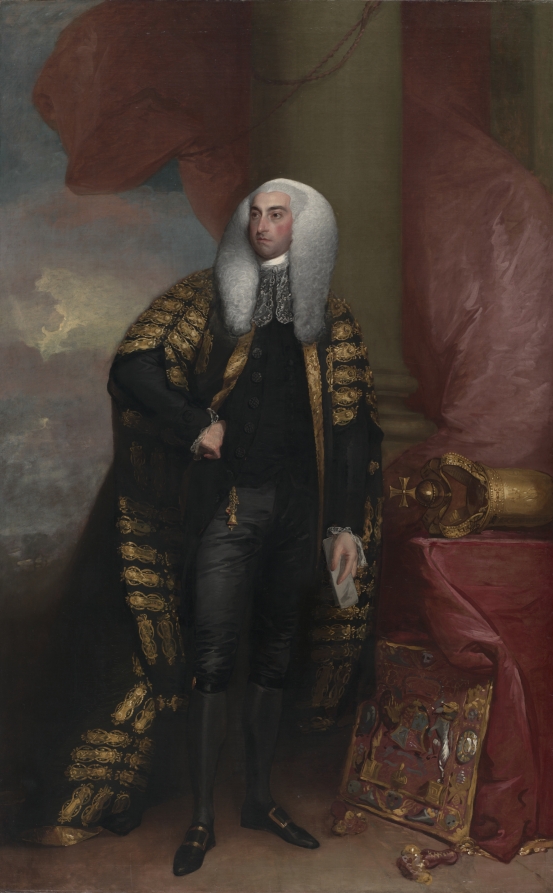
Baron FitzGibbon, 1789, by Gilbert Stuart
Gilbert Stuart · The Cleveland Museum of Art · General Income Fund
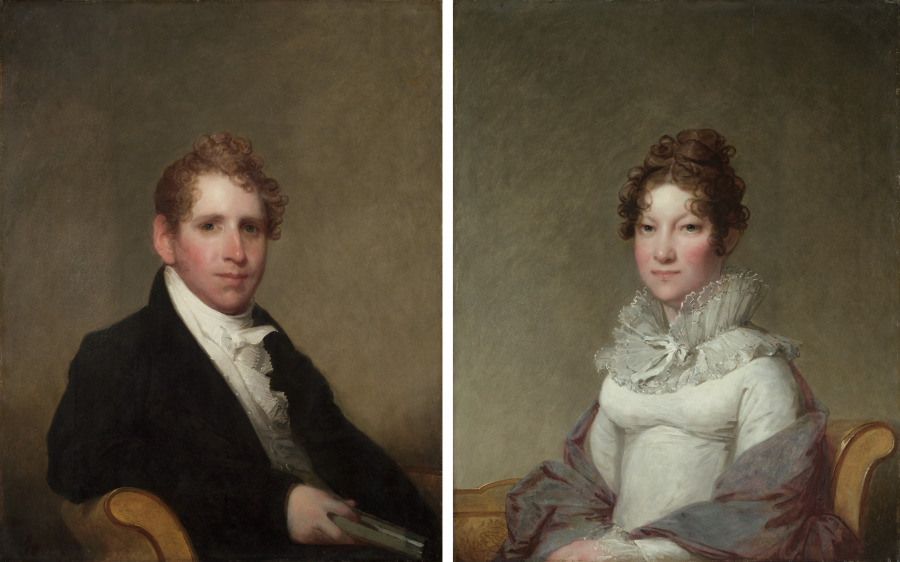
Dr. James Stuart; Mary Campbell Stuart, c. 1815, by Gilbert Stuart
Gilbert Stuart · The Cleveland Museum of Art · The Charles W. Harkness Gift
Key facts
Key facts
• Name — Gilbert Stuart • Birth Name — Gilbert Stewart • Born — 3 December 1755 • Birthplace — Saunderstown, Colony of Rhode Island and Providence Plantations, British America • Died — 9 July 1828 • Place of death — Boston, Massachusetts, U.S. • Field — Painting • Works — * George Washington (The Athenaeum Portrait) (1796) • George Washington (Lansdowne portrait) (1796) • Vaughan Portrait (1795) • The Skater (1782) • Catherine Brass Yates (1794) • John Adams (1824)
Early life
Early life
• Illustration — The Gilbert Stuart Birthplace in Saunderstown, Rhode Island • Illustration — Portrait of William Hunter's spaniels, c. 1770 Stuart was born on December 3, 1755, in Saunderstown, a village of North Kingstown in the Colony of Rhode Island and Providence Plantations, and he was baptized at Old Narragansett Church on April 11, 1756. He was the third child of Gilbert Stuart, a Scottish immigrant employed in the snuff-making industry, and Elizabeth Anthony Stuart, a member of a prominent land-owning family from Middletown, Rhode Island. Stuart's father owned the first snuff mill in America, which was located in the basement of the family homestead. Stuart moved to Newport, Rhode Island, at the age of six, where his father pursued work in the merchant field. In Newport, he first began to show great promise as a painter. In 1770, he made the acquaintance of Scottish artist Cosmo Alexander, a visitor to the colonies who made portraits of local patrons and who became a tutor to Stuart. Under the guidance of Alexander, Stuart painted the portrait Dr. Hunter's Spaniels when he was 14; it hangs today in the Hunter House Mansion in Newport. In 1771, Stuart moved to Scotland with Alexander to finish his studies; however, Alexander died in Edinburgh one year later. Stuart tried to maintain a living and pursue his painting career, but to no avail, so he returned to Newport in 1773.
England and Ireland
England and Ireland
• Illustration — The Skater, a 1782 portrait of Sir William Grant Stuart's prospects as a portraitist were jeopardized by the onset of the American Revolution and its social disruptions. Although he was a patriot, he departed for England in 1775 following the example set by John Singleton Copley. His painting style during this period began to develop beyond the relatively hard-edged and linear style that he had learned from Alexander. He was unsuccessful at first in pursuit of his vocation, but he became a protégé of Benjamin West in 1777 and studied with him for the next six years. The relationship was beneficial, with Stuart exhibiting for the first time at the Royal Academy in spring of 1777. By 1782, Stuart had met with success, largely due to acclaim for The Skater, a portrait of Sir William Grant. It was Stuart's first full-length portrait and, according to a rival, it belied the prevailing opinion that Stuart "made a tolerable likeness of a face, but as to the figure, he could not get below the fifth button'". Stuart said that he was "suddenly lifted into fame by a single picture". The prices for his pictures were exceeded only by those of renowned English artists Joshua Reynolds and Thomas Gainsborough. Despite his many commissions, however, he was habitually neglectful of finances and was in danger of being sent to debtors' prison. In 1787, he fled to Dublin, Ireland where he painted and accumulated debt with equal vigor.
New York City and Philadelphia
New York City and Philadelphia
Stuart ended his 18-year stay in Britain and Ireland in 1793, leaving behind numerous unfinished paintings. He returned to the United States with a particular goal of painting a portrait of George Washington and having an engraver reproduce it and provide for his family through the engraving's sale. He settled briefly in New York City and pursued portrait commissions from influential people who could bring him to Washington's attention. In 1794, he painted statesman John Jay, from whom he received a letter of introduction to Washington. In 1795, Stuart moved to the Germantown section of Philadelphia, where he opened a studio, and Washington posed for him later that year. • Illustration — George Washington engraving by G.F.C. Smillie • Illustration — Lansdowne portrait of George Washington, 1796 Stuart painted Washington in a series of iconic portraits, each of them leading to a demand for copies and keeping him busy and highly paid for years. The most famous and celebrated of these likenesses, the Athenaeum portrait, is portrayed on the United States one-dollar bill. Stuart painted about 50 reproductions of it. However, he avoided completing the original version. After finishing Washington's face, he kept it to make copies which he sold for $100 each. Thus, the original portrait remained in its unfinished state at the time of his death in 1828. An engraver at the US Bureau of Engraving and Printing, George Frederick Cumming Smillie, made an etching of the painting which was used on multiple banknotes. A vignette of the portrait appears on the 1899 2-dollar silver certificate, and the one dollar note of (1918 to 2023). United States one-dollar bills featured the image for decades (1918 to 2023). The painting was jointly purchased by the National Portrait Gallery and Museum of Fine Arts, Boston in 1980, and is generally on display in the National Portrait Gallery. Another celebrated image of Washington is the full-length Lansdowne portrait, now in the National Portrait Gallery. Its historical importance is almost matched by an early forgery based on it which was purchased for the White House. This painting was rescued during the Burning of Washington in the War of 1812 thanks to the efforts of First Lady Dolley Madison and Paul Jennings, one of President James Madison's slaves. Three replicas of the original portrait are accepted as by Stuart. Additional copies were painted by other artists. In 1803, Stuart opened a studio in Washington, D. C. In 1800, Thomas Jefferson paid Stuart $100.00 for a portrait but never received it, because in 1805, Stuart painted another portrait of Jefferson over the 1800 portrait. In 1821, Stuart sent a copy of the 1805 so called "Edgehill" portrait to Jefferson. The original 1805 portrait became part of Jane Stuart collection until it was damaged in a fire in 1853. In 1937, Orland Campbell acquired the 1805 portrait and discovered the truth. In June 1959, Campbell had an exhibit at Amherst College of the 1800/1805 portrait and his reconstruction of the "lost" 1800 portrait. Campbell also published an account "The Lost Portraits of Thomas Jefferson Painted by Gilbert Stuart Recovered and Studied by Orland and Courtney Campbell" (1959).
Boston, 1805–1828
Boston, 1805–1828
Stuart moved to Devonshire Street in Boston in 1805, continuing in both critical acclaim and financial troubles. He exhibited works locally at Doggett's Repository and Julien Hall. Predictably, he was sought out for advice by other American artists, such as John Trumbull, Thomas Sully, Washington Allston, and John Vanderlyn.
Personal life
Personal life
• Illustration — Portrait of Stuart by Sarah Goodridge, c. 1825 Stuart married Charlotte Coates around September 1786; she was 13 years his junior and "exceedingly pretty". They had 12 children, five of whom died by 1815 and two others of whom died in their youth. Their daughter Jane (1812–1888) was also a painter. She sold many of his paintings and her replicas of them from her studios in Boston and Newport, Rhode Island. In 2011, she was inducted into the Rhode Island Heritage Hall of Fame. In 1824, Stuart suffered a stroke which left him partially paralyzed, but he continued to paint for two years until his death in Boston on July 9, 1828, at 72. He was buried in the Central Burial Ground at Boston Common. Stuart left his family deeply in debt, and his wife and daughters were unable to purchase a grave site. He was, therefore, buried in an unmarked grave which was purchased cheaply from Benjamin Howland, a local carpenter. His family recovered from their financial troubles 10 years later, and they planned to move his body to a family cemetery in Newport. However, they could not remember the exact location of his body, and it was never moved. There is a monument for Stuart, his wife, and their children at the Common Burying Ground in Newport. The Boston Athenæum held a benefit exhibition of Stuart's works in August 1828 in an effort to provide financial aid for his family. More than 250 portraits were lent for this critically acclaimed and well-subscribed exhibition. This also marked the first public showing of his unfinished 1796 Athenæum portrait of Washington.
Notable people painted
Notable people painted
• Illustration — George Washington (The Constable-Hamilton Portrait, 1797) Crystal Bridges Museum of American Art, Bentonville, Arkansas This is a partial list of portraits painted by Stuart. • Abigail Adams – Second First Lady of the United States, wife of John Adams • John Adams – Second President of the United States • John Quincy Adams – Sixth President of the United States • Charles Humphrey Atherton – United States Representative from New Hampshire from 1815 to 1817 • John Jacob Astor – First American multi-millionaire, fur trader, art patron • John Bannister – Owner of Bannister's Wharf in Newport, Rhode Island • Commodore John Barry – Father of the American Navy • Commodore Oliver Hazard Perry – Hero of the Battle of Lake Erie in 1814. * • Illustration — Gilbert Stuart painted by Jane Stuart, Gilbert Stuart Birthplace Ann Willing Bingham – Philadelphia socialite • Horace Binney – Prominent Philadelphia lawyer • Elizabeth Bowdoin, Lady Temple – wife of Sir John Temple, first British consul general to United States, 1785 • Hugh Henry Brackenridge – early American writer, Pennsylvania Supreme Court justice, and founder of the University of Pittsburgh • Jean Baptiste Casmiere Breschard – Performer and theatrical impresario • Rosalie Stier Calvert – Belgian-born heiress and mother of Charles Benedict Calvert • Mary Willing Clymer – Philadelphia socialite • John Singleton Copley – American colonial portraitist • Thomas Dawes – Early American architect, builder, military leader, politician • Horatio Gates – American Revolutionary War general • King George III – King of United Kingdom of Great Britain and Ireland, 1760–1820 • King George IV – King of United Kingdom of Great Britain and Ireland, 1820–30 • John Jay – First Chief Justice of the United States Supreme Court • Thomas Jefferson – Third President of the United States • Rufus King – a signer of United States Constitution • Robert Kingsmill – Admiral in Royal Navy during American and French Revolutionary Wars • King Louis XVI – King of France, 1774–92 • James Madison – Fourth President of the United States • Samuel Miles – Revolutionary War General and Philadelphia mayor • James Monroe – Fifth President of the United States • Daniel Pinckney Parker – Prominent Boston merchant • John Randolph of Roanoke – Virginia congressman and senator • Joshua Reynolds – English artist • Henry Rice – Boston merchant and Massachusetts state legislator • John Tayloe III – Virginia planter, builder of The Octagon House in Washington, DC. • Thomas Townshend, 1st Viscount Sydney – the cities of Sydney in New South Wales and Sydney, Nova Scotia are named in his honor • John Trumbull – artist during the period of the American Revolutionary War • George Washington – First President of the United States • Martha Washington – First Lady of the United States, wife of George Washington • Benjamin West – American painter • John FitzGibbon, 1st Earl of Clare – Attorney General and Lord Chancellor of Ireland • Catherine Brass Yates – Philadelphia socialite • John Bill Ricketts – Equestrian, leader of Ricketts' Circus in Philadelphia • Elisabeth Merry – Wife of Anthony Merry 1805.
Portrait gallery
Portrait gallery
• Illustration — Portrait of William Woollett, 1783 • Illustration — Portrait of Benjamin West, 1783–84 • Illustration — Portrait of Joshua Reynolds, 1784 • Illustration — Portrait of Isaac Barré, 1785 • Illustration — John Philip Kemble, 1785 • Illustration — John Jones of Frankley, 1785, Birmingham Museum of Art • Illustration — Mohawk leader Joseph Brant, 1785, British Museum, London • Illustration — Portrait of the Earl of Clare, 1789 • Illustration — Portrait of Catherine Brass Yates 1793–94 • Illustration — Portrait of Henry Cruger, 1794 • Illustration — Portrait of John Jay, 1794, First Chief Justice of the United States Supreme Court • Illustration — William Bayard, 1794, Princeton University Art Museum • Illustration — Portrait of Horatio Gates, 1794, Metropolitan Museum of Art • Illustration — Gibbs-Channing-Avery Portrait, 1795, Metropolitan Museum of Art New York City • Illustration — Martha Washington, c. 1796 • Illustration — alt=Detailed painting of head and shoulders of Washington. Over half of the canvas is blank. Stuart's unfinished 1796 painting of George Washington, also known as the Athenaeum Portrait, his most celebrated and famous work • Illustration — Winthrop Sargent, c. 1799–1805 • Illustration — Horace Binney, c. 1800 • Illustration — Samuel Smith, c. 1800 • Illustration — The second First Lady of the United States, Abigail Adams, c. 1800–1815 • Illustration — The second President of the United States, John Adams c. 1800–1815 • Illustration — The fourth President of the United States, James Madison, 1804, Bowdoin College Museum of Art • Illustration — Portrait of Dolley Madison, 1804 • Illustration — Anna Payne Cutts, sister of First Lady Dolley Madison, 1804, The White House • Illustration — Eleanor Parke Custis Lewis, c. 1804 • Illustration — John Carroll, first Catholic bishop of the United States, c. 1804, Georgetown University Art Collection, Washington, D.C. • Illustration — Rosalie Stier Calvert and her eldest daughter Caroline Maria, c. 1805 • Illustration — George Washington At Dorchester Heights, 1806, Boston Museum of Fine Arts • Illustration — John Rodgers, c. 1810 • Illustration — Portrait of Henry Dearborn, c. 1812 • Illustration — William Bainbridge, c. 1813 • Illustration — This lithograph of Little Turtle is reputedly based upon a lost portrait by Gilbert Stuart that was destroyed when the British burned Washington in 1814. • Illustration — Henry Rice, Boston merchant and Massachusetts state legislator, c. 1815 • Illustration — Thomas Macdonough, c. 1815–1818 • Illustration — American artist John Trumbull, c. 1818 • Illustration — The sixth President of the United States, John Quincy Adams, 1818 • Illustration — The sixth First Lady of the United States, Louisa Catherine Adams c. 1821–1826, daughter-in law of John and Abigail Adams • Illustration — The third President of the United States, Thomas Jefferson, c. 1821, National Gallery of Art, Washington, D.C. • Illustration — The fourth President of the United States, James Madison, c. 1821, National Gallery of Art • Illustration — The fifth President of the United States, James Monroe, c. 1820–1822, Metropolitan Museum of Art New York City • Illustration — Portrait of Jean-Louis Lefebvre de Cheverus, 1823 • Illustration — The second President of the United States, John Adams, 1826
Identity and origins
Identity and origins
Gilbert Stuart was recorded at birth as Gilbert Charles Stuart. The authorities additionally record the headings Gilbert Charles Stuart, Gilbert Stewart, G. Stuart, American Stuart and American Stewart. His recorded language was English. He was the child of Gilbert Stuart, Sr. And Elizabeth Stuart. One child is recorded: Jane Stuart.
Life and career
Dated record
Life and career
The full dated record · 2 entries
1755
Gilbert Stuart born at North Kingstown.
1828
Gilbert Stuart died at Boston.
Legacy
By the end of his career, Gilbert Stuart had painted the likenesses of more than 1,000 American political and social figures. He was praised for the vitality and naturalness of his portraits, and his subjects found his company agreeable. John Adams said: Speaking generally, no penance is like having one's picture done. You must sit in a constrained and unnatural position, which is a trial to the temper. But I should like to sit to Stuart from the first of January to the last of December, for he lets me do just what I please, and keeps me constantly amused by his conversation. Stuart was known for working without the aid of sketches, beginning directly upon the canvas. His approach is suggested by the advice which he gave to his pupil Matthew Harris Jouett: "Never be sparing of colour, load your pictures, but keep your colours as separate as you can. No blending, tis destruction to clear & bea[u]tiful effect." Although this is an exaggeration to avoid muddiness, Stuart's colors were remarkably fresh. At Stuart's best, he had an extraordinary ability to convey the impression of "luminous, transparent flesh" with color coming from beneath. The face seemed to be embued with life, while the beauty of its coloring conveyed a spiritual quality to contemporaries. Although uneven, he could produce astonishingly strong likenesses. John Henri Isaac Browere created a life mask of Stuart around 1825. In 1940, the U.S. Post Office issued a series of postage stamps called the "Famous Americans Series" commemorating famous artists, authors, inventors, scientists, poets, educators, and musicians. Gilbert Stuart is found on the 1 cent issue in the artists category, along with James McNeill Whistler, Augustus Saint-Gaudens, Daniel Chester French, and Frederic Remington. Today, Stuart's birthplace in Saunderstown, Rhode Island, is open to the public as the Gilbert Stuart Birthplace and Museum. The birthplace consists of the original house where he was born, with copies of his paintings hanging throughout the house, as well as a separate art gallery in which are displayed several original paintings by both Gilbert Stuart and his daughter Jane. The museum opened in 1931. • Illustration — alt=Marble plaque with an outlay of a feather linked to a piece of chain, and the name "Gilbert Stuart" carved on it. Memorial tablet located in the Boston Common • Illustration — John H. I. Browere's life mask portrait of Stuart, c. 1825 • Illustration — Gilbert StuartIssue of 1940 Gilbert Stuart's paintings of Washington, Jefferson, and others have served as models for dozens of U.S. postage stamps. Washington's image from the famous portrait The Athenaeum is probably the most noted example of Stuart's work on postage. • Illustration — 1861 • Illustration — 1861 • Illustration — 1903 • Illustration — 1954
Context
Primary material
Context
The circumstances in which Gilbert Stuart stands. Joseph Anthony Jr. Catherine Yates Pollock (Mrs. Catherine Brass Yates (Mrs.
Documents and archives
Primary material
Documents and archives
scholarly publication
- Stuart, Gilbert, Benezit Dictionary of Artists, 2011
Scholarly · Crossref registry · 2011
Institutional database
- Wikidata, structured authority record Q41402: Gilbert Stuart
Scholarly · Wikimedia Foundation
authority file
- Gemeinsame Normdatei 119151324, Gilbert, Stuart.
General reference · Deutsche Nationalbibliothek
Notes from the source article
Cited by Wikipedia
Notes from the source article
These works are cited by the source article, in its own numbering. They are recorded as its citations, not as sources VALÉORINE has verified.
- 1.Worcester Art Museum. Gilbert Stuart (1775–1828).
- 2.[http://www.gilbertstuartmuseum.com/ Park, 1926, vol. 1, p. 15. He was baptised without a middle name but occasionally adopted the middle name "Charles" when in London, apparently to connect himself with the last serious Stuart claimant to the British throne. See Dorinda Evans, Gilbert Stuart and the Impact of Manic Depression, Ashgate Publishing Ltd., 2013, p. 127. ]
- 3.Smithsonian National Postal Museum. 10-cent Washington.
- 4.Gilbert Stuart Birthplace.
- 5.Gilbert Stuart . ArtCyclopedia. Paintings in Museums and Public Art Galleries. Retrieved July 24, 2007.
- 6.Committee of Management. The Old Narragansett Church (St. Paul's): Built A.D. 1707. A Constant Witness to Christ and His Church. 15. 1915.
- 7.The Gilbert Stuart Museum. Gilbert Stuart.
- 8.Gilbert Stuart. NNDB.
- 9.McLanathan 1986, p. 13.
- 10.Gilbert Stuart Birthplace . Gilbert Stuart. Retrieved July 28, 2007.
- 11.National Gallery of Art. Gilbert Stuart, Newport and Edinburgh (1755–1775).
- 12.Redwood Library and Athenæum, Newport Rhode Island. Gilbert Stuart.
- 13.Germantown, Portrait Artist. Gilbert Stuart.
- 14.Evans 1999, p. 10
- 15.National Gallery of Art . Gilbert Stuart. London (1775–1787). Retrieved July 31, 2007.
- 16.National Gallery of Art. Retrieved November 24, 2019.
- 17.Christman, M., & Barlow, M. (2003). Stuart [Stewart], Gilbert. Grove Art Online. Retrieved November 29, 2019.
- 18.Christman, Margaret C. S. "Stuart, Gilbert." In Grove Art Online. Oxford Art Online. Retrieved October 1, 2012
- 19.National Gallery of Art .The Skater (Portrait of William Grant), 1782. Retrieved November 23, 2014.
- 20.National Gallery of Art . Gilbert Stuart. Dublin (1787–1793). Retrieved July 31, 2007.
- 21.Park et al. (1926), p. 44.
- 22.americanrevolution.org. Gilbert Stuart – Washington.
- 23.Smithsonian Institution. George Washington.
- 24.National Gallery of Art . Gilbert Stuart. Philadelphia (1794–1803). Retrieved July 31, 2007.
- 25."George Washington Portrait by Gilbert Stuart" , www.mountvernon.org. Retrieved September 14, 2019.
- 26.Wallechinsky, David and Irving Wallace. Unfinished Art: Gilbert Stuart's Portrait of George Washington. The People's Almanac. Trivia-Library.com.
- 27.Schöne, Michael H. G. F. C. Smillie - Der beste Graveur seiner Zeit. geldscheine-online. December 19, 2023.
- 28.Museum of Fine Arts, Boston, George Washington Accessed December 12, 2014.
- 29.National Portrait Gallery Collections Search, p. 9. Accessed December 12, 2014.
- 30.Evans, Dorinda, "William Winstanley (fl 1791-1808): Gilbert Stuart's Shadow and a Swindling Genius", The British Art Journal, XX, no. 3, Winter 2019/2020, 98-101.
- 31.Office of the Clerk, U.S. House of Representatives, Artist Gilbert Stuart's portraits of George Washington. Accessed: May 11, 2012.
- 32.National Gallery of Art . Gilbert Stuart. Washington, D.C. (1803–1805). Retrieved July 31, 2007.
- 33.American Heritage Magazine April 1958 Volume IX Number 3. The Case of the Missing Portrait. 1958.
- 34.Evening star. Washington DC [volume], June 12, 1959, Page C-10, Image 48. 2 Jefferson Paintings go on Exhibt.
- 35.E. Cotton. The Boston Directory. 237. 1813.
- 36.Daily Advertiser, March 2, 1822
- 37.Boston Commercial Gazette, December 1, 1825
- 38.Quote from Jane Stuart in Evans 2013, p. 14.
- 39.Newport Historical Society. History Bytes: Jane Stuart. October 22, 2013.
- 40.Conley, Patrick T. Jane Stuart. Rhode Island Heritage Hall of Fame. 2011.
- 41.McLanathan 1986, p. 148.
- 42.McLanathan 1986, p. 150.
- 43.Wolpaw, Jim. Gilbert Stuart: A Portrait from Life (9-Minute Trailer). Documentary.
- 44.Jane Stuart. Rhode Island Historical Cemetery Commission. 2007.
- 45.Swan, Mabel Munson The Athenæum Gallery 1827–1873: The Boston Athenæum as an Early Patron of Art (Boston: The Boston Athenæum, 1940) pp. 62–73
- 46.Gilbert Stuart Museum. Gilbert Stuart.
- 47.McLanathan 1986, p. 147.
- 48.Evans 1999, pp. 28, 56, 95-96 (quote), 105-06, 110, 118.
- 49.Evans 1999, pp. 27, 56. For uneven, see Evans 2013, pp. 18-19, 69-73, 82-84, 148.
- 50.Charles Henry Hart. Browere's life masks of great Americans. Printed at the De Vinne Press for Doubleday and McClure Company, 1899. Internet Archive
- 51.Gilbert Stuart Museum. Gilbert Stuart Birthplace and Museum.
- 52.Mason 1879, pp. 125–283.
- 53.Elizabeth Bowdoin. National Portrait Gallery, Smithsonian Institution.
- 54.Fielding 1929.
- 55.Red Digital de Colecciones de Museos de España - Museos. ceres.mcu.es.
- 56.Evans, Dorinda. Gilbert Stuart and the Impact of Manic Depression. Ashgate Publishing, Ltd. 14. January 1, 2013. 978-1-4094-4164-9.
Bibliography printed in the source article · 6
- Carter, Harvey Lewis. The Life and Times of Little Turtle: First Sagamore of the Wabash. University of Illinois Press. 1987. 0-252-01318-2.
- Evans, Dorinda. The Genius of Gilbert Stuart. Princeton University Press. 1999. 0-691-05945-4.
- cite journal
- cite book
- cite book
- Park, Lawrence, John Hill Morgan, and Royal Cortissoz (1926). Gilbert Stuart : An Illustrated Descriptive List of His Works. New York: W. E. Rudge.
References
Citations
References
Each reference names the institution holding it, so a reader may go to the document itself.
scholarly publication
Stuart, Gilbert, Benezit Dictionary of Artists, 2011Crossref registry
Institutional witnessInstitutional database
Wikidata, structured authority record Q41402: Gilbert StuartWikimedia Foundation
Institutional witnessauthority file
Gemeinsame Normdatei 119151324, Gilbert, Stuart.Deutsche Nationalbibliothek
Secondary witnessreference work
Secondary witness
Further particulars
Held on the record
Further particulars
Open the remaining particulars
Formation and teaching. He trained under Cosmo Alexander. Each of those relationships is stated by the authority record rather than inferred from style. Stuart worked in painting. His work is associated with Neoclassicism. He worked at Dublin, Boston, New York City and Philadelphia. Work and production. Works recorded as notable number 3: John Jones of Frankley, Mrs. His recorded genre is portrait. Works and catalogued output.
Career and activity
Stephen Peabody and Lansdowne Portrait
Recognition and collections
Work by Gilbert Stuart is
Minneapolis Institute of Art, Art Institute of Chicago, The Nelson-Atkins Museum of Art and Thyssen-Bornemisza Museum
Lansdowne Portrait
1796 · National Portrait Gallery
The Encyclopedia exists whether or not anything is for sale. Corrections are recorded rather than overwritten, and every version of this record is kept. Published 14 August 2026.
Elsewhere in Paintings
18,717 published records in this field, each with its sources named.
- Gijsbrecht LeytensArtist
- Gil ImanáArtist
- Gilbert GaulArtist
- Gilbert Joseph HolidayArtist
- Gilberto AlmeidaArtist
- Gilberto Ruíz ValdézArtist
- Gilles AillaudArtist
- Gilles AllouArtist
Best supported in this field
For owners
Own a work by Gilbert Stuart?
A specialist will read what you send and tell you what the house can establish, what it cannot, and whether the object is suited to sale. There is no charge and no obligation. The object stays with you throughout; nothing is shipped to us unless it is arranged in writing beforehand.