
Gérard Edelinck
Illustration — Portrait of Gérard Edelinck by his son Nicolas Gérard Edelinck (20 October 1640 (baptized) – 2 April 1707) was a copper-plate engraver and print publisher of Flemish origin, who worked in Paris from 1666 and became a naturalized French citizen in 1675.
Also recorded as Gerard Edeling · Gerard Edeleij · Gerard Edelinck · G. Edelinck
Gérard Edelinck
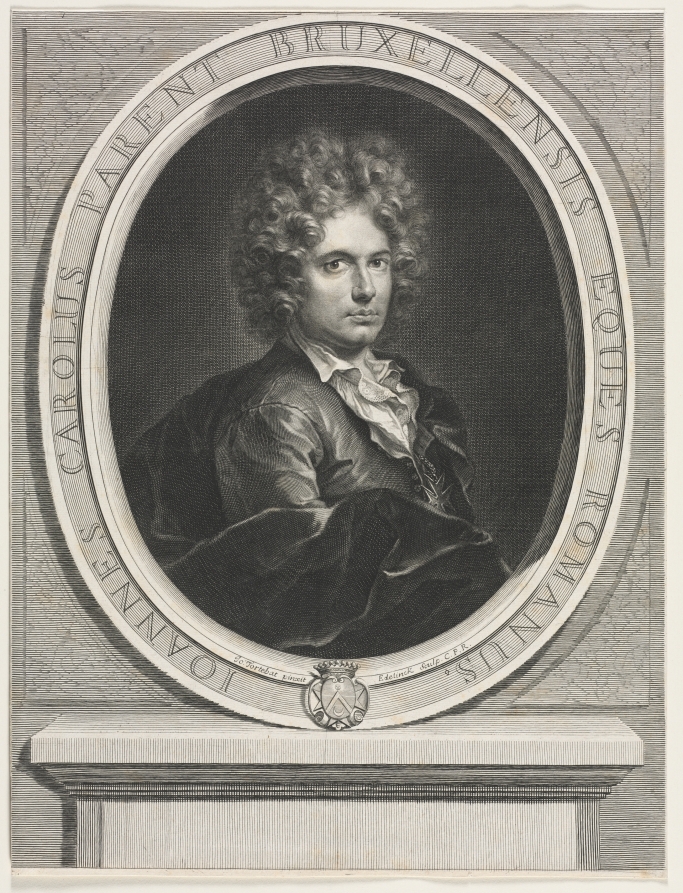
Gerard Edelinck · The Cleveland Museum of Art · Gift of Edward B. Greene · CC0
- Born
- 1640. · Antwerp.
- Died
- 1707. · Paris.
- Nationality
- France and Habsburg Netherlands.
- Occupation
- graphic artist, painter, printmaker and copper engraver.
- Fields
- painting.
- Teachers
- François de Poilly.
- Languages
- French.
VALÉORINE Encyclopedia
VALÉORINE documentary reading
Documentary summary
Illustration — Portrait of Gérard Edelinck by his son Nicolas Gérard Edelinck (20 October 1640 (baptized) – 2 April 1707) was a copper-plate engraver and print publisher of Flemish origin, who worked in Paris from 1666 and became a naturalized French citizen in 1675.
Admitted source layer · organised and presented by VALÉORINE
Reference Check
Propose documentary evidence for Gérard Edelinck. A contribution is never written directly as fact: identity, source, rights and evidence gates still decide.
Sign in to contribute
World of VALÉORINE
Documentary connections
Only confirmed graph relationships appear here. Images are shown only when their identity and reuse rights both pass the documentary gate.

Documentary evidence
Documentary basis
Authority files
wikidata · Q893319 · wikipedia · Gérard Edelinck
In this article
Life
Life
Training under François de Poilly is recorded. Jean Edelinck is recorded as having studied under Gérard Edelinck. The recorded working language is French. The field of work recorded is painting. Places of work recorded in the authority are France. Work by Gérard Edelinck is recorded in the collections of Art Institute of Chicago, The Nelson-Atkins Museum of Art, Auckland Art Gallery, Finnish National Gallery and National Gallery of Victoria.
Edelinck was born in Antwerp, where he received his early training under the engravers Gaspar Huybrechts (1619–1684) and Cornelius Galle the Younger. He went to Paris in 1666, where he worked with his fellow Fleming Nicolas Pitau the elder. To improve himself further he subsequently studied under François de Poilly, Robert Nanteuil, and Philippe de Champaigne. These masters likewise had soon done all they could to help him onwards, and Edelinck ultimately took the first rank among line engravers. • Illustration — Philippe de Champaigne His excellence was generally acknowledged; and having become known to Louis XIV he was appointed, on the recommendation of Le Brun, teacher at the academy established at the Gobelins manufactory for the training of workers in tapestry. He was also entrusted with the execution of several important works. In 1677 he won admission to the Académie royale de peinture et de sculpture (Royal Academy of Painting and Sculpture) with his Portrait of Philippe de Champaigne, engraved after a self-portrait.
Work
Work
• Illustration — Alexander and Hephaistion visit the family of Darius in their tent after the battle of Issus, engraved by Gérard Edelinck from a painting by Charles le Brun Edelinck stands apart from both his predecessors and contemporaries because his skill was not confined to any single aspect of engraving. Some engravers excelled in the accurate rendering of form, others in light and shade, color, or the texture of different surfaces. Edelinck mastered all of these elements and brought them together through his exceptional command of the burin. What distinguishes his work is the balance among these qualities: no single element calls attention to itself, but each contributes to the unity and overall effect of the engraving. Edelinck was especially good as an engraver of portraits, and executed prints of many of the most eminent persons of his time. Among these are those of Le Brun, Rigaud, Champaigne, Nanteuil, La Fontaine, Colbert, John Dryden, Descartes, Jean-Baptiste Lully, etc. He died at Paris in 1707. His younger brother Jean, and his son Nicholas, were also engravers.
Works
Works
Among his most famous works are: • Holy Family, after Raphael • Penitent Magdalene, after Charles le Brun • Alexander at the Tent of Darius, after Le Brun • Combat of Four Knights, after Leonardo da Vinci • Christ surrounded with Angels, after Le Brun • St. Louis praying, after Le Brun • St Charles Borromeo before a crucifix, after Le Brun
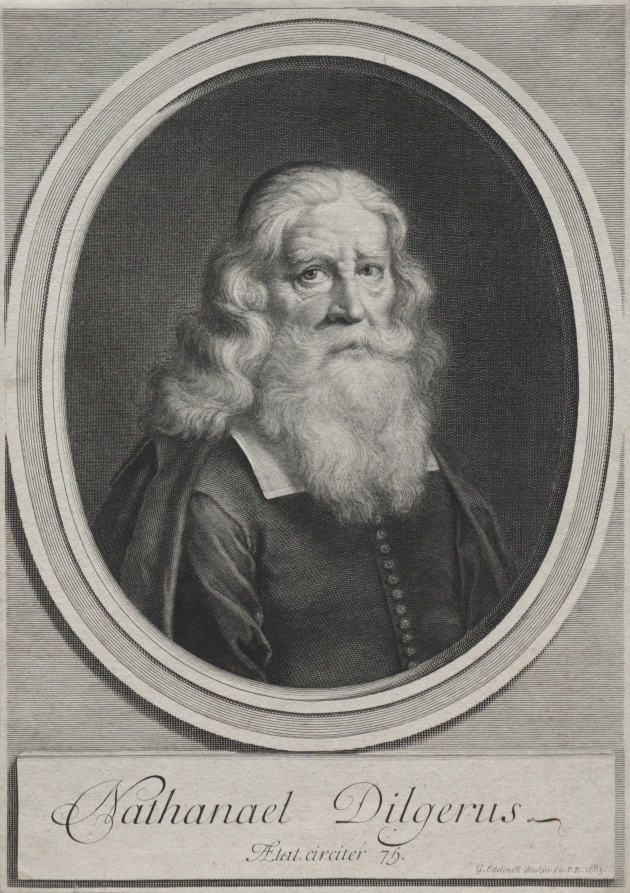
Nathanael Dilgerus, Minister of Danzig, 1683, by Gérard Edelinck
Gerard Edelinck · The Cleveland Museum of Art · Bequest of Mrs. Madeleine Hamill in memory of Lawrence Hamill
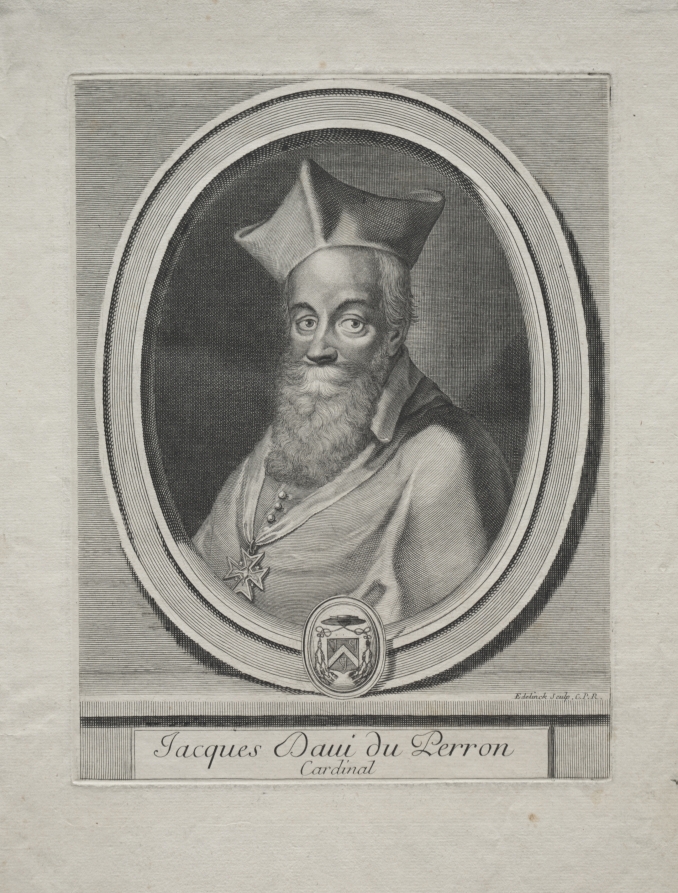
Cardinal Jaques Davey Duperron, c. 1680–1700, by Gérard Edelinck
Gerard Edelinck · The Cleveland Museum of Art · Gift of Robert Hays Gries
Life and career
Dated record
Life and career
The full dated record · 2 entries
1640
Gérard Edelinck born at Antwerp.
1707
Gérard Edelinck died at Paris.
Places
Named by the record
Places
Only places the record itself states, plotted where the house gazetteer settles their coordinates. Nothing is inferred from a name or a nationality.
Antwerp.
Birth place
Paris.
Death place
Notes from the source article
Cited by Wikipedia
Notes from the source article
These works are cited by the source article, in its own numbering. They are recorded as its citations, not as sources VALÉORINE has verified.
- 1.Manuel de l'amateur d'estampes. 6.
- 2.Manuel de l'amateur d'estampes. 6.
- 3.Gérard Edelinck : les artistes célèbres. 1886.
- 4.Edelinck : Biographie du graveur Gérard Edelinck sur adlitteram.free.fr.
- 5.Gérard Edelinck : les artistes célèbres. 1886.
- 6.Les Amis de Versailles. amisdeversailles.com.
- 7.Gérard Edelinck, d'après Charles Le Brun, La Tente de Darius. Images d’Art. 1676. 2017-02-05.
- 8.Gérard Edelinck, Les quatre cavaliers ou la bataille d'Anghiari. Images d’Art. 1503. 2017-02-05.
- 9.Gérard Edelinck : les artistes célèbres. 1886.
- 10.Gerard EDELINCK (1640-1707). wittert.ulg.ac.be.
- 11.Antoine Trouvain (1652?-1708) - Peintre, graveur et éditeur - Ressources de la Bibliothèque nationale de France. data.bnf.fr.
- 12.Gérard Edelinck : les artistes célèbres. 1886.
- 13.Église Saint Benoît de Paris (disparue). tombes-sepultures.com.
- 14.La Tente de Darius, RMN
- 15.Combat de quatre cavaliers
References
Citations
References
Each reference names the institution holding it, so a reader may go to the document itself.
reference work
Secondary witnessreference work
Secondary witness
People, houses and institutions
Knowledge graph
People, houses and institutions
Teachers, collaborators, publishers and institutions recorded against this person, each on a stated basis.
Died at
1- ParisPlace
Established from a fact already recorded on a verified source.
Further particulars
Held on the record
Further particulars
Open the remaining particulars
The authorities additionally record the headings Gerard Edeling, Gerard Edeleij, Gerard Edelinck, G. Edelinck and Edelingh. His recorded language was French. He married Magdeleine Regnesson. One child is recorded: Nicolas Edelinck. Formation and teaching. He trained under François de Poilly. Each of those relationships is stated by the authority record rather than inferred from style. Recorded as graphic artist, painter, printmaker and copper engraver.
Identity and origins
Recognition and collections
Work by Gérard Edelinck is
Art Institute of Chicago, The Nelson-Atkins Museum of Art, Auckland Art Gallery and Finnish National Gallery
The Encyclopedia exists whether or not anything is for sale. Corrections are recorded rather than overwritten, and every version of this record is kept. Published 16 August 2026.
Elsewhere in Prints
4,138 published records in this field, each with its sources named.
- Gerard BouttatsEngraver
- Gérard CochetEngraver
- Gerard de JodeEngraver
- Gerard de LairesseEngraver
- Gérard Ernest SchneiderEngraver
- Gerard van HonthorstEngraver
- Gerard VanderguchtEngraver
- Gerardus OorthuysEngraver
Best supported in this field
For owners
Own a work by Gérard Edelinck?
A specialist will read what you send and tell you what the house can establish, what it cannot, and whether the object is suited to sale. There is no charge and no obligation. The object stays with you throughout; nothing is shipped to us unless it is arranged in writing beforehand.