
Georges de La Tour
Georges de La Tour (13 March 1593 – 30 January 1652) was a French Baroque painter, who spent most of his working life in the Duchy of Lorraine, which was temporarily absorbed into France between 1641 and 1648. He painted mostly religious chiaroscuro scenes lit by candlelight. Artist at the confluence of Nordic, Italian, and French cultures, and a contemporary of Jacques Callot and the Le Nain brothers, La Tour is a keen observer of everyday reality.
Also recorded as Georges du Mesnil De La Tour · Georges du Mesnil de La Tour · Dumesnil La Tour · Claude du Menil De La Tour
Georges de La Tour
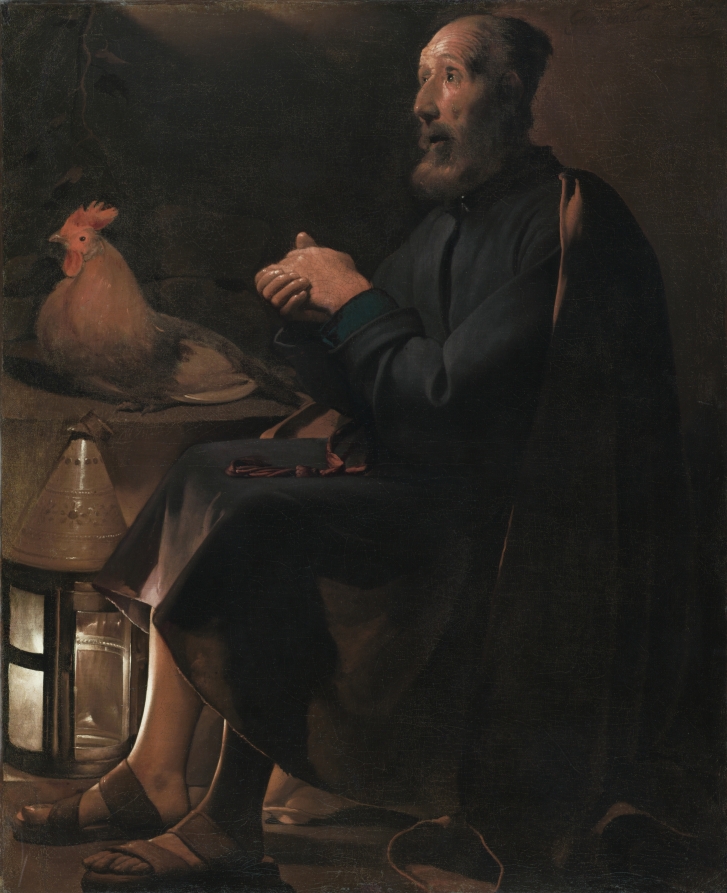
Georges de La Tour · The Cleveland Museum of Art · Gift of the Hanna Fund · CC0
- Name
- Georges de La Tour
- Born
- 13 March 1593
- Birthplace
- Vic-sur-Seille, Duchy of Lorraine
- Died
- 30 January 1652
- Place of death
- Lunéville, Duchy of Lorraine
- Movement
- Baroque
- Nationality
- Duchy of Lorraine
- Occupation
- painter · architectural drafter
- Fields
- Caravaggisti · genre painting · religious painting
- Known for
- The Dream of Saint Joseph · Joseph the Carpenter · The Newborn
VALÉORINE Encyclopedia
VALÉORINE documentary reading
Documentary summary
Georges de La Tour (13 March 1593 – 30 January 1652) was a French Baroque painter, who spent most of his working life in the Duchy of Lorraine, which was temporarily absorbed into France between 1641 and 1648. He painted mostly religious chiaroscuro scenes lit by candlelight. Artist at the confluence of Nordic, Italian, and French cultures, and a contemporary of Jacques Callot and the Le Nain brothers, La Tour is a keen observer of everyday reality.
Admitted source layer · organised and presented by VALÉORINE
Reference Check
Propose documentary evidence for Georges de La Tour. A contribution is never written directly as fact: identity, source, rights and evidence gates still decide.
Sign in to contribute
Documentary evidence
Documentary basis
Authority files
wikidata · Q203371 · wikipedia · Georges de La Tour
In this article
Biography
Biography
His pronounced taste for plays of light and shadow makes him one of the most original successors of Caravaggio. Recognised during his lifetime, he was quickly forgotten after his death. Rediscovered in the early 20th century by German art historian Hermann Voss, he later inspired writers as diverse as René Char, André Malraux, Pascal Quignard, and Charles Juliet.
Key facts
Key facts
• Name — Georges de La Tour • Born — 13 March 1593 • Birthplace — Vic-sur-Seille, Duchy of Lorraine • Died — 30 January 1652 • Place of death — Lunéville, Duchy of Lorraine • Movement — Baroque • Patrons — Henry II, Duke of Lorraine • Notable Works — The Fortune Teller Joseph the Carpenter Magdalene at a Mirror The Card Sharp with the Ace of Diamonds • Illustration — Joseph the Carpenter, 1642, Louvre.
Personal life
Personal life
• Illustration — Magdalene with Two Flames, c. 1640, Metropolitan Museum of Art Georges de La Tour was born in the town of Vic-sur-Seille in the Diocese of Metz, which was technically part of the Holy Roman Empire, but had been ruled by France since 1552. Baptism documentation revealed that he was the son of Jean de La Tour, a baker, and Sybille de La Tour, née Molian. It has been suggested that Sybille came from a partly noble family. His parents had seven children in all, with Georges being the second-born. La Tour's educational background remains somewhat unclear, but it is assumed that he traveled either to Italy or the Netherlands early in his career. He may possibly have trained under Jacques Bellange in Nancy, the capital of Lorraine, although their styles are very different. His paintings reflect the Baroque naturalism of Caravaggio, but this probably reached him through the Dutch Caravaggisti of the Utrecht School and other Northern (French and Dutch) contemporaries. In particular, La Tour is often compared to the Dutch painter Hendrick Terbrugghen. In 1617 he married Diane Le Nerf, from a minor noble family, and in 1620 he established his studio in her quiet provincial home-town of Lunéville, part of the independent Duchy of Lorraine which was occupied by France, during his lifetime, in the period 1641–1648. He painted mainly religious and some genre scenes. He was given the title "Painter to the King" (of France) in 1638, and he also worked for the Dukes of Lorraine in 1623–4, but the local bourgeoisie provided his main market, and he achieved a certain affluence. He is not recorded in Lunéville between 1639 and 1642, and may have traveled again; Anthony Blunt detected the influence of Gerrit van Honthorst in his paintings after this point. He was involved in a Franciscan-led religious revival in Lorraine, and over the course of his career he moved to painting almost entirely religious subjects, but in treatments with influence from genre painting. Georges de La Tour and his family died in 1652 in an epidemic in Lunéville. His son Étienne (1621–1692) was his pupil.
Works
Works
• Illustration — Saint Jerome reading La Tour's early work shows influences from Caravaggio, probably via his Dutch followers, and the genre scenes of cheats—as in The Fortune Teller—and fighting beggars clearly derive from the Dutch Caravaggisti, and probably also his fellow-Lorrainer, Jacques Bellange. These are believed to date from relatively early in his career. La Tour is best known for the nocturnal light effects which he developed much further than his artistic predecessors had done, and transferred their use in the genre subjects in the paintings of the Dutch Caravaggisti to religious painting in his. Unlike Caravaggio his religious paintings lack dramatic effects. He painted these in a second phase of his style, perhaps beginning in the 1640s, using chiaroscuro, careful geometrical compositions, and very simplified painting of forms. His work moves during his career towards greater simplicity and stillness—taking from Caravaggio very different qualities than Jusepe de Ribera and his Tenebrist followers did. • Illustration — The Musicians' Brawl, (Hurdy-gurdy group), c. 1625–1630, Getty Museum He often painted several variations on the same subjects, and his surviving output is relatively small. His son Étienne was his pupil, and distinguishing between their work in versions of La Tour's compositions is difficult. The version of the Education of the Virgin in the Frick Collection in New York is an example, as the Museum itself admits. Another group of paintings (example left), of great skill but claimed to be different in style to those of La Tour, have been attributed to an unknown "Hurdy-gurdy Master". All show older male figures (one group in Malibu includes a female), mostly solitary, either beggars or saints. • Illustration — Dice-players, c. 1651, probably his last work, Preston Hall Museum, Stockton-on-Tees, UK. After his death at Lunéville in 1652, La Tour's work was forgotten until rediscovered in 1915 by Hermann Voss, a German art historian who would later become head of Hitler's Führermuseum; some of La Tour's work had in fact been confused with Vermeer, when the Dutch artist underwent his own rediscovery in the nineteenth century.
Gallery
Gallery
• Illustration — Job Mocked by his Wife, c. 1625–1650, Musée départemental d'Art ancien et contemporain, Épinal, France • Illustration — Magdalene with the Smoking Flame, c. 1640, Los Angeles County Museum of Art • Illustration — The Newborn Christ, c. 1645–1648, Museum of Fine Arts of Rennes • Illustration — The education of the Virgin, c. 1650, The Frick Collection • Illustration — The smoker, 1646, Tokyo Fuji Art Museum • Illustration — The Flea-Catcher, 1638, Musée Lorrain, Nancy • Illustration — Saint Andrew in the Albi Apostles series, c. 1620 • Illustration — The Repentant Magdalene, c. 1635-1640, National Gallery of Art • Illustration — The Cheat with the Ace of Clubs, c. late 1620s, Kimbell Art Museum, Fort Worth, Texas. Another version (with Diamonds and slightly different clothes) is in the Louvre. • Illustration — The Fortune Teller, 1633–1639, Metropolitan Museum of Art • Illustration — The Hurdy-Gurdy Player, c. 1610–1630, Prado Museum • Illustration — Portrait of an Old Man, c. 1624–1650, De Young Museum, San Francisco • Illustration — Portrait of an Old Woman, c. 1624–1650, De Young Museum, San Francisco
Life and career
Dated record
Life and career
The full dated record · 2 entries
1593
Georges de La Tour born at Vic-sur-Seille.
1652
Georges de La Tour died at Lunéville.
Context
Primary material
Context
The circumstances in which Georges de La Tour stands.
Documents and archives
Primary material
Documents and archives
Institutional database
- Wikidata, structured authority record Q203371: Georges de La Tour
Scholarly · Wikimedia Foundation
reference work
- “Georges de La Tour”, English Wikipedia, consulted as further reading
Reputable secondary · Wikipedia
Notes from the source article
Cited by Wikipedia
Notes from the source article
These works are cited by the source article, in its own numbering. They are recorded as its citations, not as sources VALÉORINE has verified.
- 1.https://digitalcommons.lsu.edu/gradschool_theses/462/ Crissy Bergeron Thesis – page 7, and note 4, quoting Thuillier p.19
- 2.Anthony Blunt, Art and Architecture in France, 1500–1700, 1953, Penguin
- 3.Wright, 35, 44–46
- 4.Comment Georges de La Tour a été sauvé de l'oubli par un historien de l'art allemand en 1915. www.lefigaro.fr. 25 September 2025.
- 5.Dictionary of Art Historians. Voss, Hermann. 2018-02-21.
References
Citations
References
Each reference names the institution holding it, so a reader may go to the document itself.
Institutional database
Wikidata, structured authority record Q203371: Georges de La TourWikimedia Foundation
Institutional witnessreference work
Secondary witness
Further particulars
Held on the record
Further particulars
Open the remaining particulars
The authorities additionally record the headings Georges du Mesnil De La Tour, Georges du Mesnil de La Tour, Dumesnil La Tour, Claude du Menil De La Tour and Claude du Menil de La Tour. His recorded language was French. Work and production. Works recorded as notable number 3: The Dream of Saint Joseph, Joseph the Carpenter and The Newborn. His recorded genres are Caravaggisti, genre and religious.
Identity and origins
Recognition and collections
Work by Georges de La Tour is
Museo del Prado, The Nelson-Atkins Museum of Art, J. Paul Getty Museum and Nationalmuseum
The Encyclopedia exists whether or not anything is for sale. Corrections are recorded rather than overwritten, and every version of this record is kept. Published 14 August 2026.
Elsewhere in Paintings
18,717 published records in this field, each with its sources named.
- Georges BellengerArtist
- Georges CainArtist
- Georges CallotArtist
- Georges CroegaertArtist
- Georges Emile LebacqArtist
- Georges Ferdinand BigotArtist
- Georges FocusArtist
- Georges Hanna SabbaghArtist
Best supported in this field
For owners
Own a work by Georges de La Tour?
A specialist will read what you send and tell you what the house can establish, what it cannot, and whether the object is suited to sale. There is no charge and no obligation. The object stays with you throughout; nothing is shipped to us unless it is arranged in writing beforehand.