
George Ripley
Sir George Ripley (c. 1415–1490) was an English Augustinian canon, author, and alchemist.
George Ripley
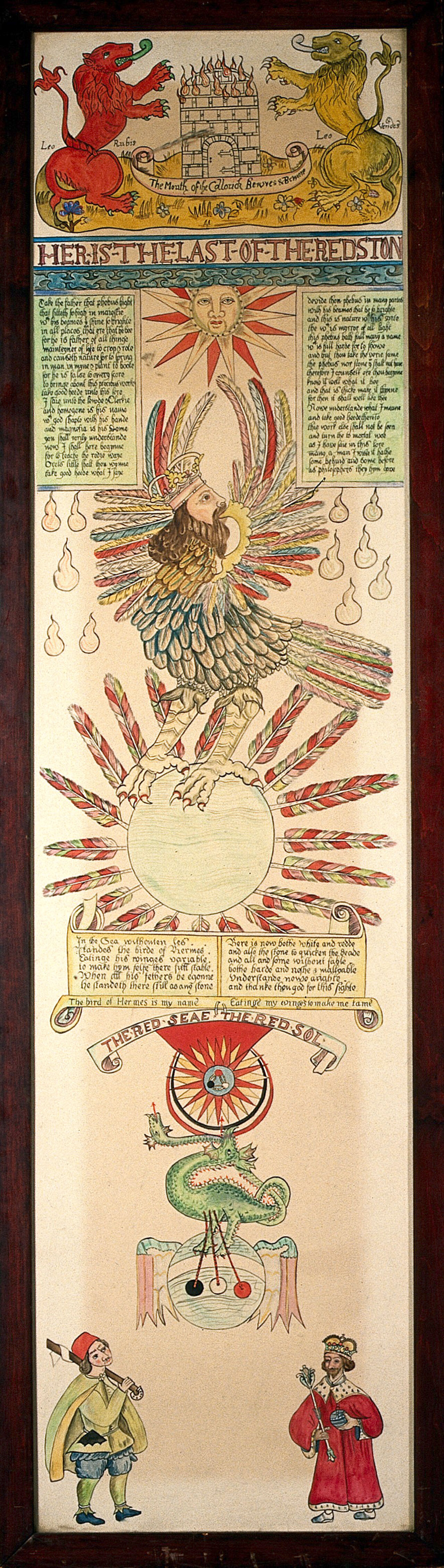
George Ripley · Wellcome Collection, London · Wellcome Collection · Public Domain Mark
- Name
- George Ripley
- Born
- c. 1415
- Birthplace
- Kingdom of England
- Died
- 1490
- Nationality
- United Kingdom of Great Britain and Ireland
- Occupation
- alchemist · poet
- Languages
- Latin
VALÉORINE Encyclopedia
VALÉORINE documentary reading
Documentary summary
Sir George Ripley (c. 1415–1490) was an English Augustinian canon, author, and alchemist.
Admitted source layer · organised and presented by VALÉORINE
Note VALÉORINE
George Ripley (1415–1490) was a British alchemist and poet. Born in England, the alchemist died in Boston. Languages used include Latin.
Composed from admitted, traceable facts · 26 September 2026
VALÉORINE
Reference Check
Propose documentary evidence for George Ripley. A contribution is never written directly as fact: identity, source, rights and evidence gates still decide.
Sign in to contribute
Documentary evidence
Documentary basis
Authority files
wikidata · Q631738
In this article
Key facts
Key facts
• Honorific Prefix — Sir • Name — George Ripley • Born — c. 1415 • Birthplace — Kingdom of England • Died — 1490 • Notable Works — The Compound of Alchemy, Cantilena Riplaei, The Ripley Scroll (disputed) • Main Interests — Alchemy
Biography
Biography
• Illustration — Alchemists Revealing Secrets from the Book of Seven Seals, The Ripley Scroll, detail George Ripley was one of England's most famous alchemists. His alchemical writings attracted attention not only when they were published in the fifteenth century, but also later in the sixteenth and seventeenth centuries. His writings were studied by noted figures such as the alchemist John Dee, Robert Boyle (who is considered to be the first modern chemist), and even Isaac Newton. A great deal of myth has grown up around Ripley, such as that he studied in Italy for twenty years and became a favourite of Pope Innocent VIII. He did however spend a number of years on the continent, and after his return to England he wrote his work The Compound of Alchemy; or, the Twelve Gates leading to the Discovery of the Philosopher's Stone (Liber Duodecim Portarum) in 1471. The Cantilena Riplaei is one of the first poetic compositions on the subject of alchemy. Most of Ripley's work is based on the work of pseudo-Ramon Lull, although The Compound of Alchemy is based largely on the work of a little-known alchemist of the fifteenth century, named Guido de Montanor. Another story about him is reported by Thomas Fuller in his Worthies of England, which describes a reputable English gentleman who reported having seen a record in the island of Malta which stated that Ripley gave the enormous sum of one hundred thousand pounds sterling annually to the Knights of that island and of Rhodes to support their war against the Turks. Ripley is known as the "Canon of Bridlington". He spent his later years as an anchorite near Boston (Yorkshire).
The Wheel
The Wheel
• Illustration — George Ripley's Wheel, by Elias Ashmole, 1652 Some scholars claim that the writings of The Compound of Alchemy were meant to be read in light of an alchemical drawing done by Ripley called the Wheel. This drawing is in essence an analogy of the planets of the Solar System, of which at the time, Earth was considered to be the centre. Ripley encoded his alchemical recipes into this drawing, depicting them as the planets which revolved around the Earth, or, more specifically, the elements of his work. In alchemy, there is often an analogical connection made between heaven and Earth, and this connection is symbolised by the use of the seven planetary symbols: Sol (Sun), Luna (Moon), Mercurius (Mercury), Venus, Mars, Jupiter, and Saturn. These planets correspond respectively to gold, silver, quicksilver, copper, iron, tin, and lead.
The Vision of Sir George Ripley
The Vision of Sir George Ripley
A commentary upon Ripley's works was written in a series of treatises by the English alchemist Eirenaeus Philalethes. Ripley's Vision, written in the Twelve Gates, became the subject of an exposition by Eirenaeus published in 1677 in London. The English form of the Vision gives a fair sample of the allusive style.
The "Ripley Scroll"
The "Ripley Scroll"
• Illustration — An excerpt from a copy of the Ripley Scroll There are approximately 23 copies of the Ripley Scroll in existence. The scrolls range in size, colour, and detail but are all variations on a lost 15th-century original. Although they are named after George Ripley, there is no evidence that Ripley designed the scrolls himself. They are called Ripley scrolls because some of them include poetry associated with the alchemist. The scrolls' images are symbolic references to the philosopher's stone. • London, British Library, Add MS 5025 (Alchemical scrolls), Four scrolls are drawn in Lubeck 1588. • London, Science Museum, A21950, 18th century. • London, Wellcome Institute, 692 & 693, two scrolls 16th century. • Cambridge, Fitzwilliam Museum, MS 276, 16th century. • ref. also a version of Ripley Scrowle by James Standysh, 16th century, British Library, Add MS 32621. • Oxford, Bodleian Library MS Bodl Rolls 1 | Alchemical Roll • Oxford, Bodleian Library MS Ash. Rolls 40 | Alchemical Roll • Oxford, Bodleian Library MS Ash. Rolls 52 | Alchemical Roll • Oxford, Bodleian Library MS Ash. Rolls 53 | Alchemical Roll
Canonical works
Canonical works
• George Ripley, Cantilena Riplaei • George Ripley, Opera omnia chemica. Kassel, 1649. • George Ripley, Liber duodecim portarum, also contained in J.J. Mangetus, Bibliotheca Chemica Curiosa (Geneva 1702), Vol. II, pp 275–285. • Aeyrenaeus Philalethus, Ripley Reviv'd; or, An Exposition upon Sir George Ripley's Hermetico-Poetical Works (London 1678).
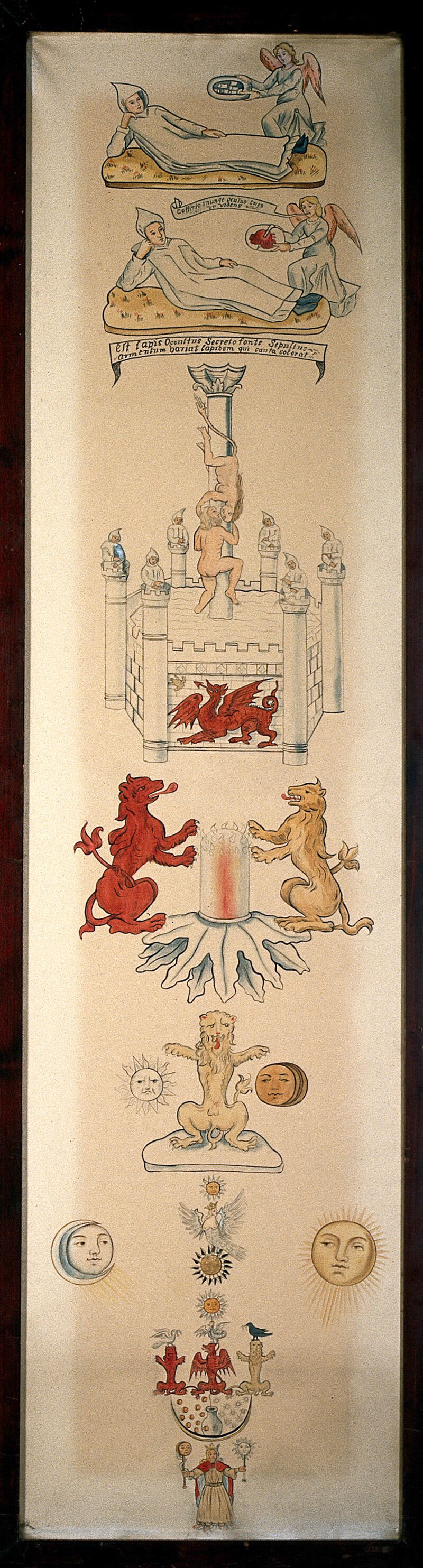
Alchemical devices. Watercolour after George Ripley., by George Ripley
George Ripley · Wellcome Collection, London · Wellcome Collection
Places
Named by the record
Places
Only places the record itself states, plotted where the house gazetteer settles their coordinates. Nothing is inferred from a name or a nationality.
England.
Birth place
Boston.
Death place
Notes from the source article
Cited by Wikipedia
Notes from the source article
These works are cited by the source article, in its own numbering. They are recorded as its citations, not as sources VALÉORINE has verified.
- 1.What's On? - George Ripley and the Philosopher's Stone. www.bodleian.ox.ac.uk.
- 2.Rampling, Jennifer. Establishing the Canon: George Ripley and his alchemical sources. Ambix. 55. 3. 189–208. 2008.
- 3.Rampling, Jennifer. Transmission and Transmutation: George Ripley and the place of English alchemy in early modern Europe. Early Science and Medicine. 17. 5. 477–499. 2012.
- 4.Rampling, "Establishing the Canon."
- 5.Rampling, Jennifer M. Depicting the Medieval Alchemical Cosmos. Early Science and Medicine. 18. 1–2. 45–86. 2013.
- 6.10/05/2012, Material World - BBC Radio 4. BBC.
- 7.See and do - Science Museum. Science Museum.
Bibliography printed in the source article · 5
- Rola, Stanislas Klossowski de. The Secret Art of Alchemy. Thames & Hudson: London, 1973.
- Jung, Carl Gustav. Psychologie u. Alchemie. Rascher Verlag: Zurich, 1944).
- Mackay, Charles. Extraordinary Popular Delusions and the Madness of Crowds. Office of the National Illustrated Library: London, 1852.
- The works of Sir George Ripley
- Full version of Yale Ripley Scroll at Wikimedia

References
Citations
References
Each reference names the institution holding it, so a reader may go to the document itself.
reference work
Secondary witness
The Encyclopedia exists whether or not anything is for sale. Corrections are recorded rather than overwritten, and every version of this record is kept. Published 17 August 2026.
Elsewhere in Books
38,988 published records in this field, each with its sources named.
- George R. R. MartinAuthor
- George Randolph ChesterAuthor
- George RanettiAuthor
- George RichardsAuthor
- George Robert Aberigh-MackayAuthor
- George Robert SimsAuthor
- George RobertsAuthor
- George Rostrevor HamiltonAuthor
Best supported in this field
For owners
Own a work by George Ripley?
A specialist will read what you send and tell you what the house can establish, what it cannot, and whether the object is suited to sale. There is no charge and no obligation. The object stays with you throughout; nothing is shipped to us unless it is arranged in writing beforehand.