
George Cooke
Illustration — Commercial Docks, Rotherhithe, London (engraved after unknown artist, 1827) George Cooke (22 January 1781 – 27 February 1834), was an English line engraver.
Also recorded as George, I Cooke · George Cooke I · George Turner Cooke · George (Turner) Cooke
George Cooke
George Cooke · Wellcome Collection, London · Wellcome Collection · Public Domain Mark
- Born
- 1781 · London.
- Died
- 1834 · Barnes.
- Nationality
- United Kingdom of Great Britain and Ireland · Kingdom of Great Britain
- Occupation
- painter · printmaker · engraver
- Fields
- portrait
- Teachers
- James Basire
- Languages
- English
VALÉORINE Encyclopedia
VALÉORINE documentary reading
Documentary summary
Illustration — Commercial Docks, Rotherhithe, London (engraved after unknown artist, 1827) George Cooke (22 January 1781 – 27 February 1834), was an English line engraver.
Admitted source layer · organised and presented by VALÉORINE
Reference Check
Propose documentary evidence for George Cooke. A contribution is never written directly as fact: identity, source, rights and evidence gates still decide.
Sign in to contribute
World of VALÉORINE
Documentary connections
Only confirmed graph relationships appear here. Images are shown only when their identity and reuse rights both pass the documentary gate.

Documentary evidence
Documentary basis
Authority files
wikidata · Q5538104 · wikipedia
In this article
Life and work
Life and work
Training under James Basire is recorded. George Hollis, William John Cooke and Thomas Shotter Boys are recorded as having studied under George Cooke. The recorded working language is English. Subjects and genres recorded for the work are portrait. Work by George Cooke is recorded in the collections of Minneapolis Institute of Art, Auckland Art Gallery, Musée national des beaux-arts du Québec, National Portrait Gallery and National Library of Wales.
Cooke was born in London in 1781. His father was a native of Frankfurt, Germany, who in early life settled in England and became a wholesale confectioner. At the age of 14, George Cooke was apprenticed to James Basire (1730-1802). Around the end of his apprenticeship he engraved many plates for Brewer's The Beauties of England and Wales, some in conjunction with his elder brother, William Bernard Cooke. Afterwards, he produced engravings for Pinkerton's 16-volume Collection of Voyages and Travels, during which his brother William made plans for the first edition of The Thames, to which George Cooke contributed two plates. This work was followed by Picturesque Views on the Southern Coast of England, from drawings made principally by Turner. It was commenced in 1814 and completed in 1826, and George Cooke engraved 15 plates, nearly one-third of the total, and some vignettes. Next appeared an improved edition of The Thames, for which he engraved the 'Launch of the Nelson' and the 'Fair on the Thames,' after Luke Clennell, and the 'Opening of Waterloo Bridge,' after Philip Reinagle. • Illustration — "Phlox carnea", engraving after William Miller (from "The Botanical Cabinet", 1818) Between 1817 and 1833 he produced, in connection with Loddiges of Hackney, London a number of plates for the Botanical Cabinet,' and about the same time he engraved some of the plates, after Turner, for Hakewill's Picturesque Tour of Italy, 1820, and Sir Walter Scott's Provincial Antiquities and Picturesque Scenery of Scotland, 1826, in which latter work should be especially noted "Edinburgh from the Calton Hill". To these were added plates for Thomas Allason's Antiquities of Pola, 1819, John Spencer-Stanhope's Olympia, (published by Rodwell and Martin, 1824), and D'Oyly and Mant's Bible, as well as some of those for John Hughes' Views in the South of France, chiefly on the Rhone, after Peter De Wint. Besides these Cooke engraved a few plates for the publications of the Dilettanti Society, and for the Ancient Marbles in the British Museum, and the Ancient Terracottas in the same collection, and single plates after Turner of a "View of Gledhow" for Whitaker's Loidis and Elmete, and "Wentworth House" for Thomas Dunham Whitaker's History of Richmondshire. In 1815, he produced some lithographs for Henry Holland's Travels in the Ionian Isles,.... He also engraved the "Iron Bridge at Sunderland", from an outline by Edward Blore; for Surtees's History of Durham; and the "Monument of Sir Francis Bacon" in St Michael's Church, St Albans, for Robert Clutterbuck's History of Hertfordshire. In 1825, Cooke finished his fine engraving of "Rotterdam", from Augustus Wall Callcott's picture belonging to the Earl of Essex, and shortly afterwards issued a prospectus announcing a series of plates from Callcott's works, of which two, "Antwerp" and "Dover", were begun and considerably advanced when vexation at the loss of the proceeds of his 'Rotterdam,'caused by the failure of his agent, led to their abandonment. He then began, in 1826, the Views in London and its Vicinity, engraved from drawings by Callcott, Stanfield, Roberts, Prout, Stark, Harding, Cotman, and Havell, ending with the 12th issue just before his death. In 1833, Cooke produced Views of the Old and New London Bridges, executed conjointly with his son, Edward William Cooke, who also made the drawings. He also produced plates for Frederick Nash's Views in Paris, Colonel Batty's Views of European Cities, Baron Taylor's Spain published by Robert Jennings, Rhodes's Peak Scenery and Yorkshire Scenery, several for Stark's Scenery of the Rivers of Norfolk, and one of "Southampton", after Copley Fielding, for the Gallery of the Society of Painters in Water Colours. Cooke was one of the original members of the "Society of Associated Engravers", who joined together for the purpose of engraving the pictures in the National Gallery, and two of his plates were in preparation at the time of his death. He likewise attempted engraving in mezzotint, and in that style executed a plate of 'Arundel Castle,' after Turner; but it was not a success, and was never published. Cooke died of 'brain fever' on 27 February 1834 at Barnes, where he was buried.
![Mon-Ka-Ush-Ka (Monkaushka), a Sioux chief, holding a sword. Coloured lithograph by A. Hoffy after G. Cooke, 1837., [1837], by George Cooke](https://iiif.wellcomecollection.org/image/V0047524/full/800,/0/default.jpg)
Mon-Ka-Ush-Ka (Monkaushka), a Sioux chief, holding a sword. Coloured lithograph by A. Hoffy after G. Cooke, 1837., [1837], by George Cooke
George Cooke · Wellcome Collection, London · Wellcome Collection
Life and career
Dated record
Life and career
Explore 1781–1834
The full dated record · 8 entries
1781
George Cooke born at London.
1819
Picturesque Views of the Antiquities of Pola in Istria, Posterior View of the Two Temples (Yale Center for British Art).
1826
Session's House, Clerkenwell Green (Yale Center for British Art).
1827
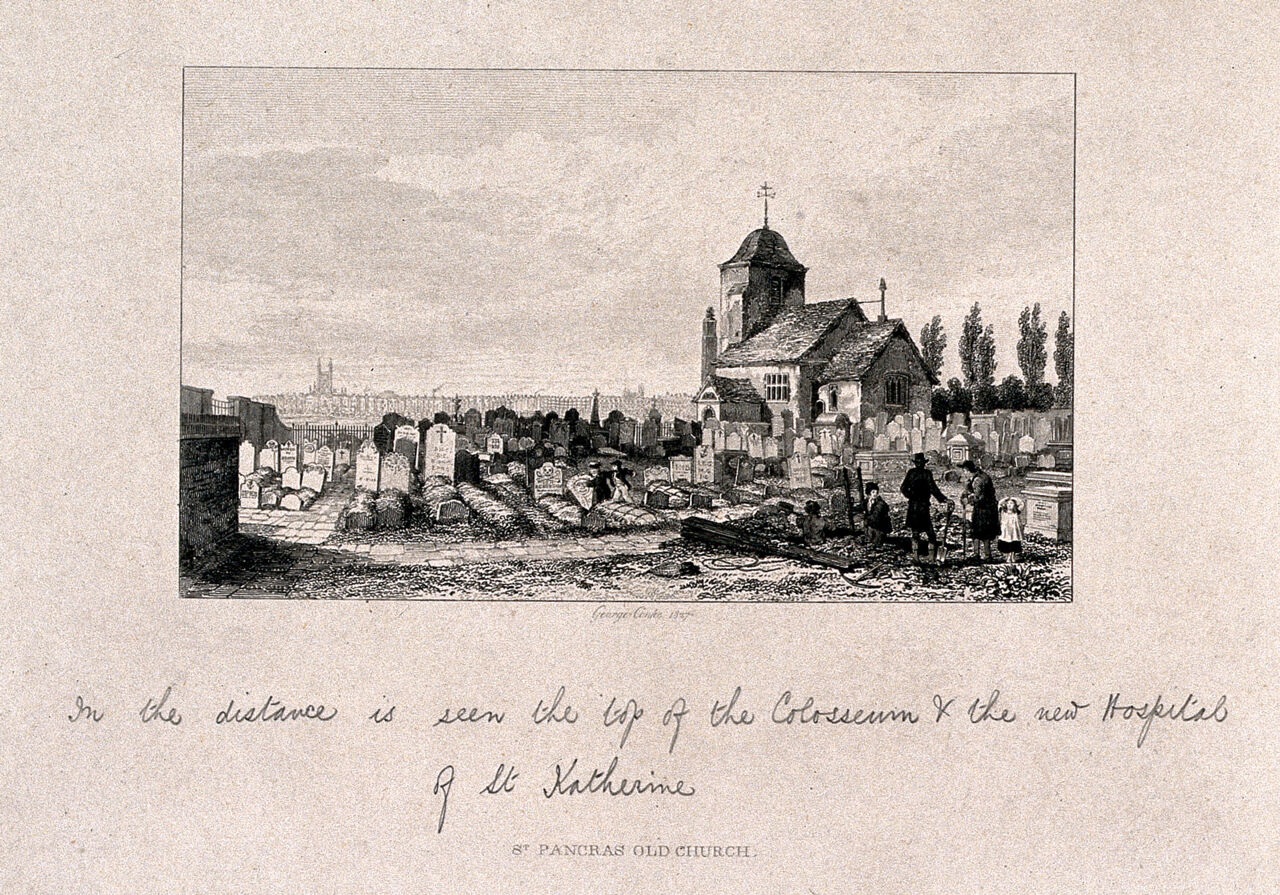
Hanover Terrace, Regent's Park (Yale Center for British Art).
1828
The Southwark Iron Bridge (Yale Center for British Art).
1828
St. Dunstan's in the East, from the Customs House (Yale Center for British Art).
1833
The Post Office & St. Paul's, from St. Martin's Le Grand (Yale Center for British Art).
1834
George Cooke died at Barnes.
Places
Named by the record
Places
Only places the record itself states, plotted where the house gazetteer settles their coordinates. Nothing is inferred from a name or a nationality.
London.
Birth place
Barnes.
Death place
Notes from the source article
Cited by Wikipedia
Notes from the source article
These works are cited by the source article, in its own numbering. They are recorded as its citations, not as sources VALÉORINE has verified.
- 1.Cooke, George (1781-1834).
- 2.The Thames etc (Vernor, Hood & Sharpe and W.B. Cooke, 1811).
- 3.Joseph Mallord William Turner. Picturesque views on the southern coast of England (J. and A. Arch, 1826).
- 4.Conrad Loddiges (and sons). The Botanical Cabinet (J. & A. Arch, 1822)
- 5.James Hakewill. A picturesque tour of Italy: from drawings made in 1816-1817 (J. Murray, 1820).
- 6.Walter Scott. Provincial antiquities of Scotland, volume II (R. Cadell, 1834).
- 7.George D'Oyly & Richard Mant. The Holy Bible (Clarendon press, 1818).
- 8.A description of the collection of ancient marbles in the British museum (W. Bulmer and co, 1812).
- 9.A description of the collection of ancient terracottas in the British Museum (W. Bulmer and Co., 1810).
- 10.George Cooke. Views in London and its vicinity (1826-34)
References
Citations
References
Each reference names the institution holding it, so a reader may go to the document itself.
reference work
George CookeGeneral reference literature
Secondary witnessreference work
Wikidata, structured authority record Q5538104: George CookeWikimedia Foundation
Secondary witness
People, houses and institutions
Knowledge graph
People, houses and institutions
Teachers, collaborators, publishers and institutions recorded against this person, each on a stated basis.
Died at
1- BarnesPlace
Established from a fact already recorded on a verified source.
Further particulars
Held on the record
Further particulars
Open the remaining particulars
He trained under James Basire. Each of those relationships is stated by the authority record rather than inferred from style.
The authorities additionally record the headings George, I Cooke, George Cooke I, George Turner Cooke, George (Turner) Cooke and G. His recorded language was English. One child is recorded: Edward William Cooke. Recorded as painter, printmaker and engraver.
Identity and origins
Recognition and collections
Work by George Cooke is
Minneapolis Institute of Art, Auckland Art Gallery, Musée national des beaux-arts du Québec and National Portrait Gallery
Paul's, from St.
The Encyclopedia exists whether or not anything is for sale. Corrections are recorded rather than overwritten, and every version of this record is kept. Published 16 August 2026.
Elsewhere in Prints
4,138 published records in this field, each with its sources named.
- George BellowsEngraver
- George BobaEngraver
- George BrookshawEngraver
- George ClausenEngraver
- George DaweEngraver
- George de ZayasEngraver
- George Emerick EssigEngraver
- George Frederick Cumming SmillieEngraver
Best supported in this field
For owners
Own a work by George Cooke?
A specialist will read what you send and tell you what the house can establish, what it cannot, and whether the object is suited to sale. There is no charge and no obligation. The object stays with you throughout; nothing is shipped to us unless it is arranged in writing beforehand.