
Georg Friedrich Schmidt
Georg Friedrich Schmidt (24 January 1712 - 25 January 1775) was a German engraver, etcher and pastel painter, in the Rococo style.
Also recorded as Georg Fridrich Šmidt · Georg Fridrich Smidt · Schmidt · g. f. schmidt
Georg Friedrich Schmidt
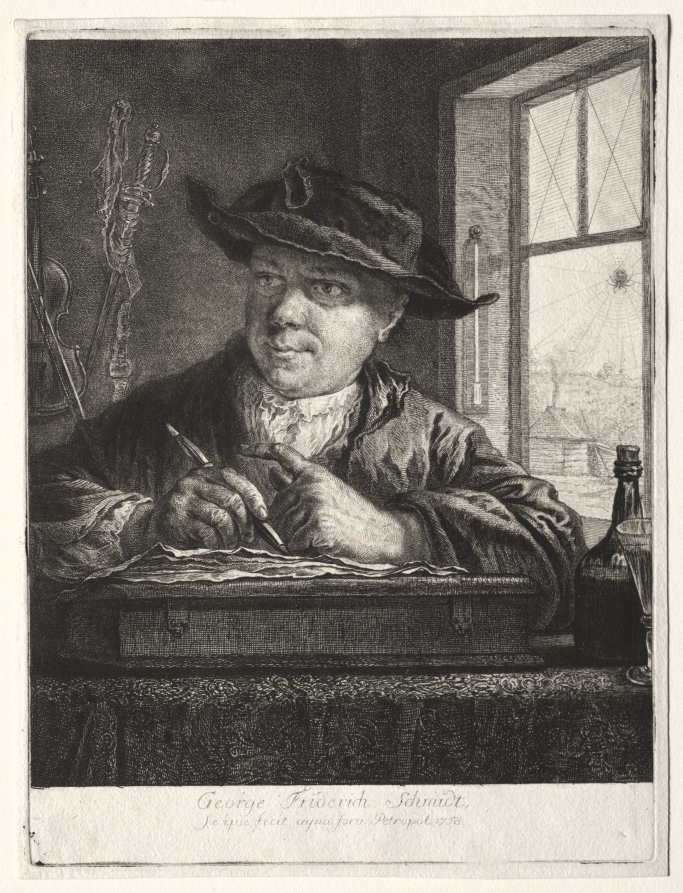
Georg Friedrich Schmidt · The Cleveland Museum of Art · Gift of Mrs. A. Dean Perry in memory of Mr. and Mrs. Edward Belden Greene · CC0
- Name
- Georg Schmidt
- Born
- 24 January 1712
- Birthplace
- Wandlitz, Prussia
- Died
- 25 January 1775
- Place of death
- Berlin, Prussia
- Nationality
- Germany.
- Occupation
- painter, etcher, illustrator, engraver and artist.
- Education
- Academy of Arts and Berlin.
- Teachers
- Georg Paul Busch and Nicolas de Larmessin.
- Languages
- German.
VALÉORINE Encyclopedia
VALÉORINE documentary reading
Documentary summary
Georg Friedrich Schmidt (24 January 1712 - 25 January 1775) was a German engraver, etcher and pastel painter, in the Rococo style.
Admitted source layer · organised and presented by VALÉORINE
Reference Check
Propose documentary evidence for Georg Friedrich Schmidt. A contribution is never written directly as fact: identity, source, rights and evidence gates still decide.
Sign in to contribute
World of VALÉORINE
Documentary connections
Only confirmed graph relationships appear here. Images are shown only when their identity and reuse rights both pass the documentary gate.
Documentary evidence
Documentary basis
Authority files
gnd · 1155186672 · wikidata · Q877735 · wikipedia · Georg Friedrich Schmidt
In this article
Biography
Biography
Schmidt worked between 1712 and 1775 across painter, copper engraver, etcher, illustrator and engraver and 2 further recorded occupations. Every statement below returns to a source shown in the evidence panel; where the record is silent or divided, the article says so instead of resolving it.
Georg Friedrich Schmidt studied at Academy of Arts, Berlin. Training under Georg Paul Busch and Nicolas de Larmessin is recorded. The recorded working language is German. Places of work recorded in the authority are Strasbourg, Paris and Berlin. Work by Georg Friedrich Schmidt is recorded in the collections of Museum Boijmans Van Beuningen, Minneapolis Institute of Art, Auckland Art Gallery, Finnish National Gallery and National Gallery of Victoria.
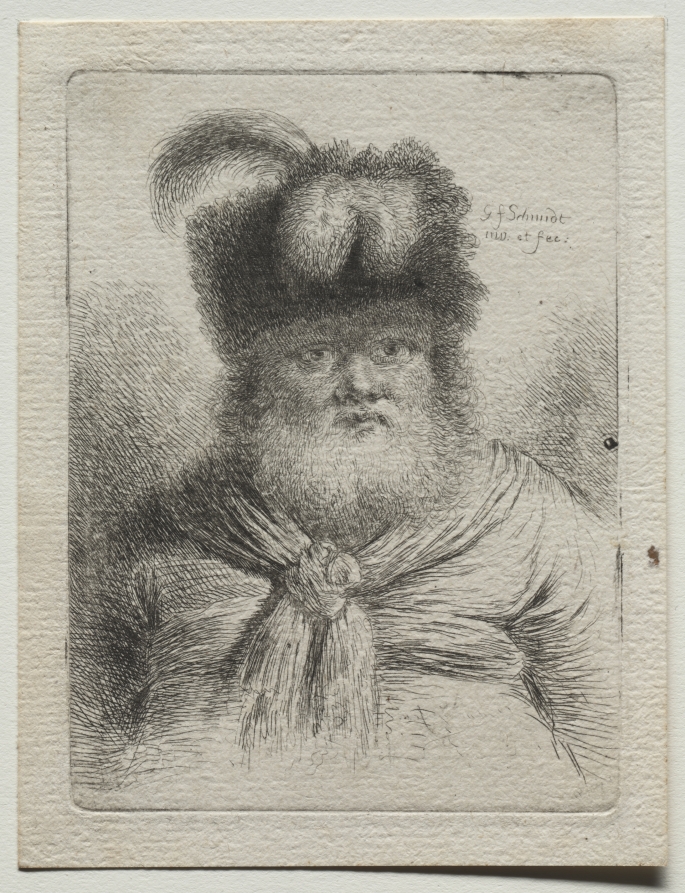
Old Man in a Fur Hat, by Georg Friedrich Schmidt
Georg Friedrich Schmidt · The Cleveland Museum of Art · Gift of Mr. and Mrs. Severance A. Millikin
Key facts
Key facts
• Name — Georg Schmidt • Born — 24 January 1712 • Birthplace — Wandlitz, Prussia • Died — 25 January 1775 • Place of death — Berlin, Prussia
Life and work
Life and work
His parents were cloth makers, and it was originally intended that he would follow them into the trade, but he displayed artistic talent at an early age. When he was fourteen, he was allowed to take lessons at the Prussian Academy of Arts. On the advice of his teachers, an apprenticeship for him was obtained with the engraver, Georg Paul Busch. In the 1730s, he began his mandatory military service, but continued to produce engravings. After doing one of then-Crown Prince Frederick he was released from service, through the intercession of Frederick's mentor, Friedrich Wilhelm von Grumbkow, and started his own business. During his time at the Academy, he befriended the Director and court painter, Antoine Pesne, who was originally from France. Pesne provided him with a recommendation to the painter, Nicolas Lancret, so he could continue his studies in Paris. In 1736, together with his former fellow-student and friend, Friedrich Wilhelm Hoeder, he left Berlin and headed there. While passing through Straßburg, they met the engraver, Johann Georg Wille, and he joined them. Schmidt and he shared a room for several years, while waiting for admission to the Académie Royale de Peinture et de Sculpture, and became close friends. A small pension from then-King Frederick helped him live in relative ease. Nicolas IV de Larmessin, "Engraver to the King", took him into his workshop, where he completed a seven-month training course; engraving portraits for art dealers and providing some illustrations for the publisher, Michel Odieuvre. In 1740, with some assistance from Hyacinthe Rigaud, he became self-employed. In 1742, King Louis XV officially granted permission for Protestants to attend the Académie Royale. The following year, however, he accepted an offer to become a court engraver back in Berlin. He returned there in the middle of the Second Silesian War, and his first major assignment was creating tactical maps of the battles of Kesselsdorf and Soor, which were published in 1746. That same year, he married Dorothée Luise Viedebandt, whose father was Director of the Russian Trading Company in Berlin. A large dowry may have been a factor. Two years later, their son August was born. He turned out to be an unruly child, who sometimes sold his father's works secretly and squandered the money. Much of his work involved illustrating King Frederick's writings, although he also produced portraits and copies of the works of Rembrandt. Following the outbreak of the Seven Years' War, the demand for art decreased dramatically, and tensions rose at the court. As did many of his colleagues, he accepted an invitation from Empress Elizabeth of Russia and went to St. Petersburg on leave, without his family. He would spend five years there. From 1758, he was the head of an engraving school. Most of his work involved portraits. Despite numerous requests for him to stay, he left shortly after Elizabeth's death, in 1762, and returned to Berlin. August died in 1766, aged only eighteen. Having established his reputation throughout Europe, he soon became a wealthy man and was able to acquire a collection of original etchings by Rembrandt. He did, however, continue to give lessons at the Prussian Academy. Over the years, his style fell out of fashion, and he found himself slowly being overshadowed by younger engravers who were willing to work for less. Dorothée died in 1771, and Georg followed in 1775, aged sixty-three. His estate was sold at auction. His tomb, in the Luisenstädtische Kirche, was destroyed along with the church during World War II.
Selected works
Selected works
• Illustration — Dorothee Louise Schmidt, 1761 • Illustration — Count Schuwalow, 1760 • Illustration — The Italian Theatre; after Nicolas Lancret, 1738 • Illustration — The Schmettau-Plan for Berlin, 1750 • Illustration — Empress Elisabeth; after Louis Tocqué, 1761 • Illustration — Julien Offray de La Mettrie, 1751
Life and work
Life and work
Georg Friedrich Schmidt was born on 24 January 1712 in Wandlitz. Schmidt held the nationality of Germany. Schmidt was educated at Academy of Arts, Berlin. Schmidt studied under Georg Paul Busch and Nicolas de Larmessin. Married to: Dorothea Luise Schmidt. Schmidt worked as painter, copper engraver, etcher and illustrator, and the authority record catalogues a further 3 occupations under the same name, among them engraver, visual artist and artist. Schmidt worked in Strasbourg, Paris, Berlin, Saint Petersburg and Berlin. Schmidt worked in German.
Life and career
Dated record
Life and career
Explore 1712–1775
The full dated record · 7 entries
1712
Georg Friedrich Schmidt was born on 24 January 1712.
1753
Madame Schmidt (the Artist's Wife), dated 1753, held by The Art Institute of Chicago.
1753
Madame Schmidt (the Artist's Wife) (The Art Institute of Chicago).
1757
Recorded as work location: Saint Petersburg.
1762
Recorded as work location: Berlin.
1775
Dies at Berlin.
1775
Georg Friedrich Schmidt died on 25 January 1775.
Places
Named by the record
Places
Only places the record itself states, plotted where the house gazetteer settles their coordinates. Nothing is inferred from a name or a nationality.
Wandlitz.
Birth place
Berlin.
Death place
Catalogued output
Paintings, drawings and prints
These are objects catalogued as visual works, each held or recorded by the institution named against it. 15 works carry dates between 1741 and 1773. The run opens with Monseigneur Louis-Charles d'Orléans de Saint-Albin, Archbishop of Cambrai and closes with The old Tobias is mocked by his wife. The 1750s are the densest part of the run, with 7 titles, and that concentration is a fact about what the registers have catalogued rather than a judgement on the work itself.
Monseigneur Louis-Charles d'Orléans de Saint-Albin, Archbishop of Cambrai
1741
Pierre Mignard
1744
The Old Soldier
1750
Samuel Liber Baro de Cocceji
1751
Felice Salimbeni
1751
Francesco Algarotti
1752
Self-Portrait
1752
The Artist's Wife Sewing
1753
The Persian
1756
Dorothée Louise Viedebandt (The Artist's Wife)
1761
Hirsch Michel
1762
Johann Melchior Dinglinger
1769
Primary material
Documents and archives
scholarly publication
- Schmidt, Georg Friedrich, Benezit Dictionary of Artists, 2011
Scholarly · Crossref registry · 2011
authority file
- Gemeinsame Normdatei 1155186672, Georg Friedrich Schmidt.
General reference · Deutsche Nationalbibliothek
reference work
- “Georg Friedrich Schmidt”, English Wikipedia, consulted as further reading
Reputable secondary · Wikipedia
Authority records
References
Citations
References
Each reference names the institution holding it, so a reader may go to the document itself.
scholarly publication
Schmidt, Georg Friedrich, Benezit Dictionary of Artists, 2011Crossref registry
Institutional witnessauthority file
Gemeinsame Normdatei 1155186672, Georg Friedrich Schmidt.Deutsche Nationalbibliothek
Secondary witnessreference work
Secondary witnessinstitutional register
Wikidata, structured authority record Q877735: Georg Friedrich SchmidtWikimedia Foundation
General reference
Further particulars
Held on the record
Further particulars
Open the remaining particulars
Georg Friedrich Schmidt studied at Academy of Arts, Berlin. He trained under Georg Paul Busch and Nicolas de Larmessin.
The Encyclopedia exists whether or not anything is for sale. Corrections are recorded rather than overwritten, and every version of this record is kept. Published 16 August 2026.
Elsewhere in Illustration
5,224 published records in this field, each with its sources named.
- Gennadij SpirinIllustrator
- Geoff TaylorIllustrator
- Geoffrey HayesIllustrator
- Georg Carl KochIllustrator
- Georg KlusemannIllustrator
- Georg KrauseIllustrator
- Georg MaccoIllustrator
- Georg MühlbergIllustrator
Best supported in this field
For owners
Own a work by Georg Friedrich Schmidt?
A specialist will read what you send and tell you what the house can establish, what it cannot, and whether the object is suited to sale. There is no charge and no obligation. The object stays with you throughout; nothing is shipped to us unless it is arranged in writing beforehand.