
Genia Averbuch
Genia Averbuch (1909–1977) was an Israeli architect.
Also recorded as Eugenie Averbuch · Genia Averbouch · Gina Averbuch · Averbuch, Genia
Genia Averbuch

Rubinstein Felix · CC BY-SA 3.0
- Name
- Genia Averbuch ג'ניה אוורבוך
- Born
- 1909
- Birthplace
- Smila, Kiev Governorate, Russian Empire
- Died
- 1977 (aged 67–68)
- Place of death
- Tel Aviv, Israel
- Nationality
- Israel
- Occupation
- architect · urban planner
- Fields
- architecture
- Education
- Herzliya Hebrew Gymnasium
- Languages
- Hebrew
VALÉORINE Encyclopedia
VALÉORINE documentary reading
Documentary summary
Genia Averbuch (1909–1977) was an Israeli architect.
Admitted source layer · organised and presented by VALÉORINE
Reference Check
Propose documentary evidence for Genia Averbuch. A contribution is never written directly as fact: identity, source, rights and evidence gates still decide.
Sign in to contribute
World of VALÉORINE
Documentary connections
Only confirmed graph relationships appear here. Images are shown only when their identity and reuse rights both pass the documentary gate.
Documentary evidence
Documentary basis
Authority files
wikidata · Q528902 · wikipedia · Genia Averbuch
In this article
Key facts
Key facts
• Name — Genia Averbuch ג'ניה אוורבוך • Born — 1909 • Birthplace — Smila, Kiev Governorate, Russian Empire • Died — 1977 (aged 67–68) • Place of death — Tel Aviv, Israel • Parents — Zeev Averbuch Zviya Averbuch • Illustration — Zina Dizengoff Circle in the 1940s • Illustration — Zina Dizengoff Circle in 2010 • Illustration — Beit ha-Halutzot 2007 Genia Averbuch (1909–1977) was an Israeli architect.
Early life and education
Early life and education
She was born in 1909 in Smila, Russian Empire. Genia Averbuch's family immigrated to Palestine in 1911 when she was two years old and settled in Tel Aviv. Her father, Zeev Averbuch, was the city's first pharmacist, and her mother Zviya was a sculptor. Averbuch grew up and went to school in Tel Aviv, and in 1926, when she was 17, she went to study architecture in the Regia Scuola di Architettura in Rome where other young people from Palestine studied. After two years in Rome, Averbuch continued her studies in Belgium and in 1930 she received a diploma in architecture from the Royal Academy of Arts of Brussels.
Architecture career
Architecture career
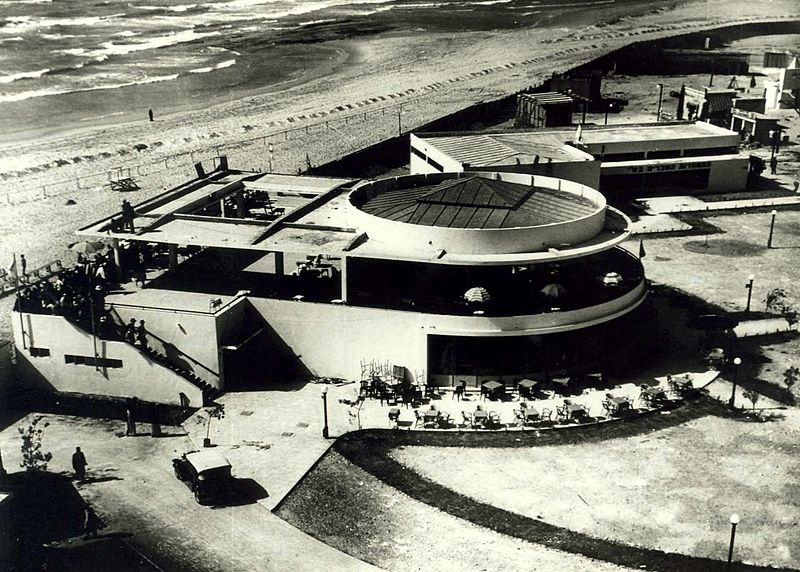
In 1930 at the age of 21, Averbuch returned to Palestine and launched her professional career. She worked for two years in the technical department of the Jewish Agency under Richard Kauffmann. After that she opened an independent firm together with architect Shlomo Ginsburg, nicknamed Sha’ag, a graduate of the first class at the Technion and the first architectural faculty in Palestine. Averbuch was married to Sha'ag for a short period during 1933. Tel Aviv was the urban center and heart of the Jewish community in Palestine. The large immigration wave of middle class German Jews in early 1930s led to a building spurt in the city. Together with Sha'ag, Averbuch designed many apartment buildings and urban villas, and she collaborated with Elsa Gidoni Mandelstamm in designing Café Galina for the Levant Fair in 1934. The structure's white geometry and transparency were typical of the International European style. In 1934 Averbuch won a competition for the design of a municipal plaza, Zina Dizengoff Circle, which became the city's central public space and symbol of its modernization. In 1935 Averbuch married Haim Elperin, the first commissioner of the Tel Aviv Police and one of the founders of the Israeli Red Cross (Magen David Adom). Their only son Daniel was born in 1936. From 1935 through the end of the 1930s, Averbuch worked with building engineer I. Greynetz, and together they entered several competitions in Tel Aviv. During World War II Averbuch also worked in the Tel Aviv municipal building department. In 1939 Averbuch won a competition for designing Beit ha-Halutzot (Pioneer Women's House) in Jerusalem. Winning this competition marked the beginning of Averbuch's long-term professional collaboration with women's organizations in Palestine. Between 1939 and 1955, Averbuch designed social institutions for women and children for all the women's organizations in Palestine (except for Hadassah, which did not work with women architects): WIZO, Leni, Moetzet Ha'poalot, the Mizrahi Women's Organization of America and B'nai B'rith Women. Her work includes pioneers' houses (residences for single women) in Jerusalem (1942) and in Netanya (1950), and agricultural youth villages for children and adolescent Holocaust refugees (Kfar Batya, 1945; Hadassim, 1947). During the 1950s Averbuch continued to design apartment buildings in Tel Aviv, particularly in the booming northern section of the city. In the 1960s she designed two synagogues for the religious Zionist movement and was the second woman to design synagogues in Israel: the synagogue at the first yeshiva high school in Israel, "Midrashat Noam" in Pardes Hannah (1965), and the synagogue at the religious kibbutz Ein HaNatziv (1966). The partnership between Averbuch and Baron lasted through the mid-1970s. In the 1960s a third partner, Chaim Romem, joined the firm. During the period of the British Mandate, Averbuch participated in architecture competitions and won many prizes and citations. She was well known and well respected in the professional community. In the mid-1940s she began serving as a professional judge for design competitions. Many of the residential buildings she designed in Tel Aviv are situated in the White City area designated as a UNESCO World Cultural Heritage Site and have been chosen for preservation by the Tel Aviv municipality. In 2013, in appreciation of Genia Averbuch's contribution to Tel Aviv's urban landscape, the city decided to name a circle for her.

Dizengoff Square in Tel Aviv.
תכנון ובניה בישראל
Events in Israel
Ilan Shchori · My Tour-Il - History site of the land of Israel via the PikiWiki - Israel free image collection project
Life and career
Dated record
Life and career
The full dated record · 2 entries
1909
Genia Averbuch born at Smila.
1977
Genia Averbuch died at Israel.
Places
Named by the record
Places
Only places the record itself states, plotted where the house gazetteer settles their coordinates. Nothing is inferred from a name or a nationality.
Smila.
Birth place
Israel.
Death place
Primary material
Documents and archives
scholarly publication
- Elsa Gidoni and Genia Averbuch: Architects for the Women Workers’ Council and WLI, Modern Architecture and Gender in Pre-State Israel, 2025
Scholarly · Crossref registry · 2025
- Genia Averbuch:, Israel as a Modern Architectural Experimental Lab, 1948–1978, 2019
Scholarly · Crossref registry · 2019
reference work
- Wikidata, structured authority record Q528902: Genia Averbuch
Reputable secondary · Wikimedia Foundation
- “Genia Averbuch”, English Wikipedia, consulted as further reading
Reputable secondary · Wikipedia
Notes from the source article
Cited by Wikipedia
Notes from the source article
These works are cited by the source article, in its own numbering. They are recorded as its citations, not as sources VALÉORINE has verified.
- 1.Edina Meyer-Maril. Architects in Palestine: 1920–1948. Jewish Women's Archive.
- 2.Legendary Architect Lightens Up an Old Jerusalem Stone Monument
Bibliography printed in the source article · 3
- Davidi, Sigal. Modern Architecture and Gender in Pre-State Israel, Palgrave-Macmillan, 2025.
- Davidi, Sigal. Women Design Synagogues: Gender insights into the history of modern Israeli synagogue architecture. Israel Studies 28, no. 1, Indiana University Press (2023): 140-161.
- Davidi, Sigal. Genia Averbuch: Modernism Meets the Vernacular; Youth Villages for New Immigrants, 1948-1955. In Anat Geva and Inbal Ben-Asher Gitler (eds), Israel as a Modern Architectural Experimental Lab (1948-1978), (Bristol and Wilmington: Intellect Books, 2020): 147-172.
References
Citations
References
Each reference names the institution holding it, so a reader may go to the document itself.
scholarly publication
Elsa Gidoni and Genia Averbuch: Architects for the Women Workers’ Council and WLI, Modern Architecture and Gender in Pre-State Israel, 2025Crossref registry
Institutional witnessscholarly publication
Genia Averbuch:, Israel as a Modern Architectural Experimental Lab, 1948–1978, 2019Crossref registry
Institutional witnessreference work
Wikidata, structured authority record Q528902: Genia AverbuchWikimedia Foundation
Secondary witnessreference work
Secondary witness
Further particulars
Held on the record
Further particulars
Open the remaining particulars
The authorities additionally record the headings Eugenie Averbuch, Genia Averbouch, Gina Averbuch and Averbuch, Genia. Her recorded language was Hebrew. She was the child of Zeev Averbuch. She married Haim Elperin.
Identity and origins
The Encyclopedia exists whether or not anything is for sale. Corrections are recorded rather than overwritten, and every version of this record is kept. Published 16 August 2026.
Elsewhere in Design
11,558 published records in this field, each with its sources named.
- Gene DubDesigner
- Gene LeedyDesigner
- Gene Stratton-PorterDesigner
- Gene SummersDesigner
- Gennady OvcharenkoDesigner
- Gennaro Maria d'AfflittoDesigner
- Geoffrey BawaDesigner
- Geoffrey BazeleyDesigner
Best supported in this field
For owners
Own a work by Genia Averbuch?
A specialist will read what you send and tell you what the house can establish, what it cannot, and whether the object is suited to sale. There is no charge and no obligation. The object stays with you throughout; nothing is shipped to us unless it is arranged in writing beforehand.