
Gauntlet
Gauntlet is a 1985 multidirectional shooter video game developed and published by Atari Games for arcades. It is one of the first multiplayer dungeon crawl arcade games. The core design of Gauntlet comes from the 1983 game Dandy for the Atari 8-bit computers, which resulted in a threat of legal action.
Also recorded as Arcade Gauntlet · 1985 Gauntlet
Gauntlet

空練 · 撮影者提供。 · CC BY-SA 3.0
- Date
- 1985
- Publisher
- Gauntlet was published by U.S. Gold.
- Genre
- role-playing video game
VALÉORINE Encyclopedia
VALÉORINE documentary reading
Documentary summary
Gauntlet is a 1985 multidirectional shooter video game developed and published by Atari Games for arcades. It is one of the first multiplayer dungeon crawl arcade games. The core design of Gauntlet comes from the 1983 game Dandy for the Atari 8-bit computers, which resulted in a threat of legal action.
Admitted source layer · organised and presented by VALÉORINE
Reference Check
Propose documentary evidence for Gauntlet. A contribution is never written directly as fact: identity, source, rights and evidence gates still decide.
Sign in to contribute
World of VALÉORINE
Documentary connections
Only confirmed graph relationships appear here. Images are shown only when their identity and reuse rights both pass the documentary gate.
Documentary evidence
Documentary basis
Authority files
wikidata · Q734758
In this article
The object
The object
It also has similarities to the 1983 maze game Time Bandit. The arcade version of Gauntlet was released in October 1985, initially available only as a dedicated four-player cabinet. Atari distributed a total of 7,848 arcade units. In Japan, the game was released by Namco in February 1986. Atari later released a two-player cabinet variant in June 1986, aimed at operators who could not afford or did not have sufficient space for the four-player version.
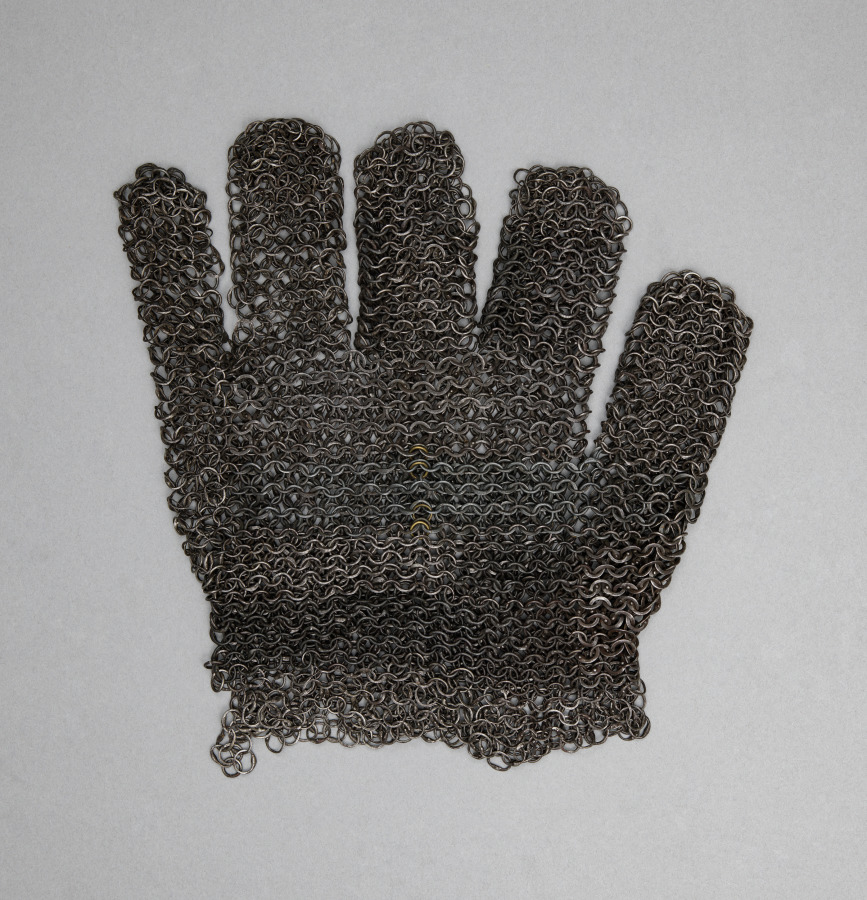
Gauntlet, 1500s
The Cleveland Museum of Art · Gift of Mr. and Mrs. John L. Severance
Key facts
Key facts
• Title — Gauntlet • Developer — Atari Games • Designer — Ed Logg • Programmer — Ed Logg, Bob Flanagan • Artist — * Sam Comstock • Susan G. McBride • Alan J. Murphy • Will Noble • Series — Gauntlet • Platforms — ZX Spectrum, Commodore 64, Amstrad CPC, MSX, Atari ST, Atari 8-bit, Apple IIGS, Apple II, NES, MS-DOS, Macintosh, Master System • Genre — Multidirectional shooter, dungeon crawl • Modes — Single-player, multiplayer • Arcade System — Atari Gauntlet
Gameplay
Gameplay
• Illustration — Arcade version screenshot The game is set within a series of top-down, third-person, orthographic mazes where the object is to kill monsters, gather treasures, and find the exit in every level. An assortment of special items can be located in each level. These items can increase the player's health, unlock doors, award more points and destroy all of the enemies on screen. Each player controls one of four fantasy-based characters: Thor, a warrior; Merlin, a wizard; Thyra, a valkyrie; or Questor, an Elf. The characters are named on the cabinet artwork, but in-game they are referred only by the title of their classes. Each character has his or her own unique strengths and weaknesses. For example, the warrior is strongest in hand-to-hand combat, the wizard has the most powerful magic, the valkyrie has the best armor, and the Elf is the fastest in movement. The characters are assigned by control panel in the four-player version, whereas in the two-player version each player selects their own character at the start of the game or while joining during the middle of play. The enemies are an assortment of fantasy-based monsters, including ghosts, grunts, demons, lobbers, sorcerers, and thieves. Each enters the level through specific generators, which can be destroyed. The most dangerous enemy is Death, who can only be destroyed by using a magic potion—otherwise Death will vanish automatically after it has drained a certain amount of health from the player. As the game progresses, higher levels of skill are needed to reach the exit, with success often depending on the willingness of the players to cooperate by sharing food and luring monsters into places where they can be engaged and slaughtered more conveniently. While contact with enemies reduces the player's health, health also slowly drains on its own, thus creating a time limit. When a character's health reaches zero, that character dies. The character can be revived in place with full health by spending a game credit—inserting a coin in the arcade—within a certain short time window after it died. This allows even the least proficient players to keep playing indefinitely, if they are willing to keep inserting coins. However, each player's final score will be divided by the amount of credits they used to play. Aside from the ability to have up to four players at once, the game is also noted for the narrator's voice, which is produced by a TMS5220C speech chip. The TMS5220C speech was encoded by Earl Vickers. The narrator (voiced by Ernie Fosselius) frequently makes statements repeating the game's rules, including: "Shots do not hurt other players, yet", "Remember, don't shoot food", "Elf shot the food", and "Warrior needs food, badly". The narrator occasionally comments on the battle by saying, "I've not seen such bravery" or "Let's see you get out of here". When a player's life force points fall below 200, the narrator states, "Your life force is running out", "Elf needs food", or "Valkyrie is about to die". The control panel for the four-player cabinet is wider than other standard uprights in order to accommodate four people at the same time. Each player has an eight-way joystick and two buttons: one for "fire" (ranged attack) and one for "magic". The "magic" button also starts the game. After Gauntlets release, other games started using this design, so it was a popular conversion target for newer games after it had its run.
Development
Development
Originally called Dungeons, the game was conceived by Atari game designer Ed Logg. He claimed inspiration from his son's interest in the paper-based game Dungeons & Dragons and from his own interest in the 1983 four-player dungeon crawl for the Atari 8-bit computers, Dandy. The game's development spanned from 1983 to 1985, with a team being led by designers Ed Logg and Roger Zeigler. The working title became legally unavailable in April 1985, so it was renamed Gauntlet in May. Based upon some of the most elaborate hardware design in Atari's history to date, it is the company's first coin-operated game that features a voice synthesizer chip. Another game that Gauntlet bears a striking resemblance to is Time Bandit (1983), especially its Atari ST version released in 1985, which led to claims of one possibly being a "clone" of the other. However, Time Bandit designer Harry Lafnear stated that his game was based on Konami's earlier arcade game Tutankham (1982), and that he only found out about Gauntlet after the Atari ST version was completed in late 1985. He believes neither game copied each other, but that their similarities stem from being inspired by earlier "maze shoot 'em up" titles such as Tutankham. In 2008, Retro Gamer magazine called Tutankham "an early Gauntlet".
Dandy dispute
Dandy dispute
Ed Logg, the co-creator of Asteroids and Centipede, is credited with the original game design of Gauntlet in the arcade version, as well as the 1987 NES release. After its release, John Palevich threatened a lawsuit, asserting that the original concept for the game was from Dandy, a game for the Atari 8-bit home computers written by Palevich and published in 1983. The conflict was settled without any suit being filed, with Atari Games doing business as Tengen allegedly awarding Palevich a Gauntlet game machine. While he is credited with "special thanks" through 1986, Logg is entirely removed from credits on later releases and as of 2007 Logg claims no involvement with the NES game. Dandy was later reworked by Atari Corporation and published for the Atari 2600, Atari 7800, and Atari 8-bit computers as Dark Chambers in 1988.
Ports
Ports
• Illustration — NES box art Gauntlet was ported to MS-DOS, Apple II, Mac, MSX, Nintendo Entertainment System, Apple IIGS, Master System, Atari ST, Commodore 64, Atari 8-bit computers, Amstrad CPC, and ZX Spectrum. An X68000 version was under development by M2, before being showcased to Tengen, Atari Games' consumer software publishing division, and released as Gauntlet IV for the Sega Genesis. The NES version was developed and released by Tengen in 1988, and was the very first title to be developed in the United States for the NES. In 1998, the game was re-released for PlayStation and Windows as part of the compilation Arcade's Greatest Hits: The Atari Collection 2.
Expansion pack
Expansion pack
Gauntlet: The Deeper Dungeons is an expansion pack for the original computer ports of Gauntlet with 512 new levels. It was developed by Gremlin Graphics and released in 1987 by U.S. Gold in the UK and Europe and Mindscape in the US for the Amstrad CPC, MSX, Atari ST, Commodore 64, and ZX Spectrum ports of Gauntlet. Many of its levels were entries in a competition throughout Europe in which ten winners were awarded prizes, a Gauntlet T-shirt and a copy of the program for their computers. The contest was announced in the instructions of many of the ported games. The levels are presented randomly and its artwork is the side panel artwork of the arcade cabinet with only the main characters shown. The enemies were removed from the image and replaced with a pink background. Reviewers noted that the levels were much harder than those in the original game, although the consensus was that it was not quite as good as the first game or the newly released arcade sequel.
Commercial
Commercial
The game was highly profitable upon its November 1985 launch in North America, reportedly earning one San Mateo, California arcade operator $15,000 in sixteen weeks and another Canadian operator US$4,500 in nine days. In the United States, it topped the monthly RePlay upright arcade cabinet chart in December 1985, and topped the Play Meter arcade video game charts from January 1986 to March 1986; after being displaced by Sega's Hang-On in April, Gauntlet returned to the top spot in May. RePlay listed it as the second highest-grossing arcade video game of 1986 in the United States, below Hang-On, while AMOA listed it as the year's highest-earning dedicated arcade cabinet. Atari ultimately sold a total of 7,848 Gauntlet video game arcade cabinets. In Japan, Gauntlet was a commercial success for Namco. At a Japanese trade show in late 1985, the game drew large crowds and set record earnings for an Atari arcade cabinet. Game Machine listed Gauntlet as the second most popular upright/cockpit arcade game of March 1986, below Sega's Space Harrier, before Gauntlet topped the chart in April. It went on to be Japan's third highest-grossing upright/cockpit arcade game during the first half of 1986 (below Hang-On and Space Harrier), and the sixth highest during the second half of the year. It was Japan's fourth highest-grossing upright/cockpit arcade game of 1986, below Hang-On, Space Harrier and Pole Position II. In the United Kingdom, the home computer conversions topped the UK sales chart in December 1986. It went on to sell more than 200,000 copies in the UK by 1987, and over 300,000 copies As of 1988.
Critical
Critical
The arcade game received a positive review from Clare Edgeley of Computer and Video Games upon release. Yung Min Choi reviewed the home computer conversion of Gauntlet with Demon Stalkers for Computer Gaming World, and stated that "in reality, players who crave this type of action will not be disappointed with either game". Entertainment Weekly picked the game as the 14th-greatest game available in 1991, saying: "There have been sequels to this game, but nothing matches the original Gauntlet, an innovative, fast-playing mix of mazes, monsters, and magic spells". The Mac version was reviewed in 1989 in Dragon No. 150 by Hartley, Patricia, and Kirk Lesser in "The Role of Computers" column. The reviewers gave the game four out of five stars. Compute! praised the Macintosh version's sound effects. Computer and Video Games praised the accuracy of the Amstrad version, and said that it had "great graphics, good sounds, and perfect playability". Crash praised the smooth and fast scrolling, and the longevity, with Avenger being listed as the only alternative. In their Master System review, ACE said that people of all ages could quickly master the controls and tasks. The Spectrum version was the biggest-selling game of 1986, and was voted number 38 in the Your Sinclair Readers' Top 100 Games of All Time. More than a decade after release, the Official UK PlayStation Magazine noted that they "spent many a night hunched over a fag-stained Gauntlet machine", but said that the limitations had become apparent in the late 1990s. Next Generation, while not including the game in their "Top 100 Games of All Time", noted in the intro that "for the record, Gauntlet was number 101". In 1995, Flux magazine rated the game 89th on their "Top 100 Video Games." In 1996, GamesMaster ranked Gauntlet 18th in its "Top 100 Games of All Time."
Places
Named by the record
Places
Only places the record itself states, plotted where the house gazetteer settles their coordinates. Nothing is inferred from a name or a nationality.
- United States
Named but not plotted · 1
Gauntlet is associated with United States.
Country
Legacy
The arcade original was followed by a 1986 sequel, Gauntlet II, which was followed by further sequels on home platforms, including Gauntlet: The Third Encounter, Gauntlet III: The Final Quest, and Gauntlet IV. The arcade series was revived with Gauntlet Legends in 1998, which itself saw the sequels Gauntlet Dark Legacy and Gauntlet: Seven Sorrows. The original Gauntlet arcade game is included in Midway Arcade Treasures (2003) for the GameCube, PlayStation 2, Xbox, and Microsoft Windows, and Midway Arcade Origins (2012) for the Xbox 360 and PlayStation 3. The game was rebooted in 2014 on home platforms as Gauntlet.
Awards
At the 1986 Golden Joystick Awards in London, Gauntlet won Game of the Year, and was runner-up in the category of Arcade Game of the Year. It also received a Smash Hit award from ZX Computing magazine. It also won "Best Audio Enhancement in a Video Game" and "Most Innovative Video Game" at the 1986 Amusement Players Association's Players Choice Awards; the overall Game of the Year award went to the arcade version of Super Mario Bros.
Notes from the source article
Cited by Wikipedia
Notes from the source article
These works are cited by the source article, in its own numbering. They are recorded as its citations, not as sources VALÉORINE has verified.
- 1.'Role-playing' Vid. Cash Box. November 2, 1985.
- 2.The Adventures Continues With Gauntlet. Atari Games Players Journal. 1. 3. August 1986.
- 3.The International Arcade Museum. Gauntlet.
- 4.EMAP. Gauntlet for Four. Sinclair User. 53. 97. August 1986.
- 5.Availability Update. Computer Entertainer. 6. 7. 14. October 1987.
- 6.Availability Update. Computer Entertainer. 6. 8. 14. November 1987.
- 7.Availability Update. Computer Entertainer. 6. 9. 14. December 1987.
- 8.Availability Update. Computer Entertainer. 7. 1. 14. April 1988.
- 9.Availability Update. Computer Entertainer. 7. 4. 13. July 1988.
- 10.Availability Update. Computer Entertainer. 8. 2. 14. May 1989.
- 11.Gauntlet – Sega Review. Mean Machines. 1. 58–60. October 1990.
- 12.Classic Game Postmortem: Gauntlet. GDC Vault.
- 13.Logg, Ed. Gauntlet Postmortem.
- 14.Atari Games. Atari Production Numbers Memo. January 4, 2010.
- 15.Agency for Cultural Affairs. Gantoretto. Media Arts Database.
- 16.'Gauntlet' For Two. Cash Box. June 21, 1986.
- 17.Arcade History. Gauntlet The Arcade Video Game by Atari Games Corp.
- 18.Scimeca, Dennis. The Making Of Gauntlet -- A Classic Arcade Game That Atari Never Saw Coming. G4TV. March 8, 2012.
- 19.Harry Lafnear Interview. Atari Legend. September 5, 2003.
- 20.Imagine Publishing. Developer Lookback: Konami Part I. Retro Gamer. 53. 29. August 2008.
- 21.ATARI PROTOS.com. Dark Chambers.
- 22.tsr. Tetris Forever. Atari HQ.
- 23.Vendel, Curt. The Atari 65XEM (AMY Sound Processor).
- 24.M2. Corporate Profile. December 20, 2013.
- 25.Volume 7, Issue 5. Computer Entertainer. August 2017.
- 26.Gauntlet: The Deeper Dungeons instructions.
- 27.Original Gauntlet cassette tape version instructions released by U.S. Gold.
- 28.Biggs, Sara. The Deeper Dungeons review. Your Sinclair. 18. 58. June 1987.
- 29.The Deeper Dungeons review. Sinclair User. 63. 49. June 1987.
- 30.The Deeper Dungeons review. ZX Computing. 35. June 1986.
- 31.The Deeper Dungeons review. Computer Gamer. 27. 73. June 1987.
- 32.EMAP. Gauntlet Review. ACE. 37. 87. October 1990.
- 33.Future plc. Gauntlet Review. Amstrad Action. 16. 68–69. January 1987.
- 34.Newsfield. Gauntlet Review. Crash!. 37. 16–17. February 1987.
- 35.EMAP. Gauntlet Review. C+VG. 63. 36–37. January 1987.
- 36.EMAP. Gauntlet By US Gold. C+VG. 110. 120–121. January 1991.
- 37.Guide: Sega. Computer and Video Games. Complete Guide to Consoles: Volume IV. 89–110. November 1990.
- 38.Gauntlet Review. Joystick. 15. 107. April 1991.
- 39.EMAP. Gauntlet Review. Sinclair User. 59. 40–41. February 1987.
- 40.Newsfield. Version Update Gauntlet. The Games Machine. 11. 56. February 1987.
- 41.Future plc. Running the Gauntlet. Your Sinclair. 14. 56–57. February 1987.
- 42.Newsfield. Gauntlet Review. Zzap!64. 63. 20–22. February 1987.
- 43.EMAP. Gauntlet Review. Commodore User. 40. 18–19. January 1987.
- 44.Argus Press. Gauntlet Review. Computer Gamer. 23. 46–47. February 1987.
- 45.Paragon Publishing. Software A-Z: Master System. Console XS. 1 (June/July 1992). 137–47. 23 April 1992.
- 46.PC Electrical-Electronic Press. Gauntlet Review. Your Computer. 23. 47–48. February 1987.
- 47.Game review, Amstrad June magazine, Future Publishing, issue 16, January 1987
- 48.RePlay: The Players' Choice. RePlay. 11. 3. 4. December 1985.
- 49.National Play Meter. Play Meter. 12. 1. 20–1. January 15, 1986.
- 50.National Play Meter. Play Meter. 12. 2. 30–1. February 1986.
- 51.National Play Meter. Play Meter. 12. 5. 116–7. April 1, 1986.
- 52.National Play Meter. Play Meter. 12. 74–5. July 15, 1986.
- 53.Amusement Players Association. Top 20 of 1986. Top Score. 3. July–August 1987.
- 54.AMOA JB, Games & Cig Vending Awards Winners. Cash Box. 30. December 6, 1986.
- 55.Atari Scores a Breakthrough with 'Gauntlet'. RePlay. 11. 2. 104. November 1985.
- 56.Amusement Press, Inc. Game Machine's Best Hit Games 25 - アップライト, コックピット型TVゲーム機 (Upright/Cockpit Videos). Game Machine. 280. 21. 15 March 1986.
- 57.Amusement Press, Inc. Best Hit Games 25. Game Machine. 281. 21. 15 April 1986.
- 58.Amusement Press, Inc. Game Machine's Best Hit Games 25: '86 上半期. Game Machine. 288. 28. 15 July 1986.
- 59.Amusement Press, Inc. Game Machine's Best Hit Games 25: '86 下半期. Game Machine. 300. 16. 15 January 1987.
- 60.The Charts. Your Computer. 7. 3. 16. March 1987.
- 61.Newsfield. Out Run. Crash. 49. 22–23 (22). February 1988. 0954-8661.
- 62.History in the Making: The First Three Years. Computer and Video Games. 83 (September 1988). 51. 16 August 1988.
- 63.Arcade Action: Gauntlet. Computer and Video Games. 50 (December 1985). 88. 16 November 1985.
- 64.Choi, Yung Min. Ramparts and Rodents: A Look at Two Action Adventure Dungeons. Computer Gaming World. 40–41. April 1988.
- 65.Strauss, Bob. Video Games Guide. Entertainment Weekly.
- 66.Lesser, Hartley. The Role of Computers. Dragon. 150. 68–73, 95. October 1989.
- 67.Aycock, Heidi E. H. Compute! Specific: Mac. Compute!. 16. December 1989.
- 68.Future plc. Top 100 Speccy Games. Your Sinclair. 72. 27–29. December 1991.
- 69.Alt URL.
- 70.Atari Greatest Hits review, Official PlayStation Magazine, Future Publishing issue 36, page 125, September 1998
- 71.Imagine Media. Top 100 Games of All Time. Next Generation. 21. 37. September 1996.
- 72.Harris Publications. Top 100 Video Games. Flux. 4. 32. April 1995.
- 73.Top 100 Games of All Time. GamesMaster. 44. 77. July 1996.
- 74.EMAP. Golden Joystick Awards. Computer and Video Games. 66. 101. April 1987.
- 75.Argus Press. Gauntlet Review. ZX Computing. 82–83. March 1987.
- 76.Amusement Players Association. Amusement Players Association's Players Choice Awards. Top Score. Winter 1987.
Bibliography printed in the source article · 2
- Casus Belli #35 (Dec 1986)
- Ludotique | Article | RPGGeek. rpggeek.com.
References
Citations
References
Each reference names the institution holding it, so a reader may go to the document itself.
authority record
General reference
The Encyclopedia exists whether or not anything is for sale. Corrections are recorded rather than overwritten, and every version of this record is kept. Published 17 August 2026.
Elsewhere in Collectables
20,755 published records in this field, each with its sources named.
- GatewaysWork
- Gatling GearsWork
- Gato RobotoWork
- Gator PanicWork
- Gauntlet Dark LegacyWork
- Gauntlet IIWork
- Gauntlet IVWork
- Gauntlet LegendsWork
Best supported in this field
For owners
Own a copy of Gauntlet?
A specialist will read what you send and tell you what the house can establish, what it cannot, and whether the object is suited to sale. There is no charge and no obligation. The object stays with you throughout; nothing is shipped to us unless it is arranged in writing beforehand.