
Gabriel de Jongh
Illustration — "Landscape with Cottage" Gabriel Cornelis de Jongh (6 April 1913 – 11 March 2004) was a Dutch-born South African painter. After a very close relationship with his father, Gabriel decided to pursue the same career, his father being both tutor and critic. Gabriel de Jongh was working in oil, watercolour, ink and pencil, he painted landscapes, still lifes, seascapes, and wildlife; he also depicted religious themes.
Also recorded as Gabriel Cornelis De Jongh
Gabriel de Jongh
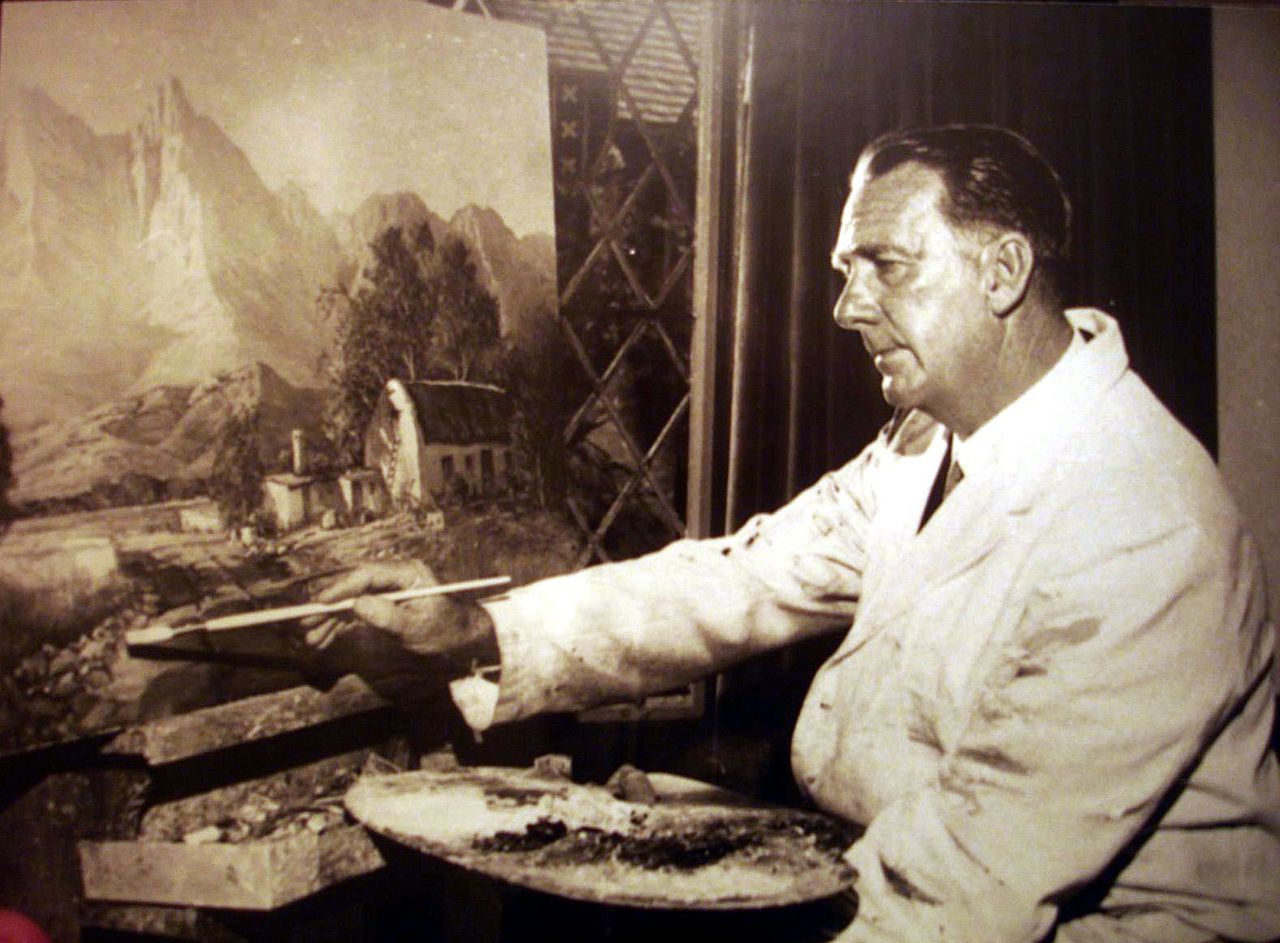
Public domain
- Born
- Gabriel de Jongh was born on 6 April 1913. · Amsterdam.
- Nationality
- Kingdom of the Netherlands · South Africa
- Occupation
- painter
- Languages
- English
VALÉORINE Encyclopedia
VALÉORINE documentary reading
Documentary summary
Illustration — "Landscape with Cottage" Gabriel Cornelis de Jongh (6 April 1913 – 11 March 2004) was a Dutch-born South African painter. After a very close relationship with his father, Gabriel decided to pursue the same career, his father being both tutor and critic. Gabriel de Jongh was working in oil, watercolour, ink and pencil, he painted landscapes, still lifes, seascapes, and wildlife; he also depicted religious themes.
Admitted source layer · organised and presented by VALÉORINE
Reference Check
Propose documentary evidence for Gabriel de Jongh. A contribution is never written directly as fact: identity, source, rights and evidence gates still decide.
Sign in to contribute
World of VALÉORINE
Documentary connections
Only confirmed graph relationships appear here. Images are shown only when their identity and reuse rights both pass the documentary gate.
Documentary evidence
Documentary basis
Authority files
wikidata · Q5515919 · wikipedia · Gabriel de Jongh
In this article
Biography
Biography
Tinus de Jongh travelled to South Africa in 1921, his wife following with the family six months later, and settled in a cottage in Fish Hoek. Gabriel accompanied his father on rambles through the Cape Peninsula, searching for painterly subjects. Later he studied at the Michaelis School of Fine Art and the Slade School of Art in London. He did a course in woodcarving under H. Meyerowitz in Cape Town, and a course in photo-lithography at the Cape Times. Tinus bought a car in 1923, travelling ever further afield, and always accompanied by his family. In 1924 the family moved to Rondebosch, Gabriel attending Rondebosch and Wynberg Boy's schools, and matriculating in 1930. Before starting his training at the Cape Times, Gabriel was tutored for a year in watercolour techniques by his father. Gabriel spent all his free time producing small watercolours of the Malay Quarter, Cape Town Docks and Table Mountain. Over weekends he pursued various sports and was a keen golfer. His tennis was of sufficiently high standard to represent The Cape Times in tournaments. He became a member of the S A Turf Club and owned a champion racehorse, "Glorious". Completing his apprenticeship he became interested in colour reproduction of fine art, coming under the guidance of Charles Hardy. During this period he started experimenting with etchings. Tinus exhibited in Hermanus in 1937 and suggested that Gabriel display some of his works. Gabriel's twenty watercolours sold on the first day. When some of his works were displayed in Port Elizabeth and well-received, the news delighted his father. Thereafter his work was regularly exhibited at various art societies in the Eastern Cape, Orange Free State and Johannesburg. Gabriel married Mercia Maria Kotze in 1938, moving into a home adjacent to his parents. He joined the Civil Defence Corps with his father until 1942 when all expatriate Dutch citizens were called up by the Dutch government. Tinus' declining health was diagnosed as lung cancer and Gabriel was granted compassionate leave to be with his father, who died on 17 July 1942. Gabriel was ordered to join the Eighth Contingent of the Koninklijke Nederlandsche Brigade, and embarked on the "Sabajak" arriving in Britain on 16 December 1942. Amidst preparations for war, Gabriel spent his free time drawing in the English countryside, and attended the Slade School of Art, transferred to Windermere during the war, as a part-time student. On 5 August 1944 he departed for Normandy. Injured by anti-personnel shells, he was declared medically unfit, arriving back in South Africa on 12 June 1945, and returning to work at The Cape Times, traumatised by his war experiences. In 1946 he acquired an army truck converted to a caravan, and set off with his wife and son Tinus, on a grand painting tour of the Eastern Cape, Basutoland and Natal. While staying at the Cathedral Peak Hotel in the Drakensberg, he was persuaded to exhibit his works there by the owner, Albert van der Riet. This proved a large factor in his swing from watercolours to oils. Gabriel made lengthy tours of Britain, Europe, South America and East Africa, but remained devoted to the landscapes of the Western Cape, referred to by his descendants as the "boompie-bergie-huisie-thing". He purchased a boat, the Pocketa, in which he explored the Cape waters. A painting of Cape Point is displayed in the clubhouse of the Marlin and Tuna Club of which he was a member. Other commissions included Jan van Riebeek's landing in Table Bay, the 1963 volcanic eruption on Tristan da Cunha, and a 1,8 x 2,4 metre canvas of the elephant Ndlulamithi. His works are to be seen in public and private collections all over the world. Gabriel established the Tinus de Jongh Memorial Gallery in Stellenbosch in 1981 and turned into a major tourist attraction on the wine route. The gallery closed ten years later when the Lanzerac Hotel changed hands.
The recorded working language is English.
Places
Named by the record
Places
Only places the record itself states, plotted where the house gazetteer settles their coordinates. Nothing is inferred from a name or a nationality.
Gabriel de Jongh was born at Amsterdam.
Birthplace
Amsterdam.
Birth place
Primary material
Documents and archives
reference work
- “Gabriel de Jongh”, English Wikipedia, consulted as further reading
Reputable secondary · Wikipedia
authority record
- Wikidata, structured authority record Q5515919: Gabriel de Jongh
General reference · Wikidata
Notes from the source article
Cited by Wikipedia
Notes from the source article
These works are cited by the source article, in its own numbering. They are recorded as its citations, not as sources VALÉORINE has verified.
References
Citations
References
Each reference names the institution holding it, so a reader may go to the document itself.
reference work
Secondary witnessauthority record
General reference
The Encyclopedia exists whether or not anything is for sale. Corrections are recorded rather than overwritten, and every version of this record is kept. Published 18 August 2026.
Elsewhere in Paintings
18,623 published records in this field, each with its sources named.
- Gabino ReyArtist
- Gabriel BlanchardArtist
- Gabriel BrachoArtist
- Gabriel BriardArtist
- Gabriel DelucArtist
- Gabriel FerrierArtist
- Gabriel François DoyenArtist
- Gabriel GuayArtist
Best supported in this field
For owners
Own a work by Gabriel de Jongh?
A specialist will read what you send and tell you what the house can establish, what it cannot, and whether the object is suited to sale. There is no charge and no obligation. The object stays with you throughout; nothing is shipped to us unless it is arranged in writing beforehand.