
Fumihiko Maki
Fumihiko Maki (槇 文彦, Maki Fumihiko; 6 September 1928 – 6 June 2024) was a Japanese architect. In 1993, he received the Pritzker Prize for his work, which often explores pioneering uses of new materials and fuses the cultures of east and west. Maki died on 6 June 2024, at the age of 95.
Fumihiko Maki

jeanbaptisteparis derivative work: aghith · flickr: Fumihiko Maki · CC BY-SA 2.0
- Born
- 1928. · Tokyo.
- Died
- 2024. · Tokyo.
- Nationality
- Japan and Empire of Japan.
- Occupation
- architect, teacher and opinion journalist.
- Fields
- architecture.
- Education
- University of Tokyo, Harvard Graduate School of Design, Cranbrook Academy of Art and Keio Futsubu School.
- Known for
- Tokyo Metropolitan Gymnasium, 4 World Trade Center and Spiral.
- Honours
- Pritzker Architecture Prize, Praemium Imperiale, Wolf Prize in Architecture, Person of Cultural Merit, Auguste Perret Prize and Fellow of the American Academy of Arts and Sciences.
- Languages
- Japanese.
VALÉORINE Encyclopedia
VALÉORINE documentary reading
Documentary summary
Fumihiko Maki (槇 文彦, Maki Fumihiko; 6 September 1928 – 6 June 2024) was a Japanese architect. In 1993, he received the Pritzker Prize for his work, which often explores pioneering uses of new materials and fuses the cultures of east and west. Maki died on 6 June 2024, at the age of 95.
Admitted source layer · organised and presented by VALÉORINE
Note VALÉORINE
No house-authored Note is published until its assertions and sources pass the VALÉORINE evidence contract. The documentary article remains available in full while that enrichment is being consolidated.
Documentary enrichment in progress · no unsupported statement published
Reference Check
Propose documentary evidence for Fumihiko Maki. A contribution is never written directly as fact: identity, source, rights and evidence gates still decide.
Sign in to contribute
World of VALÉORINE
Documentary connections
Only confirmed graph relationships appear here. Images are shown only when their identity and reuse rights both pass the documentary gate.
Documentary evidence
Evidence Panel
not yet certified
- Identity
- resolved
- Independent source families
- 0
- Admitted assertions
- 0
- Open conflicts
- 0
Authority files
gnd · 109119582X · wikidata · Q312827 · wikipedia · Fumihiko Maki
In this article
Early life
Early life
Fumihiko Maki studied at University of Tokyo, Harvard Graduate School of Design and Cranbrook Academy of Art. The recorded working language is Japanese. The field of work recorded is architecture. Places of work recorded in the authority are Tokyo. Employment is recorded with University of Tokyo, Harvard University and Washington University in St. Works named in the authority record are Tokyo Metropolitan Gymnasium, 4 World Trade Center and Spiral. Work by Fumihiko Maki is recorded in the collections of San Francisco Museum of Modern Art and Museum of Modern Art. Distinctions recorded are Pritzker Architecture Prize, Praemium Imperiale, Wolf Prize in Architecture and Person of Cultural Merit.
Maki was born in Tokyo. While studying at the University of Tokyo, one of his professors was Kenzo Tange, one of the most influential post-war architects. Tange introduced him to Metabolism and Urbanism which was very influential to Maki. He then graduated with a Bachelor of Architecture degree in 1952, moved to the Cranbrook Academy of Art in Bloomfield Hills, Michigan, graduating with a master's degree in 1953. A year later he studied at Harvard Graduate School of Design, graduating with a Master of Architecture degree in 1954. Maki stated that the Urban Design conference was an influential event he attended while at the GSD (Graduate School Design). As noted above, Maki was awarded the Pritzker Prize in 1993, being the second Japanese Architect to receive this award after Tange. This was influential for Maki because it acknowledged his work and achievements globally.
Career
Career
From 1956 to 1963, he took a post as assistant professor of architecture at Washington University in St. Louis, where he also was awarded his first commission: the design of Steinberg Hall (an art center) on the university's Danforth Campus. This building remained his only completed work in the United States until 1993, when he completed the Yerba Buena Center for the Arts building in San Francisco. In 2006, he returned to Washington University in St. Louis to design the new home for the Mildred Lane Kemper Art Museum and Walker Hall. In 1960 he returned to Japan to help establish the Metabolism Group, an avant-garde movement that formed in 1960. "The group adopted the world to express their ambitions to actively, metabolically develop a city through continuous growth and renewal." This group allowed Maki to learn and create new ideas about Urbanism. Fumihiko stated that Urbanism is "the essential backcloth to architecture." This is necessary because without knowing the background and culture of an area, the design won't having meaning to that place. Architecture is supposed to build greater meaning to where it is being placed. After leaving Washington University, he became an assistant professor at Harvard in 1964. Maki worked for Skidmore, Owings and Merrill in New York City and for Sert Jackson and Associates in Cambridge, Massachusetts and founded Maki and Associates in 1965. When he returned to Tokyo in 1965, he worked on the Hillside Terrace Project for almost a quarter of a century beginning in 1967. This project that he had been working on over a long period of time helped show how the project evolved his career. It had six different phases each at a different time in his life. He mentioned how this project shaped his architectural views and experiences as the lifestyle in Tokyo had changed, meaning the project was as well. In 2006, he was invited to join the judging panel for an international design competition for the new Gardens by the Bay in Singapore. Maki designed an extension building for the MIT Media Lab in Cambridge, Massachusetts, which was completed in 2009. After completing a $330 million expansion of the headquarters of the United Nations in Manhattan, Maki designed Tower 4 at the former World Trade Center site which opened in 2013. While it has criticized his 51 Astor Place project as "out of place," New York magazine called Tower 4 "pretty exquisite." Maki designed the London campus of the Aga Khan University along with a cultural centre as part of the King's Cross development project. This was Maki's first European projects and represented the third and fourth Aga Khan projects for Maki, who also designed the Delegation of the Ismaili Imamat in Ottawa and Aga Khan Museum in Toronto. He was also assigned by the Sonja & Reinhard Ernst Stiftung to design the Museum Reinhard Ernst in Wiesbaden, Germany, to display the foundations' collection of abstract art. Maki's work was guided by philosophy, he always thought about it as the way a person could use the space, basing it on human experiences and spatial perception. According to Maki, light entering a space is a central point of the design, and is the driving force from every scale even in materiality choice. Maki also mentioned how light entering a space is very crucial, playing a role in the way people interact, and feel. He wrote, "naturally, patterns of light and shadow, earthy colors and textures, as well as the sound of water, when integrated into built environments, are imbued with a special poetic quality of their own. It follows that various poetic and architectonic principles, experienced simultaneously as related."
Works
Works
Maki is known for fusing modernism with Japanese architectural traditions. For instance, he introduced the concept of oku, which is the idea of "inwardness" and a spatial theory. He wrote, "perceiving space is important in formulating ideas of what future cities should be like". Also, as written in his journal, he mentioned many different types of oku which are "oku-dokoro (inner place), oku-guchi (inner entrance), oku-sha (inner shrine), oku-yama (mountain recesses), and oku-zashiki (inner room), all relevant to the notion of physical space; oku-gi (secret or hidden principles) and oku-den (secret or hidden mysteries of an art)." This is demonstrated in the use of walls and landscape in the Shimane Museum of Ancient Izumo. Maki's other notable projects include the following: Japan: Toyoda Auditorium, main building and landmark of Nagoya University (1960) Hillside Terrace (1969) Expo '70, with Kenzo Tange and others (1970, Osaka) St. Mary's International School (1971) Osaka Prefectural Sports Center (1972) Okinawa Ocean Expo Aquarium(1975–2002) Spiral (1985) Makuhari Messe (1989) Keio University Shonan Fujisawa Campus (1990) Tokyo Metropolitan Gymnasium (1991) TV Asahi (2003) United States Steinberg Hall at Washington University (1960s in St. Louis) Yerba Buena Center for the Arts (1993 in San Francisco) Mildred Lane Kemper Art Museum and Walker Hall at Washington University (2006 in St. Louis) MIT Media Lab Extension at Massachusetts Institute of Technology (2009 in Cambridge, Massachusetts) Annenberg Public Policy Center at the University of Pennsylvania (2009 in Philadelphia) 51 Astor Place (2013 in Manhattan, New York) 4 World Trade Center (150 Greenwich Street) (2013 in Manhattan) Germany Ensemble Global Gate (2000–2006 in Düsseldorf) Office Building Solitaire (2001 in Düsseldorf) Singapore Republic Polytechnic (2006) Skyline @ Orchard Boulevard (2015) Canada Delegation of the Ismaili Imamat (2008 in Ottawa) Aga Khan Museum (2014 in Toronto) Switzerland Building Square 3 at Novartis Campus (2009 in Basel) China Sea World Culture and Arts Center (2017 in Shekou) United Kingdom Aga Khan Centre (2018 in London) India Bihar Museum 2015 in Patna Works in progress United Nations new building in New York City Andhra Pradesh capital city, Amaravati New city hall of Yokohama Reinhard Ernst Museum in Wiesbaden
Life and career
Dated record
Life and career
The full dated record · 2 entries
1928
Fumihiko Maki born at Tokyo.
2024
Fumihiko Maki died at Tokyo.
Primary material
Documents and archives
reference work
- Wikidata, structured authority record Q312827: Fumihiko Maki
Reputable secondary · Wikimedia Foundation
- “Fumihiko Maki”, English Wikipedia, consulted as further reading
Reputable secondary · Wikipedia
scholarly publication
- Maki, Fumihiko [槇文彦] (1928--), Routledge Encyclopedia of Modernism
Scholarly · Crossref registry
authority file
- Gemeinsame Normdatei 109119582X, New Public Architecture: Recent Projects by Fumihiko Maki and Arata Isozaki (1985 : New York, NY).
Unverified · Deutsche Nationalbibliothek
Awards
1988: Wolf Prize in Arts 1993: Pritzker Architecture Prize 1993: International Union of Architects Gold Medal 1999: Praemium Imperiale 2011: AIA Gold Medal
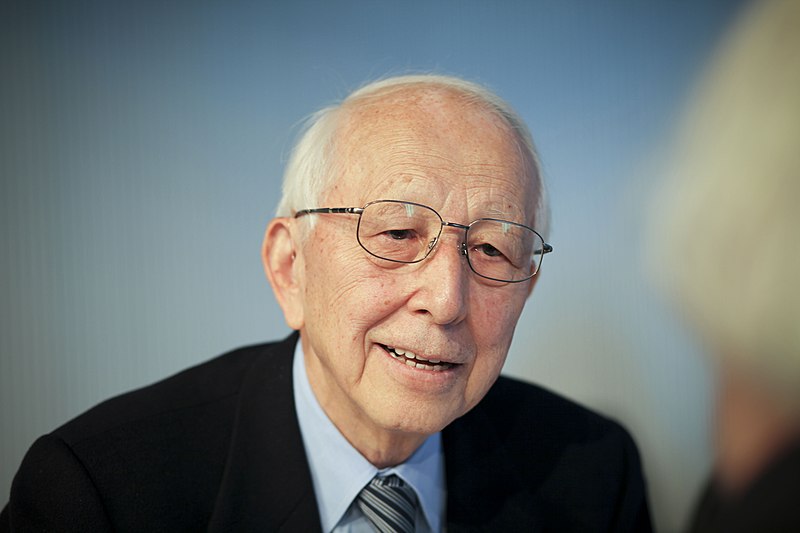
The Japanese architect Fumihiko Maki at MIT Media Lab.
jeanbaptisteparis · flickr: Fumihiko Maki
Notes from the source article
Cited by Wikipedia
Notes from the source article
These works are cited by the source article, in its own numbering. They are recorded as its citations, not as sources VALÉORINE has verified.
- 1.Part Laureates: Fumihiko Maki. PritzkerPrize.com.
- 2.建築家の槙文彦さん死去 幕張メッセ、4ワールドトレードセンター設計
- 3.Bernstein, Fred A. Fumihiko Maki, Honored Architect of Understated Buildings, Dies at 95. The New York Times. 2024-06-12. 0362-4331.
- 4.Biography: Fumihiko Maki The Pritzker Architecture Prize. www.pritzkerprize.com.
- 5.AIA. Fumihiko maki wins pritzker prize. The AIA Journal. 1993.
- 6.Fumihiko Maki - Pritzker Architecture Prize Laureate - 1993. PritzkerPrize.com.
- 7.Chiu-Shee, Colleen. REINVENTING THE COLLECTIVE FOR ETHICAL DESIGN: The Theoretical Confluences of Fumihiko Maki's "Collective Form" and Thom Mayne's "Combinatory Urbanism". 2019.
- 8.Shelton, Barrie. Urbanism: Prelude to Architecture. Built Environment. 35. 2. 286–288. 2009. 10.2148/benv.35.2.286.
- 9.Maki, Fumihiko. “My Urban Design of Fifty Years.” Ekistics, vol. 73, no. 436/441, 2006, pp. 26–38. JSTOR, http://www.jstor.org/stable/43623717 . Accessed 18 Feb. 2026. (JSTOR)
- 10.MIT Facilities. Media Lab and SA+P Extension.
- 11.The Approval Matrix. New York. 4 November 2013.
- 12.Japan's Fumihiko Maki to design Aga Khan university in London. Architect Journal. 12 October 2012.
- 13.Museum Reinhard Ernst.
- 14.R. B. SCHWARTZ. Poetic-Architectonic Realizations: Louis Kahn and Fumihiko Maki. Journal of Comparative Literature and Aesthetics.
- 15.Fumihiko Maki Japanese architect. Encyclopedia Britannica.
- 16.Maki, Fumihiko. The city and inner space. Ekistics. 46. 278. 328–334. 1979. 43619675.
- 17.Buntrock, Dana. Materials and Meaning in Contemporary Japanese Architecture: Tradition and Today. Routledge. 204. 2010. 9780415778909.
- 18.名古屋大学豊田講堂 | docomomo. docomomo.
- 19.Aga Khan Centre.
Bibliography printed in the source article · 2
References
Citations
References
Each reference names the institution holding it, so a reader may go to the document itself.
scholarly publication
Maki, Fumihiko [槇文彦] (1928--), Routledge Encyclopedia of ModernismCrossref registry
Verifiedauthority file
Gemeinsame Normdatei 109119582X, New Public Architecture: Recent Projects by Fumihiko Maki and Arata Isozaki (1985 : New York, NY).Deutsche Nationalbibliothek
Partially resolvedreference work
Wikidata, structured authority record Q312827: Fumihiko MakiWikimedia Foundation
Partially resolvedreference work
Partially resolved
The Encyclopedia exists whether or not anything is for sale. Corrections are recorded rather than overwritten, and every version of this record is kept. Published 14 August 2026.
Elsewhere in Design
11,558 published records in this field, each with its sources named.
- Fuad SeyidzadehDesigner
- Fuensanta NietoDesigner
- FuficiusDesigner
- Fulgence BienvenüeDesigner
- Füsun EczacıbaşıDesigner
- Fyodor AmlongDesigner
- Fyodor GornostayevDesigner
- Fyodor KonDesigner
Best supported in this field
For owners
Own a work by Fumihiko Maki?
A specialist will read what you send and tell you what the house can establish, what it cannot, and whether the object is suited to sale. There is no charge and no obligation. The object stays with you throughout; nothing is shipped to us unless it is arranged in writing beforehand.