
Friedrich Rückert
Johann Michael Friedrich Rückert (German: [ˈʁʏkɐt]; 16 May 1788 – 31 January 1866) was a German poet, translator, and professor of Oriental languages.
Also recorded as Freimund Raimar · Freimund Reimer · Freimund Reimar · Erich Friedrich Truck
Friedrich Rückert

various · Scan from the original work · Public domain
- Born
- 1788.
- Died
- 1866.
- Nationality
- Kingdom of Bavaria.
- Occupation
- poet, writer, translator, university teacher, poet lawyer and orientalist.
VALÉORINE Encyclopedia
VALÉORINE documentary reading
Documentary summary
Johann Michael Friedrich Rückert (German: [ˈʁʏkɐt]; 16 May 1788 – 31 January 1866) was a German poet, translator, and professor of Oriental languages.
Admitted source layer · organised and presented by VALÉORINE
Note VALÉORINE
No house-authored Note is published until its assertions and sources pass the VALÉORINE evidence contract. The documentary article remains available in full while that enrichment is being consolidated.
Documentary enrichment in progress · no unsupported statement published
Reference Check
Propose documentary evidence for Friedrich Rückert. A contribution is never written directly as fact: identity, source, rights and evidence gates still decide.
Sign in to contribute
Documentary evidence
Evidence Panel
not yet certified
- Identity
- resolved
- Independent source families
- 0
- Admitted assertions
- 0
- Open conflicts
- 0
Authority files
wikidata · Q60644 · wikipedia · Friedrich Rückert
In this article
Biography
Biography
Johann Michael Friedrich Rückert was born 16 May 1788 in Schweinfurt and was the eldest son of a lawyer, Johann Adam Rückert, and his wife, Maria Barbara (née Schwappach). He was educated at the local Gymnasium and at the universities of Würzburg and Heidelberg. From 1816 to 1817, he worked on the editorial staff of the Morgenblatt at Stuttgart. Nearly the whole of the year 1818 he spent in Rome, and afterwards he lived for several years at Coburg (1820–1826), where he married Luise Wiethaus-Fischer in 1821. He was appointed a professor of Oriental languages at the University of Erlangen in 1826, and, in 1841, he was called to a similar position in Berlin, where he was also made a privy councillor. In 1849 he resigned his professorship at Berlin, and went to live full-time in his Gut (estate) at Neuses (now a part of Coburg). When Rückert began his literary career, Germany was at war with Napoleon; and in his first volume, Deutsche Gedichte (German Poems), published in 1814 under the pseudonym Freimund Raimar, he gave, particularly in the powerful Geharnischte Sonette (Sonnets in Arms/Harsh Words), vigorous expression to the prevailing sentiment of his countrymen. From 1815 to 1818, appeared Napoleon, eine politische Komödie in drei Stücken (Napoleon, a Political Comedy in Three Parts), of which only two parts were published. In 1817, Der Kranz der Zeit (The Wreath of Time), was published. He issued a collection of poems, Östliche Rosen (Eastern Roses), in 1822; and from 1834 to 1838 his Gesammelte Gedichte (Collected Poems) were published in six volumes, a selection which has passed through many editions. Rückert was master of thirty languages and made his mark chiefly as a translator of Oriental poetry and as a writer of poems conceived in the spirit of Oriental masters. Much attention was attracted by a translation of the Maqamat of Al-Hariri of Basra (Hariris Makamen) in 1826, Nal und Damajanti, an Indian tale, in 1828, Rostem und Suhrab, eine Heldengeschichte (Rostem and Suhrab, a Story of Heroes) in 1830, and Hamasa, oder die ältesten arabischen Volkslieder (Hamasa, or the Oldest Arabian Folk Songs) in 1846. Among his original writings dealing with Oriental subjects are: Morgenländische Sagen und Geschichten (Oriental Myths and Poems) (1837) Erbauliches und Beschauliches aus dem Morgenland (Edifying and Contemplative, from the Orient) (1836–1838) Brahmanische Erzählungen (Brahmin Stories) (1839). The most elaborate of his works is Die Weisheit des Brahmanen (The Wisdom of the Brahmins), published in six volumes from 1836 to 1839. The former and Liebesfrühling (Spring of Love) (1844), a cycle of love-songs, are the best known of all Rückert's productions. From 1843 to 1845 he issued the dramas Saul und David (1843), Herodes der Große ("Herod the Great") (1844), Kaiser Heinrich IV (1845) and Christofero Colombo (1845), all of which are considered greatly inferior to the work to which he owes his place in German literature. At the time of the Danish war in 1864 he wrote Ein Dutzend Kampflieder für Schleswig-Holstein (A Dozen Battle Songs for Schleswig-Holstein), which, although published anonymously, made considerable impression on audiences. Rückert died in 1866, aged 77, in Neuses, now part of Coburg. He is buried in the cemetery there. Rückert's poetry was commonly set to music and there are about 121 settings of his work – making him the fourth most-set German poet, behind Goethe, Heine and Rilke. Among the composers who set his poetry to music are Schubert, Robert and Clara Schumann, Brahms (including Two Songs for Voice, Viola and Piano, among others), Josef Rheinberger, Mahler (song cycles Kindertotenlieder and Rückert-Lieder), Max Bruch, Max Reger, and Elise Schmezer.
Life and career
Dated record
Life and career
Explore 1788–1867
The full dated record · 3 entries
1788
Friedrich Rückert born at Schweinfurt.
1866
Friedrich Rückert died at Neuses.
1867
Aus Friedrich Rückert's Nachlass, herausg. von H. Rückert (1867) is digitised and catalogued by Internet Archive.
Memorials
A monument to Rückert is situated at Marktplatz in Schweinfurt. The monument of Rückert, whose birth house stands at the southeast corner of the town hall, has stood in the central square of Schweinfurt since 1890. It was created by architect Friedrich Ritter von Thiersch and sculptor Wilhelm von Rühmann. Allegorical figures from his works – Geharnischte Sonette ("Withering Sonnets") and Weisheit des Brahmanen ("Wisdom of the Brahmans") – are situated at the feet of the bronze Rückert. Rückert is also commemorated by a small museum in his home at Neuses (now in Friedrich-Rückert-Strasse) and a park, Rückertpark which also features a memorial bust.
Literature
A comprehensive but by no means complete edition of Rückert's poetical works appeared in 12 volumes in 1868–1869. Subsequent editions have been edited by L. Laistner (1896), C. Beyer (1896), G. Ellinger (1897). See B. Fortlage, F. Rückert und seine Werke (1867); C. Beyer, Friedrich Rückert, ein biographisches Denkmal (1868), Neue Mitteilungen über Rückert (1873), and Nachgelassene Gedichte Rückerts und neue Beiträge zu dessen Leben und Schriften (1877); R. Boxberger, Rückert-Studien (1878); P. de Lagarde, Erinnerungen an F. Rückert (1886); F. Muncker, Friedrich Rückert (1890); G. Voigt, Rückerts Gedankenlyrik (1891). Hans Wollschläger und Rudolf Kreutner (Ed.): Historisch-kritische Ausgabe in Einzelbänden, Schweinfurt 1998ff.; thus far 4 volumes in 5 parts (as of July 2004): Die Weisheit des Brahmanen, 2 volumes, 1998. Gedichte von Rom, 2000. Liedertagebuch I/II, 1846–1847, 2001 Liedertagebuch III/IV, 1848–1849, 2002. Liedertagebuch V/VI, 1850–1851, Erster Band, 2003. Hans Wollschläger (Ed.): Kindertotenlieder [1993 also as insel taschenbuch 1545]. Hartmut Bobzin (Ed.): Der Koran in der Übersetzung von Friedrich Rückert, 4th edition, Würzburg 2001. Friedrich Rückert: Firdosi's Königsbuch (Schahname) Sage I–XIII. Aus dem Nachlaß herausgegeben von E. A. Bayer. 1890. Nachdruck: epubli GmbH, Berlin, 2010 ISBN 978-3-86931-356-6 Friedrich Rückert: Firdosi's Königsbuch (Schahname) Sage XX–XXVI. Aus dem Nachlaß herausgegeben von E. A. Bayer. Nachdruck der Erstausgabe. epubli Berlin, 2010, ISBN 978-3-86931-555-3. (Details) Wolfgang von Keitz (Hrsg.): Oestliche Rosen. epubli, Berlin 2012, ISBN 978-3-8442-0415-5. (Details) In 1847, Rückert also translated select verses of the Tirukkural, an ancient Tamil classic, into German.
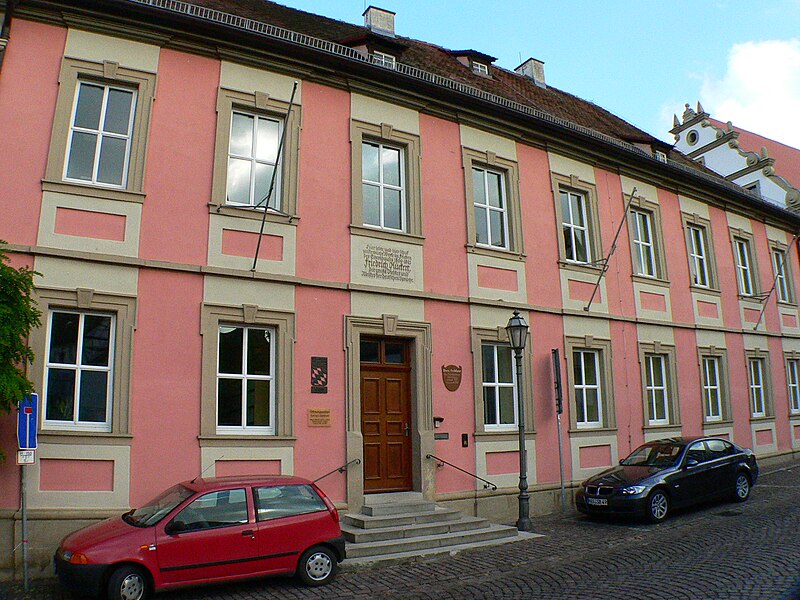
"Amtshaus" in Ebern - Eltern- und Wohnhaus Friedrich Rückerts
Presse03

caption: "Friedrich Rückert. Nach dem Denkmal in Schweinfurt von W. Rümann."
various · Scan from the original work
Notes from the source article
Cited by Wikipedia
Notes from the source article
These works are cited by the source article, in its own numbering. They are recorded as its citations, not as sources VALÉORINE has verified.
- 1.Schweinfurt, Unterfranken, Bavaria, Germany. Evangelische Lutherisch Kirchenbuch: St. Johannis Taufen Register [Baptismal Register] 1787-1801 volume, p. 87, year 1788, month May. [Archion.de, image #48 in dataset.]
- 2.Elise Schmezer Song Texts. lieder.net.
- 3.Klüglein, Norbert. Coburg Stadt und Land (German). Verkehrsverein Coburg. 1991.
- 4.Sanjeevi, N. Bibliography on Tirukkural. In First All India Tirukkural Seminar Papers. University of Madras. 147. 1973.
References
Citations
References
Each reference names the institution holding it, so a reader may go to the document itself.
reference work
Wikidata, structured authority record Q60644: Friedrich RückertWikimedia Foundation
Partially resolvedreference work
Partially resolved
The Encyclopedia exists whether or not anything is for sale. Corrections are recorded rather than overwritten, and every version of this record is kept. Published 14 August 2026.
Elsewhere in Books
38,988 published records in this field, each with its sources named.
- Friedrich NietzscheAuthor
- Friedrich RadszuweitAuthor
- Friedrich Reinhold KreutzwaldAuthor
- Friedrich Robert FaehlmannAuthor
- Friedrich SchillerAuthor
- Friedrich SchlegelAuthor
- Friedrich SorgeAuthor
- Friedrich SpielhagenAuthor
Best supported in this field
For owners
Own a work by Friedrich Rückert?
A specialist will read what you send and tell you what the house can establish, what it cannot, and whether the object is suited to sale. There is no charge and no obligation. The object stays with you throughout; nothing is shipped to us unless it is arranged in writing beforehand.