
Franz Roh
Franz Roh (21 February 1890 – 30 December 1965), was a German historian, photographer, and art critic. Roh is perhaps best known for his 1925 book Nach-Expressionismus: Magischer Realismus: Probleme der neuesten europäischen Malerei ("Post-expressionism: Magical Realism: Problems of the newest European painting") he coined the term magic realism. Roh was born in Apolda (in present-day Thuringia), Germany.
Franz Roh

Murray Bosinsky · Self-photographed · Public domain
- Born
- 1890.
- Died
- 1965.
- Nationality
- Germany.
- Occupation
- art historian, photographer, university teacher, art critic and visual artist.
VALÉORINE Encyclopedia
VALÉORINE documentary reading
Documentary summary
Franz Roh (21 February 1890 – 30 December 1965), was a German historian, photographer, and art critic. Roh is perhaps best known for his 1925 book Nach-Expressionismus: Magischer Realismus: Probleme der neuesten europäischen Malerei ("Post-expressionism: Magical Realism: Problems of the newest European painting") he coined the term magic realism. Roh was born in Apolda (in present-day Thuringia), Germany.
Admitted source layer · organised and presented by VALÉORINE
Reference Check
Propose documentary evidence for Franz Roh. A contribution is never written directly as fact: identity, source, rights and evidence gates still decide.
Sign in to contribute
Documentary evidence
Documentary basis
Authority files
wikidata · Q66832 · wikipedia · Franz Roh
In this article
Roh and magic realism
He studied at universities in Leipzig, Berlin, and Basel. In 1920, he received his Ph.D. in Munich for a work on Dutch paintings of the 17th century. During the Nazi regime, he was isolated and briefly put in jail for his book Foto-Auge (Photo-Eye); he used his jail time he used to write the book Der Verkannte Künstler: Geschichte und Theorie des kulturellen Mißverstehens ("The unrecognized artist: history and theory of cultural misunderstanding"). After the war, in 1946, he married art historian Juliane Bartsch. He died in Munich.
Roh is perhaps best remembered as the critic who coined the term magic realism. But, though the lineage is direct, his magic realism has a very different meaning from the one used to describe the work of writers such as Gabriel García Márquez and Isabel Allende that dominates our current understanding of the term. Roh, celebrating the post-expressionist return of the visual arts to figural representation, utilized the phenomenology of Edmund Husserl and Martin Heidegger to emphasize that "the autonomy of the objective world around us was once more to be enjoyed; the wonder of matter that could crystallize into objects was to be seen anew." Roh was, then, emphasizing the "magic" of the normal world as it presents itself to us (i.e., how, when we really look at everyday objects, they can appear strange and fantastic) and not the world of magic (in which objects are literally transformed into something fantastic) that the literary school emphasizes. Roh himself, writing in the 1950s and perhaps already seeing the confusion his term had caused in this regard, emphasized that his use of the word magic was, "of course not in the religious-psychological sense of ethnology." Roh's magic realism, though not often written about in recent years, is nonetheless an important contribution to a phenomenological or existential theory of aesthetics. This link is emphasized by the fact that it was the Spanish phenomenologist José Ortega y Gasset's disciple Fernando Vela who translated Roh's essay into Spanish, thereby setting the stage for its appropriation by the literary movement.
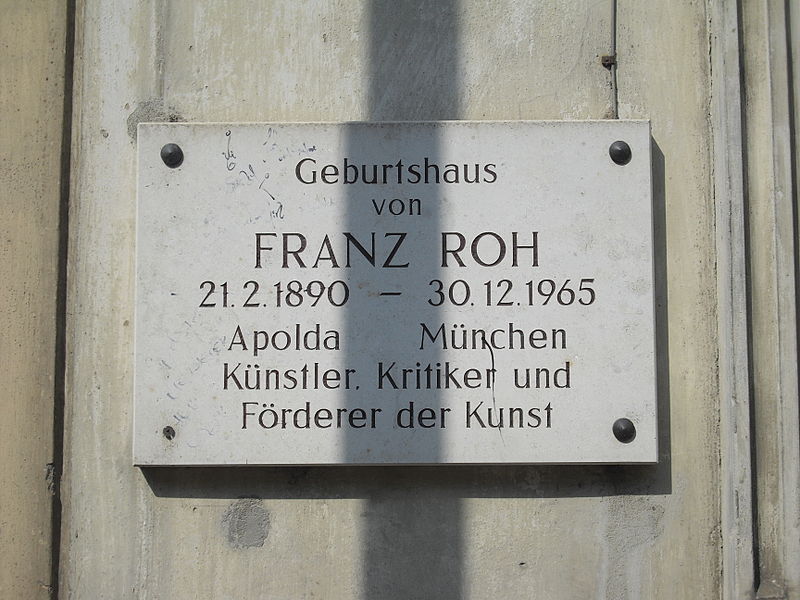
Franz-Roh-Gedenktafel
Murray Bosinsky at German Wikipedia · Own work (Original text: selbst erstellt)

Gedenktafel für Franz Roh an seinem Geburtshaus in Apolda
BrThomas
Notes from the source article
Cited by Wikipedia
Notes from the source article
These works are cited by the source article, in its own numbering. They are recorded as its citations, not as sources VALÉORINE has verified.
- 1.Duke University Press. Magical Realism: Theory, History, Community. 1995.
- 2.Roh, Franz. German Art in the 20th Century. New York Graphic Society, Ltd. 1968.
References
Citations
References
Each reference names the institution holding it, so a reader may go to the document itself.
reference work
Secondary witnessreference work
Secondary witness
The Encyclopedia exists whether or not anything is for sale. Corrections are recorded rather than overwritten, and every version of this record is kept. Published 14 August 2026.
Elsewhere in Photography
11,392 published records in this field, each with its sources named.
- Franz MayerPhotographer
- Franz Norbert MöslangPhotographer
- Franz PfemfertPhotographer
- Franz PlanerPhotographer
- Franz von LenbachPhotographer
- Franz Wilhelm JunghuhnPhotographer
- Franz Xaver SetzerPhotographer
- Franz-Peter WeixlerPhotographer
Best supported in this field
For owners
Own a work by Franz Roh?
A specialist will read what you send and tell you what the house can establish, what it cannot, and whether the object is suited to sale. There is no charge and no obligation. The object stays with you throughout; nothing is shipped to us unless it is arranged in writing beforehand.