
Frans Wouters
Illustration — Diana resting in a landscape Frans Wouters (1612–1659) was a Flemish Baroque painter who translated the monumental Baroque style of Peter Paul Rubens into the small context of cabinet paintings. He was a court painter to the Roman Emperor and the Prince of Wales and was active as an ambassador and art dealer.
Also recorded as Frans Wooters · Franchoys Wouters · François Wouters · Disciple de Vandick Vauters
Frans Wouters

Pieter de Jode II / After Frans Wouters · Public domain
- Born
- 1612 · Lier.
- Died
- 1659 · Antwerp.
- Nationality
- Habsburg Netherlands
- Occupation
- painter
- Movements
- Baroque
- Teachers
- Peter Paul Rubens
VALÉORINE Encyclopedia
VALÉORINE documentary reading
Documentary summary
Illustration — Diana resting in a landscape Frans Wouters (1612–1659) was a Flemish Baroque painter who translated the monumental Baroque style of Peter Paul Rubens into the small context of cabinet paintings. He was a court painter to the Roman Emperor and the Prince of Wales and was active as an ambassador and art dealer.
Admitted source layer · organised and presented by VALÉORINE
Note VALÉORINE
No house-authored Note is published until its assertions and sources pass the VALÉORINE evidence contract. The documentary article remains available in full while that enrichment is being consolidated.
Documentary enrichment in progress · no unsupported statement published
Reference Check
Propose documentary evidence for Frans Wouters. A contribution is never written directly as fact: identity, source, rights and evidence gates still decide.
Sign in to contribute
World of VALÉORINE
Documentary connections
Only confirmed graph relationships appear here. Images are shown only when their identity and reuse rights both pass the documentary gate.
Documentary evidence
Evidence Panel
not yet certified
- Identity
- resolved
- Independent source families
- 0
- Admitted assertions
- 0
- Open conflicts
- 0
Authority files
wikidata · Q1959143 · wikipedia · Frans Wouters
In this article
Life
Life
Training under Peter Paul Rubens is recorded. Places of work recorded in the authority are Antwerp, Vienna and London. Positions recorded include court painter. Work by Frans Wouters is recorded in the collections of Finnish National Gallery, Nationalmuseum, Royal Museum of Fine Arts Antwerp, Museum of Fine Arts Ghent (MSK) and Kroměříž Archdiocesan Museum.
Frans Wouters was born in Lier, present-day Belgium. He was first apprenticed to Pieter van Avont in Antwerp in 1629 but broke his contract to move to the workshop of Rubens in 1634. He became a master in the Guild of St. Luke the following year. He assisted Rubens in 1635 in the decorations for the Joyous Entry into Antwerp of the Cardinal-Infante Ferdinand of Austria in 1635. Rubens had the overall management of this decorative project which was realized with the assistance of a large number of Antwerp painters such as Jacob Jordaens, Cornelis de Vos, Jan Cossiers, Peter Snayers, Thomas Willeboirts Bosschaert, Theodoor van Thulden, Jan Boeckhorst, Peeter Symons, Jacob Peter Gowy and others, who worked after Rubens' modellos. • Illustration — Allegory of sight He spent the 1630s as court painter to Holy Roman Emperor Ferdinand II. He was sent as an ambassador of Ferdinand II to England in 1637. The following year, he became the painter of the Prince of Wales, the future Charles II of England. In England, Wouters would certainly have had the opportunity to meet his compatriot Anthony van Dyck, who was at that time the court painter of Charles I of England. Even after his return to Antwerp in 1641 he remained in contact with Charles II during the period of the English Civil War and the Commonwealth. He was described in 1658 as Charles's 'ayuda de cámera' (chamberlain). In Antwerp he collaborated again with his former master Pieter van Avont mainly adding landscapes to van Avont's compositions. He became involved in the art market. In this capacity he assisted in the valuation of the paintings in Rubens' estate. His marriage to Maria Doncker, daughter of the treasurer of Antwerp, in 1644 provided him with a substantial fortune. In 1648, he became dean of the Antwerp Guild of St. Luke. He was involved in the sale of the art collection of George Villiers, 1st Duke of Buckingham by the English Parliamentary Commissioners in 1648. At around this time Wouters began to work for Archduke Leopold Wilhelm of Austria, the then Governor of the Southern Netherlands and an avid art patron and collector.
Work
Work
• Illustration — Bacchanal Wouters' style and subject matter reflect the taste of his international aristocratic clients who preferred small paintings, decorative landscapes and mythological stories. Other themes appreciated by these patrons were scenes dealing with alchemy, the four elements, Allegories of the Five Senses as well as iconographical themes that allowed for different levels of interpretation based on a number of references and allusions, or devices such as the 'picture within a picture'. An example is the Allegory of sight (Auctioned at Dorotheum on 19 April 2016 in Vienna, lot 29) where the sense of sight is represented primarily by the woman regarding herself in the mirror. This act also alludes to another theme, that of vanity, which is further evoked by the still life painting on the right. The room with its variety of precious objects, scientific instruments, paintings and sculptures has taken the semblance of a 'cabinet of curiosities. The multitude of objects refers to the various forms of visual perception and man's desire to take possession of the things he sees by understanding them. The world map in the foreground further alludes to man's ability to observe and understand distant worlds. In contrast, the monkey in the foreground of the painting is only capable of achieving the lowest, most superficial level of seeing, the staring at things without genuine understanding. Even the use of two pairs of spectacles does not help the poor animal. His style bore initially a resemblance to the late Mannerism of Joos de Momper and was later influenced by Rubens and in particular Rubens' landscape paintings. After entering the service of Archduke Leopold William, Wouters' work demonstrated the increased influence of Anthony van Dyck and the human figures in his paintings became elongated and emotionally expressive. He painted biblical scenes and mythological landscapes in this style.
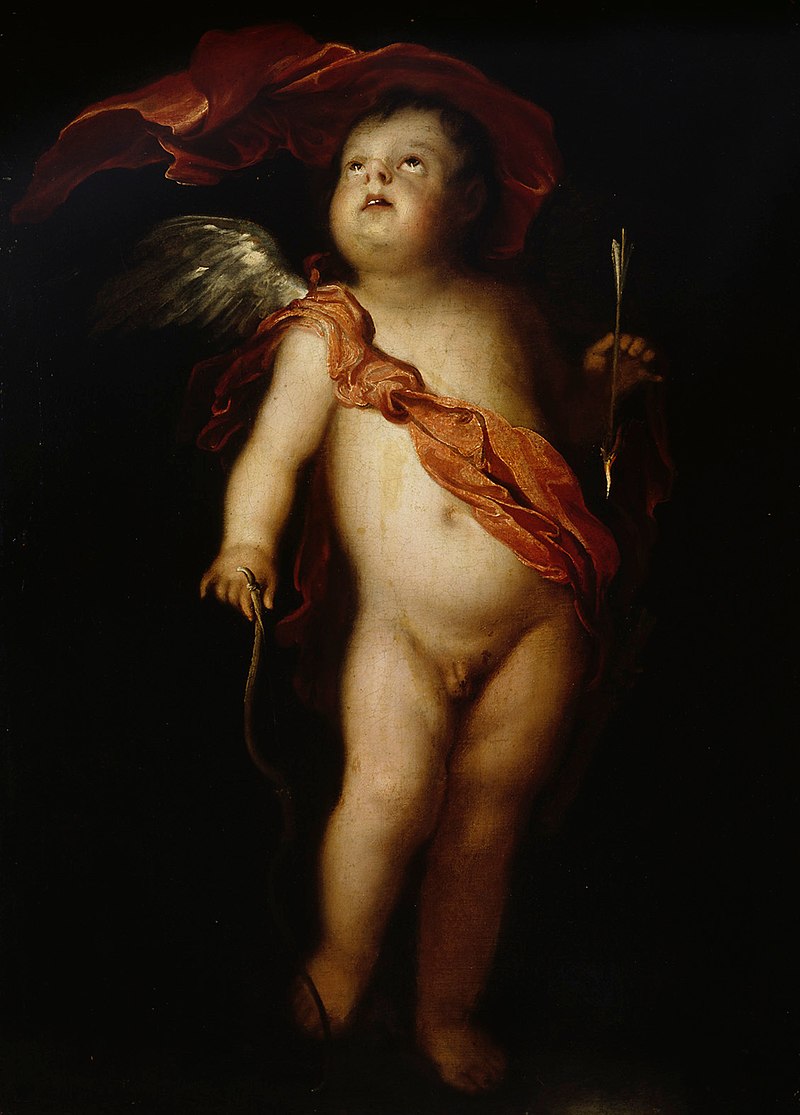
Frans Wouters - Cupid with his bow - A II 1407 - Finnish National Gallery
Frans Wouters · http: kokoelmat.fng.fi/app?si=A+II+1407

Offerande aan Maria en het Kind - Frans Wouters - Museum voor Schone Kunsten Gent
Frans Wouters
Places
Named by the record
Places
Only places the record itself states, plotted where the house gazetteer settles their coordinates. Nothing is inferred from a name or a nationality.
Lier.
Birth place
Antwerp.
Death place
Citations
References
Each reference names the institution holding it, so a reader may go to the document itself.
reference work
Partially resolvedreference work
Partially resolved
The Encyclopedia exists whether or not anything is for sale. Corrections are recorded rather than overwritten, and every version of this record is kept. Published 14 August 2026.
Elsewhere in Paintings
18,792 published records in this field, each with its sources named.
- Frans VerbeeckArtist
- Frans VerhasArtist
- Frans Wilhelm OdelmarkArtist
- Frans WithoosArtist
- Frans YkensArtist
- František ČermákArtist
- František Jakub ProkyšArtist
- František JanákArtist
Best supported in this field
For owners
Own a work by Frans Wouters?
A specialist will read what you send and tell you what the house can establish, what it cannot, and whether the object is suited to sale. There is no charge and no obligation. The object stays with you throughout; nothing is shipped to us unless it is arranged in writing beforehand.