
Francis Grose
Illustration — Francis Grose FSA, engraving by Francesco Bartolozzi (1787) Francis Grose (before 11June 173112May 1791) was an English antiquary, draughtsman, and lexicographer. He produced A Classical Dictionary of the Vulgar Tongue (1785) and A Provincial Glossary, with a Collection of Local Proverbs, and Popular Superstitions (1787).
Also recorded as Francis Grosse · Captain Grose · F. Grose · Grose
Francis Grose

David Octavius Hill · Prof Wilson. Land of Burns. 1840 · Public domain
- Born
- 1731 · London.
- Nationality
- United Kingdom of Great Britain and Ireland · Kingdom of Great Britain
- Occupation
- lexicographer · linguist · painter · antiquarian bookseller
- Fields
- lexicography
- Languages
- English
VALÉORINE Encyclopedia
VALÉORINE documentary reading
Documentary summary
Illustration — Francis Grose FSA, engraving by Francesco Bartolozzi (1787) Francis Grose (before 11June 173112May 1791) was an English antiquary, draughtsman, and lexicographer. He produced A Classical Dictionary of the Vulgar Tongue (1785) and A Provincial Glossary, with a Collection of Local Proverbs, and Popular Superstitions (1787).
Admitted source layer · organised and presented by VALÉORINE
Note VALÉORINE
Francis Grose (1731–1791) was a British and British antiquarian bookseller, lexicographer and linguist. The antiquarian bookseller was born in London and died in Dublin.
Francis Grose worked in London. Activity centred on lexicography. Works are held at Yale Center for British Art.
Composed from admitted, traceable facts · 02 October 2026
VALÉORINE
Reference Check
Propose documentary evidence for Francis Grose. A contribution is never written directly as fact: identity, source, rights and evidence gates still decide.
Sign in to contribute
World of VALÉORINE
Documentary connections
Only confirmed graph relationships appear here. Images are shown only when their identity and reuse rights both pass the documentary gate.

Documentary evidence
Documentary basis
Authority files
bnf · getty · gnd · loc · wikidata · Q4150369 · wikipedia · Francis Grose
In this article
Early life
Early life
Grose was born at his father's house in Broad Street, St-Peter-le-Poer, London. His parents were Swiss immigrant and jeweller Francis Jacob Grose (d. 1769), and his wife, Anne (d. 1773), daughter of Thomas Bennett of Greenford in Middlesex. Grose was baptised on 11 June 1731 in the parish of St Peter-le-Poer. The eldest of seven children, Grose probably received a classical education but first aimed at a career in the Army. In 1747, he was in Flanders, apparently as a volunteer in Howard's (later 19th) regiment of foot: later he received a commission as cornet in Cobham's (later 10th) regiment of dragoons. Posted to Kent on excise duties in 1750, he met and married Catherine Jordan of Canterbury. They were eventually to have ten children, six of whom survived to adulthood. Their eldest son, also called Francis Grose, was the Lieutenant Governor of New South Wales, Australia from 1792 to 1794. Grose left the army in October 1751, possibly to avoid his regiment's posting to Scotland. In 1755, his father bought him the post of Richmond Herald but Francis showed little interest in heraldry and was to sell it again in February 1763. In 1757, Grose was elected a member of the Society of Antiquaries, and 1759 he resumed his soldiering career, this time in the militia, which meant he could avoid distant postings. He was commissioned into the Surrey Militia as lieutenant and adjutant, and it was his subsequent promotion to captain in 1765 that led to his adoption of the familiar title "Captain Grose". The Surrey militia was disembodied in 1762 but this hardly affected Grose, who continued to receive a salary as paymaster and adjutant even in peacetime. With bequests from his parents and from his wife, who died in 1774, added to the salary he drew as a militia captain, Grose at this time was able to live reasonably well despite the demands made on his purse by the need to raise, educate and provide for his children.
Death
Death
• Illustration — Grave of Francis Grose and James Gandon While on an expedition to Ireland to collect antiquarian material, Grose died in Dublin at the house of Horace Hone, of an apoplectic stroke. His father had built a house, known as Richmond, in Drumcondra before his death. He was buried on 18 May 1791, at Drumcondra cemetery. His nephew Daniel and a Dr. Edward Ledwich, who had already published a book on Irish antiquities, completed the final volume of Grose's Antiquities of Ireland in 1791.
Other works
Other works
In addition to the books above mentioned, Grose wrote a Treatise on Ancient Armour and Weapons. Additionally, it is noted that he was the (anonymous) author of Advice to the Officers of the British Army: With the addition of some Hints to the Drummer and Private Soldier, which was published in 1783 as a mocking look backwards on the conduct of the war against the American colonies. Every instance of corruption, disregard and vice are suggested for every rank of the army. Tongue in cheek, but obviously rooted in truth, it is a great companion to Vulgar Tongue. It also contains a satirical portrait of Jeremiah Hodges, Grose's erstwhile commanding officer in the Surrey militia. Two parodies by Thomas Bridges, A Travestie of Homer and The Battle of the Genii, were formerly erroneously attributed to Francis Grose.
List of works
List of works
A list of works ordered by original year of the publication of the first volume: • (new edition, 1784) • (new edition, 1784) • (new edition, 1783) • (new edition, 1785) * * * * • • (supplement published in 1789) * * * * * * Others: * * * • – volume one, volume two, volume three *
Life and career
Dated record
Life and career
Explore 1731–1791
The full dated record · 3 entries
1731
Francis Grose born at London.
1791
Dies at Dublin.
1791
Francis Grose died at Dublin.
Places
Named by the record
Places
Only places the record itself states, plotted where the house gazetteer settles their coordinates. Nothing is inferred from a name or a nationality.
London.
Birth place
Dublin.
Death place
Books and publications
• Illustration — Various antiquarian books, including Grose's Antiquities of England and Wales Grose had early on shown a keen interest in drawing, having attempted sketches of medieval buildings as far back as 1749, and having taken formal instruction at a drawing school in the mid-1750s. He was not a particularly gifted draughtsman but he mixed in the London artistic milieu and began to exhibit, first at the Society of Artists in 1767–8 and then at the Royal Academy. His interest was in the field of medieval remains, which were beginning to exercise an increasing grip on the public imagination. In 1772, he published the first part of The Antiquities of England and Wales, a work which he unashamedly aimed at the popular market. Essentially, it targeted those who wanted to know about antiquities but had neither time nor means to visit them in person, and contained small panoramas of medieval ruins, together with an informative text on a separate page. Sometimes the text was taken from books already published, or from information supplied by other antiquaries (both acknowledged); sometimes Grose collated material himself from which he could work up an article. From 1772 onwards, he also toured the country to visit and draw sites for inclusion in The Antiquities. The fourth and last volume came out in June 1776, and Grose almost immediately began work on a supplement. His publishing career was interrupted however, when the Surrey militia was again called into service between 1778 and 1783. This was not a happy experience for him. Where previously Grose had been able to spend his summers visiting and sketching ancient sites, he was now obliged to attend his regiment in various training camps. He did not get on well with his new commanding officer, and he handled regimental finances in a slipshod manner. The result was that he incurred debts towards fellow officers that would take years to straighten out. The financial pressure forced him to increase both the rate and the range of his publications. • Illustration — Alloway Kirk from Grose's The Antiquities of Scotland The Supplement to The Antiquities was resumed in 1783, this time with a higher proportion of the illustrations being done by other artists. Drawing on his own fieldwork, Grose also branched out into producing dictionaries, including the famous A Classical Dictionary of the Vulgar Tongue (1785) and A Provincial Glossary, with a Collection of Local Proverbs, and Popular Superstitions (1787). Though intended to amuse, they give an unusually vivid picture of the speech of the day which would not normally find inclusion in standard dictionaries, and contained, in all, about 9,000 terms which more scholarly works of the time habitually overlooked. He produced books on military antiquities and armour, as well as satirical essays, and in 1788 began the first of several tours of Scotland in order to produce The Antiquities of Scotland. It was on the second of these tours, in summer 1789, that he met and immediately formed a friendship with the poet Robert Burns. Burns met him while he was staying with Robert Riddell at the Friar's Carse, collecting material for his Scottish work. Burns suggested to him that he should include Alloway Kirk in his Scottish Antiquities, and Grose agreed on condition that Burns provided a witch tale to go with his drawing. In June 1790, Burns sent Grose a prose tale with a variant in a letter to Grose, following it up with a rhymed version, "Tam o' Shanter". Grose was the first art critic to affirm, in his "Rules for drawing caricaturas: with an essay on comic painting" (1788), published in William Hogarth's The Analysis of Beauty (1791 edition), that aesthetic emotions emerge from a specific "cultural" environment, and that aesthetics are neither innate nor universal, but formed by their cultural context. Grose therefore has a claim to be considered as the first critical "aesthetic regionalist theorist" in proclaiming the anti-universality of aesthetics.
Primary material
Documents and archives
institutional register
- Bibliothèque nationale de France authority file 120783370
General reference · Bibliothèque nationale de France
- FAST authority file 11046
General reference · FAST
- GND (German National Library) authority file 124154271
General reference · GND (German National Library)
- IdRef (French universities) authority file 029083753
General reference · IdRef (French universities)
- ISNI authority file 0000000114376541
General reference · ISNI
- Library of Congress authority file n50032813
General reference · Library of Congress
reference work
- “Francis Grose”, English Wikipedia, consulted as further reading
Reputable secondary · Wikipedia
References and sources
References and sources
• References • Sources * * • Capt John Davis, Historical Records of the Second Royal Surrey or Eleventh Regiment of Militia, London: Marcus Ward, 1877.
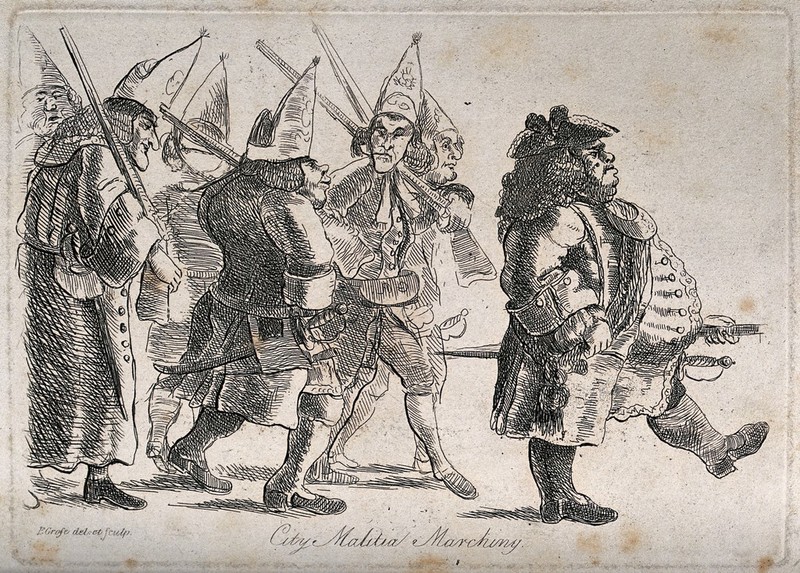
A fat man in uniform and carrying a sword leads a disorderly band of men with rifles. Etching by F. Grose after himself., 1788, by Francis Grose
Francis Grose · Wellcome Collection, London · Wellcome Collection
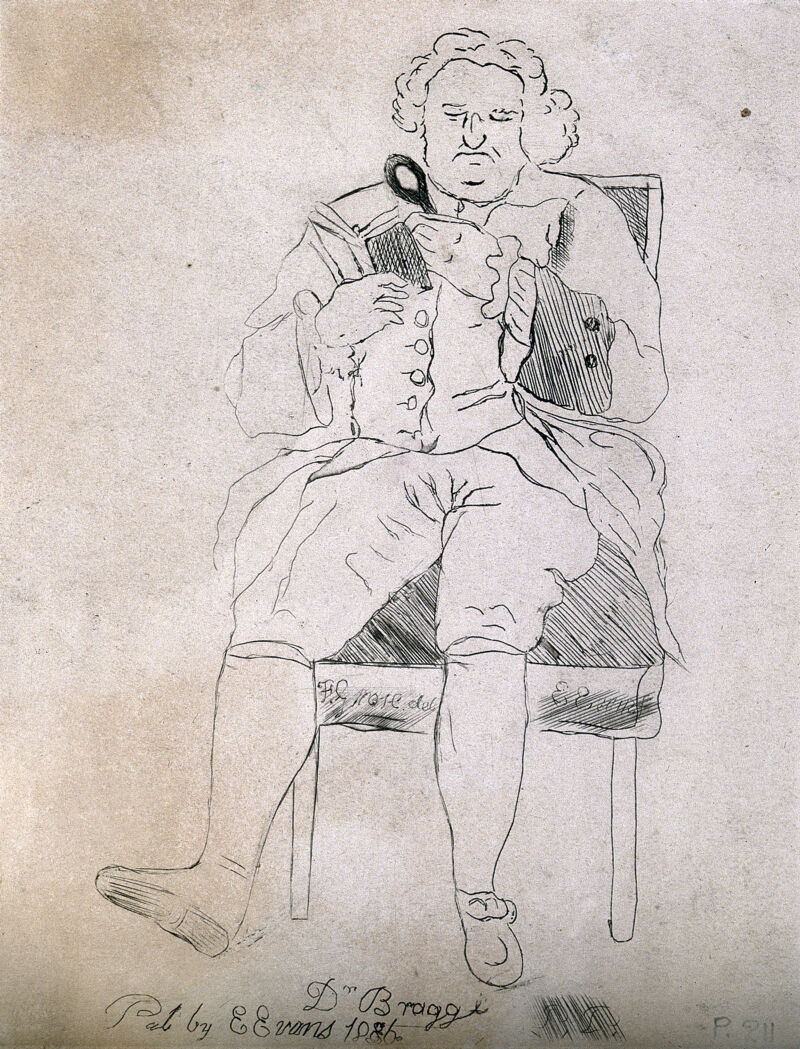
Robert Bragge. Etching by F. Grose., by Francis Grose
Francis Grose · Wellcome Collection, London · Wellcome Collection
Notes from the source article
Cited by Wikipedia
Notes from the source article
These works are cited by the source article, in its own numbering. They are recorded as its citations, not as sources VALÉORINE has verified.
- 1.Davis, Appendix G: 'Biography of Captain Francis Grose'.
- 2.Warwick William Wroth (1890). "Grose, Francis" . In Dictionary of National Biography. 23. London. pp. 272-273.
- 3.Jarndyce, London, 2020.
- 4.Fiona Macdonald. The Vulgar Tongue: A dictionary of filthy words. bbc.com. 16 September 2015.
- 5.Bezrucka, Yvonne. The invention of northern aesthetics in 18th-century English literature. 2017.
- 6.H. L. Mallalieu. The Dictionary of British Watercolour Artists up to 1920. Antique Collectors' Club. 155. 1986. 1-85149-025-6.
- 7.Kingston, Rev. John. Parish of Fairview. Dundalgan Press Ltd. 44–54. 1953.
- 8.Máire de Paor (1993), "Irish Antiquarian Artists," p. 124, in Visualizing Ireland, ed. Adele M. Dalsimer, Faber and Faber,
Bibliography printed in the source article · 3
- Farrant. John H. Grose, Francis (bap. 1731, d. 1791). September 2004. online. October 2009.
- Grose, Francis.
- Capt John Davis, Historical Records of the Second Royal Surrey or Eleventh Regiment of Militia, London: Marcus Ward, 1877.
References
Citations
References
Each reference names the institution holding it, so a reader may go to the document itself.
institutional register
Bibliothèque nationale de France authority file 120783370Bibliothèque nationale de France
Secondary witnessinstitutional register
Secondary witnessinstitutional register
GND (German National Library) authority file 124154271GND (German National Library)
Secondary witnessinstitutional register
IdRef (French universities) authority file 029083753IdRef (French universities)
Secondary witnessinstitutional register
Secondary witnessinstitutional register
Library of Congress authority file n50032813Library of Congress
Secondary witnessinstitutional register
National Library of Australia authority file 35153431National Library of Australia
Secondary witnessinstitutional register
RKDartists authority file 34225RKDartists
Secondary witness
Every cited source · 12
- 01
Bibliothèque nationale de France authority file 120783370
institutional register · General reference · Bibliothèque nationale de France
Consult the source - 02
- 03
GND (German National Library) authority file 124154271
institutional register · General reference · GND (German National Library)
Consult the source - 04
IdRef (French universities) authority file 029083753
institutional register · General reference · IdRef (French universities)
Consult the source - 05
ISNI authority file 0000000114376541
institutional register · General reference · ISNI
Consult the source - 06
Library of Congress authority file n50032813
institutional register · General reference · Library of Congress
Consult the source - 07
National Library of Australia authority file 35153431
institutional register · General reference · National Library of Australia
Consult the source - 08
RKDartists authority file 34225
institutional register · General reference · RKDartists
Consult the source - 09
Union List of Artist Names authority file 500017314
institutional register · General reference · Union List of Artist Names
Consult the source - 10
- 11
“Francis Grose”, English Wikipedia, consulted as further reading
reference work · Reputable secondary · Wikipedia
Consult the source - 12
Wikidata, structured authority record Q4150369: Francis Grose
institutional register · General reference · Wikimedia Foundation
Consult the source
The Encyclopedia exists whether or not anything is for sale. Corrections are recorded rather than overwritten, and every version of this record is kept. Published 18 August 2026.
Elsewhere in Paintings
18,623 published records in this field, each with its sources named.
- Francis Dennis RamsayArtist
- Francis DoddArtist
- Francis Focer BrownArtist
- Francis GrantArtist
- Francis GruberArtist
- Francis GuyArtist
- Francis HaymanArtist
- Francis Henry NewberyArtist
Best supported in this field
For owners
Own a work by Francis Grose?
A specialist will read what you send and tell you what the house can establish, what it cannot, and whether the object is suited to sale. There is no charge and no obligation. The object stays with you throughout; nothing is shipped to us unless it is arranged in writing beforehand.