
George Petrie
George Petrie (1 January 1790 – 17 January 1866) was an Irish artist, antiquarian, archaeologist and collector of Irish traditional music. Petrie played a role in building the collections of the Royal Irish Academy and National Museum of Ireland.
Also recorded as G. Petrie · Petrie · Petry
George Petrie

Internet Archive Book Images · https: Source book page · No known copyright restrictions
- Name
- George Petrie
- Born
- 1 January 1790
- Birthplace
- Dame Street, Dublin, Ireland
- Died
- 17 January 1866
- Occupation
- Painter, Antiquarian
- Nationality
- United Kingdom of Great Britain and Ireland · Kingdom of Great Britain
- Fields
- painting
- Honours
- Cunningham Medal
- Languages
- English
VALÉORINE Encyclopedia
VALÉORINE documentary reading
Documentary summary
George Petrie (1 January 1790 – 17 January 1866) was an Irish artist, antiquarian, archaeologist and collector of Irish traditional music. Petrie played a role in building the collections of the Royal Irish Academy and National Museum of Ireland.
Admitted source layer · organised and presented by VALÉORINE
Reference Check
Propose documentary evidence for George Petrie. A contribution is never written directly as fact: identity, source, rights and evidence gates still decide.
Sign in to contribute
World of VALÉORINE
Documentary connections
Only confirmed graph relationships appear here. Images are shown only when their identity and reuse rights both pass the documentary gate.
Documentary evidence
Documentary basis
Authority files
wikidata · Q982108
In this article
Biography
Biography
The recorded working language is English. The field of work recorded is painting. Subjects and genres recorded for the work are music of Ireland. Work by George Petrie is recorded in the collections of National Gallery of Ireland. Distinctions recorded are Cunningham Medal.
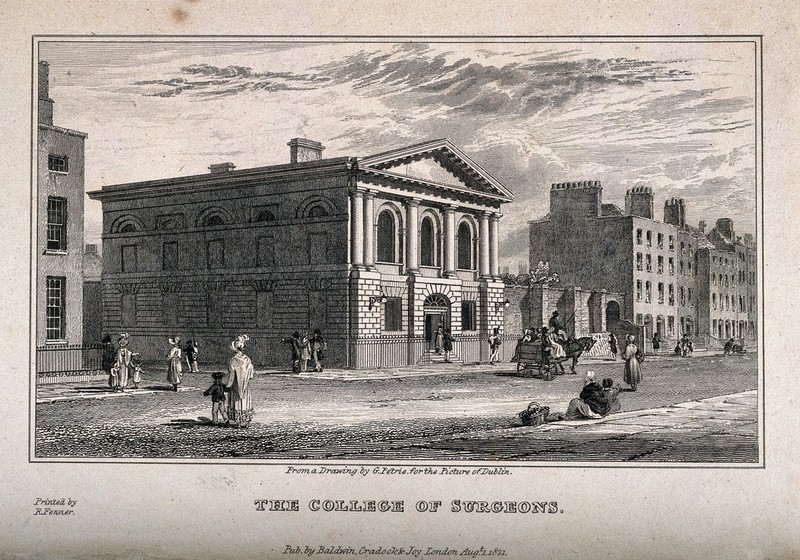
The street outside the College of Surgeons, Dublin, Ireland. Steel engraving, 1821, after G. Petrie., 1 August 1821, by George Petrie
George Petrie · Wellcome Collection, London · Wellcome Collection
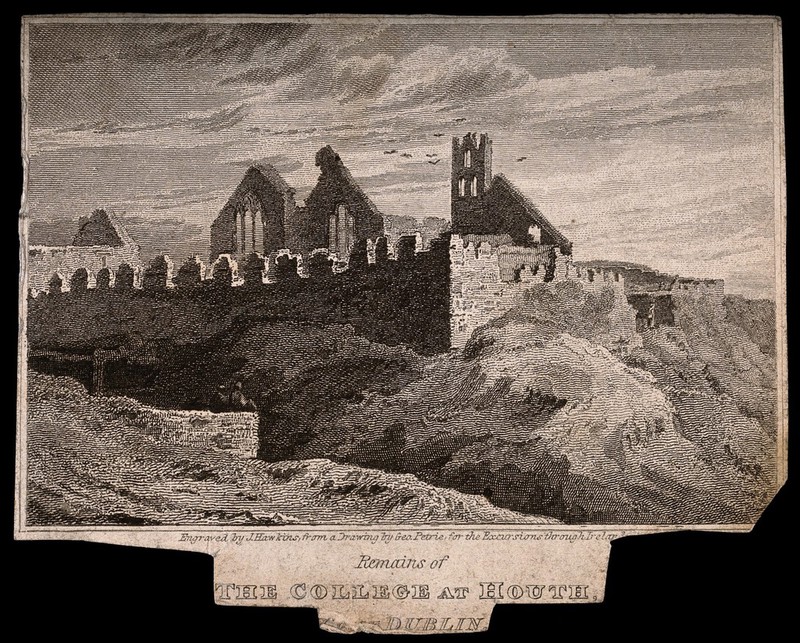
Howth College, Dublin,
George Petrie · Wellcome Collection, London · Wellcome Collection
Key facts
Key facts
• Name — George Petrie • Born — 1 January 1790 • Birthplace — Dame Street, Dublin, Ireland • Died — 17 January 1866 • Occupation — Painter, Antiquarian
Early life
Early life
Petrie was born on 1 January 1790 in Dame Street, Dublin to James Petrie, a portrait painter and Elizabeth Petrie (Simpson). An only child, Petrie's father was born in Dublin to Scottish parents whilst his mother was born in Edinburgh. Enrolling at the English Grammar School in 1799, Petrie later attended the Dublin Society drawing school. Helping his father paint miniatures from childhood, Petrie developed an interest in archaeology as a teenager.
Career
Career
• Illustration — Vice-Regal Lodge, Dublin, c. 1831 – by George Petrie. After an abortive trip to England in the company of friends Francis Danby and James Arthur O'Connor, he returned to Ireland where he worked mostly producing sketches for engravings for travel books – including among others, George Newenham Wright's guides to Killarney, Wicklow and Dublin, Thomas Cromwell's Excursions through Ireland, and James Norris Brewer's Beauties of Ireland. In the late 1820s and 1830s, Petrie significantly revitalised the Royal Irish Academy's antiquities committee. He was responsible for their acquisition of many important Irish manuscripts, including an autograph copy of the Annals of the Four Masters, as well as examples of insular metalwork, including the Cross of Cong and Roscrea Brooch. His writings on early Irish archaeology and architecture were of great significance, especially his essay on the Round Towers of Ireland, which appeared in his 1845 book titled The Ecclesiastical Architecture of Ireland. He is often called "the father of Irish archaeology". His survey of the tombs at Carrowmore still informs study of the site today. From 1833 to 1843, he was employed by Thomas Colby and Thomas Larcom as head of the Topographical Department (the antiquities division) of the Irish Ordnance Survey. Amongst his staff were John O'Donovan and Eugene O'Curry. A prizewinning essay submitted to the Royal Irish Academy in 1834 on Irish military architecture was never published, but his seminal essay On the History and Antiquities of Tara Hill was published by the Academy in 1839. During this period Petrie was himself the editor of two popular antiquarian magazines, the Dublin Penny Journal and, later, the Irish Penny Journal. Another major contribution of Petrie's to Irish culture was the collection of Irish traditional airs and melodies which he published in 1855 as The Petrie Collection of the Ancient Music of Ireland. The first commercial recording of Petrie's collection was The Petrie Collection of the Ancient Music of Ireland (the 1855 Edition of 147 Airs & the 1882 Edition of 40 Airs) [2007, 8-cd set, Trigon TRD 1526, 187 tracks] arranged and performed by Irish pianist J.J. Sheridan. William Stokes's contemporary biography includes detailed accounts of Petrie's working methods in his collecting of traditional music: "The song having been given, O'Curry wrote the Irish words, when Petrie's work began. The singer recommenced, stopping at a signal from him at every two or three bars of the melody to permit the writing of the notes, and often repeating the passage until it was correctly taken down..." As an artist, his favourite medium was watercolour which, due to the prejudices of the age, was considered inferior to oil painting. Nonetheless, he can be considered one of the finest Irish Romantic painters of his era. Some of his best work is in the collections of the National Gallery of Ireland, such as his watercolour painting Gougane Barra Lake with the Hermitage of St Finbarr, Co. Cork (1831). He was awarded the Royal Irish Academy's prestigious Cunningham Medal three times: firstly in 1831 for his essay on the round towers, secondly in 1834 for the essay (now lost) on Irish military architecture, and thirdly in 1839 for his essay on the antiquities of Tara Hill.
Works
Works
• incomplete, only larger works listed • Music * • * •, uncompleted fragment published posthumously • Illustrations * * * • Antiquarian works * • Also as •, unpublished, won a gold medal from the Royal Irish Academy, see * *
Identity and overview
Identity and overview
The following is established of the heading itself.
Where the work is held
Collections and holdings
Institutional holdings are recorded as follows.
Notes from the source article
Cited by Wikipedia
Notes from the source article
These works are cited by the source article, in its own numbering. They are recorded as its citations, not as sources VALÉORINE has verified.
- 1.Cooper, David. Petrie, George. March 2021.
- 2.Legg, Marie-Louise. Petrie, George (1790–1866), antiquary and painter. Cambridge University Press. 3 January 2008. 10.1093/ref:odnb/22051.
- 3.Webb, Alfred. A Compendium of Irish Biography: Comprising Sketches of Distinguished Irishmen, and of Eminent Persons Connected with Ireland by Office Or by Their Writings. 1878.
- 4.Cowell, John. Dublin's Famous People and where they lived. O'Brien Press Ltd. 149. 1996.
- 5.Briggs, Stephen. "The Roscrea Brooch Re-Provenanced?", Ulster Journal of Archaeology, volume 74, 2017. pp. 74-86.
- 6.De Breffny, Brian. Ireland: A Cultural Encyclopedia. Thames and Hudson. 191. 1983.
- 7.De Breffny, pg. 191.
- 8.An Historical Account of the Cunningham Fund. Proceedings of the Royal Irish Academy. 7. 406–419. 1857. 20489903.
Bibliography printed in the source article · 7
- Cooper, David. The Petrie Collection of the Ancient Music of Ireland. Cork University Press, 2002
- Crooke, Elizabeth. Politics, Archaeology and the Creation of a National Museum of Ireland: An Expression of National Life. Dublin: Irish Academic Press, 2001.
- Boosey & Co., London. The Complete Collection of Irish Music as Noted by George Petrie. 3 vols. 1902–1905.
- Petrie, George. Aspects of George Petrie. V. An Essay on Military Architecture in Ireland Previous to the English Invasion. Proceedings of the Royal Irish Academy: Archaeology, Culture, History, Literature. Royal Irish Academy. 72. 219–269. 1972. 25506268.
- Cox, Michael F. George Petrie. The Irish Monthly. Irish Jesuit Province. 41. 479. 233–248. May 1913. 20503385.
- Dillon, Myles. George Petrie (1789-1866). Studies: An Irish Quarterly Review. Irish Province of the Society of Jesus. 56. 223. 266–276. Autumn 1967. 30087830.
- Stokes, William. The Life and Labours in Art and Archaeology, of George Petrie. Longmans, Green, & Co. 1868.
References
Citations
References
Each reference names the institution holding it, so a reader may go to the document itself.
Institutional database
Wikidata, structured authority record Q982108: George PetrieWikimedia Foundation
Institutional witness
The Encyclopedia exists whether or not anything is for sale. Corrections are recorded rather than overwritten, and every version of this record is kept. Published 17 August 2026.
Elsewhere in Paintings
18,875 published records in this field, each with its sources named.
- George Pearse EnnisArtist
- George PeckArtist
- George PembaArtist
- George Peter Alexander HealyArtist
- George Philip ReinagleArtist
- George PhoenixArtist
- George Pitt MorisonArtist
- George ReidArtist
Best supported in this field
For owners
Own a work by George Petrie?
A specialist will read what you send and tell you what the house can establish, what it cannot, and whether the object is suited to sale. There is no charge and no obligation. The object stays with you throughout; nothing is shipped to us unless it is arranged in writing beforehand.