
Francis Frith
Francis Frith (also spelled Frances Frith, 7 October 1822 – 25 February 1898) was an English photographer and businessman. Frith was born in Chesterfield, Derbyshire, attending Quaker schools at Ackworth and Quaker Camp Hill in Birmingham (c. 1828–1838), before he started in the cutlery business.
Also recorded as Frances Frith · F. Frith
Francis Frith

Francis Frith · Philadelphia Museum of Art · Public domain
- Born
- 1822.
- Died
- 1898.
- Nationality
- United Kingdom of Great Britain and Ireland and United Kingdom.
- Occupation
- photographer.
- Movements
- Orientalism.
VALÉORINE Encyclopedia
VALÉORINE documentary reading
Documentary summary
Francis Frith (also spelled Frances Frith, 7 October 1822 – 25 February 1898) was an English photographer and businessman. Frith was born in Chesterfield, Derbyshire, attending Quaker schools at Ackworth and Quaker Camp Hill in Birmingham (c. 1828–1838), before he started in the cutlery business.
Admitted source layer · organised and presented by VALÉORINE
Note VALÉORINE
No house-authored Note is published until its assertions and sources pass the VALÉORINE evidence contract. The documentary article remains available in full while that enrichment is being consolidated.
Documentary enrichment in progress · no unsupported statement published
Reference Check
Propose documentary evidence for Francis Frith. A contribution is never written directly as fact: identity, source, rights and evidence gates still decide.
Sign in to contribute
World of VALÉORINE
Documentary connections
Only confirmed graph relationships appear here. Images are shown only when their identity and reuse rights both pass the documentary gate.
Documentary evidence
Evidence Panel
not yet certified
- Identity
- resolved
- Independent source families
- 0
- Admitted assertions
- 0
- Open conflicts
- 0
Authority files
getty · 500033382 · gnd · 1087220211 · wikidata · Q978878 · wikipedia · Francis Frith
In this article
Early life
Early life
He suffered a nervous breakdown in 1843, recuperating over the next two years. In 1850 he started a photographic studio in Liverpool, known as Frith & Hayward. A successful grocer, and later, printer, Frith fostered an interest in photography, becoming a founding member of the Liverpool Photographic Society in 1853. Frith sold his companies in 1855 in order to dedicate himself entirely to photography. He journeyed to the Middle East on three occasions between 1856 and 1860, taking with him three glass plate cameras, the largest of which measured 16" x 20". He used the collodion process, a major technical achievement in hot and dusty conditions.
Francis Frith Jr was born in Chesterfield, Derbyshire, the second child and only son of Francis Frith Sr and his wife Alice, née Walker. He was born into a merchant Quaker family. He was originally apprenticed in the cutlery trade, but eventually became a grocer, supplying ships at Liverpool. He appears to have learned photography sometime in the 1850s, and in 1859 was one of the founding members of the Liverpool Photographic Society.
Travels with a camera (1856–59)
Travels with a camera (1856–59)
Frith was one of the first of a new type of entrepreneurial photographer to establish himself as a retailer of scenic photographs on a large scale. During his travels he noted that tourists were the main consumers of the views of Italy, but armchair travellers bought scenes from other parts of the world in the hope of obtaining a true record, "far beyond anything that is in the power of the most accomplished artist to transfer to his canvas." These words express the ambitious goal that Frith set for himself when he departed on his first trip to the Nile Valley in 1856 with his inventive friend Francis H. Wenham, who acted as lighting technician. He also made two other trips before 1860, extending his photo-taking to Palestine and Syria. In addition to photography, he also kept a journal during his travels elaborating on the difficulties of the trip, commenting on the "smothering little tent" and the collodion fizzing – boiling up over the glass. Frith also noticed the compositional problems regarding the point of view from the camera. According to Frith, "the difficulty of getting a view satisfactorily in the camera: foregrounds are especially perverse; distance too near or too far; the falling away of the ground; the intervention of some brick wall or other common object... Oh what pictures we would make if we could command our point of views." An image he took known as the "Approach to Philae" is just one example which elaborates his ability to find refreshing photographic solutions to these problems. (cited from "A World History of Photography") When not taking photographs in the Middle East, he was back in England, printing them and reproducing them in illustrated books – including his Egypt and Palestine photographed described by Francis Frith 1858–60 and Egypt, Palestine and Sinai (1860) with text by Mrs Sophia Poole and Reginald Stuart Poole - both of which became very popular.
Francis Frith & Co. and marriage
Francis Frith & Co. and marriage
When he had finished his travels in the Middle East in 1859, he opened the firm of Francis Frith & Co. in Reigate, Surrey, as the world's first specialist photographic publisher. In 1860, he married Mary Ann Rosling (sister of Alfred Rosling, the first treasurer of the Photographic Society) and embarked upon a colossal project—to photograph every town and village in the United Kingdom; in particular, notable historical or interesting sights. Initially he took the photographs himself, but as success came, he hired people to help him and set about establishing his postcard company, a firm that became one of the largest photographic studios in the world. Within a few years, over two thousand shops throughout the United Kingdom were selling his postcards. Photographs attributed to Francis Frith & Co Ltd are held in the Conway Library of Art and Architecture at The Courtauld Institute of Art and in the National Portrait Gallery.
Work
Work
Many of his photographs were collected into published volumes. Initially these works were compiled by established publishing companies. However, by the 1860s, Firth realised that he could profit from publishing his own images and established the publishing company F. Frith & Co. Select list of publications Egypt and Palestine, Photographed and Described by Francis Frith, 2 volumes, London, James S. Virtue, 1858–1859 Cairo, Sinai, Jerusalem, and the Pyramids of Egypt, A Series of Sixty Photographic Views, by Francis Frith, With Descriptions by Mrs. Sophia Lane Poole and Reginald Stuart Poole, London, James S. Virtue, n.d. (1860) Egypt, Palestine and Nubia, 4 volumes, by Francis Frith, London + Glasgow + Edinburgh, William MacKenzie, 1862 Egypt, Nubia and Ethiopia, Illustrated by One Hundred Stereoscopic Photographs Taken by Francis Frith for Messrs. Negretti and Zambra, With Descriptions and Numerous Wood Engravings by Joseph Bonomi, and Notes by Samuel Sharpe London, Smith, Elder and Co., 1862 The Gossiping Photographer at Hastings, Reigate 1864 The Gossiping Photographer on the Rhine, Reigate 1864
Quaker
Quaker
Frith was "recorded" as a Quaker minister in 1872 (at this time there only some 250 recorded ministers in England and Wales). He served on numerous committees, and frequently spoke in favour of pacifism and abstinence. He was an occasional contributor of philosophical and religious articles and poems to the Quaker journal, the Friends' Quarterly Examiner. In his sixties, Frith positioned himself at the extreme liberal wing of society. In 1884, he published (with William Pollard and William Turner) A Reasonable Faith, a highly controversial pamphlet which challenged evangelical orthodoxy by questioning the factuality of the Bible. Although the liberal views expressed in A Reasonable Faith were quickly and vociferously attacked by leading evangelical Quakers, liberal theology rapidly gained support and within ten years became the majority view. Thus it was Francis Frith and his co-authors who began the liberalisation of the Quaker movement and paved the way for the philanthropic and educational reforms for which the movement is well known today.
Francis Frith & Co. continues
Francis Frith & Co. continues
His family continued the firm, which was finally closed in 1971. Following closure of the business, Bill Jay, one of Britain's first photography historians, identified the archive as being nationally important, and "at risk". Jay managed to persuade McCann-Erikson the London advertising agency to approach their client Rothmans of Pall Mall on 14 December 1971 to purchase the archive to ensure its safety. Rothmans went ahead and acquired the archive within weeks. Frith was re-launched in 1975 as "The Francis Frith Collection" by John Buck, a Rothmans executive, with the intention of making the Frith photographs available to as wide an audience as possible. On 25 August 1977, Buck bought the archive from Rothmans, and has run it as an independent business since that time – trading as The Francis Frith Collection. In 2016 the company completed a two-year project to scan the entire archive and now holds over 330,000 high resolution digital images. The company website enables visitors to browse all 330,000 Frith photographs, depicting some 7,000 cities, towns and villages.
Britain's First Photo Album
Britain's First Photo Album
The ten-part BBC series Britain's First Photo Album, presented by John Sergeant, was first shown on BBC2 in March 2012 and takes a look at the history of Francis Frith's pioneering photographic work. A 320-page book also entitled Britain's First Photo Album has been published.
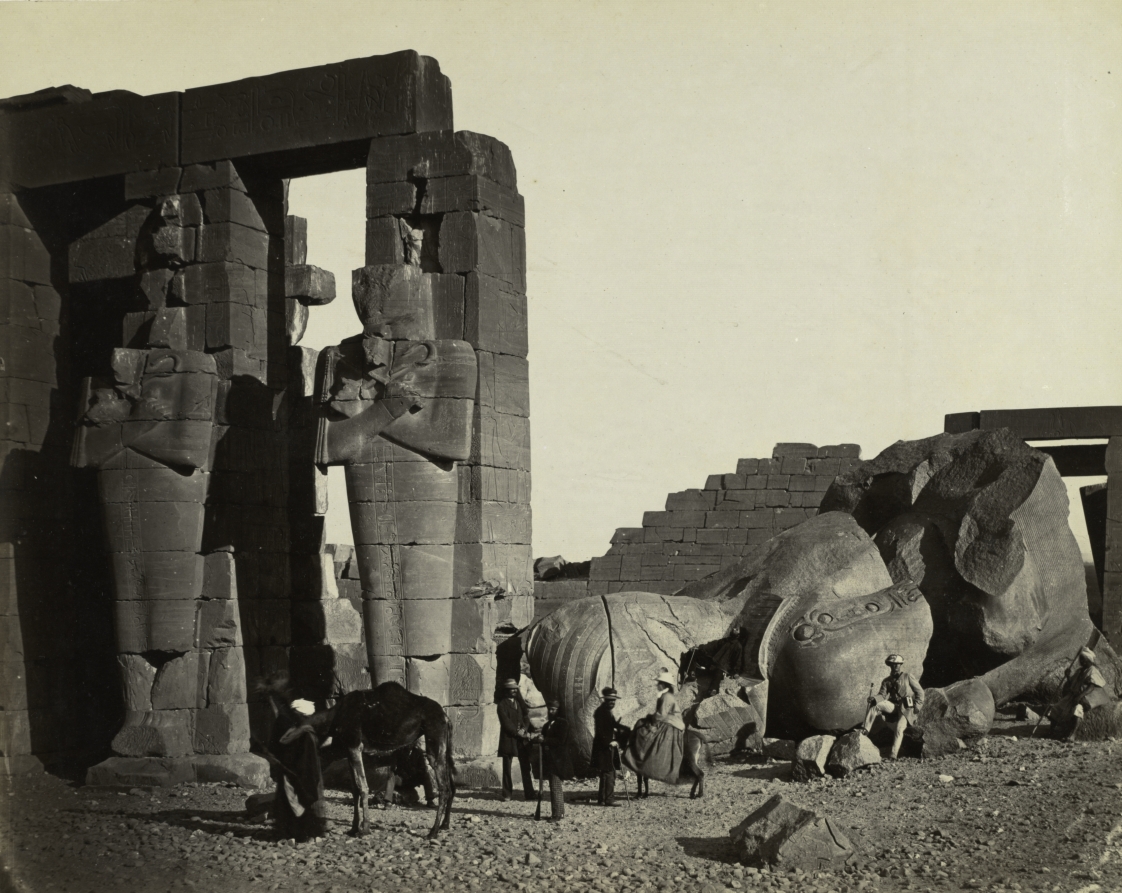
Fallen Statue at the Ramesseum, Thebes, 1857, by Francis Frith
Francis Frith · The Cleveland Museum of Art · Andrew R. and Martha Holden Jennings Fund
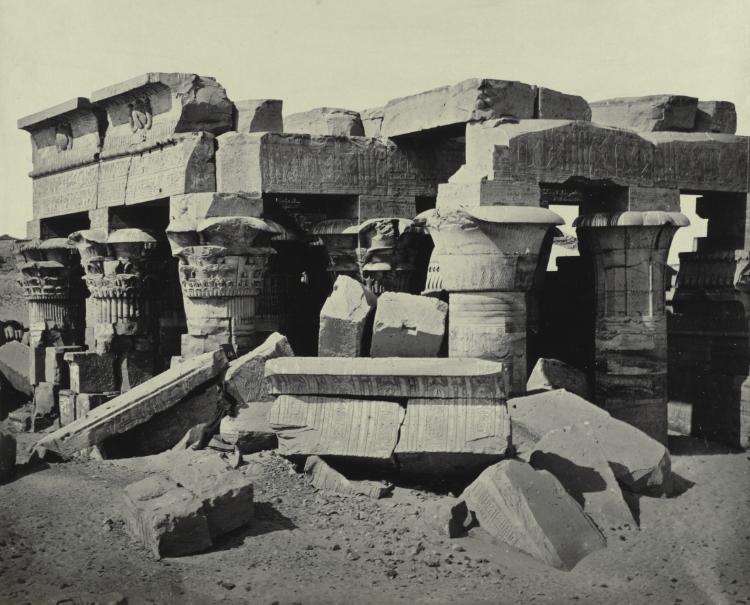
Kom Ombo, c. 1858, by Francis Frith
Francis Frith · The Cleveland Museum of Art · John L. Severance Fund
Life and career
Dated record
Life and career
The full dated record · 2 entries
1822
Francis Frith born at Chesterfield.
1898
Francis Frith died at Cannes.
Primary material
Documents and archives
authority file
- Gemeinsame Normdatei 1087220211, Francis Frith Collection (Andover).
Unverified · Deutsche Nationalbibliothek
- Getty Union List of Artist Names 500033382, Francis Frith & Co..
Unverified · The Getty Research Institute
authority record
- Wikidata, structured authority record Q978878: Francis Frith
Unverified · Wikidata
reference work
- “Francis Frith”, English Wikipedia, consulted as further reading
Reputable secondary · Wikipedia
Notes from the source article
Cited by Wikipedia
Notes from the source article
These works are cited by the source article, in its own numbering. They are recorded as its citations, not as sources VALÉORINE has verified.
- 1.Scan of the birth certificate, Public Record Office
- 2.Jackson, Sarah. House of Cards. Amateur Photographer. 31–34. 12 August 2000. 0002-6840.
- 3.MoMA. Francis Frith.
- 4.The current organisation called "Liverpool Photographic Society" claims to have been founded in 1952. The South Liverpool Photographic Society . Accessed 15 June 2008.
- 5.Watterson, Barbara. The Photographs of Francis Frith (1822–1898): A Victorian View of Ancient Egypt. Archaeology. Archaeological Institute of America. 37. 6. 48–53. 1984. 0003-8113.
- 6.Weintraub, Maxim Leonid. Encyclopedia of Nineteenth-Century Photography. Routledge. 1. 558–560. 2008. 978-0-415-97235-2.
- 7.Hannavy, J., Encyclopedia of Nineteenth-Century Photography, Routledge, 2012, p. 1031
- 8.Bill Jay. Up the Nile with Francis Frith. British Journal of Photography. 8 January 1982.
- 9.Hannavy, J., Encyclopedia of Nineteenth-Century Photography, Routledge, 2012, p. 1031
- 10.Williams, C., "The Visual Image of Nineteenth Century Cairo," in Abdullah, T., Serag, M., Jones, M., Sakkūt, H. and O'Kane, B. (eds), Arab and Islamic Studies, American University in Cairo Press, 1997, pp. 48–50
- 11.Who made the Conway Library?. Digital Media. 2020-06-30.
- 12.Francis Frith & Co Ltd - National Portrait Gallery. www.npg.org.uk.
- 13.Howe, Kathleen Stewart. Encyclopedia of Nineteenth-Century Photography. Routledge. 1. 560–562. 2008. 978-0-415-97235-2.
- 14.FQE was published 1867 to 1946 under that title and from 1946 as Friends Quarterly.
- 15.Family of Francis Frith and Mary Ann Roslino. firthworks.
- 16.Francis Frith. all-about-photo.com.
- 17.Francis Frith. The Museum of Modern Art.
- 18.Frith company records.
- 19.Francisfrith.com. Britain's First Photo Album.
- 20.Britain's First Photo Album episode 7; BBC TV
References
Citations
References
Each reference names the institution holding it, so a reader may go to the document itself.
authority file
Gemeinsame Normdatei 1087220211, Francis Frith Collection (Andover).Deutsche Nationalbibliothek
Partially resolvedauthority file
Getty Union List of Artist Names 500033382, Francis Frith & Co..The Getty Research Institute
Partially resolvedauthority record
Partially resolvedreference work
Partially resolved
The Encyclopedia exists whether or not anything is for sale. Corrections are recorded rather than overwritten, and every version of this record is kept. Published 14 August 2026.
Elsewhere in Photography
11,392 published records in this field, each with its sources named.
- Francis Edgar StanleyPhotographer
- Francis Edgar WilliamsPhotographer
- Francis Fauvel GouraudPhotographer
- Francis ForshewPhotographer
- Francis FukuyamaPhotographer
- Francis GaltonPhotographer
- Francis GamichonPhotographer
- Francis Godolphin Osbourne StuartPhotographer
Best supported in this field
For owners
Own a work by Francis Frith?
A specialist will read what you send and tell you what the house can establish, what it cannot, and whether the object is suited to sale. There is no charge and no obligation. The object stays with you throughout; nothing is shipped to us unless it is arranged in writing beforehand.