
Francis Barlow
Francis Barlow (c. 1626 – 1704) was an English painter, etcher, and illustrator. He ranks among the most prolific book-illustrators and printmakers of the 17th century, working across several genres: natural history, hunting and recreation, politics, and decoration and design.
Also recorded as Francis Barlno · Barlno · Barloe · Barlow
Francis Barlow
Francis Barlow · Wellcome Collection, London · Wellcome Collection · Public Domain Mark
- Name
- Francis Barlow
- Born
- c. 1626
- Birthplace
- Lincolnshire, England
- Died
- 1704 (aged c. 78)
- Field
- Painting, etching, book illustration, comics
- Nationality
- United Kingdom
- Occupation
- painter · illustrator · etcher · draftsperson
- Fields
- painting
- Languages
- English
VALÉORINE Encyclopedia
VALÉORINE documentary reading
Documentary summary
Francis Barlow (c. 1626 – 1704) was an English painter, etcher, and illustrator. He ranks among the most prolific book-illustrators and printmakers of the 17th century, working across several genres: natural history, hunting and recreation, politics, and decoration and design.
Admitted source layer · organised and presented by VALÉORINE
Reference Check
Propose documentary evidence for Francis Barlow. A contribution is never written directly as fact: identity, source, rights and evidence gates still decide.
Sign in to contribute
World of VALÉORINE
Documentary connections
Only confirmed graph relationships appear here. Images are shown only when their identity and reuse rights both pass the documentary gate.

Documentary evidence
Documentary basis
Authority files
wikidata · Q3081300
In this article
Biography
Biography
Barlow is known as "the father of British sporting painting"; he was Britain's first wildlife painter, beginning a tradition that reached a high-point a century later, in the work of George Stubbs. He was furthermore a pioneer in the history of comics by creating A True Narrative of the Horrid Hellish Popish Plot (c. 1682), a picture story about the life of Titus Oates and the Popish Plot, which is told in a series of illustrated sequences where the story is written underneath them and the characters depicted on those images use speech balloons to talk. While it is not the first example of its kind in history, it is one of the oldest which is signed.
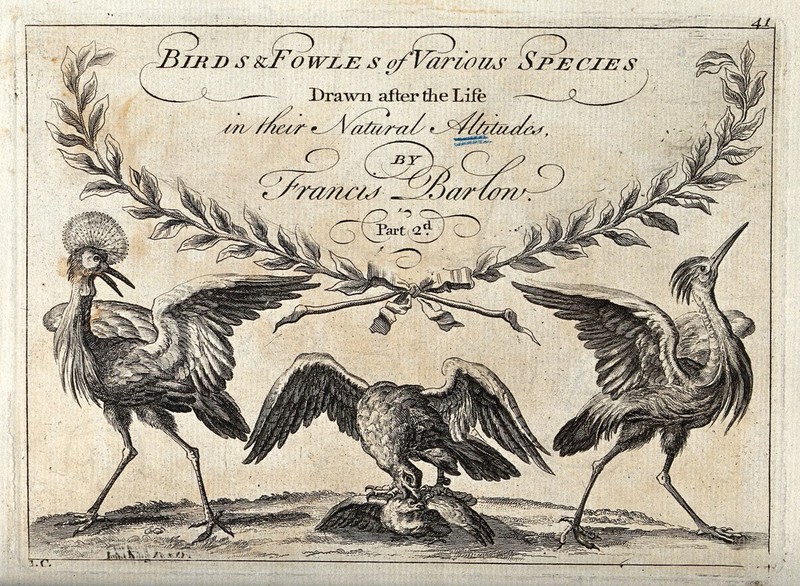
A title page illustrated with a grebe, an eagle and a heron. Engraving, ca. 1690, after F. Barlow., 1690, by Francis Barlow
Francis Barlow · Wellcome Collection, London · Wellcome Collection
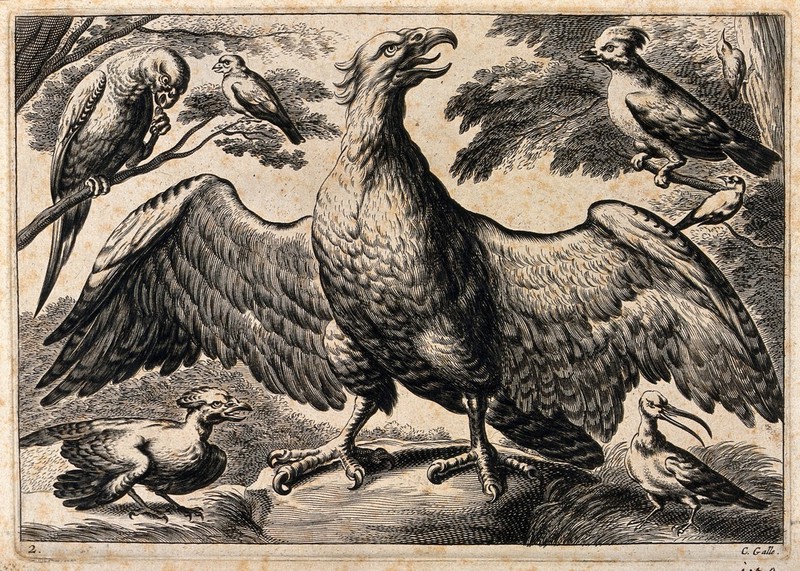
An eagle surrounded by parrots and other birds. Etching by C. Galle, ca. 1670, after F. Barlow., 1670, by Francis Barlow
Francis Barlow · Wellcome Collection, London · Wellcome Collection
Key facts
Key facts
• Name — Francis Barlow • Born — c. 1626 • Birthplace — Lincolnshire, England • Died — 1704 (aged c. 78) • Field — Painting, etching, book illustration, comics • Notable Works — A True Narrative of the Horrid Hellish Popish Plot
Life
Life
Barlow was born c. 1626 in Lincolnshire. The exact day of Barlow's death is unknown but he was buried on 11 August 1704. Joseph Strutt records that Barlow died in poverty: "not withstanding all his excellency in design, the multitude of pictures and drawings he appears to have made, and the assistance also of a considerable sum of money, said to have been left to him by a friend, he died in indigent circumstances."
Work
Work
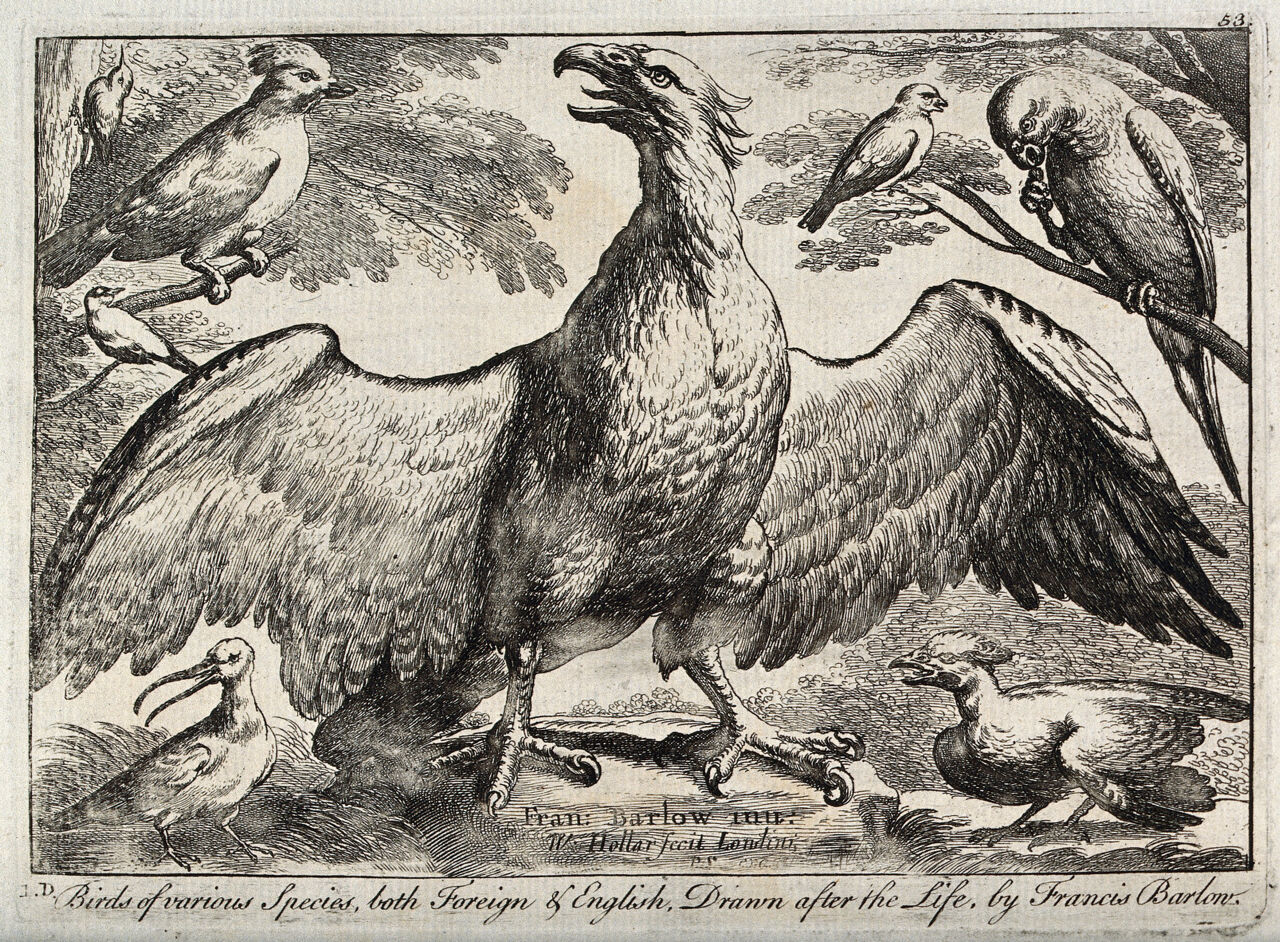
Barlow's first major work was the illustration (via twelve plates) of poet Edward Benlowe's Theophila (1652). In Barlow's favour, Bullen said in 1885 that "the volume [was] valued rather for the engravings than for the text." According to Manchester's Chetham's Library, no two copies of Benlowe's Theophila are the same, and no copy survives in good condition. The Victoria and Albert Museum holds two different copies, one of which includes an original drawing by Barlow. • Illustration — Coursing the Hare, illustration by Barlow to Richard Blome's The Gentleman's Recreation, 1686 Barlow designed the one hundred and ten woodcuts for John Ogilby's translation of Aesop's Fables, published in 1665, several of the plates of which Barlow etched himself. Hugh James Rose observed in the early 19th century that Barlow's "chief merit [...] as a designer, lay in his exactness in the portrayal of birds, fishes, and animals of all kinds, which are executed in a spirited, and in many instances a masterly manner." One example of this gift is in a set of twelve prints by Wenceslaus Hollar of engravings after drawings by Barlow, entitled Several Ways of Hunting, Hawking, and Fishing, invented by Francis Barlow, engraved by W. Hollar, 1671, published by John Overton. A 2011 article in History Today explored the subtext in examples of Barlow's work: though his wildlife paintings are superb works of art in themselves, they are, at the same time, "full of rich metaphors that shed light on the anxieties and concerns of a Britain emerging from the horrors of civil war". A case in point is A Decoy, Barlow's allegory on the threat posed to England by Roman Catholicism. In the years leading up to the Glorious Revolution, Barlow became the prime designer of political satire in support of the Whigs; Whig MP Denzil Onslow (1642-1721) acquired or commissioned a number of paintings by Barlow, to decorate his manor house, Pyrford Court. These were more recently housed at Clandon Park, an 18th-century mansion near Guildford, Surrey, becoming one of the largest collections of Barlow's surviving work. Barlow's (and others') work "miraculously" survived a devastating fire at Clandon Park on 29 April 2015. Examples of Barlow's work can be seen at Ham House (in Ham, south of Richmond in London); examples are held, too, by: Tate Britain, the National Portrait Gallery, the British Museum, and the Victoria and Albert Museum. Barlow frequently signed the initials of his name, F.B., instead of inserting it at full length, sometimes enclosing the initials in a small circle.
Assessment
Assessment
Barlow has come to be regarded as a "surprisingly neglected artist". Art historian Mark Hallett accounts for this by noting that Barlow's time is British art's "forgotten era" - one that "has tended to be overshadowed by the achievements of earlier artists, such as Van Dyck, or those that came later, such as Hogarth"; Hallett finds this unjust: Barlow made a significant contribution to what "in reality [...] was a remarkably rich, vibrant and cosmopolitan period for the visual arts in Britain."
Gallery
Gallery
• Illustration — The Mice in Council, from Ogilby's translation of Aesop's Fables (1665) • Illustration — Seuerall wayes of hunting, hawking and fishing according to the English manner, title page; 1671 • Illustration — Pack of playing cards depicting the Popish Plot, c. 1679; V&A Museum no. 20366: 1 to 52
Life and career
Dated record
Life and career
Explore 1624–1704
The full dated record · 3 entries
1624
Francis Barlow born at Lincolnshire.
1687
Aesop's Fables by Francis Barlow (1687) is digitised and catalogued by Internet Archive.
1704
Francis Barlow died at London.
Places
Named by the record
Places
Only places the record itself states, plotted where the house gazetteer settles their coordinates. Nothing is inferred from a name or a nationality.
Lincolnshire.
Birth place
London.
Death place
Primary material
Documents and archives
scholarly publication
- Barlow, Francis (d. 1704), painter and etcher, Oxford Dictionary of National Biography, 2004
Scholarly · Crossref registry · 2004
reference work
- Wikidata, structured authority record Q3081300: Francis Barlow
Reputable secondary · Wikimedia Foundation
Citations
References
Each reference names the institution holding it, so a reader may go to the document itself.
scholarly publication
Barlow, Francis (d. 1704), painter and etcher, Oxford Dictionary of National Biography, 2004Crossref registry
Institutional witnessreference work
Wikidata, structured authority record Q3081300: Francis BarlowWikimedia Foundation
Secondary witness
The Encyclopedia exists whether or not anything is for sale. Corrections are recorded rather than overwritten, and every version of this record is kept. Published 16 August 2026.
Elsewhere in Illustration
5,224 published records in this field, each with its sources named.
- Frances FryIllustrator
- Frances MacDonaldIllustrator
- Frances Tipton HunterIllustrator
- Francesca AlexanderIllustrator
- Francis Carruthers GouldIllustrator
- Francis CoudrillIllustrator
- Francis Donkin BedfordIllustrator
- Francis J. BroadhurstIllustrator
Best supported in this field
For owners
Own a work by Francis Barlow?
A specialist will read what you send and tell you what the house can establish, what it cannot, and whether the object is suited to sale. There is no charge and no obligation. The object stays with you throughout; nothing is shipped to us unless it is arranged in writing beforehand.