
Ferdinand Freiligrath
Illustration — Ferdinand Freiligrath in 1851 • Illustration — Ferdinand Freiligrath lived in Unkel 1839/40 Ferdinand Freiligrath (17 June 1810 – 18 March 1876) was a German poet, translator and liberal agitator, who is considered part of the Young Germany movement.
Also recorded as Hermann Ferdinand Freiligrath
Ferdinand Freiligrath

Johann Peter Hasenclever · 1. Bildindex der Kunst und Architektur: object 02531210 – image file ng1906_085a.jpg 2. Google Arts Culture — _AHL0THeHM6Ptg · Public domain
- Born
- 1810. · Detmold.
- Died
- 1876. · Stuttgart.
- Nationality
- Principality of Lippe.
- Occupation
- linguist, poet, translator, writer, journalist and revolutionary.
- Fields
- poetry and translation into German.
- Languages
- German.
VALÉORINE Encyclopedia
VALÉORINE documentary reading
Documentary summary
Illustration — Ferdinand Freiligrath in 1851 • Illustration — Ferdinand Freiligrath lived in Unkel 1839/40 Ferdinand Freiligrath (17 June 1810 – 18 March 1876) was a German poet, translator and liberal agitator, who is considered part of the Young Germany movement.
Admitted source layer · organised and presented by VALÉORINE
Note VALÉORINE
Ferdinand Freiligrath (1810–1876) was a journalist, linguist and poet, among other activities, a national of the Principality of Lippe. The journalist was born Hermann Ferdinand Freiligrath in Detmold. Activity centred on poetry and translation into German. Languages used include German.
Composed from admitted, traceable facts · 26 September 2026
VALÉORINE
Reference Check
Propose documentary evidence for Ferdinand Freiligrath. A contribution is never written directly as fact: identity, source, rights and evidence gates still decide.
Sign in to contribute
World of VALÉORINE
Documentary connections
Only confirmed graph relationships appear here. Images are shown only when their identity and reuse rights both pass the documentary gate.
Documentary evidence
Evidence Panel
technical hold · checked 25 September 2026
- Identity
- resolved
- Independent source families
- 0
- Admitted assertions
- 0
- Open conflicts
- 0
Authority files
gnd · 7785874-8 · wikidata · Q213719 · wikipedia · Ferdinand Freiligrath
In this article
Life
Life
Freiligrath was born in Detmold, Principality of Lippe. His father was a teacher. He left a Detmold gymnasium at 16 to be trained for a commercial career in Soest. There he also familiarized himself with French and English literature, and before he was 20 had published verses in local journals. He worked in Amsterdam from 1831 to 1836 as a banker's clerk. After publishing translations of Victor Hugo's Odes and Chants du crépuscule, and launching a literary journal, Rheinisches Odeon (1836–38), in 1837 he started working as a bookkeeper in Barmen, where he remained until 1839. Later on, he started writing poems for the Musen-Almanach (edited by Adelbert von Chamisso and Gustav Schwab) and the Morgenblatt (ed. Cotta). His first collection of poems (Gedichte) was published in 1838 in Mainz. This contained his poems "Löwenritt", "Prinz Eugen", and "Der Blumen Rache". His early poems were inspired by Victor Hugo's Orientales, which he also partly translated into German; they often dealt with exotic subjects. The poem "Der Mohrenfürst", for example, tells the story of a black prince who was a fierce warrior. He is defeated in battle, sold as a slave and ends up as a drummer in a circus, only the lion's skin he wore that now decorates the drum still reminding him of his previous life. This poem was set as a song by Carl Loewe. His 1838 book of poems won immediate and wide favour, and he decided upon a literary career which he embarked upon in 1839. He cooperated in several now unimportant works, and in 1842 received a pension of 300 thalers from the Prussian king, Frederick William IV. He married, and, to be near his friend Emanuel Geibel, settled at St. Goar. Freiligrath was a friend of the American poet Henry Wadsworth Longfellow. In 1842, when Longfellow was taking a rigorous water cure at a health spa in the former Marienberg Benedictine Convent at Boppard on the Rhine, a fellow patient introduced him to Freiligrath at the latter's home in St. Goar. Freiligrath had a special interest in English and American poetry. There followed many meetings and outings in Germany where this topic was discussed, and Longfellow presented Freiligrath with copies of his books Hyperion and Ballads and Other Poems. The friendship developed further in their correspondence. Freiligrath had expressed beliefs that the artist should not be demeaned by becoming involved with politics and criticized the poet Georg Herwegh for his politicized poetry; however, due to political repression (censorship), and the encouragement of fellow poet Hoffmann von Fallersleben, Freiligrath later became more political. In 1844, he surrendered his pension, and in his Glaubensbekenntnis (Confession of Faith) placed his poetic gifts at the service of the democratic agitation that was to culminate in the Revolution of 1848. Such poems as "Trotz alledem" (a translation of Burns's "A man's a man for a' that"), "Die Freiheit", "Das Recht" and "Hamlet" made his absence from Germany expedient. He left for Belgium where he met Karl Marx. From there, he proceeded to Switzerland and then to London, publishing in 1846 Englische Gedichte aus neuerer Zeit, a volume of translations, and Ça ira, a collection of political songs. He lived until 1848 in England, where he resumed his commercial career. At the invitation of Longfellow, he considered going to America, but on the short-lived triumph of liberalism returned to Germany as a democratic leader. There, he was a leader of the Democratic League in 1848, alongside Karl Marx, Wilhelm Wolff and Frederick Lessner, the last of whom became his personal friend. In 1843, Franz Liszt set Freiligrath's poem "O lieb, so lang du lieben kannst" to music, published in 1847 — the song was later arranged by Liszt for solo piano as his "Liebesträume" No. 3 (1850), which subsequently became one of his most famous piano pieces. German composer Elise Schmezer set Freiligrath’s text to music in her Lieder, Romanzen und Balladen fur Tenor, opus 4. Upon his return to Germany, Freiligrath settled in Düsseldorf, and worked for the Neue Rheinische Zeitung (general editor: Karl Marx, editor of cultural pages: Georg Weerth), a paper which he cofounded with Marx, Friedrich Engels and Wilhelm Wolff. It was not long before he had again called down upon himself the ill-will of the ruling powers by a poem, Die Toten an die Lebenden (The Dead to the Living, 1848). He was arrested on a charge of lèse-majesté, but the prosecution ended in his acquittal. This trial, in which he was acquitted, is memorable for another reason, being the first jury trial ever held in Prussia. He published Zwischen den Garben (1849) and Neue politische und soziale Gedichte (New Political and Social Poems, 1850). New difficulties arose; his association with the democratic movement rendered him an object of constant suspicion, and in 1851 he judged it more prudent to go back to London. There he became the director of the London branch of the Schweizer Generalbank and set up residence in the north-east of the city at 3 Sutton Place, Hackney. He remained in London until 1868, supporting himself by office work and poetic translations, among which were an anthology, the Rose, Thistle, and Shamrock (1854), Longfellow's Hiawatha (1857), and Shakespeare's Cymbeline and The Winter's Tale. These kept up his popularity in Germany, where in 1866 a subscription of 60,000 thalers was raised for him, partly as a political manifesto. Back in Germany after the amnesty of 1868, Freiligrath settled first in Stuttgart and in 1875 in the neighbouring town of Cannstatt. He became a nationalist, publishing the patriotic poems "Hurrah, Germania!" and "Die Trompete von Vionville", inspired by Germany's victory in the Franco-Prussian War. His 1848 poem In Kümmernis und Dunkelheit attributed military symbolism to the colors of the German tricolor flag (which at the time stood only for the nation, not any political entity): the black was for gunpowder, the red for blood and the yellow the glow given off by the fire. He died in Cannstatt in 1876. Among the first writers to translate Freiligrath into English was the Irish poet James Clarence Mangan (in the latter's Anthologia Germanica, no. XIX, published in the Dublin University Magazine in 1845). A selection, by his daughter, from the English translations of his poems was published in the Tauchnitz Collection of German Authors (Leipzig, 1869).
Works
Works
*
Identity
Identity
Ferdinand Freiligrath is recorded as linguist, poet, translator, writer and journalist.

Ferdinand Freiligrath
Lith. Anst. v. J. G. Bach Lpzg · Die politischen Lyriker unserer Zeit. Ein Denkmal mit Portraits und kurzen historischen Charakteristiken (Google Book Search), nach S. 282
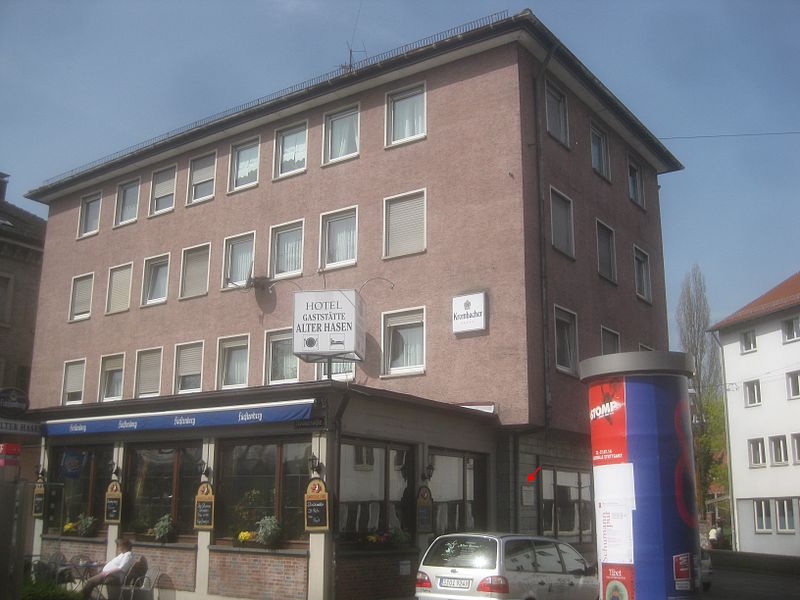
Wirtshaus „Alter Hasen“, Stuttgart- de:Bad Cannstatt, Neckartalstraße 73. Nach teilweiser Zerstörung im Zweiten Weltkrieg wurde das Haus wieder neu aufgebaut. In dem Haus starb am 18. März 1876 der Dichter de:Ferdinand Freiligrath. 1976 wurde eine Gedenktafel an dem Haus angebracht (roter Pfeil).
Gerd Leibrock
Life and career
Dated record
Life and career
Explore 1810–1876
The full dated record · 3 entries
1810
Ferdinand Freiligrath born at Detmold.
1871
Poems: From the German of Ferdinand Freiligrath (1871) is digitised and catalogued by Internet Archive.
1876
Ferdinand Freiligrath died at Stuttgart.
Places
Named by the record
Places
Only places the record itself states, plotted where the house gazetteer settles their coordinates. Nothing is inferred from a name or a nationality.
Detmold.
Birth place
Stuttgart.
Death place
Primary material
Documents and archives
reference work
- “Ferdinand Freiligrath”, English Wikipedia, consulted as further reading
Reputable secondary · Wikipedia
- Wikidata, structured authority record Q213719: Ferdinand Freiligrath
Reputable secondary · Wikimedia Foundation
scholarly publication
- Ferdinand Freiligrath, Preußische Jahrbücher Band 37, 1876
Scholarly · Crossref registry · 1876
authority file
- Gemeinsame Normdatei 7785874-8, Ferdinand Freiligrath.
Unverified · Deutsche Nationalbibliothek
Literature
Literature
Literature
Ferdinand Freiligrath's Gesammelte Dichtungen Band 2, 1898
Ferdinand Freiligrath e i limiti dell’esotismo, Between, 2026
Scholarly footprint
Literature
Scholarly footprint
A count of publications is evidence of attention, not of standing, and is given here only as a measure.
Notes from the source article
Cited by Wikipedia
Notes from the source article
These works are cited by the source article, in its own numbering. They are recorded as its citations, not as sources VALÉORINE has verified.
- 1.1905.
- 2.Robertson, John George. 11. 94-94.
- 3.1920.
- 4.James Taft Hatfield, "The Longfellow-Freiligrath Correspondence," Publications of the Modern Language Association, Vol. 48, No. 4 (December 1933), pp. 1223-1291.
- 5.Nicolaievsky, Boris. Karl Marx: man and fighter. Pelican Books. 105. 1976. 0140215948.
- 6.Carl Schurz. Lebenserinnerungen Bis zum Jahre 1850: Selections. Allyn and Bacon. 200 (note to p. 18). 1913.
- 7.Lessner, Frederick. Sixty Years in the Social-Democratic Movement. 1907.
- 8.Elise Schmezer Song Texts LiederNet. www.lieder.net.
- 9.G.V. Plekhanov: Notes on "Ludwig Feuerbach ." (Part 1). www.marxists.org.
- 10.Freiligrath, Ferdinand.
References
Citations
References
Each reference names the institution holding it, so a reader may go to the document itself.
scholarly publication
Ferdinand Freiligrath, Preußische Jahrbücher Band 37, 1876Crossref registry
Verifiedreference work
Partially resolvedauthority file
Gemeinsame Normdatei 7785874-8, Ferdinand Freiligrath.Deutsche Nationalbibliothek
Partially resolvedreference work
Wikidata, structured authority record Q213719: Ferdinand FreiligrathWikimedia Foundation
Partially resolved
The Encyclopedia exists whether or not anything is for sale. Corrections are recorded rather than overwritten, and every version of this record is kept. Published 15 August 2026.
Elsewhere in Books
38,377 published records in this field, each with its sources named.
- Ferdinand d'Orléans, Duke of MontpensierAuthor
- Ferdinand de LessepsAuthor
- Ferdinand DuguéAuthor
- Ferdinand FabreAuthor
- Ferdinand GrapperhausAuthor
- Ferdinand GregoroviusAuthor
- Ferdinand HardekopfAuthor
- Ferdinand KürnbergerAuthor
Best supported in this field
For owners
Own a work by Ferdinand Freiligrath?
A specialist will read what you send and tell you what the house can establish, what it cannot, and whether the object is suited to sale. There is no charge and no obligation. The object stays with you throughout; nothing is shipped to us unless it is arranged in writing beforehand.