
Farnham Maxwell-Lyte
Farnham Maxwell Lyte FRSC (10 January 1828 – 4 March 1906), sometimes Maxwell Farnham Lyte, and after his death often called Maxwell-Lyte, was an English chemist and the pioneer of a number of techniques in photographic processing.
Also recorded as Maxwell Lyte · F. Maxwell Lyte · Farnham Maxwell Lyte
Farnham Maxwell-Lyte

http: cybermuse.beaux-arts.ca/cybermuse/search/artwork_zoom_e.jsp?mkey=101368 · Public domain
- Name
- Farnham Maxwell Lyte
- Born
- 10 January 1828
- Birthplace
- Brixham, Devon, England
- Died
- 4 March 1906
- Place of death
- South Kensington, London, England
- Education
- Christ's College, Cambridge
- Known for
- Photographs of the French Pyrenees
- Nationality
- United Kingdom of Great Britain and Ireland
- Occupation
- photographer · engineer · chemist
- Honours
- Fellow of the Chemical Society
VALÉORINE Encyclopedia
VALÉORINE documentary reading
Documentary summary
Farnham Maxwell Lyte FRSC (10 January 1828 – 4 March 1906), sometimes Maxwell Farnham Lyte, and after his death often called Maxwell-Lyte, was an English chemist and the pioneer of a number of techniques in photographic processing.
Admitted source layer · organised and presented by VALÉORINE
Reference Check
Propose documentary evidence for Farnham Maxwell-Lyte. A contribution is never written directly as fact: identity, source, rights and evidence gates still decide.
Sign in to contribute
World of VALÉORINE
Documentary connections
Only confirmed graph relationships appear here. Images are shown only when their identity and reuse rights both pass the documentary gate.

Documentary evidence
Documentary basis
Authority files
wikidata · Q3066972 · wikipedia · Farnham Maxwell Lyte
In this article
Key facts
Key facts
• Name — Farnham Maxwell Lyte • Born — 10 January 1828 • Birthplace — Brixham, Devon, England • Died — 4 March 1906 • Place of death — South Kensington, London, England • Education — Christ's College, Cambridge • Father — Henry Francis Lyte • Relatives — Henry Maxwell Lyte (nephew) • Children — 5 • Known for — Photographs of the French Pyrenees
Early life
Early life
Lyte was born on 10 January 1828 in Brixham, Devon, the fifth and last child of Henry Francis Lyte (the author of "Abide with Me") and Anne Maxwell. Lyte was sixteen when he first came across photography, hearing the news of William Henry Fox Talbot's invention of the calotype. In 1846, as F. M. Lyte, he entered Christ's College, Cambridge, where he graduated BA in chemical engineering in 1851, promoted to MA in 1863. On leaving Cambridge, the young Lyte became a mining engineer and was an Associate of the Society of Civil Engineers and a Fellow of the Chemical Society.
Société Ramond
Société Ramond
In 1864, Lyte was among the founders of the Société Ramond, a learned society devoted to the ethnographic and scientific study of the Pyrenees. Although he did not take part in the initial meeting at the hôtel des Voyageurs in Gavarnie attended by Henry Russell, Charles Packe, and Émilien Frossard and his two sons, he attended the second meeting at Frossard's house in Bagnères-de-Bigorre. At this meeting the rules for admittance were laid down, the society was given its name, and executive positions were decided upon; Maxwell Lyte was chosen as the society's first vice-president. It was on the initiative of the Société Ramond that the observatory on the Pic du Midi de Bigorre was built. Before its construction, Lyte had carried out observations with a large telescope, and made photographs of the eclipse of the sun of 18 July 1860. He also made meteorological readings, determining the average temperature of Bagnères-de-Bigorre over two years of recordings.
Later years
Later years
Maxwell Lyte gave up photography when he moved with his family to Dax. Returning to his original profession as a mining engineer, he bought the sulphur springs of Moudang and a salt mine in Dax, but these were failures. He died suddenly in 1906 at his residence at 60 Finborough Road, South Kensington, London, and was buried at St Mary The Boltons, Kensington. In its review of the year 1906, the British Journal of Photography noted his death and offered the following estimation of his contribution to photographic processing:
Personal life
Personal life
In 1851, Lyte married Eleanora Julia Bolton (1828–1896), a daughter of Cornelius H. Bolton, of Faithlegg, County Waterford, with whom he had five children. In 1894, their son Cecil Henry Maxwell Lyte married the Hon. Mary Lucy Agnes Stourton, a daughter of Alfred Stourton, 23rd Baron Mowbray and his wife Mary Margaret Corbally.
Identity and origins
Identity and origins
The authorities additionally record the headings Maxwell Lyte, F. Maxwell Lyte and Farnham Maxwell Lyte. He was the child of Henry Francis Lyte and Anne (Maxwell) Lyte. He married Eleanora Julia Bolton. 4 children are recorded: Ida Mary Maxwell-Lyte, Alice Anne Maxwell-Lyte, Cecil Henry Maxwell-Lyte and Eleanora Gertrude Maxwell-Lyte.
Identity
Identity
Farnham Maxwell-Lyte is recorded as having received Fellow of the Chemical Society. Recognition and collections. Maxwell-Lyte received Fellow of the Chemical Society. Paul Getty Museum.
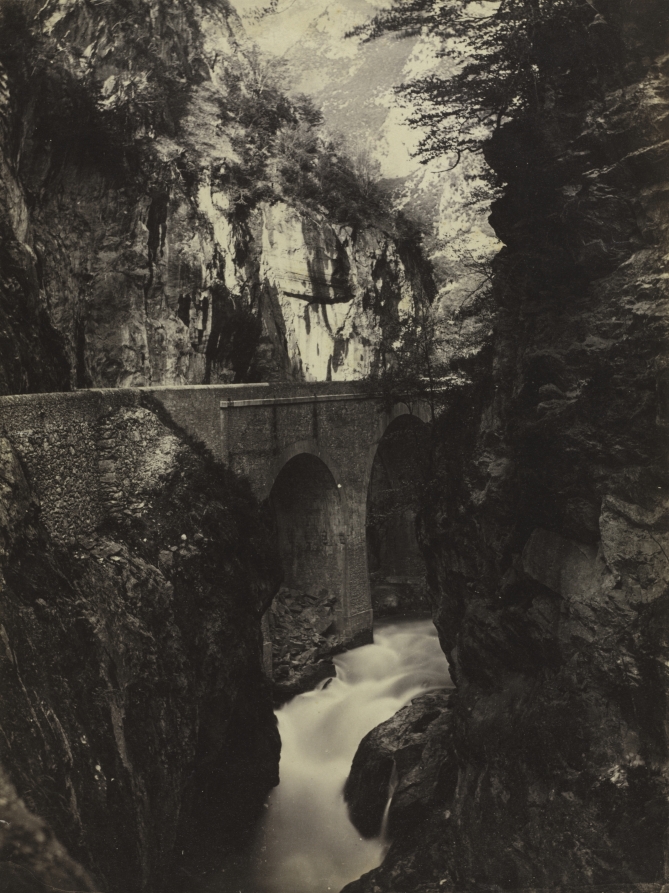
Road to Eaux-Chaudes, Pyrenees (recto), c. 1855, by Farnham Maxwell-Lyte
Farnham Maxwell Lyte · The Cleveland Museum of Art · Gift of Paula and Robert Hershkowitz in memory of Sam Wagstaff
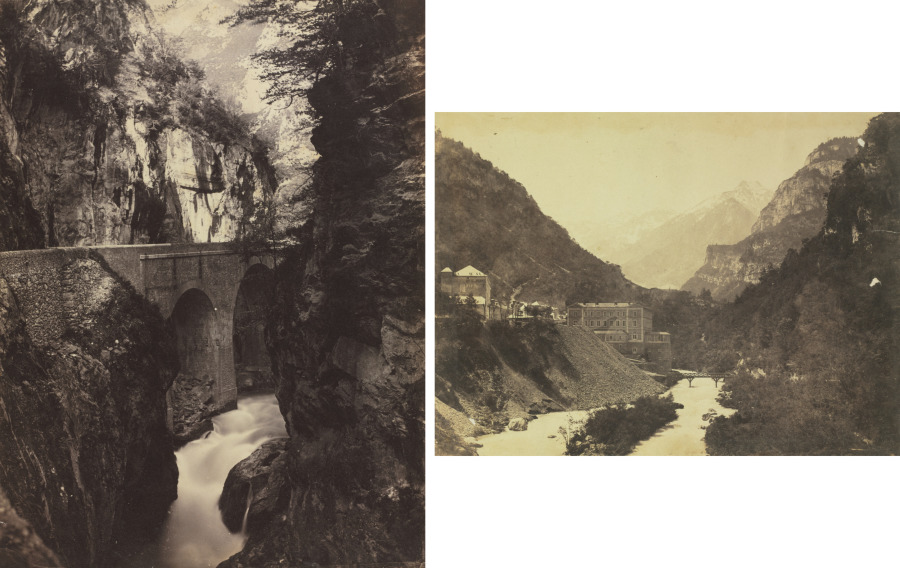
Road to Eaux-Chaudes, Pyrenees (recto); Eaux-Chaudes, Pyrenees (verso), c. 1855, by Farnham Maxwell-Lyte
Farnham Maxwell Lyte · The Cleveland Museum of Art · Gift of Paula and Robert Hershkowitz in memory of Sam Wagstaff
Life and career
Dated record
Life and career
The full dated record · 2 entries
1828
Farnham Maxwell-Lyte born at Devon.
1906
Farnham Maxwell-Lyte died at London.
Places
Named by the record
Places
Only places the record itself states, plotted where the house gazetteer settles their coordinates. Nothing is inferred from a name or a nationality.
Devon.
Birth place
London.
Death place
Processing
As both a chemist and a photographer, Lyte made many improvements to the technique of photographic processing, working with collodion and wax paper, and introducing a process of his own invention which he called métagélatine; this process was adopted by several photographers and is described, as the "Metagelatine Dry Process", in Wilson's Cyclopedic Photography. In 1854 he wrote up the results of his investigations into what became known as the "honey" process. This was "a method of improving the wet-collodion process by extending the longevity of the sensitized plate" As its name suggests, in this process honey was used both as the preservative solution and in the dusting-in (the 17 June 1854 issue of Notes and Queries contains his description and analysis of his experiments with the process). Maxwell Lyte's letter appeared a fortnight after George Shadbolt, former editor of the British Photographic Journal, had independently contacted the Photographic Society (now the Royal Photographic Society), giving his description of an identical experiment with honey. • Illustration — Pont d'Orthez, Basses-Pyrenees, by Maxwell Lyte, c. 1858 Lyte was one of the pioneers of inserting an imported sky into a landscape photograph to mitigate the problems of sensitivity of the collodion plates, a process that he justified in a letter of 6 November 1861 to the journal Moniteur de la photographie. In the April 1862 issue of the British Journal of Photography he published his findings on the presence of "anti-chlors" in photographic paper, a substance that jeopardised the stability of silver prints. He introduced borax and phosphate toning baths that are still used today, as well as pioneering the use of iodide.
Photography
Photography
In 1853, Lyte travelled to Luz-Saint-Sauveur in the Pyrenees on account of his bad health, and in 1856 his family joined him there. He settled in Pau and frequented an English circle, in which he met a group of photographers including John Stewart, Jean-Jacques Heilmann, Pierre Langlumé, and Louis Désiré Blanquart-Evrard, who were known as the "Group of Pau". He lived in France from 1853 until 1880. In 1854, he was one of the founders of the Société française de photographie and also became an Honorary Fellow of the Royal Photographic Society. • Illustration — Pyrenees, 1860, Maxwell Lyte, 1860
Landscape photography
Landscape photography
Maxwell Lyte took scenic photographs in the period just before commercial photographers started to take and market mass-produced views in the 1860s. According to Dan Younger (in notes for an exhibition of antique photographs at Kenyon College): Maxwell Lyte photographed the mountains, villages, waterfalls and bridges of the Pyrenees, often exhibiting his photographs under the auspices of the Société française de photographie. He showed them almost every year from 1855 to 1865 in cities such as London, Glasgow, Edinburgh and Paris, and received several international prizes: he won the silver medal at 1855 Exposition Universelle in Paris, and his Pyrenean landscapes gained him a gold medal in Bordeaux in 1859. He also regularly submitted photographs to the Photographic Society of Scotland's annual exhibition in Edinburgh, sending his entries from his home in Pau and winning silver medals at the 5th exhibition (for Pierrefith) and 7th exhibition (for Lac d'Oo). Despite the thoroughness of his instructions for the transport of his fragile prints from Pau to Scotland, the Daily Scotsman of 26 December 1859 wrote: • Illustration — Cascade de l'Enfer à Luchon, by Maxwell Lyte, c. 1858 Maxwell Lyte: Bagneres di Bigonne [sic] – An excellent specimen. Other specimens of the same artist are equally good; and we are happy to add that the injury these beautiful views sustained in their transmission to this country, by a nail being driven through them has been skillfully repaired, and does not now injure their general effect. Several of his photographs were included in an 1858 volume of Pyrenean views entitled Vues, costumes et monuments des Pyrénées, copies de grands maîtres. • Illustration — Members of the Société Ramond lay the first stone of the Pic du Midi de Bigorre observatory in 1879, artist unknown
Citations
References
Each reference names the institution holding it, so a reader may go to the document itself.
reference work
Secondary witnessreference work
Secondary witness
The Encyclopedia exists whether or not anything is for sale. Corrections are recorded rather than overwritten, and every version of this record is kept. Published 17 August 2026.
Elsewhere in Photography
11,392 published records in this field, each with its sources named.
- Farhat Basir KhanPhotographer
- Fariba HajamadiPhotographer
- Farin UrlaubPhotographer
- Farm Security AdministrationPhotographer
- Farrah KarapetianPhotographer
- Farrell GrehanPhotographer
- Farzana WahidyPhotographer
- Fatemeh BehboudiPhotographer
Best supported in this field
For owners
Own a work by Farnham Maxwell-Lyte?
A specialist will read what you send and tell you what the house can establish, what it cannot, and whether the object is suited to sale. There is no charge and no obligation. The object stays with you throughout; nothing is shipped to us unless it is arranged in writing beforehand.