
Eugène Grasset
Eugène Samuel Grasset (French pronunciation: [øʒɛn samɥɛl ɡʁasɛ]; 25 May 1845 – 23 October 1917) was a Swiss decorative artist who worked in Paris, France in a variety of creative design fields during the Belle Époque. He is considered a pioneer in Art Nouveau design.
Also recorded as Samuel Grasset · Eugène-Samuel Grasset · Eugene Samuel Grasset · Eugene Grasset
Eugène Grasset

[1] · Public domain
- Born
- 1845.
- Died
- 1917.
- Nationality
- France and Switzerland.
- Occupation
- type designer, poster artist, sculptor, painter, postage stamp designer, illustrator, graphic artist, draftsperson, visual artist and artist.
- Movements
- Symbolism and Art Nouveau.
- Known for
- Ancien siège de la chambre de commerce de Paris.
VALÉORINE Encyclopedia
VALÉORINE documentary reading
Documentary summary
Eugène Samuel Grasset (French pronunciation: [øʒɛn samɥɛl ɡʁasɛ]; 25 May 1845 – 23 October 1917) was a Swiss decorative artist who worked in Paris, France in a variety of creative design fields during the Belle Époque. He is considered a pioneer in Art Nouveau design.
Admitted source layer · organised and presented by VALÉORINE
Reference Check
Propose documentary evidence for Eugène Grasset. A contribution is never written directly as fact: identity, source, rights and evidence gates still decide.
Sign in to contribute
Documentary evidence
Documentary basis
Authority files
wikidata · Q524154 · wikipedia · Eugène Grasset
In this article
Biography
Biography
Grasset was born in Lausanne, Switzerland on 25 May 1845. He was raised in an artistic environment as the son of a cabinetmaker and sculptor who taught him at an early age how to use the chisel and the gouge. He studied drawing under Francois-Louis David Bocion (1828–1890) and in 1861 went to Zürich to study architecture. After completing his education, he visited Egypt, an experience that would later be reflected in a number of his poster designs. He became an admirer of Japanese art, which influenced some of his designs as well. Between 1869 and 1870, Grasset worked as a theater painter and sculptor in Lausanne. Here he met Viollet le Duc, whose reflection on the Middle Ages and the method advocating the link between form, function and material came to permeate Grasset's work. In 1871 he moved to Paris and he started to design furniture, wallpapers, fabrics, and tapestries as well as ceramics and jewelry. He created architectural elements of woodwork that were integrated into buildings. His fine art decorative pieces were crafted from ivory, gold, and other precious materials in unique combinations, and his creations are considered a cornerstone of Art Nouveau motifs and patterns. In 1877 Eugène Grasset turned to graphic design, producing income-generating products such as postcards and eventually postage stamps for both France and Switzerland. It was poster art, based on the work of Viollet le Duc, that quickly became his forte. Some of his works became part of the Maîtres de l'Affiche, including his lithograph, "Jeanne d'Arc Sarah Bernhardt". In 1890, he designed the "Semeuse who spreads seeds of dandelion" logo used by the dictionary publishers, Éditions Larousse. Grasset's commercial work would be based on the drawings of Viollet le Duc. With the growing popularity of French posters in the United States, Grasset was soon contacted by several American companies. In the 1880s, he did his first American commission and more success led to his cover design for the 1892 Christmas issue of Harper's Magazine. In 1894 he created "The Wooly Horse" and "The Sun of Austerlitz" for The Century Magazine to help advertise their serialized story on the life of Napoleon Bonaparte. The "Wooly Horse" image proved so popular that Louis Comfort Tiffany recreated it in stained glass. Grasset's work for U.S. institutions helped pave the way for Art Nouveau to dominate American art. Grasset taught design at the École Guérin from 1890 to 1903, at the École d’Art graphique in the rue Madame from 1903 to 1904, at the Académie de la Grande Chaumière from 1904 to 1913, and at the École Estienne in Paris. Grasset had freely adapted the alphabet of Nicolas Jenson (1471) with the intention of using it to print a book on his own method for ornamental composition, inspired by the courses he gave to the Guérin school. Georges Peignot acquired Grasset's alphabet and obtained an official patent on 7 October 1897 for the typeface under the name, "Grasset". He then gave Henri Parmentier, the workshop's punchcutter, the mission to engrave it. In 1896 he published a dissertation on the use of plants in designs, that featured images of designs prepared by his students. Among his students were Paul Berthon, Georges Bourgeot, Paul Follot, Marcelle Gaudin, Augusto Giacometti, Arsène Herbinier, Anna Martin, Mathurin Méheut, Juliette Milési, Otto Ernst Schmidt, Auguste Silice, Maurice Pillard Verneuil, Aline Poitevin, Pierre Selmersheim, Tony Selmersheim, Camille Gabriel Schlumberger, Eliseu Visconti, and Philippe Wolfers At the Universal Exhibition of 1900 in Paris, the G. Peignot et Fils typefoundry introduced the "Grasset" typeface, an Italic design created by Eugène Grasset in 1898 for use on some of his posters. Additionally, Grasset collaborated with jeweler Henri Vever, showcasing works such as the intricate 'Hercules' pendant, praised for its detailed artistry and mythological inspiration. Grasset died in 1917 in Sceaux in the Hauts-de-Seine département, southwest of Paris.
Life and career
Dated record
Life and career
The full dated record · 2 entries
1841
Eugène Grasset born at Lausanne.
1917
Eugène Grasset died at Sceaux.
General and cited references
General and cited references
Anne Murray Robertson (1998). Eugène Grasset: une certaine image de la femme: [exposition, Fondation Neumann, Gingins, 17 septembre 1998 - 31 janvier 1999]. Skira. ISBN 978-88-8118-409-5. Jean-François Luneau (2006). Félix Gaudin: peintre-verrier et mosaïste, 1851-1930. Presses Univ Blaise Pascal. ISBN 978-2-84516-284-6.
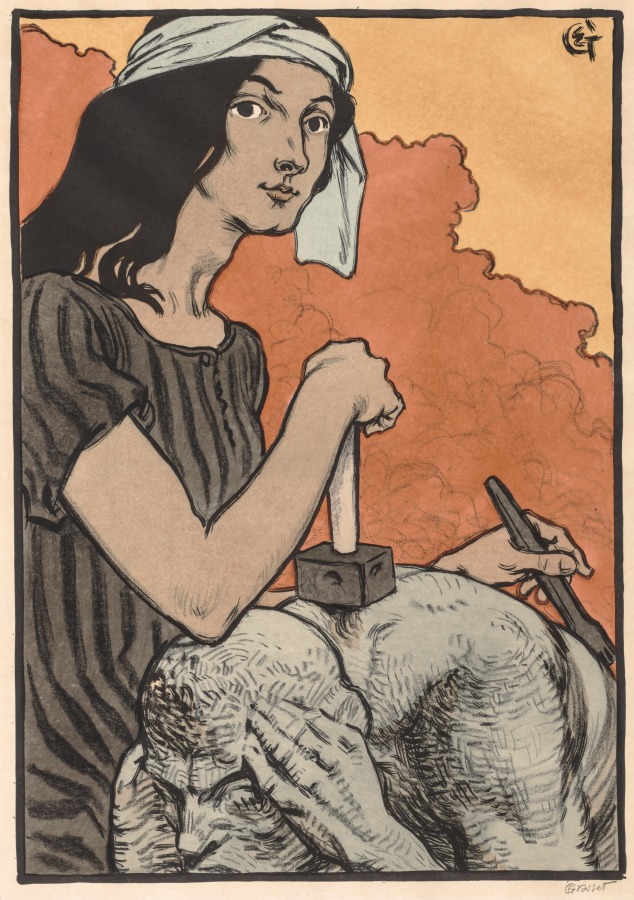
Sculptress, 1897, by Eugène Grasset
Eugène Grasset · The Cleveland Museum of Art · Gift of Henry H. Hawley
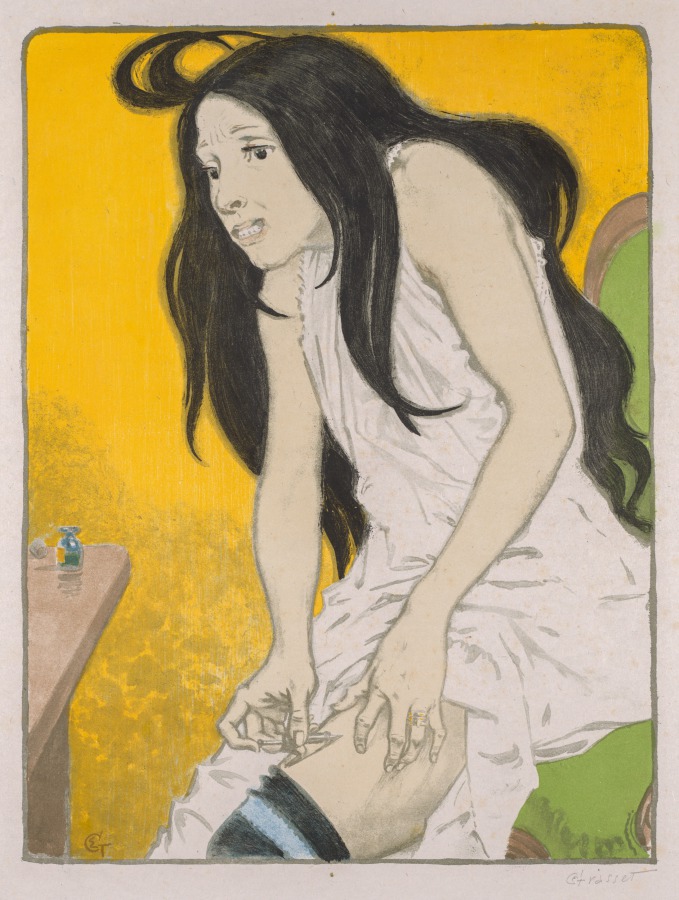
Morphine Addict, 1897, by Eugène Grasset
Eugène Grasset · The Cleveland Museum of Art · Dudley P. Allen Fund
Notes from the source article
Cited by Wikipedia
Notes from the source article
These works are cited by the source article, in its own numbering. They are recorded as its citations, not as sources VALÉORINE has verified.
- 1.Murray Robertson, p. 19
- 2.Murray Robertson, p. 103
- 3.Jean-François Luneau, p. 359
- 4.Murray Robertson, Anne. Eugene Grasset. Swiss Institute of Art Research. 2016.
- 5.Eugene Grasset. Art Directory.
- 6.Plants and Their Application to Ornament (1896), Public Domain Review, accessed 2019.05.01
- 7.Modern Design in Jewellery and Fans. 2015-07-31.
References
Citations
References
Each reference names the institution holding it, so a reader may go to the document itself.
reference work
Secondary witnessreference work
Secondary witness
The Encyclopedia exists whether or not anything is for sale. Corrections are recorded rather than overwritten, and every version of this record is kept. Published 14 August 2026.
Elsewhere in Paintings
19,261 published records in this field, each with its sources named.
- Eugène Galien-LaloueArtist
- Eugene GarinArtist
- Eugène GirardetArtist
- Eugène GoyetArtist
- Eugène Henri Alexandre ChigotArtist
- Eugène IsabeyArtist
- Eugene IvanovArtist
- Eugene J. MartinArtist
Best supported in this field
For owners
Own a work by Eugène Grasset?
A specialist will read what you send and tell you what the house can establish, what it cannot, and whether the object is suited to sale. There is no charge and no obligation. The object stays with you throughout; nothing is shipped to us unless it is arranged in writing beforehand.