
Eugène Fromentin
Eugène Fromentin (24 October 182027 August 1876) was a French painter and writer.
Also recorded as Eugène Fromentin-Dupeux · Eugène Samuel Auguste Fromentin-Dupeux · Eugène Samuel Auguste Fromentin · Eugène-Samuel-Auguste Fromentin
Eugène Fromentin
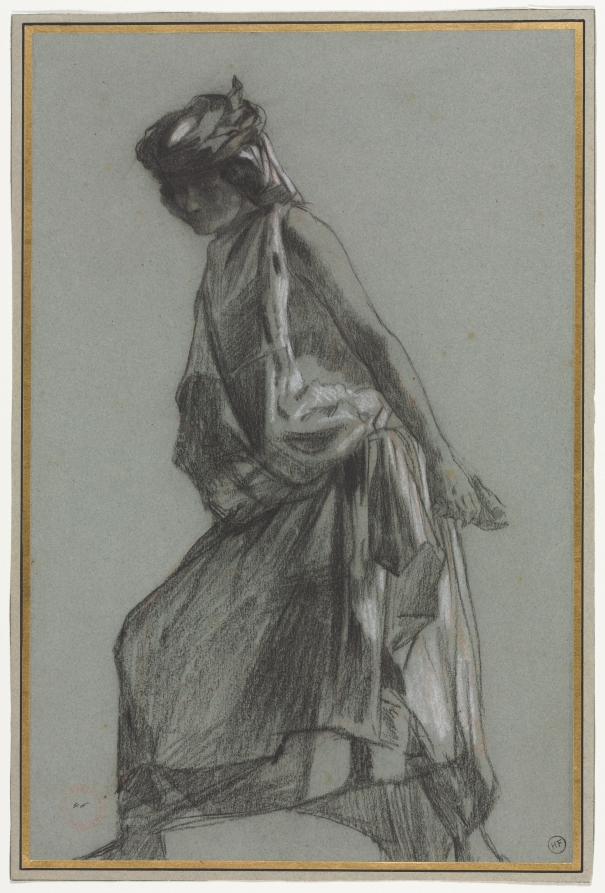
Eugène Fromentin · The Cleveland Museum of Art · L. E. Holden Fund · CC0
- Name
- Eugène Fromentin
- Born
- 24 October 1820
- Birthplace
- La Rochelle, France
- Died
- 27 August 1876
- Field
- Painter, Novelist, Travel literature, Art critic
- Training
- Louis Cabat
- Movement
- Orientalist
- Nationality
- France.
- Occupation
- painter, writer and art historian.
- Fields
- painting and literature.
- Movements
- Orientalism.
- Teachers
- Jean-Charles-Joseph Rémond and Louis-Nicolas Cabat.
VALÉORINE Encyclopedia
VALÉORINE documentary reading
Documentary summary
Eugène Fromentin (24 October 182027 August 1876) was a French painter and writer.
Admitted source layer · organised and presented by VALÉORINE
Note VALÉORINE
No house-authored Note is published until its assertions and sources pass the VALÉORINE evidence contract. The documentary article remains available in full while that enrichment is being consolidated.
Documentary enrichment in progress · no unsupported statement published
Reference Check
Propose documentary evidence for Eugène Fromentin. A contribution is never written directly as fact: identity, source, rights and evidence gates still decide.
Sign in to contribute
World of VALÉORINE
Documentary connections
Only confirmed graph relationships appear here. Images are shown only when their identity and reuse rights both pass the documentary gate.
Documentary evidence
Evidence Panel
not yet certified
- Identity
- resolved
- Independent source families
- 0
- Admitted assertions
- 0
- Open conflicts
- 0
Authority files
wikidata · Q353746 · wikipedia · Eugène Fromentin
In this article
Biography
Biography
Training under Jean-Charles-Joseph Rémond and Louis-Nicolas Cabat is recorded. Fernand Cormon, Henri Gervex and Ferdinand Humbert are recorded as having studied under Eugène Fromentin. The recorded working language is French. The field of work recorded is painting and literature. Subjects and genres recorded for the work are landscape. Works named in the authority record are Falconry in Algeria: the kill, Courriers, country of Ouled-Nayls, in spring, Arab Riders Stop in the Forest and Farmyard with Cattle. Work by Eugène Fromentin is recorded in the collections of Minneapolis Institute of Art, The Nelson-Atkins Museum of Art, Metropolitan Museum of Art, Museum of Fine Arts Ghent (MSK) and Rijksmuseum.
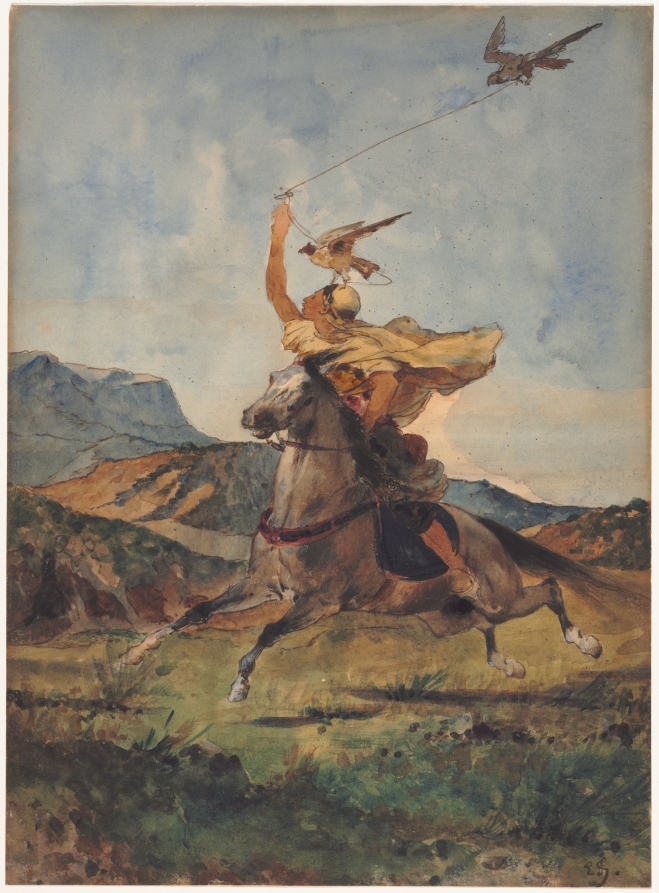
The Falconer, c. 1864, by Eugène Fromentin
Eugène Fromentin · The Cleveland Museum of Art · Norman O. Stone and Ella A. Stone Memorial Fund
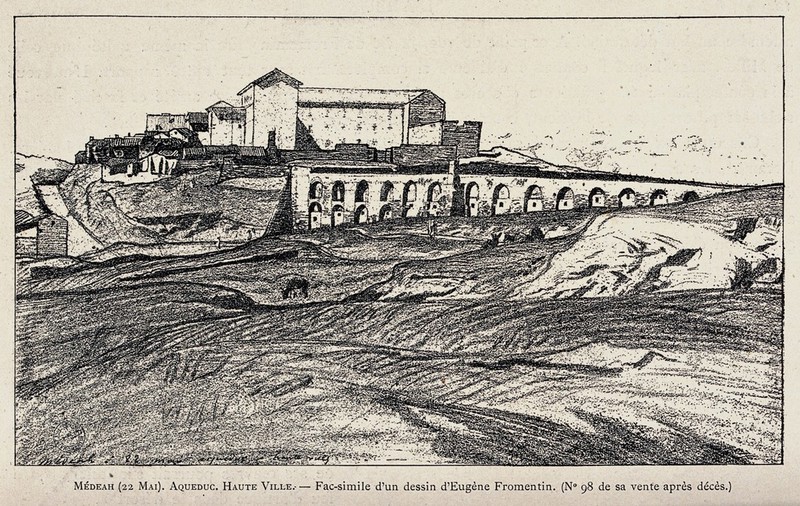
An aqueduct at Médeah. Lithograph after E. Fromentin., by Eugène Fromentin
Eugène Fromentin · Wellcome Collection, London · Wellcome Collection
Key facts
Key facts
• Name — Eugène Fromentin • Born — 24 October 1820 • Birthplace — La Rochelle, France • Died — 27 August 1876 • Place of death — La Rochelle, France • Field — Painter, Novelist, Travel literature, Art critic • Training — Louis Cabat • Movement — Orientalist
Life and career
Life and career
He was born in La Rochelle. After leaving school he studied for some years under Louis Cabat, the landscape painter. Fromentin was one of the earliest pictorial interpreters of Algeria, having been able, while quite young, to visit the land and people that suggested the subjects of most of his works, and to store his memory as well as his portfolio with the picturesque and characteristic details of North African life. His first great success was produced at the Paris Salon of 1847, by the Gorges de la Chiffa. In 1849, he was awarded a medal of the second class. In 1852, he paid a second visit to Algeria, accompanying an archaeological mission, and then completed that minute study of the scenery of the country and of the habits of its people which enabled him to give to his after-work the realistic accuracy that comes from intimate knowledge. His books include Les Maîtres d'autrefois ("The Masters of Past Time", 1876), an influential appreciation of Early Netherlandish painting and the Northern Baroque of the Old Masters of Belgium and Holland, Dominique and A Summer in the Sahara. In Les Maîtres d'autrefois he deals with the complexity of paintings by Rubens, Rembrandt and others, their style and the artists' emotions at the time of creating their masterpieces. He is also one of the first "art critics" to approach the subject of The Old Masters from a personal point of view – being a painter himself. He also puts the work in a social, political and economic context, as the Dutch Golden Age painting develops shortly after Holland won its independence. Bernhard Berenson wrote of the book, "I carry Fromentin with me, and read him each evening about the pictures I have seen that he criticizes. He is the only writer on pictures worth his salt, but I do not always agree with him." Fromentin, who maintained that "art is the expression of the invisible by means of the visible", was much influenced in style by Eugène Delacroix. His works are distinguished by striking composition, great dexterity of handling and brilliancy of colour. In them is given with great truth and refinement the unconscious grandeur of barbarian and animal attitudes and gestures. His later works, however, show signs of an exhausted vein and of an exhausted spirit, accompanied or caused by physical enfeeblement. Fromentin's other literary works include Visites artistiques (1852); Simples Pèlerinages (1856); Un été dans le Sahara (1857); Une année dans le Sahel (1858). In 1876 he was an unsuccessful candidate for the Academy. He died suddenly at La Rochelle on 27 August 1876.
Gallery
Gallery
• Illustration — Arabian Encampment, 1848 • Illustration — North African Landscape, 1847 ~ 1848 • Illustration — Boerenerf met vee [Farmyard with livestock], 1849 • Illustration — Arabs Watering Their Horses, ca. 1850 • Illustration — Arab woman, 1852 • Illustration — Enterrement maure [Moorish burial], 1853 • Illustration — La rue Bab-el-Gharbi, à El-Aghouat, 1859 • Illustration — Kabyle Shepherd, 1861 • Illustration — Cavaliers arabes ou la rencontre [Arab Horsemen or the Encounter], 1862 • Illustration — Chasse au faucon en Algérie: la curée [Falcon Hunting in Algeria: The Quarry], 1863 • Illustration — Windstorm on the Esparto Plains of the Sahara, 1864 • Illustration — Coup de vent sur les plaines d'alfa [Gust of Wind on the Plains of Alfa], 1864 • Illustration — Hunting Heron, Algeria, 1865 • Illustration — An Encampment in the Atlas Mountains, 1865 • Illustration — Standard Bearer, 1860 ~ 1865 • Illustration — Arabs on the Way to the Pastures of the Tell, 1866 • Illustration — Before the Race – Fantasia or The Halt in the Desert, 1867 • Illustration — L'Incendie [The Fire], 1867 • Illustration — Centaures, 1868 • Illustration — Halte de cavaliers arabes dans la forêt [Arab Horsemen Resting in the Forest], 1868 • Illustration — Crossing the Ford, Algeria, 1869 • Illustration — Une Fantasia [A Fantasy] – Algeria, 1869 • Illustration — Les tombeaux des Califes au Caire [The Tombs of the Caliphs in Cairo], ca. 1870 • Illustration — Nil çayı (Turkish) [Nile Tea], 1870 • Illustration — Arabs, 1871 • Illustration — On the Nile, Near Philae, 1871 • Illustration — Orientals [Egyptian Females], 1872 • Illustration — Campement dans le Sahara [Campsite in the Sahara], 1872 • Illustration — The Banks of the Nile, 1874 • Illustration — Un ravin: souvenir d'Algérie [A Ravine: Souvenir of Algeria], 1875 • Illustration — Cavalier peint en Algérie [Painted Rider in Algeria], 1875 • Illustration — La caravane (scène de la vie nomade des Larbaâ Laghouat) [The Caravan (Scene From the Nomadic Life of the Larbaâ Laghouat)], 1875 • Illustration — At the Well, 1875 • Illustration — Un Souvenir d'Esneh [A memory of Esneh], 1876 • Illustration — Le Simoun [The Simoun], 1876 • Illustration — Horses Watering in a River, undated • Illustration — Bedouins Watering Their Horses, undated • Illustration — Moroccan Horsemen at the Foot of the Chiffra Cliffs, undated • Illustration — Head of an Old Woman, undated • Illustration — The Boar Hunt, undated • Illustration — Départ pour la chasse [Departure for the hunt], undated • Illustration — On the Nile, undated • Illustration — Arab Skirmish, undated • Illustration — Le repos des chameaux [The Camels Rest], undated
Identity and origins
Identity and origins
He also worked under the names Fromentin, Eugene, Fromentin, Eugène-Samuel-Auguste and Fromentin-Dupeux, Eugene Samuel Auguste. The authorities additionally record the headings Eugène Fromentin-Dupeux, Eugène Samuel Auguste Fromentin-Dupeux, Eugène Samuel Auguste Fromentin, Eugène-Samuel-Auguste Fromentin and Eugene Samuel Auguste Fromentin-Dupeux. His recorded language was French.
Life and career
Dated record
Life and career
The full dated record · 2 entries
1820
Eugène Fromentin born at La Rochelle.
1876
Eugène Fromentin died at La Rochelle.
General references: writings about Fromentin in English
• Bales, Richard. Persuasion in the French Personal Novel: Studies of Chateaubriand, Constant, Balzac, Nerval, and Fromentin, Birmingham, AL: Summa Publications, 1997. • Beaume, Georges. Fromentin, translated from the French by Frederic Taber Cooper, New York: Stokes, 1913. • Christin, Anne-Marie, and Berrong, Richard M. "Space and Convention in Eugène Fromentin: The Algerian Experience", New Literary History, vol. 15, no. 3, Spring, 1984, pp. 559-574. • Evans, Arthur R., Jr.. The Literary Art of Eugène Fromentin: A Study in Style and Motif, Baltimore: The Johns Hopkins Press, 1966. • "Eugene Fromentin", The Art Amateur, vol. 12, no. 1, Dec., 1884, p. 9. • "Fromentin, Eugène", Benezit Dictionary of Artists, published online 31 October 2011. • Gill, Hélène. "Eugene Fromentin and the Experience of the Desert: Self-quest in the Other's Territory," Chapter 3 in The Language of French Orientalist Painting, Lewiston, NY: Edwin Mellen Press, 2003. • Gillet, Louis. "Eugène Fromentin" in The Catholic Encyclopedia, New York: Robert Appleton Company, 1909. • Gonse, Louis. Eugène Fromentin, Painter and Writer, translated by Mary Caroline Robbins, Boston: James R. Osgood and Co., 1888. • Harris, Frank. "Eugéne Fromentin: The Painter-Writer", Chapter XIV in Latest Contemporary Portraits, New York: The Macaulay Company, 1927. • Hartman, Elwood. Three Nineteenth-Century French Writer/Artists and the Maghreb: The Literary and Artistic Depictions of North Africa by Théophile Gautier, Eugène Fromentin, and Pierre Loti, Tübingen: Gunter Narr Verlag, 1994. • Kaplan, Judith. "Eugéne Fromentin (1820-1876)" in Orientalist Writers, edited by Coeli Fitzpatrick and Dwayne A. Tunstall, Detroit: Gale Cengage Learning, 2012. • Magill, Frank N., editor. "Dominique by Eugéne Fromentin" in Masterplots: 2010 Plot Stories & Essay Reviews from the World's Fine Literature, Revised Edition, volume 3, Englewood Cliffs, N.J.: Salem Press, 1976. • Mickel, Emanuel J. Eugène Fromentin, Twayne's World Authors Series 640, Boston: G.K. Hall & Co., 1981. • Schapiro, Meyer. "Eugene Fromentin as Critic" in Theory and Philosophy of Art: Style, Artist and Society, Selected Papers, New York: George Braziller, 1994. • Thompson, James P. W. "Fromentin, Eugène(-Samuel-Auguste)", Grove Art Online, published online 2003. • Wright, Barbara. "Eugène Fromentin's 'Portrait de Jeune Femme' and the Possible Identification of Its Sources", The Burlington Magazine, vol. 116, no. 854, May, 1974, pp. 274–275. • Wright, Barbara. "A drawing for 'Hodna': an early painting by Eugène Fromentin," The Burlington Magazine, vol. 155, no. 1322, May, 2013, pp. 324-325. • Wright, Barbara. Eugène Fromentin: A Life in Art and Letters, Peter Lang, 2000. • Wright, Barbara. "Eugène Fromentin (1820-76)" in Key Writers on Art, volume I, edited by Chris Murray, New York: Routledge, 2003.
Inline references
Inline references
•,. • Retrieved July 27, 2004.;. See Encyclopædia Britannica, 11th ed. (1910–1911). • Retrieved October 15, 2024., and. •;. •, and (1891 & 2012 re-prints). • Retrieved October 15, 2024., and. See Gazette des Beaux-Arts Gallica. UC Boulder. * •; (e-book).
General references: works by Eugène Fromentin in English translation
General references: works by Eugène Fromentin in English translation
• "A Critic's Program" and "A Letter to a Young Artist" in Realism and Tradition in Art, 1848-1900: Sources and Documents, edited by Linda Nochlin, Englewood Cliffs, N.J.: Prentice-Hall, 1966, pp. 19–25; reprinted from the Mary Caroline Robbins translation of Gonse (1888). • Between Sea and Sahara: An Algerian Journal, translation by Blake Robinson of Une Anée dans le Sahel (1859), Ohio University Press, 1999; reissued in 2004 by Tauris Parke Paperbacks with the subtitle An Orientalist Adventure. •. •. Reprint by Soho Book Company (1986). • "The Isle of Ré: An Unpublished Fragment" in Eugène Fromentin, Painter and Writer by Louis Gonse, translated by Mary Caroline Robbins, Boston: James R. Osgood and Co., 1888, pp. 251–271; various other quotations, letters, and excerpts by Fromentin, translated by Robbins, appear throughout the book. • The Masters of Past Time, or Criticism on the Old Flemish & Dutch Painters, uncredited translation of Les Maîtres d'autrefois (1876), New York: E.P. Dutton, 1913. • The Old Masters of Belgium and Holland, translation by Mrs. Mary C. Robbins of Les Maîtres d'autrefois (1876), Boston: Houghton Mifflin Co., 1882.
References
Citations
References
Each reference names the institution holding it, so a reader may go to the document itself.
reference work
Partially resolvedreference work
Partially resolved
Further particulars
Held on the record
Further particulars
Open the remaining particulars
He trained under Jean-Charles-Joseph Rémond and Louis-Nicolas Cabat. Each of those relationships is stated by the authority record rather than inferred from style.
Eugène Fromentin worked in painting and literature. His work is associated with Orientalism. He belonged to Académie des belles-lettres, sciences et arts de La Rochelle. Work and production. Works recorded as notable number 4: Falconry in Algeria: the kill, Courriers, country of Ouled-Nayls, in spring, Arab Riders Stop in the Forest and Farmyard with Cattle. His recorded genre is landscape.
Career and activity
Recognition and collections
Work by Eugène Fromentin is
Minneapolis Institute of Art, The Nelson-Atkins Museum of Art, Metropolitan Museum of Art and Museum of Fine Arts Ghent (MSK)
The Encyclopedia exists whether or not anything is for sale. Corrections are recorded rather than overwritten, and every version of this record is kept. Published 14 August 2026.
Elsewhere in Paintings
18,717 published records in this field, each with its sources named.
- Eugène DeullyArtist
- Eugène Emmanuel Amaury DuvalArtist
- Eugène FaureArtist
- Eugène FichelArtist
- Eugène GabritschevskyArtist
- Eugène Galien-LaloueArtist
- Eugene GarinArtist
- Eugène GirardetArtist
Best supported in this field
For owners
Own a work by Eugène Fromentin?
A specialist will read what you send and tell you what the house can establish, what it cannot, and whether the object is suited to sale. There is no charge and no obligation. The object stays with you throughout; nothing is shipped to us unless it is arranged in writing beforehand.