
ESA Optical Ground Station
The ESA Optical Ground Station (OGS Telescope or ESA Space Debris Telescope) is the European Space Agency's ground based observatory at the Teide Observatory on Tenerife, Spain, built for the observation of space debris. OGS is part of the Artemis experiment and is operated by the IAC (Instituto de Astrofísica de Canarias) and Ataman Science S.L.U. • Illustration — The telescope • Illustration — Dome operations of the OGS The observatory is a 1-meter Coudé telescope with a 0.7 degree field of view, supported by an English cross-axial mount inside a dome 12.5-meters in diameter. Its main purposes are: • to be the optical ground station of the Artemis telecommunications satellite (the project from which the telescope takes its name) • to survey space debris in different orbits around the Earth, • to conduct surveys and follow-up observations of near-Earth objects as part of ESA's Space Situational Awareness programme, and • to make scientific astronomical night observations.
Also recorded as OGS Telescope · ESA Space Debris Telescope
ESA Optical Ground Station
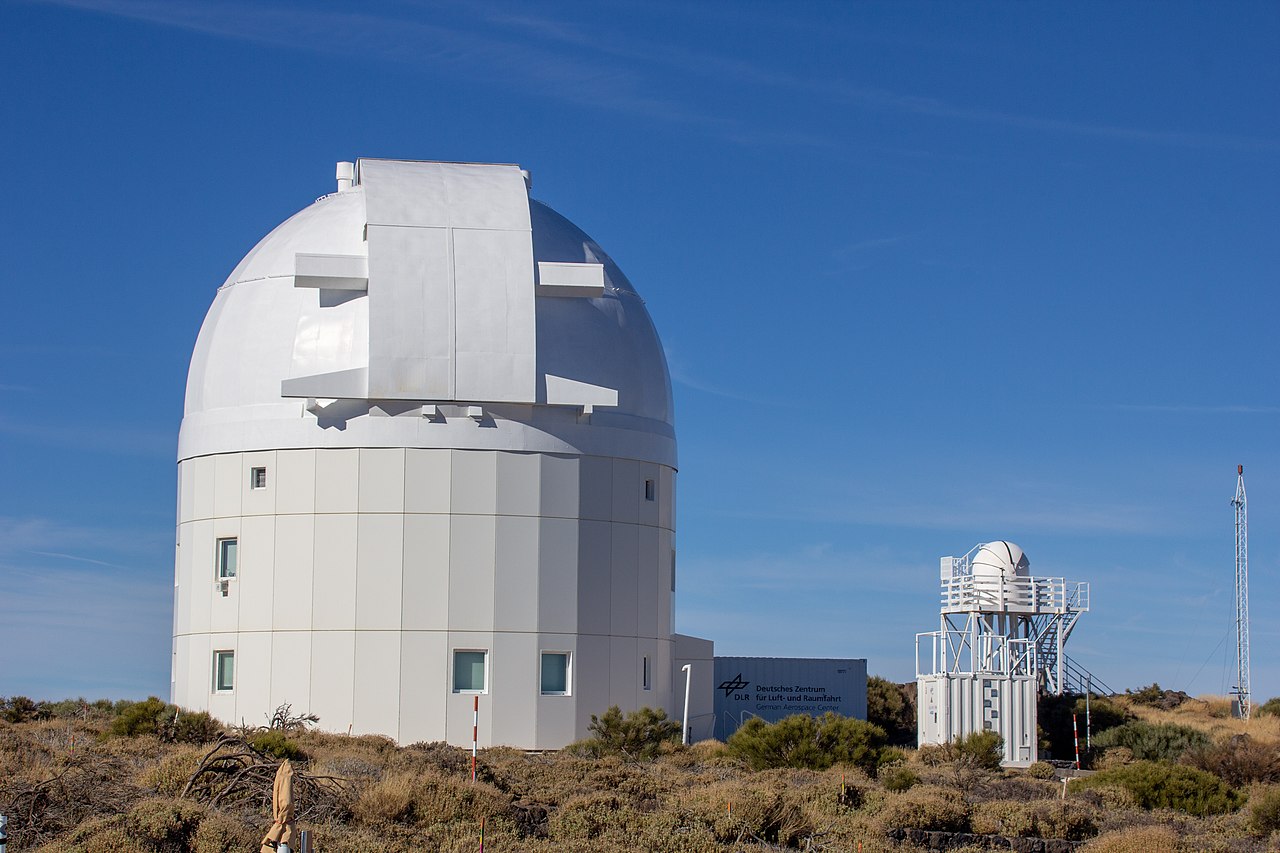
Photograph by Mike Peel ( · CC BY-SA 4.0
- Period
- 1996
- Region
- Spain
VALÉORINE Encyclopedia
VALÉORINE documentary reading
Documentary summary
The ESA Optical Ground Station (OGS Telescope or ESA Space Debris Telescope) is the European Space Agency's ground based observatory at the Teide Observatory on Tenerife, Spain, built for the observation of space debris. OGS is part of the Artemis experiment and is operated by the IAC (Instituto de Astrofísica de Canarias) and Ataman Science S.L.U. • Illustration — The telescope • Illustration — Dome operations of the OGS The observatory is a 1-meter Coudé telescope with a 0.7 degree field of view, supported by an English cross-axial mount inside a dome 12.5-meters in diameter. Its main purposes are: • to be the optical ground station of the Artemis telecommunications satellite (the project from which the telescope takes its name) • to survey space debris in different orbits around the Earth, • to conduct surveys and follow-up observations of near-Earth objects as part of ESA's Space Situational Awareness programme, and • to make scientific astronomical night observations.
Admitted source layer · organised and presented by VALÉORINE
Reference Check
Propose documentary evidence for ESA Optical Ground Station. A contribution is never written directly as fact: identity, source, rights and evidence gates still decide.
Sign in to contribute
World of VALÉORINE
Documentary connections
Only confirmed graph relationships appear here. Images are shown only when their identity and reuse rights both pass the documentary gate.
Documentary evidence
Documentary basis
Authority files
wikidata · Q5154962 · wikipedia · ESA Optical Ground Station
In this article
List of discovered minor planets
List of discovered minor planets
It is equipped with a cryogenically cooled mosaic CCD-Camera of 4k×4k pixels. The detection threshold is between 19th and 21st magnitude, which corresponds to a capability to detect space debris objects as small as 10 cm in the geostationary ring. Space debris surveys are carried out every month, centered on New Moon. Since 2006, the telescope has also been used as a receiver station for quantum communication experiments (such as testing Bell's inequality, quantum cryptography, and quantum teleportation), with the sender station being 143 km away in the observatory on La Palma. This is possible because this telescope can be tilted to a near-horizontal position to point it at La Palma, which many large astronomical telescopes are unable to do.
EAS OGS has been credited by the Minor Planet Center with the discovery of 37 minor planets. These are: • 10 September 2009 — list • 23 March 2010 — list • 22 March 2010 — list • 22 March 2010 — list • 22 March 2010 — list • 22 March 2010 — list • 284891 Kona — 13 September 2009 — list • 13 September 2009 — list • 297005 Ellirichter — 22 March 2010 — list • 22 March 2010 — list • 1 September 2010 — list • 10 September 2009 — list • 1 September 2010 — list • 10 September 2009 — list • 1 September 2010 — list • 10 September 2009 — list • 332706 Karlheidlas — 13 September 2009 — list • 22 March 2010 — list • 22 March 2010 — list • 1 June 2011 — list • 22 March 2010 — list • 1 September 2010 — list • 13 September 2009 — list • 6 June 2010 — list • 13 September 2009 — list • 13 September 2009 — list • 13 September 2009 — list • 22 March 2010 — list • 22 March 2010 — list • 1 September 2010 — list • 420779 Świdwin — 11 April 2013 — list • 22 March 2010 — list • 10 September 2009 — list • 10 September 2009 — list • 15 September 2012 — list • 13 September 2009 — list • 1 September 2010 — list
Definition
Definition
The canonical record carries the following identifying particulars. The record continues: eSA Optical Ground Station is associated with Spain. Recorded from 1996.
Places
Named by the record
Places
Only places the record itself states, plotted where the house gazetteer settles their coordinates. Nothing is inferred from a name or a nationality.
- Spain
Notes from the source article
Cited by Wikipedia
Notes from the source article
These works are cited by the source article, in its own numbering. They are recorded as its citations, not as sources VALÉORINE has verified.
References
Citations
References
Each reference names the institution holding it, so a reader may go to the document itself.
reference work
Secondary witnessreference work
Secondary witness
The Encyclopedia exists whether or not anything is for sale. Corrections are recorded rather than overwritten, and every version of this record is kept. Published 16 August 2026.
Elsewhere in Scientific instruments
736 published records in this field, each with its sources named.
- Elektronika MK-52Terminology
- EMBRACETerminology
- equatoriumTerminology
- eROSITATerminology
- ESO 3.6 m TelescopeTerminology
- European Solar TelescopeTerminology
- European VLBI NetworkTerminology
- Evpatoria ObservatoryTerminology
Best supported in this field
For owners
Own an object connected with ESA Optical Ground Station?
A specialist will read what you send and tell you what the house can establish, what it cannot, and whether the object is suited to sale. There is no charge and no obligation. The object stays with you throughout; nothing is shipped to us unless it is arranged in writing beforehand.