
Enoch Wood
Illustration — Demosthenes, Staffordshire figure modelled by Wood, c. 1800, over 18 inches tall (47.5 cm) Enoch Wood (1759–1840) was an English potter and businessman, from one of the major families in Staffordshire pottery. Starting as a modeller, he established a successful business in Burslem in the Staffordshire Potteries, from 1790-1818 trading as Wood and Caldwell.
Enoch Wood
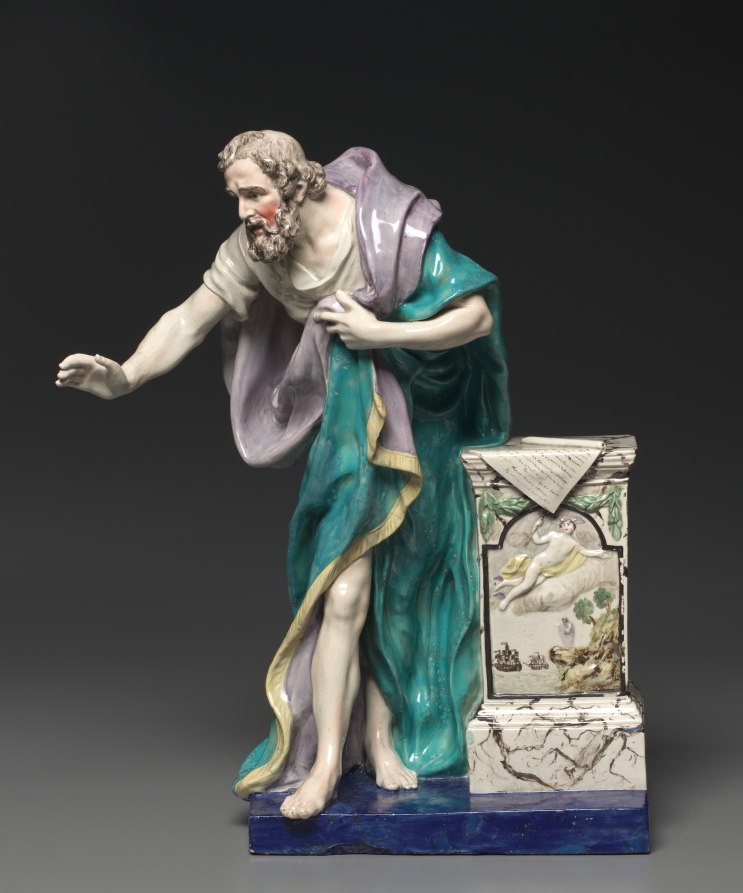
Enoch Wood · The Cleveland Museum of Art · Bequest of Nicholas J. Velloney · CC0
- Nationality
- Kingdom of England
- Occupation
- potter · sculptor · ceramicist
- Languages
- English
VALÉORINE Encyclopedia
VALÉORINE documentary reading
Documentary summary
Illustration — Demosthenes, Staffordshire figure modelled by Wood, c. 1800, over 18 inches tall (47.5 cm) Enoch Wood (1759–1840) was an English potter and businessman, from one of the major families in Staffordshire pottery. Starting as a modeller, he established a successful business in Burslem in the Staffordshire Potteries, from 1790-1818 trading as Wood and Caldwell.
Admitted source layer · organised and presented by VALÉORINE
Reference Check
Propose documentary evidence for Enoch Wood. A contribution is never written directly as fact: identity, source, rights and evidence gates still decide.
Sign in to contribute
Documentary evidence
Documentary basis
Authority files
getty · 500524525 · gnd · 122958950 · wikidata · Q52149383 · wikipedia · Enoch Wood
In this article
Life
Life
In the 18th century they produced many Staffordshire figures, which Wood modelled himself, and other types of earthenware and stoneware. After 1818 his company, now Enoch Wood & Sons, produced large quantities of blue and white transfer-printed tableware in earthenware, much of which was exported to America.
He was born in 1759; his father Aaron Wood (1717–1785) was a highly regarded pottery modeller (mould maker), and his uncle Ralph Wood I (1715–1772), also a potter, became famous for producing well-modelled figures. Enoch Wood studied drawing and anatomy with his relatives the Caddick family in Liverpool, and was apprenticed to Humphrey Palmer, an earthenware manufacturer in Hanley. He became a skillful pottery modeller. • Illustration — Sauceboat by Enoch Wood & Sons, c. 1840, showing a pass in the Catskill Mountains. In Brooklyn Museum. He began a business in Burslem in 1783 with his cousin Ralph Wood II, as an earthenware manufacturer; the two were the leading pottery modellers of the period. In 1790 he went into partnership with James Caldwell (1759-1838), a local lawyer, as Wood and Caldwell, and a new factory was built at Fountain Place in Burslem, which produced a wide range of earthenwares. The company also had mining interests: the Bycars Colliery in Burslem provided fuel for the factory. The partnership was successful, and continued until 1818, when Wood bought out Caldwell and Wood's three sons became partners, the firm becoming Enoch Wood & Sons. The new company produced a large quantity of blue transfer-printed earthenware, like other large potteries largely abandoning the figure market. A substantial amount of the wares were exported to America, where trade in earthenware increased after the end in 1815 of the Anglo-American war; Wood designed a range of items particularly for America. Enoch Wood died in 1840, and the business closed in 1845; finances were affected by a loss of trade with America, and by his children claiming their legacies. • Illustration — Plaque, before 1800, 21.9 cm • Illustration — Bust of Minerva, c. 1790 • Illustration — Bust of the Methodist preacher George Whitefield (d. 1770), c. 1790, 12 1/2 in. (31.8 cm) • Illustration — Madonna and Child, c. 1800, 34.5 cm • Illustration — Bust of George Washington, c. 1818. Wood originally modelled this bust for Wedgwood many decades before. • Illustration — Frontage of the former Fountain Place Works in Burslem, built by Enoch Wood. A Grade II listed building.
Identity
Identity
Enoch Wood is recorded as potter, sculptor and ceramicist.
Life and career
Dated record
Life and career
The full dated record · 2 entries
1759
Enoch Wood was born in 1759 at Burslem.
1840
Enoch Wood died in 1840 at Burslem.
Primary material
Documents and archives
reference work
- “Enoch Wood”, English Wikipedia, consulted as further reading
Reputable secondary · Wikipedia
- Wikidata, structured authority record Q52149383: Enoch Wood
Reputable secondary · Wikidata
authority file
- Getty Union List of Artist Names 500524525, Enoch Wood & Sons.
General reference · The Getty Research Institute
Notes from the source article
Cited by Wikipedia
Notes from the source article
These works are cited by the source article, in its own numbering. They are recorded as its citations, not as sources VALÉORINE has verified.
- 1.Enoch Wood & Sons Patriotic America. Retrieved 21 September 2018.
- 2.The Wood Family www.thepotteries.org. Retrieved 21 September 2018.
- 3.Wood and Sons Grace's Guide to British Industrial History. Retrieved 21 September 2018.
- 4.Enoch Wood (1759–1840) thepotteries.org. Retrieved 21 September 2018.
- 5.Humphrey Palmer www.thepotteries.org. Retrieved 21 September 2018.
- 6.Former Fountain Place Works Historic England, retrieved 21 October 2018.
References
Citations
References
Each reference names the institution holding it, so a reader may go to the document itself.
authority file
Getty Union List of Artist Names 500524525, Enoch Wood & Sons.The Getty Research Institute
Secondary witnessreference work
Secondary witnessreference work
Secondary witness
The Encyclopedia exists whether or not anything is for sale. Corrections are recorded rather than overwritten, and every version of this record is kept. Published 16 August 2026.
Elsewhere in Ceramics
1,104 published records in this field, each with its sources named.
- Emmanuel CooperArtist
- Emmy MoltArtist
- Ena RottenbergArtist
- engobeTerminology
- Enric Mestre i EstellésArtist
- Enrique MarinArtist
- Ercole DreiArtist
- Eren EyüboğluArtist
Best supported in this field
For owners
Own a work by Enoch Wood?
A specialist will read what you send and tell you what the house can establish, what it cannot, and whether the object is suited to sale. There is no charge and no obligation. The object stays with you throughout; nothing is shipped to us unless it is arranged in writing beforehand.