
Emanuel de Witte
Emanuel de Witte (1617–1692) was a Dutch perspective painter. In contrast to Pieter Jansz Saenredam, who emphasized architectural accuracy, De Witte was more concerned with the atmosphere of his interiors. Though few in number, de Witte also produced genre paintings.
Also recorded as Emanuel de Widt · Emanuel De Wit · Emanuel De Wytt · Emmanuel Wit
Emanuel de Witte
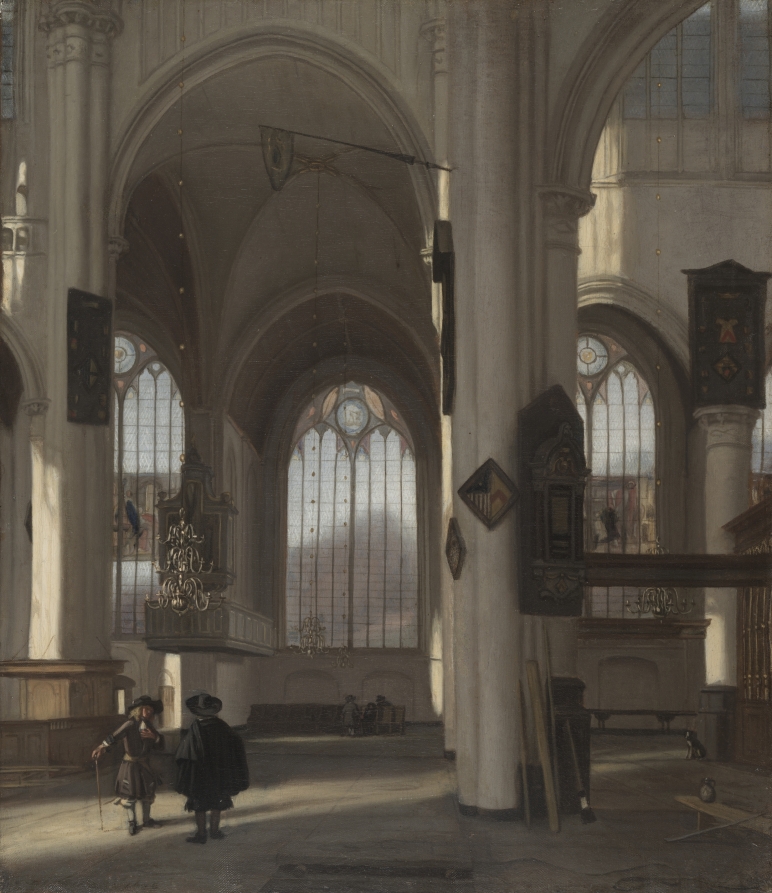
Emanuel de Witte · The Cleveland Museum of Art · Mr. and Mrs. William H. Marlatt Fund · CC0
- Name
- Emanuel de Witte
- Born
- 1617
- Died
- 1692 (74-75 years)
- Occupation
- Painter, Draughtsman
- Birthplace
- Alkmaar, Dutch Republic
- Place of death
- Amsterdam, Dutch Republic
- Education
- Evert van Aelst
- Nationality
- Dutch Republic
- Fields
- portrait · landscape painting
- Known for
- Interior of an Imaginary Catholic Church · The Oude Kerk in Amsterdam during a Service · Interior of a Protestant Gothic church with motifs of the Oude and the Nieuwe Kerk in Amsterdam
VALÉORINE Encyclopedia
VALÉORINE documentary reading
Documentary summary
Emanuel de Witte (1617–1692) was a Dutch perspective painter. In contrast to Pieter Jansz Saenredam, who emphasized architectural accuracy, De Witte was more concerned with the atmosphere of his interiors. Though few in number, de Witte also produced genre paintings.
Admitted source layer · organised and presented by VALÉORINE
Note VALÉORINE
Emanuel de Witte (1617–1692) was a Dutch painter. Born in Alkmaar, the painter died in Amsterdam.
Emanuel de Witte was a member of Alkmaar Guild of Saint Luke and worked in Alkmaar, Amsterdam and Delft, among others. The painter was active in painting.
Works include Interior of an Imaginary Catholic Church and The Oude Kerk in Amsterdam during a Service. Genres include landscape painting and portrait.
Composed from admitted, traceable facts · 02 October 2026
VALÉORINE
Reference Check
Propose documentary evidence for Emanuel de Witte. A contribution is never written directly as fact: identity, source, rights and evidence gates still decide.
Sign in to contribute
Documentary evidence
Documentary basis
Authority files
wikidata · Q711203 · wikipedia · Emanuel de Witte
In this article
Key facts
Key facts
• Name — Emanuel de Witte • Born — 1617 • Died — 1692 (74-75 years) • Occupation — Painter, Draughtsman • Period — Dutch Baroque • Subject — Architecture • Birthplace — Alkmaar, Dutch Republic • Place of death — Amsterdam, Dutch Republic • Education — Evert van Aelst
Life
Life
De Witte was born in Alkmaar and learned geometry from his father a schoolmaster. He joined the local Guild of St Luke in 1636. After a stay in Rotterdam, he moved to Delft and studied with Evert van Aelst. In 1651 de Witte settled in Amsterdam where his first wife, Geerje Arents, died in 1655. He then married a 23-year-old orphan, Lysbeth van der Plas, who exercised a bad influence on de Witte's adolescent daughter. In December 1659 both were arrested for theft from a neighbour. Lysbeth, pregnant, had to leave the city for a period of six years; she lived outside the city walls and died in 1663. Following the arrest of his wife and child, de Witte was forced to indenture himself to the Amsterdam notary and art dealer Joris de Wijs, surrendering all of his work in exchange for room, board, and 800 guilders annually. De Witte broke the contract, was sued by the dealer, and forced to indenture himself further as a result. Several patrons provided de Witte with support, but these relations did not work out well, for he tended to shout at his clients and at people watching him at work in churches. Records tell of his gambling habit and a fight with Gerard de Lairesse. Around 1688 he moved in with Hendrick van Streeck, in exchange for training him as a painter of church interiors. According to Arnold Houbraken, after an argument about the rent, de Witte hanged himself from a canal bridge in Amsterdam in 1692. The rope broke and de Witte drowned. Because the canal froze that night, his corpse was not found until eleven weeks later. • Illustration — Interior of the Portuguese synagogue in Amsterdam, 1680. • Illustration — Portrait of a Family in an Interior (Family of Pieter de Graeff), 1678 De Witte initially painted portraits as well as mythological and religious scenes. After his move from Delft to Amsterdam in 1651, de Witte specialized more and more in representing church interiors, and also he painted the old church in Amsterdam from almost every corner. He sometimes combined aspects of different churches to depict interiors of ideal churches, populating them with churchgoers, sometimes accompanied by a dog. De Witte's excellent sense of composition combined with his use of light created a powerful sense of space. According to Walter Liedtke, de Witt's "main interest was the space itself – its light, color, sheer extent, and mood – not the architecture for its own sake"; the careful arrangement of light serves to "intensify the sensation of being within a great but at the same time sheltered space." • Illustration — "Interior of a Church", by Emmanuel de Witte c. 1660
Work and production
Work and production
Works recorded as notable number 3: Interior of an Imaginary Catholic Church, The Oude Kerk in Amsterdam during a Service and Interior of a Protestant Gothic church with motifs of the Oude and the Nieuwe Kerk in Amsterdam. His recorded genres are portrait and landscape.
Life and career
Dated record
Life and career
The full dated record · 2 entries
1617
Emanuel de Witte was born in 1617.
1692
Emanuel de Witte died at Amsterdam.
Notes from the source article
Cited by Wikipedia
Notes from the source article
These works are cited by the source article, in its own numbering. They are recorded as its citations, not as sources VALÉORINE has verified.
- 1.Van Eeghen, P. van (1958) Kinderbescherming 300 en 200 jaar geleden. Maandblad Amstelodamum, December 1958, p. 221-3; Van Eeghen, I.H. van (1976) De familiestukken van Metsu van 1657 en van De Witte van 1678 met vier levensgeschiedenissen. Jaarboek Amstelodamum, p. 88-89.
- 2.Crenshaw, P. (2006) Rembrandt's Bankruptcy. The artist, his patrons and the art market in the seventeenth-century Netherlands, p. 85.
- 3.De Grote Schouwburg (1995) Schildersbiografieën van Arnold Houbraken. Samenstelling Jan Konst en Manfred Sellink.
- 4.Liedtke, W. (2001). Vermeer and the Delft School. New Haven: Yale Univ. Press. p. 434. .
Bibliography printed in the source article · 1
- E. P. Richardson, De Witte and the imaginative nature of Dutch art in Art Quarterly I, 1938, S. 5 ff.
References
Citations
References
Each reference names the institution holding it, so a reader may go to the document itself.
reference work
Wikidata, structured authority record Q711203: Emanuel de WitteWikimedia Foundation
Secondary witnessreference work
Secondary witness
Further particulars
Held on the record
Further particulars
Open the remaining particulars
The authorities additionally record the headings Emanuel de Widt, Emanuel De Wit, Emanuel De Wytt, Emmanuel Wit and Emmanuel Witte. His recorded language was Dutch. Witte worked in painting. He belonged to Alkmaar Guild of Saint Luke. He worked at Alkmaar, Delft, Rotterdam and Amsterdam.
Identity and origins
Career and activity
Recognition and collections
Work by Emanuel de Witte is
Museum Boijmans Van Beuningen, Thyssen-Bornemisza Museum, Nationalmuseum and National Gallery of Canada
The Encyclopedia exists whether or not anything is for sale. Corrections are recorded rather than overwritten, and every version of this record is kept. Published 14 August 2026.
Elsewhere in Paintings
19,183 published records in this field, each with its sources named.
- Elza Kalmár KövesháziArtist
- Ema SaikōArtist
- Emad HajjajArtist
- Emanuel BüchelArtist
- Emanuel GranbergArtist
- Emanuel LeutzeArtist
- Emanuel PrüllArtist
- Emanuel SweertArtist
Best supported in this field
For owners
Own a work by Emanuel de Witte?
A specialist will read what you send and tell you what the house can establish, what it cannot, and whether the object is suited to sale. There is no charge and no obligation. The object stays with you throughout; nothing is shipped to us unless it is arranged in writing beforehand.